Codemasters
CompanyUnited Kingdom
Documents about Codemasters



Deals Report Q1 2021
The first quarter of 2021 marked a record-breaking period for the global gaming industry, characterized by an unprecedented surge in financial activity across private investments, public offerings, and mergers and acquisitions.
- The global gaming industry saw a record-breaking Q1 2021 with $25 billion in closed transactions across 249 deals, a twofold increase compared to the first half of 2020.
- Mergers and acquisitions were the primary growth driver, accounting for 57% of total deal value at $14.3 billion, a nearly sixfold year-over-year increase fueled by major acquisitions like Microsoft’s $7.5 billion purchase of ZeniMax Media.
- Public offerings reached $8.3 billion across 36 deals, bolstered by high market valuations and prominent listings from companies including Roblox, Playtika, and Huuuge Games.



Global Video Game Deals Report Q1 2021
The first quarter of 2021 marked a historic surge in global video game industry investment, with 249 closed transactions totaling $25 billion.
- The global video game industry saw a historic Q1 2021 with $25 billion in closed transactions, a figure that rises to $39 billion when including announced deals.
- Mergers and acquisitions dominated the landscape with $14.3 billion in value, representing 5.9x year-over-year growth driven by major acquisitions like Microsoft’s $7.5 billion purchase of ZeniMax.
- Public offerings reached $8.3 billion across 36 deals, a 29x increase over the previous year, bolstered by the $41.9 billion direct listing of Roblox and IPOs from Playtika, Huuuge Games, and tinyBuild.

TWIG 121: BlizzCon 2021, Valheim Built By 5 Devs, Zynga Accelerates Growth, Rovio M&A Target
The gaming industry is currently defined by a tension between massive corporate consolidation and the surprising agility of small-scale development teams.
- Major industry players like EA are driving consolidation through large-scale acquisitions, exemplified by the $1.2 billion purchase of Codemasters.
- Large publishers face significant growth headwinds due to the post-IDFA environment and the technical challenges of scaling new titles while managing third-party data sharing risks.
- Blizzard Entertainment is experiencing internal development delays for major titles like Overwatch 2 and Diablo IV, forcing a reliance on legacy franchises such as the Diablo II remaster.

Electronic Arts 10-Q: Q3 FY2021
Electronic Arts reported modest top-line growth for the nine months ended December 31, 2020, with net revenue rising 3% YoY to $4.28 billion and live-services revenue increasing 5%.
- Electronic Arts reported a 3% YoY increase in net revenue to $4.28 billion for the nine months ending December 31, 2020, though operating income fell 30% to $251 million due to rising costs in R&D, marketing, and royalties.
- The company is executing a strategic shift toward digital distribution, evidenced by a 22% surge in full-game downloads to $733 million and an 11% decline in packaged goods sales.
- Revenue recognition adjustments related to service-obligation periods shifted approximately $300 million of net revenue from FY2021 to FY2022, resulting in a $105 million reduction in quarterly net income.
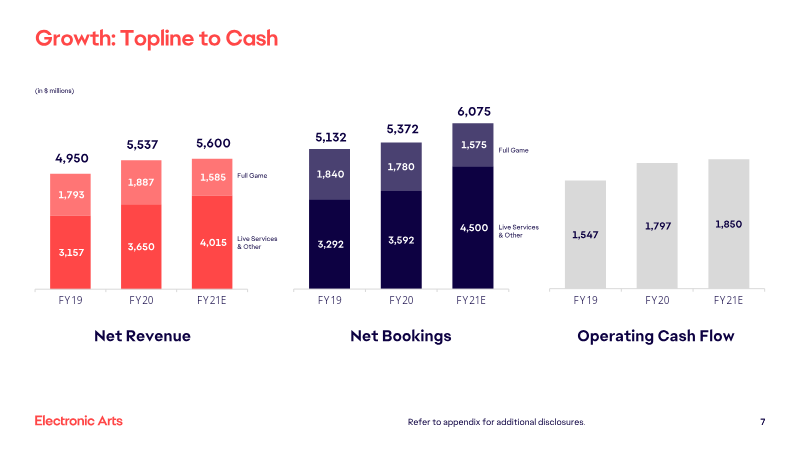
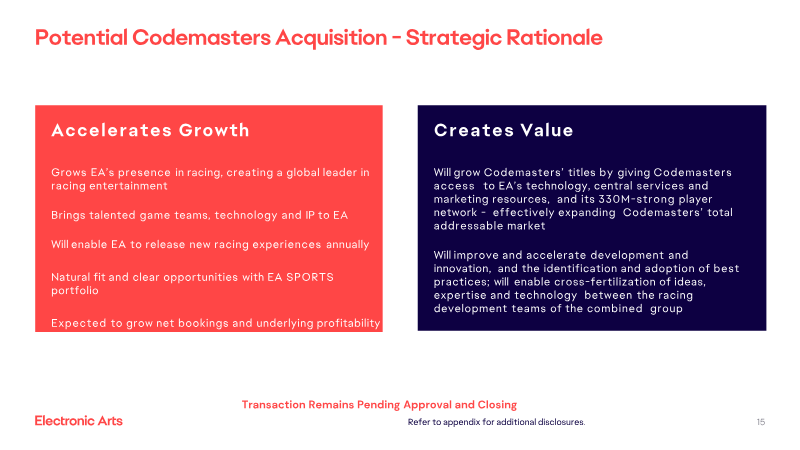

Electronic Arts Q3 FY 2021 Results
Electronic Arts reported strong financial performance for the third quarter of fiscal year 2021, characterized by record net bookings and operating cash flow.
- Electronic Arts raised its full-year net bookings outlook to $6.075 billion, up from the initial guidance of $5.550 billion, following record Q3 performance.
- Digital distribution of full-game units reached 62% over the trailing twelve months, a significant increase from 49% in the prior year.
- The company achieved a record trailing twelve-month operating cash flow of $2.061 billion, leading to the initiation of its first-ever dividend payment and a share buyback program.

Predictions, New Rev Models, and the 2021 Video Game Flywheel
This analysis explores the strategic evolution of the video game industry as it transitions from a product-based model to a media-centric "flywheel" ecosystem.
- The global video game market is projected to reach $202 billion in 2021, representing a 21% year-over-year growth driven by mobile ($96 billion), PC ($41 billion), and console software ($25.6 billion).
- Industry growth is increasingly driven by a media-centric 'flywheel' model that prioritizes long-term engagement and cross-platform intellectual property usage over traditional unit-based sales.
- Market consolidation is accelerating through high-premium acquisitions, exemplified by Microsoft’s $7.5 billion purchase of ZeniMax and EA’s $1.2 billion acquisition of Codemasters.

Is Cyberpunk 2077 the Future We Want?
This analysis explores the volatile state of the video game industry in late 2020, centered on the controversial launch of Cyberpunk 2077.
- The launch of Cyberpunk 2077 triggered a 33% decline in CD Projekt Red’s market value, highlighting the risks of prioritizing hype-driven releases over technical stability and ethical labor practices.
- Despite internal failures and technical issues, the immediate profitability of Cyberpunk 2077 raises concerns that the industry is shifting toward a model where consumer trust is secondary to capital gains.
- Hardware spending surged 58% year-over-year to $1.4 billion in November 2020, with the Nintendo Switch leading sales at 1.3 million units, followed by the PS5 at 1.1 million and Xbox Series X/S at 796,000 units.
Esports Versus COVID-19: What Inoculated Competitive Gaming Against the Pandemic
This analysis examines the resilience of the esports industry during the COVID-19 pandemic, arguing that the sector’s digital-first nature provided a natural inoculation against global lockdowns.
- The esports industry's digital-first business model allowed it to thrive during the pandemic, capturing market share while traditional sports were shuttered.
- Major industry acquisitions signaled strong market confidence, including Electronic Arts’ $1.7 billion purchase of Codemasters and Sony’s acquisition of the Evolution Championship Series (EVO).
- Esports organization Astralis demonstrated significant financial resilience, reporting an 82% year-over-year revenue increase to $8.5 million in 2020.
Zuck's Achilles Heel: Disney's Renewed Interest in Games and EA's Spending Spree
The gaming industry is currently defined by aggressive intellectual property (IP) licensing, rapid consolidation, and a contentious push for new monetization models.
- Electronic Arts spent $4.7 billion over a twelve-month period to acquire studios including Playdemic, Codemasters, and Glu Mobile to expand its mobile gaming footprint and gain leverage against platform holders like Apple.
- Disney has pivoted its interactive strategy to a licensing-heavy model, offloading the operational risks of game development by granting third-party developers like Ubisoft and Square Enix access to its franchise portfolio.
- Facebook’s attempt to integrate advertisements into its Oculus VR platform failed due to community backlash, forcing developers to withdraw from ad-testing programs and highlighting the incompatibility of current ad models with immersive environments.

FTUE: Micro Machines
The mobile adaptation of Micro Machines, published by Codemasters and Chillingo, serves as a case study for modern free-to-play (F2P) design, focusing on the integration of gacha-style collection mechanics within a casual racing framework.
- The Micro Machines mobile title, published by Codemasters and Chillingo, utilizes a gacha-style economy where players must collect randomized parts to assemble and upgrade vehicles.
- The game’s monetization strategy relies on a tiered rarity system—ranging from common to legendary—that forces players to repeatedly engage with loot packs to complete specific vehicle builds.
- The user experience suffers from a critical design flaw where the iOS push notification permission prompt is triggered immediately upon launch, increasing the risk of permanent user opt-out.

Monetizer: Codemaster's Boom! Tanks
Boom!
- Codemasters adapted proven monetization mechanics from the racing genre, specifically CSR Racing and Fast & Furious 6, and applied them to a rhythm-action tank combat framework.
- The game utilizes a dual-currency system of soft currency (cash) and hard currency (gold), with gold available through direct purchase or third-party incentivized offers via Tapjoy.
- A time-limited VIP offer is triggered immediately upon tutorial completion to drive early conversion, while any real-money purchase grants permanent VIP status for ongoing bonuses.