
GameMakers
F2P product management, game design, and monetization strategy by Joseph Kim.
Documents

GDC 2025 Recap: Industry Insights & Market Trends
The gaming industry is currently navigating a period of profound contraction, defined by an age of austerity that has fundamentally altered the landscape of major professional gatherings.
- The gaming industry is currently in an 'age of efficiency' characterized by austerity, with many high-profile studios facing severe financial instability and limited runway through 2026-2027.
- Investment in gaming has significantly contracted, as evidenced by major venture capital firms like A16Z shifting focus away from the sector despite maintaining large funds.
- GDC 2025 attendance was noticeably lower than in previous years, with the event shifting toward smaller, exclusive, executive-focused gatherings rather than broad industry participation.
Is the Overwatch 2 Battle Pass Design Broken?
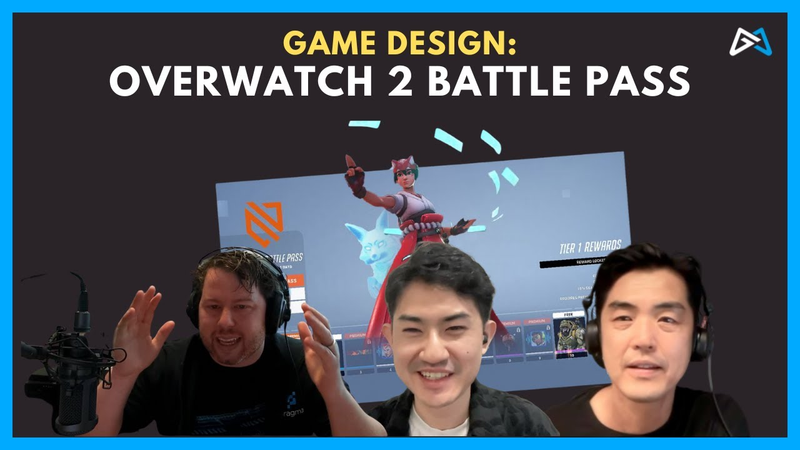
The current battle pass model in competitive shooters like Overwatch 2 faces significant friction due to its rigid, linear progression structure.
- Battle passes are estimated to generate between 30% and 60% of total revenue for modern shooter games.
- Overwatch 2 has surpassed 100 million total users since its October 2022 launch, with an estimated 20 million monthly active users.
- Successful battle pass designs are evolving from static, linear tracks toward page-based systems that offer players more choice in which content to unlock.

Top Secrets to Build Better Games
The modern game industry faces a structural crisis characterized by ballooning development costs and extended production timelines that have outpaced revenue growth.
- The traditional AAA development model is becoming unsustainable due to development costs and production timelines that have outpaced revenue growth.
- Studios must pivot from rigid, manufacturing-style planning to a model that prioritizes rapid iteration, core gameplay loops, and player-centric design.
- Leadership must move away from the 'confidence trap,' where bureaucratic consensus and rigid milestones replace expert-driven vision and early validation of a project’s core thesis.

LiveOps Secrets Revealed: How Top Game Developers Drive Success
Effective LiveOps strategies in mobile gaming rely on three core pillars: the ability to deploy content updates without client-side changes, sophisticated player segmentation, and a robust, data-driven analytics infrastructure.
- Successful LiveOps requires the technical capability to deploy content, events, and shop offers instantly without requiring client updates or server maintenance.
- Player segmentation is essential for personalization; developers should offer targeted discounts or rewards based on individual player history, such as rewarding lapsed spenders or celebrating specific gameplay milestones.
- LiveOps strategy involves balancing revenue-focused offers with retention-focused rewards, using multivariate testing to find the optimal ratio between game difficulty and reward value for different player segments.
MMPs and Attribution: Grow Your Mobile Game Now!
Mobile Measurement Partners (MMPs) function as the foundational infrastructure for the mobile gaming industry, serving as centralized hubs that normalize data across fragmented ad networks.
- MMPs serve as the essential infrastructure for mobile gaming by normalizing fragmented data across ad networks and providing unified SDKs for cross-platform attribution and ROAS calculation.
- To counter the deprecation of the Identifier for Advertisers (IDFA), MMPs have transitioned to a privacy-first framework utilizing Apple’s SKAdNetwork, probabilistic modeling, and server-side conversion APIs.
- Modern studios use MMPs as data backends by piping raw, real-time data into internal business intelligence systems for custom lifetime value modeling and fraud detection.
How AI Increased Game Engagement By 500%
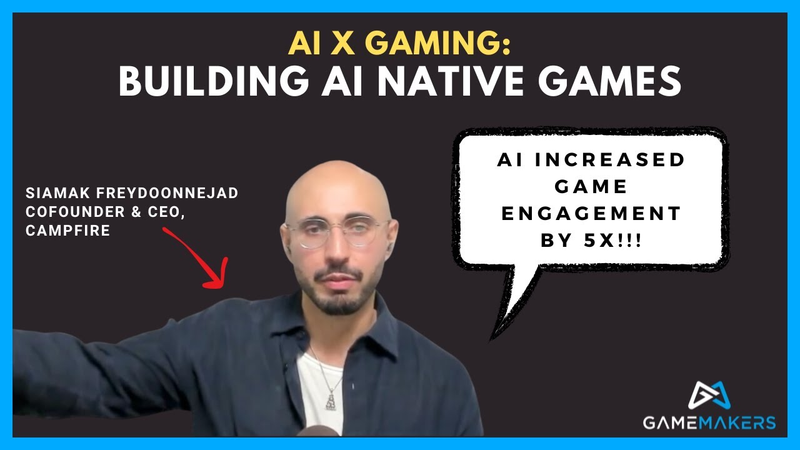
The gaming industry is undergoing a fundamental shift toward AI-native development, where generative technology serves as the primary driver of player engagement rather than a peripheral feature.
- Campfire discovered that players spent five times longer interacting with AI companions than engaging with traditional game mechanics, a finding that shifted the company's focus toward AI-native gaming.
- The company developed Sprites.AI as a toolset to simplify AI agent creation, allowing developers to manage personality traits, memory, and conversational flows without needing deep expertise in complex AI building blocks like RAG or Chain of Thought.
- To address the stochastic nature of AI outputs, Campfire implemented a monitoring framework that qualitatively analyzes agent performance to ensure interactions remain engaging and fun for users.

The Truth About Gaming's Crisis: 2024 Recap & 2025 Predictions
The global gaming industry is currently navigating a profound transition from an era of unchecked expansion to a period defined by operational efficiency and fiscal discipline.
- The gaming industry is shifting from an era of unchecked expansion to fiscal discipline, evidenced by the fact that only 15 percent of Steam playtime in 2024 was dedicated to new releases.
- Chinese developers are successfully capturing Western market share by leveraging sophisticated, quasi-social gaming platforms and high-end production capabilities, putting pressure on established giants like Microsoft, Ubisoft, and Unity.
- Generative AI is transitioning from a simple production assistant to a foundational element of game design and live-ops, which is expected to significantly lower development costs by 2025.
Game Industry Hot Takes: Ubisoft's Struggles, Unity's Revival, and Microsoft's Game Pass Gambit
The global gaming industry is currently navigating a period of intense structural volatility, characterized by the decline of legacy development models and the struggle to integrate massive acquisitions.
- Ubisoft faces significant operational challenges, with analysts suggesting the company should pivot to a leaner model focused on its core Assassin's Creed franchise rather than high-budget, underperforming titles like Star Wars Outlaws and Avatar.
- Unity is undergoing a corporate turnaround under new leadership, marked by the strategic decision to eliminate controversial runtime fees to stabilize its 70% market share in game engine technology.
- AppLovin has emerged as a dominant force in mobile advertising, generating $1 billion in quarterly revenue and demonstrating strong free cash flow that positions it as a high-growth, maturing tech entity.

The Fingerprinting Problem Destroying Mobile Growth
The mobile performance marketing landscape has undergone a fundamental transformation, moving away from manual campaign optimization toward a model defined by advanced algorithms, high-volume creative production, and sophisticated data science.
- The mobile marketing industry is shifting away from probabilistic fingerprinting toward models built on consented first-party data to counter the decline of traditional deterministic measurement.
- Successful growth strategies now require internalizing data science capabilities rather than relying on external demand-side platforms, focusing instead on primary social platforms and rewarded video networks.
- Studios should adopt a two-stage growth model that validates retention and lifetime value metrics before investing in full-scale marketing organizations.
Chinese Gaming Giants: Tencent vs. Netease | Pixels & Profits
Tencent and NetEase represent the dual pillars of the Chinese gaming industry, yet both face a precarious future defined by domestic saturation, regulatory volatility, and escalating geopolitical friction.
- Tencent achieved significant financial efficiency in 2023, increasing its operating margin to 31.5% from 25.8% in 2022 while generating $23 billion in free cash flow, an 89% year-over-year increase.
- Tencent maintains a dominant global gaming position through full ownership of major studios like Riot Games and Supercell, alongside significant minority stakes in companies including Epic Games, Ubisoft, and Krafton.
- Tencent faces substantial headwinds in the domestic Chinese market, which accounts for approximately 70% of its revenue, due to strict government regulations on gameplay and increasing competition from emerging rivals like miHoYo and Game Science.
Mastering F2P Cosmetics Monetization in Games
Effective free-to-play cosmetic monetization relies on the intersection of social signaling, player engagement, and carefully managed in-game economies.
- The presence of a secondary market significantly alters monetization strategy, as seen in platforms like Second Life, which generates $180–$200 million in revenue from a relatively small base of 50,000–60,000 concurrent users.
- Managing a secondary market requires rigorous economic oversight to prevent hyperinflation, as evidenced by the collapse of Gaia Online after the introduction of a currency-producing item.
- Player motivation for cosmetic purchases is driven by status and social signaling, particularly in competitive multiplayer games where spectating mechanics force players to visually engage with others' gear.
Mobile Gaming Market Review 1H2024 | AppMagic Data Analysis
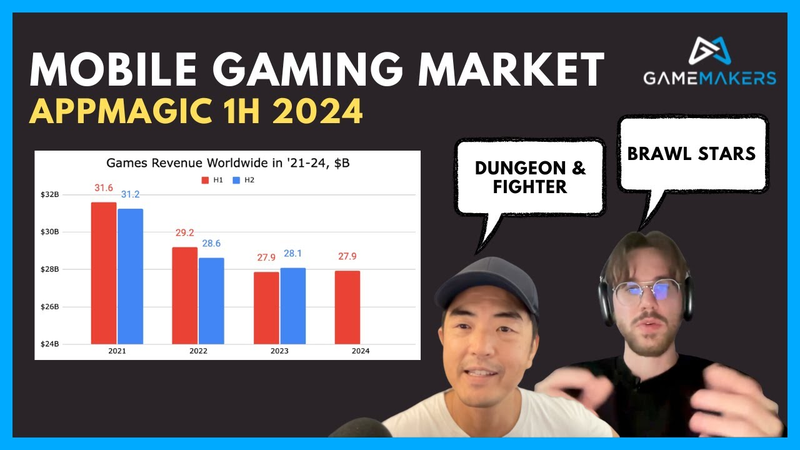
The mobile gaming market reached a state of stabilization during the first half of 2024, effectively concluding the post-pandemic decline.
- The mobile gaming market stabilized in 1H 2024, ending the post-pandemic decline with Tier 1 Western markets recording a 7% revenue increase despite modest global download growth of 1–2%.
- Major studios are shifting strategy from high-risk new title development to optimizing existing assets through sophisticated LiveOps and enhanced monetization frameworks.
- Success is increasingly driven by the 'casualization' of core mechanics, exemplified by Brawl Stars' revenue recovery and the integration of hyper-casual loops in 4X strategy titles like Last War: Survival and Whiteout Survival.