Foundations of Digital Games (FDG)
The International Conference on the Foundations of Digital Games, run by the Society for the Advancement of the Science of Digital Games and published by ACM. It covers game design, game AI, games education and game studies.
Documents
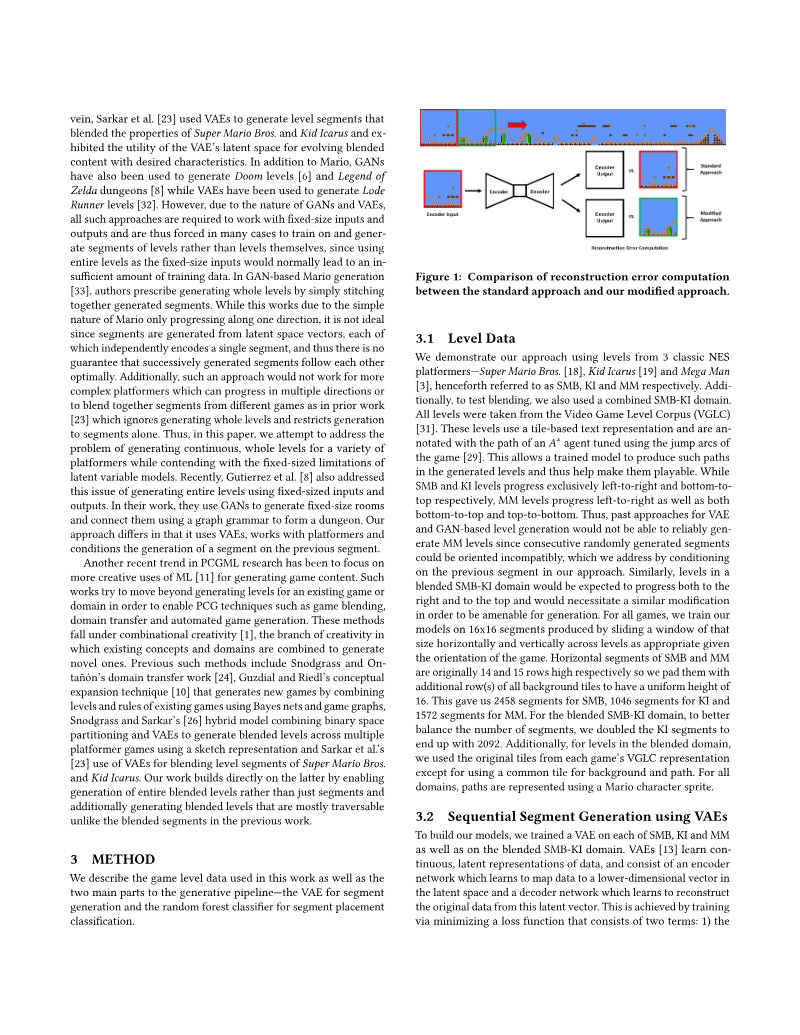
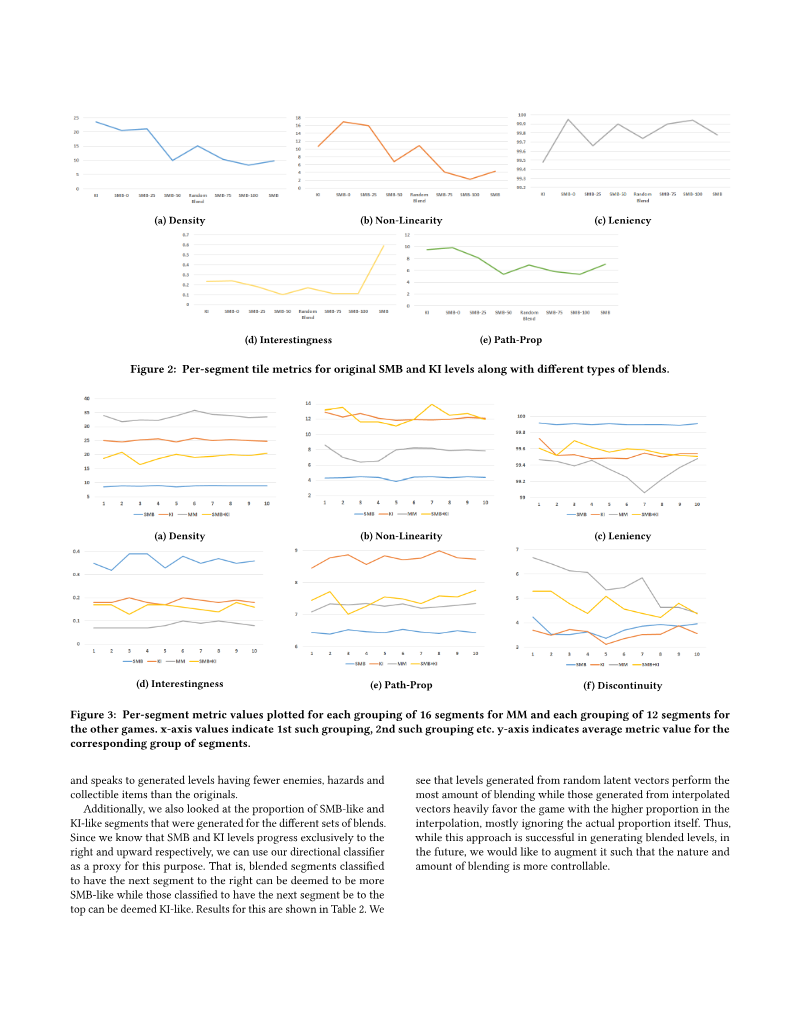
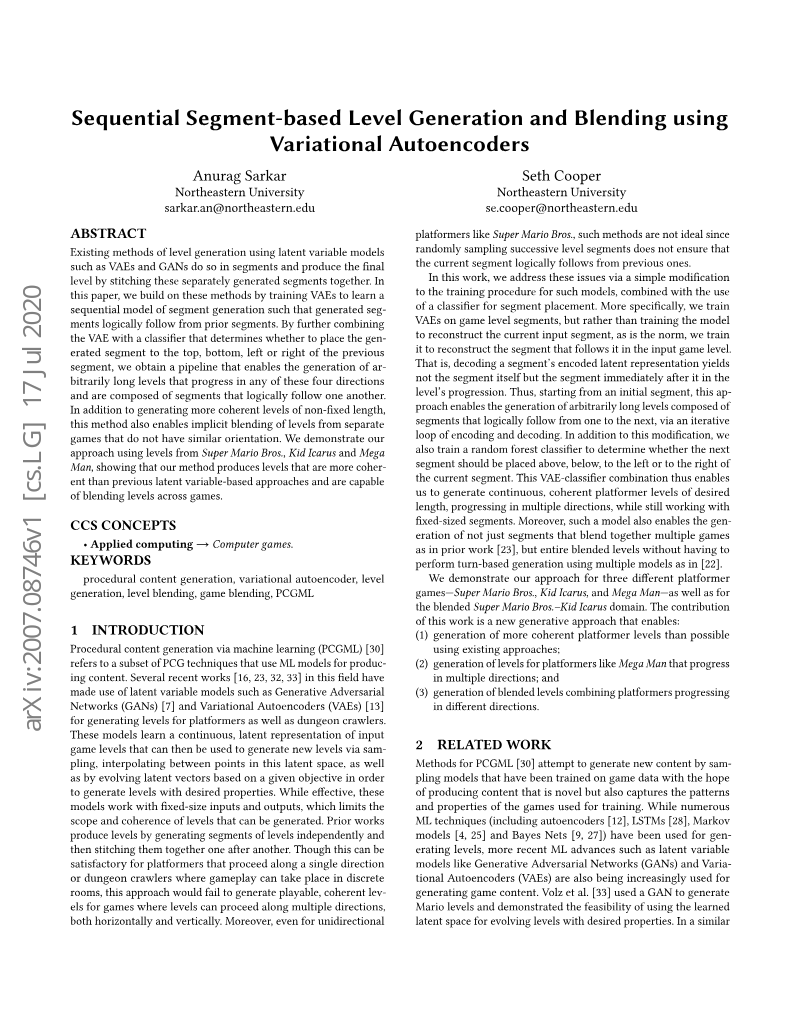
Sequential Segment-based Level Generation and Blending using Variational Autoencoders
Procedural content generation in platformer games often struggles to maintain structural coherence when stitching disparate segments together.
- A new generative framework improves platformer level design by using Variational Autoencoders to predict subsequent segments rather than reconstructing existing ones, ensuring better structural coherence.
- The system integrates a random forest classifier to govern segment placement, enabling the creation of arbitrarily long, traversable levels that maintain stylistic integrity.
- The methodology has been successfully validated using the Video Game Level Corpus to blend content from diverse titles, specifically Super Mario Bros., Kid Icarus, and Mega Man.



Mind Tricks for Presence
The primary objective is to provide game developers and designers with a theoretical framework for achieving optimal user presence in virtual and mixed reality (VR/MR) environments.
Why Game Designers Should Study Magic
Game design can be significantly enhanced by integrating principles derived from stage magic, specifically those centered on perceived causality and the psychological management of player expectations.

Intrinsic Elicitation: A Model and Design Approach for Games Collecting Human Subject Data
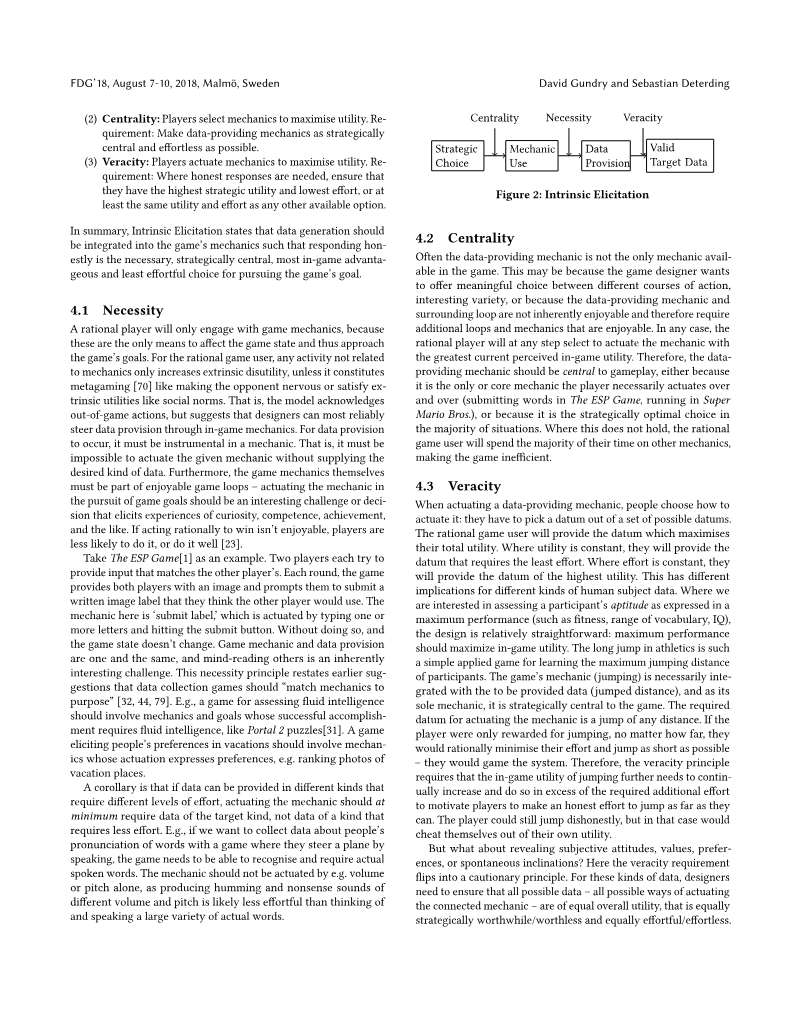
Intrinsic Elicitation establishes a novel design framework for games intended to collect human subject data, such as personal preferences or attitudes, where objective ground truth is difficult to verify.
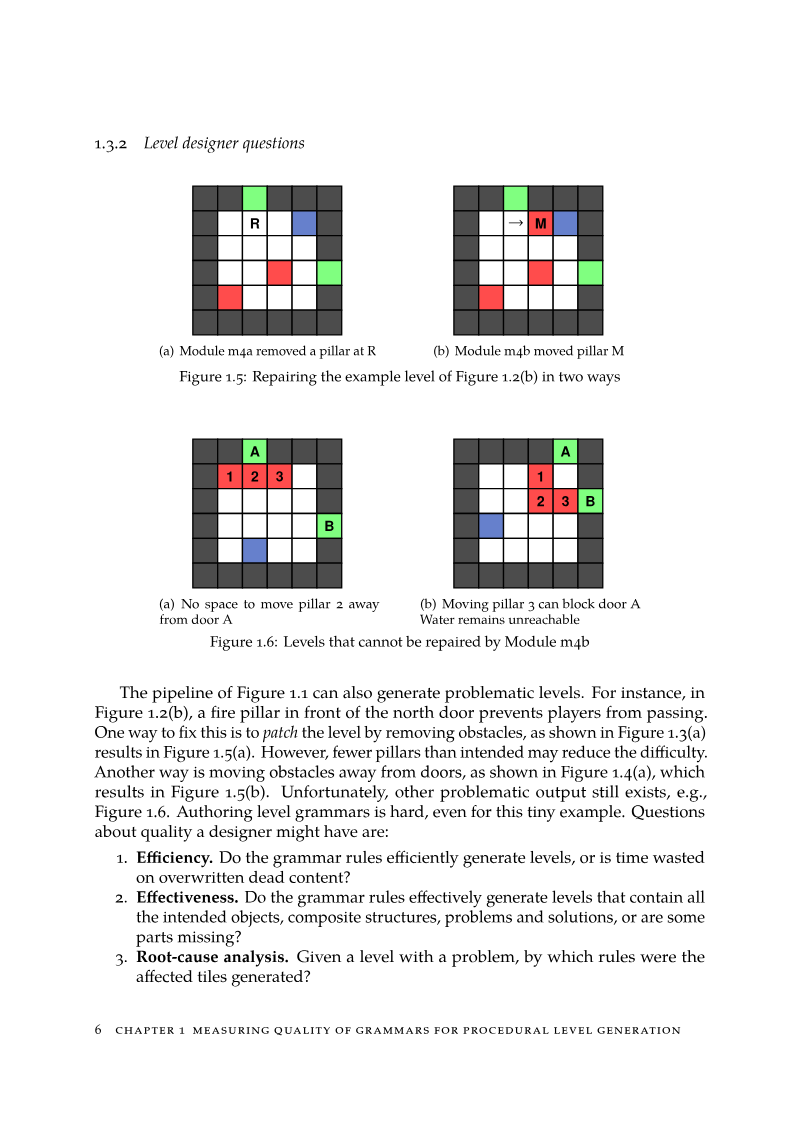
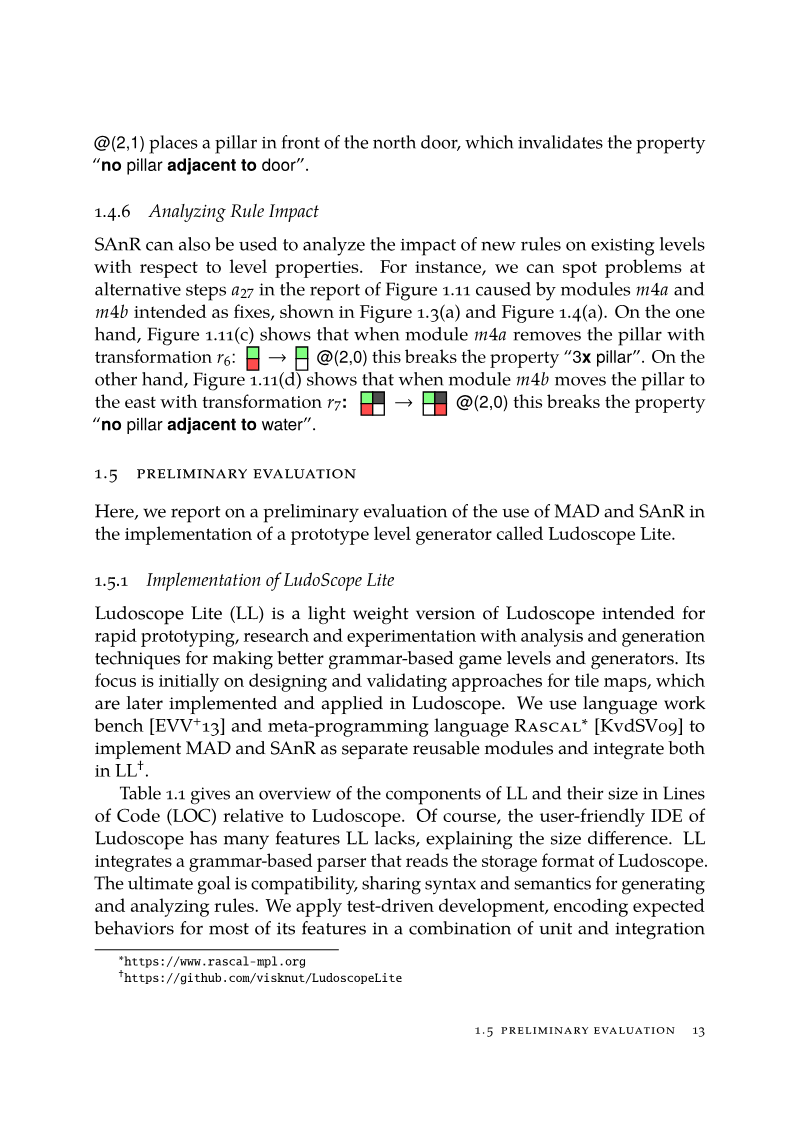
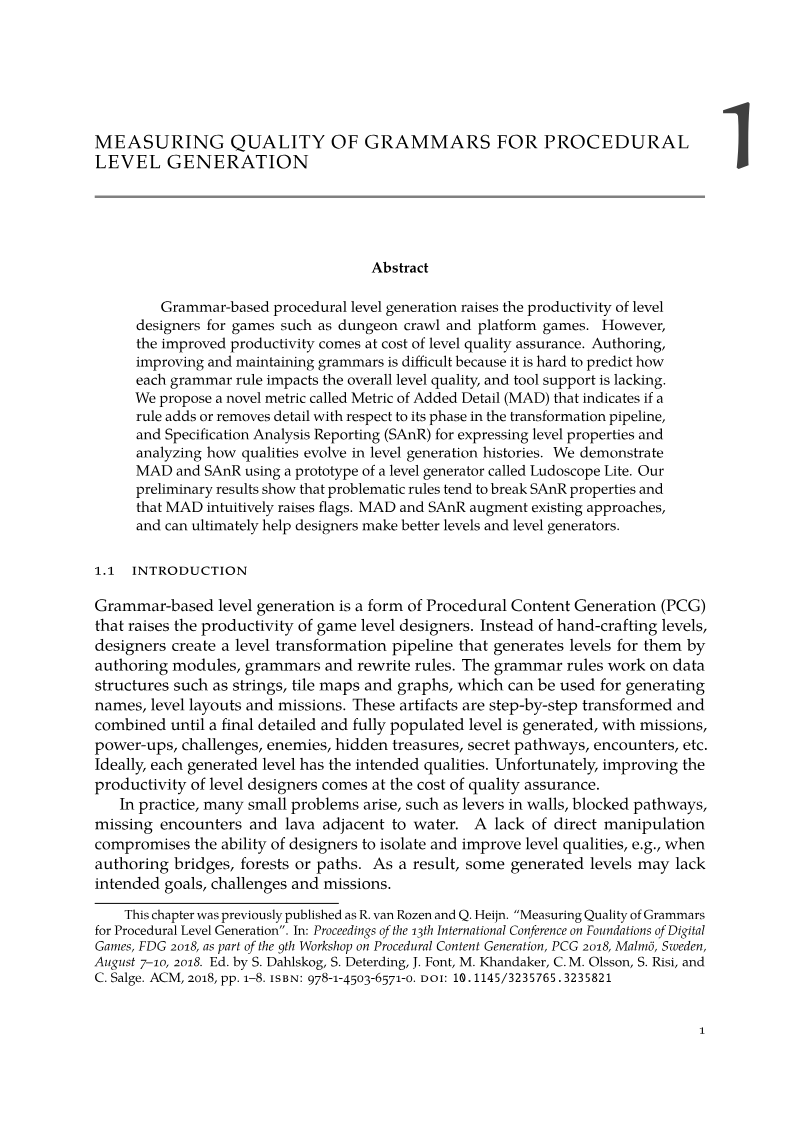
Measuring Quality of Grammars for Procedural Level Generation
Grammar-based procedural level generation frequently suffers from unpredictable rule interactions that result in structural defects and unintended design outcomes.
- The Metric of Added Detail (MAD) and Specification Analysis Reporting (SAnR) provide a new diagnostic framework to quantify rule effects and verify design intent in procedural level generation.
- MAD tracks the trajectory of level complexity by measuring whether individual generation rules increase or decrease detail throughout the process.
- SAnR enables declarative verification by analyzing final level properties against the specific generation history, allowing for automated root-cause analysis of structural defects.
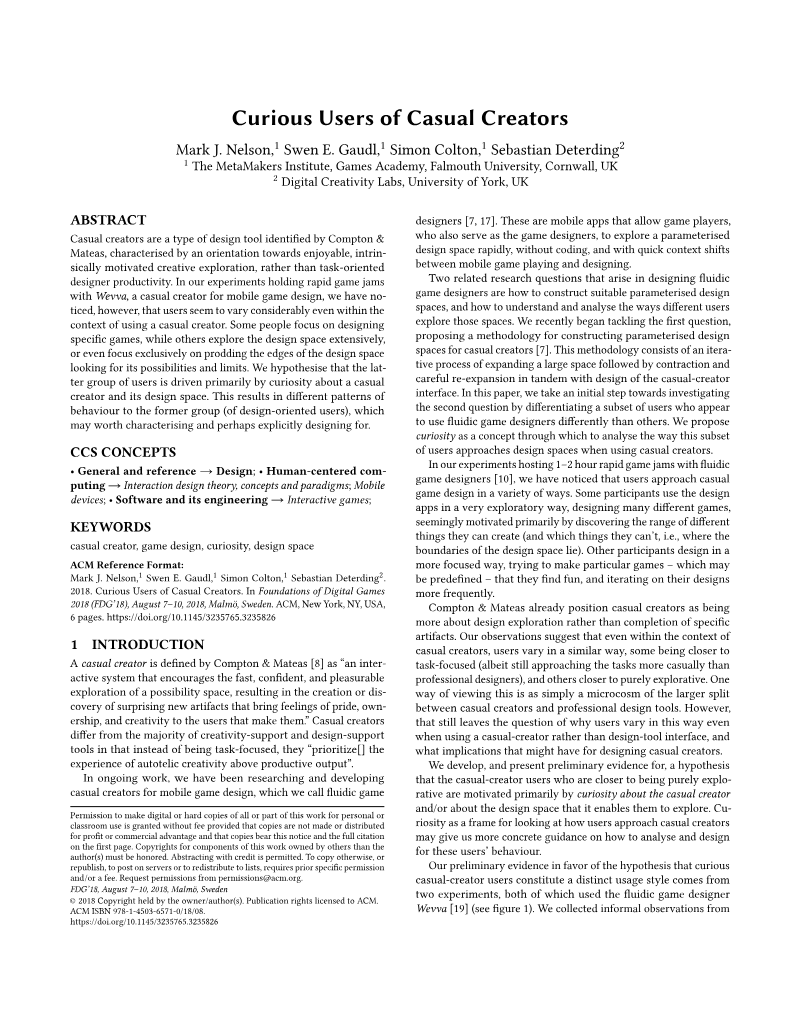

Curious Users of Casual Creators
Casual creators, defined as design tools that prioritize autotelic and exploratory experiences over traditional productivity, foster two distinct user archetypes.
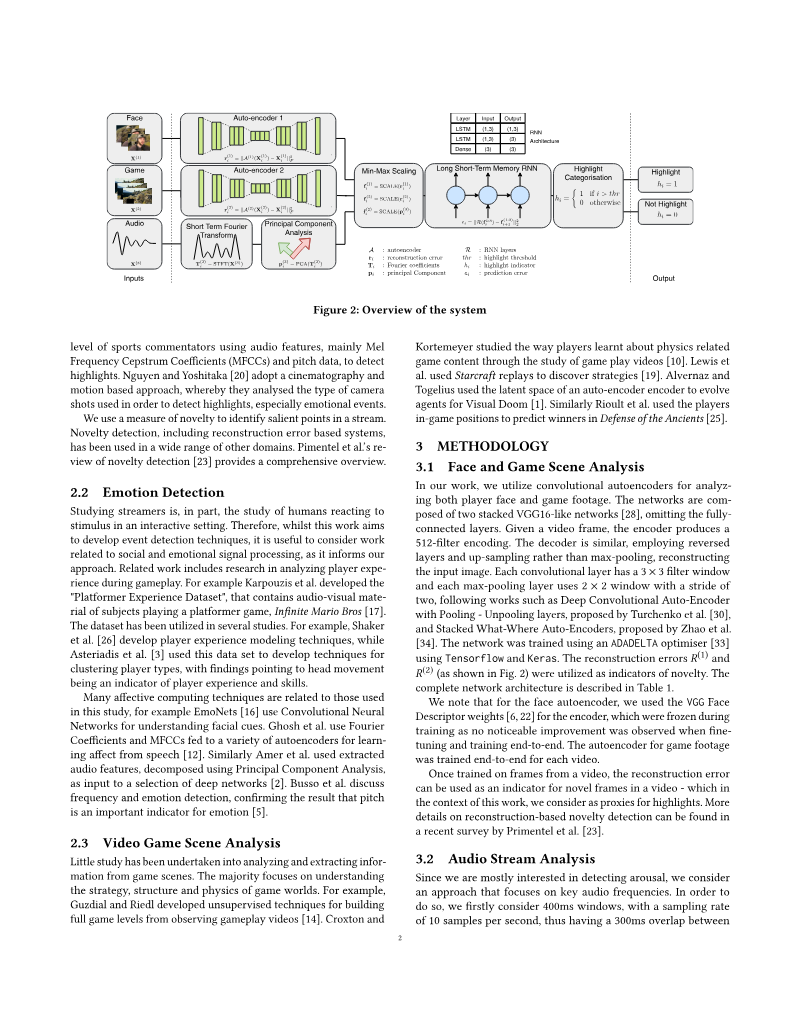
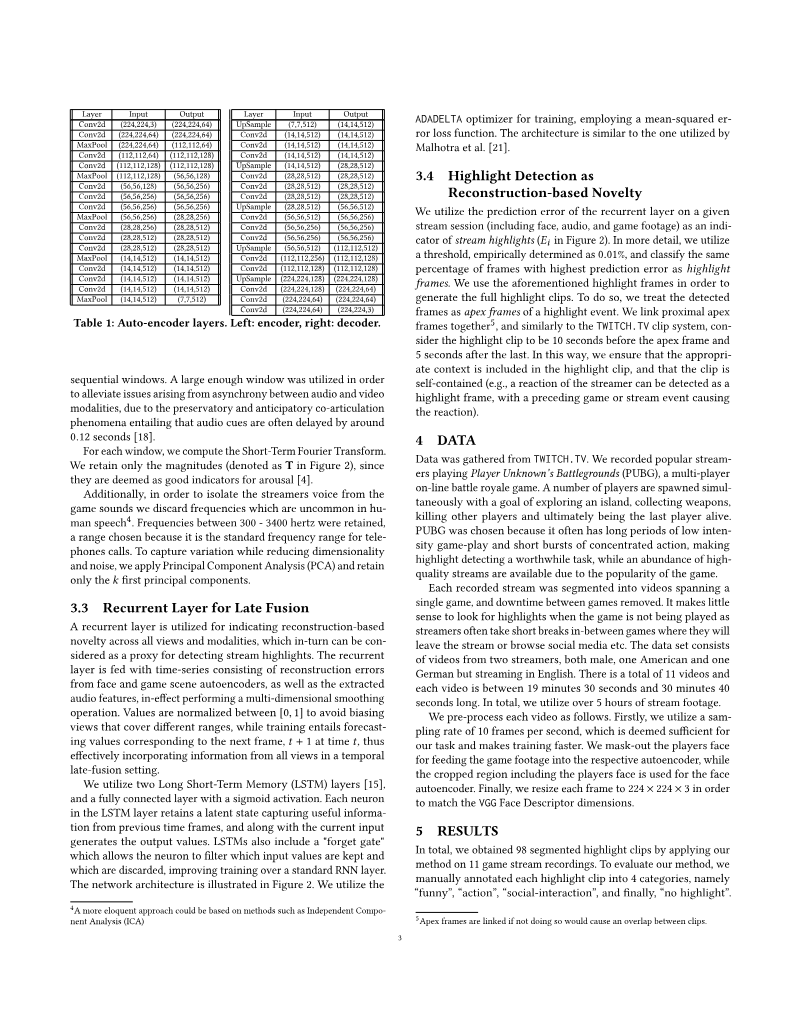
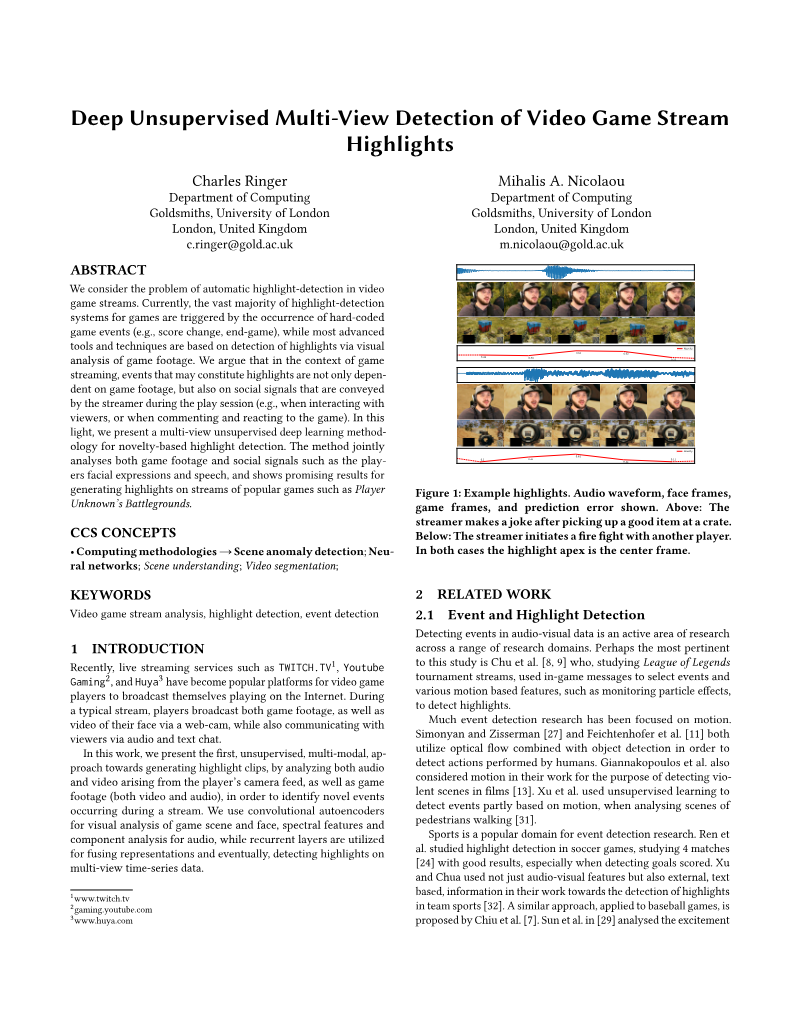
Deep Unsupervised Multi-View Detection of Video Game Stream Highlights
This research introduces an unsupervised deep learning methodology for automatically detecting highlights in video game streams.
Designing for Immediate Play
Immediate play prioritizes spontaneous, frictionless participation by blurring the boundaries between everyday reality and fictional game worlds.

The Problematic Coexistence of "Internet Gaming Disorder" and Esports
The rapid growth of esports as a professional industry presents a significant challenge to the diagnostic criteria for Internet Gaming Disorder (IGD) proposed by the American Psychiatric Association in the DSM-5.
- The DSM-5 diagnostic criteria for Internet Gaming Disorder (IGD) frequently produce false positives by failing to distinguish between clinical addiction and the high-level dedication required for professional esports.
- Standard professional training requirements, such as six or more hours of daily deliberate practice, are currently mislabeled as 'tolerance' under the DSM-5 framework.
- Emotional distress resulting from an inability to play is often incorrectly categorized as clinical withdrawal, despite being a common reaction for individuals deeply invested in a high-performance career.
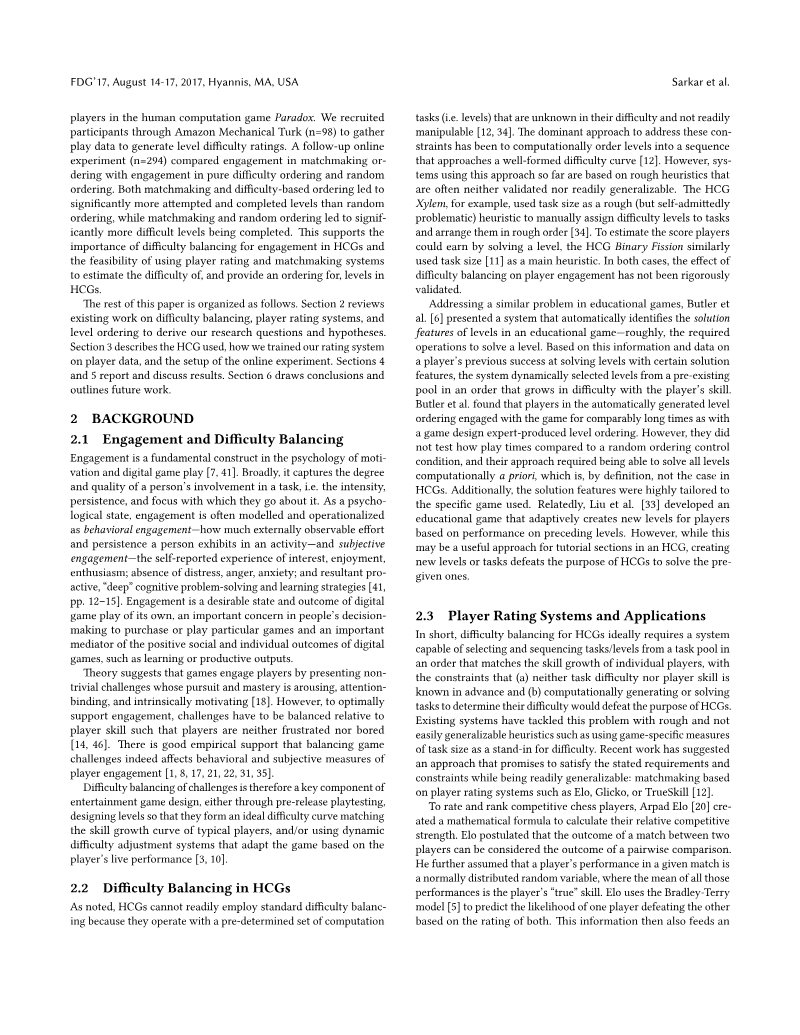
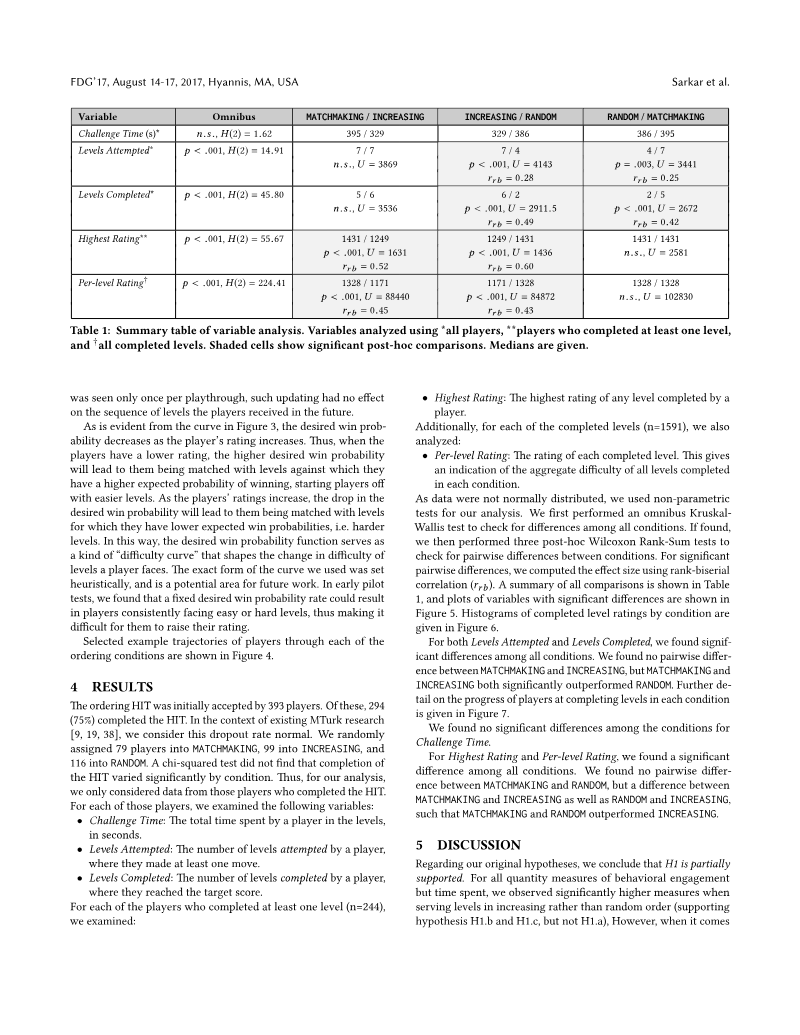

Engagement Effects of Player Rating System-Based Matchmaking for Level Ordering in Human Computation Games
Human computation games rely on the effective calibration of task difficulty to maintain player engagement and ensure the successful completion of crowdsourced objectives.
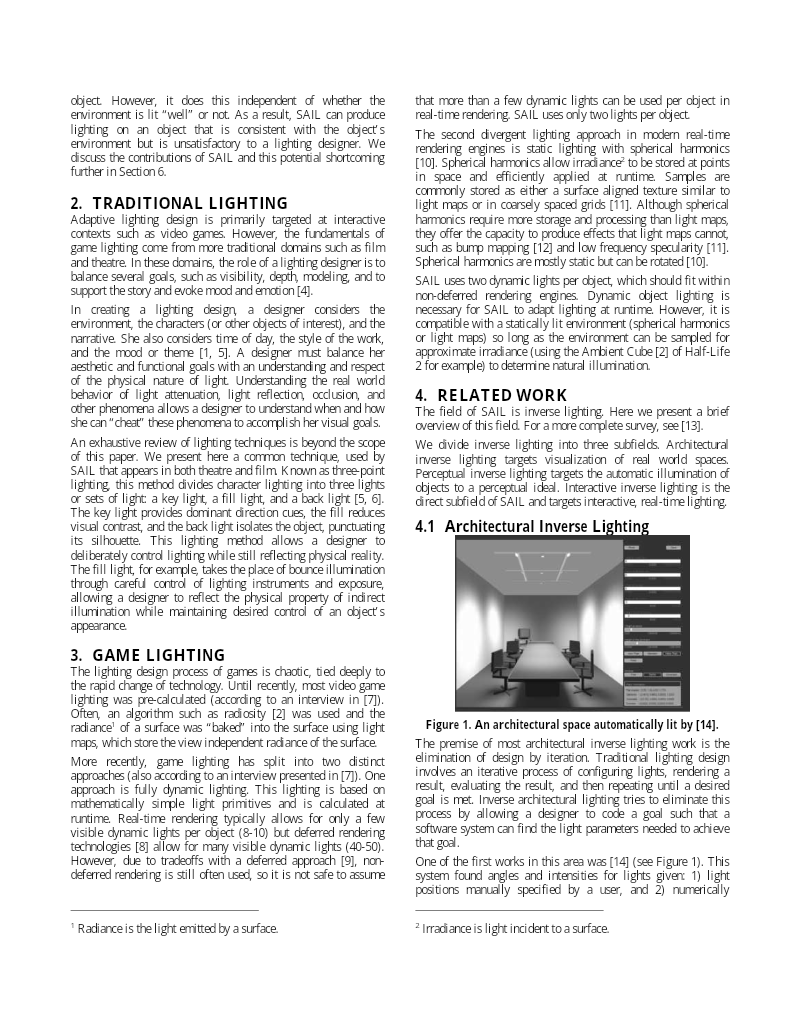
System for Automated Interactive Lighting (SAIL)
The System for Automated Interactive Lighting (SAIL) functions as an adaptive lighting framework designed to reconcile artistic intent with the unpredictable nature of interactive 3D game environments.
Do you work at Foundations of Digital Games (FDG)? Get a free report of how these documents are read and cited here.