
European Conference on Games Based Learning (ECGBL)
Annual European conference on game-based learning and serious games; its proceedings are published open access (CC BY) by Academic Conferences International.
Documents

Cultural Games Creation: An Applied Game Jam Model
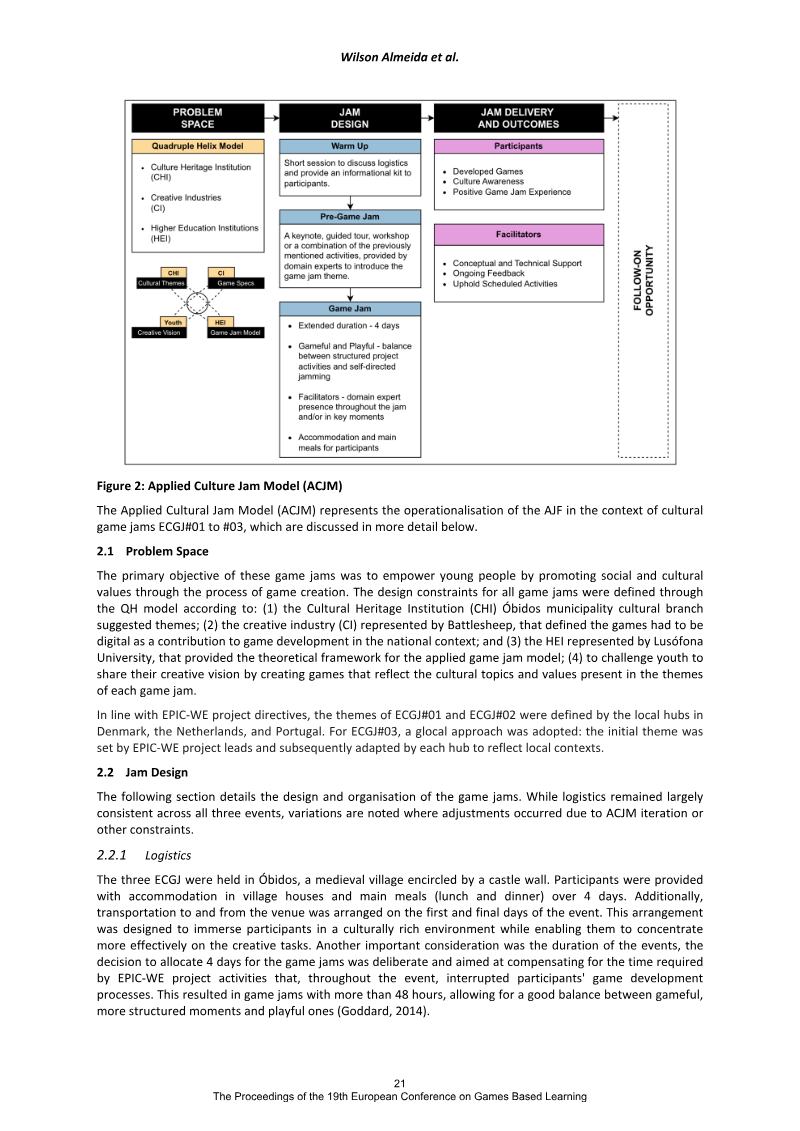
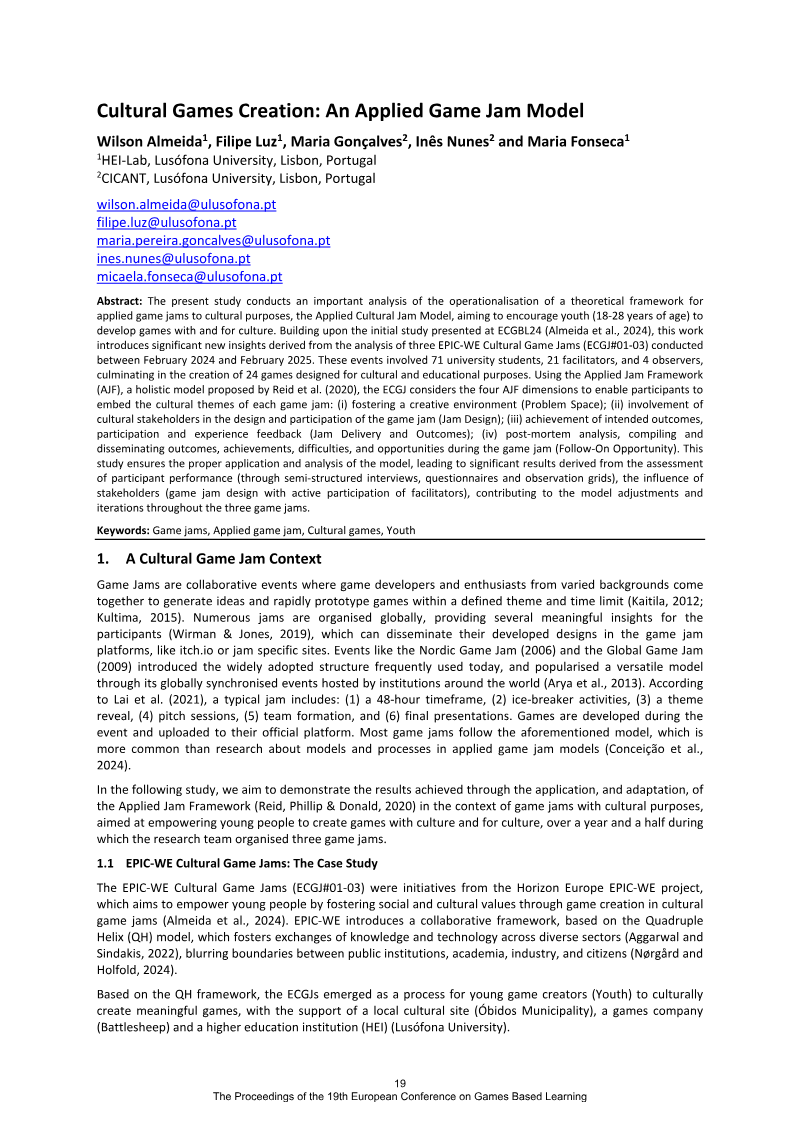
The Applied Cultural Jam Model examined here adapts the Applied Jam Framework to cultural game creation, operationalised across three EPIC-WE Cultural Game Jams (ECGJ#01–03) held in Óbidos, Portugal, between February 2024 and February 2025.
- Facilitated, on-site cultural engagement is essential to thematic depth: ECGJ#02, which had continuous cultural mentoring, produced the strongest games, while ECGJ#03, with less experienced participants and limited facilitator presence, yielded the fewest games and reduced sophistication.
- The model departs from the conventional 48-hour game jam by running four-day events with pre-game warm-ups and pitch sessions, and it relies on a Quadruple Helix collaboration linking a municipality, a games company, a university, and youth participants.
- Across three Cultural Game Jams (ECGJ#01–03) held in Óbidos, Portugal, between February 2024 and February 2025, 71 university students, 21 facilitators, and 4 observers produced 24 games.
Games Inclusion Lab: Accessible Games with Neurodivergent Adults Through Iterative Play and Design
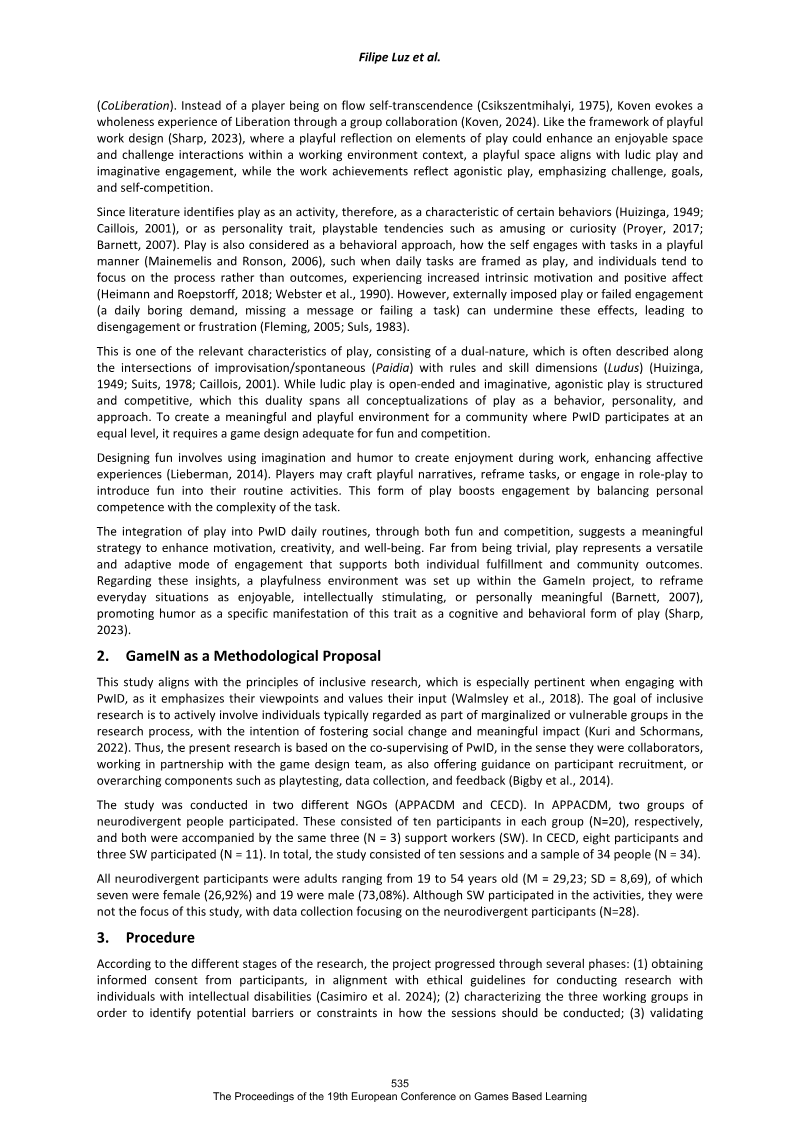
The Games Inclusion Lab (GameIN) action research project, conducted by Lusófona University researchers in Lisbon, examines how an iterative co-design approach can produce playful, accessible games for neurodivergent adults, specifically autistic people and people with intellectual disabilities.
- The GameIN action research project used iterative co-design over 30 monthly sessions with three groups across two Portuguese NGOs, involving 28 neurodivergent adults aged 19 to 54 (mean age around 30) alongside support workers as collaborators.
- The core premise is that games should be developed through frequent contact with everyday contexts rather than for a predefined target audience, with the aim of shared play regardless of individual skill levels.
- The authors argue that therapeutic framing has often overshadowed entertainment for neurodivergent audiences, producing exclusion, and propose playfulness and "CoLiberation" (collaborative shared enjoyment) as alternatives.
Designing a Gamified Learning Tool for Enhancing Project Monitoring Skills in Technical Engineering Projects: An Interdisciplinary Approach Integrating Project Management and Systems Engineering
This paper proposes the design of a gamified boardgame, the Project Monitoring Game (PMG), intended to help students practice the execution and monitoring process groups of technical engineering projects.
- The paper is a design proposal for the Project Monitoring Game (PMG), a gamified board game meant to help students practise the execution and monitoring phases of technical engineering projects, not an empirical evaluation.
- The authors argue that higher education covers project initiation and planning well but rarely exposes students to the high variability of real project execution, where progress must be tracked and baselines adjusted.
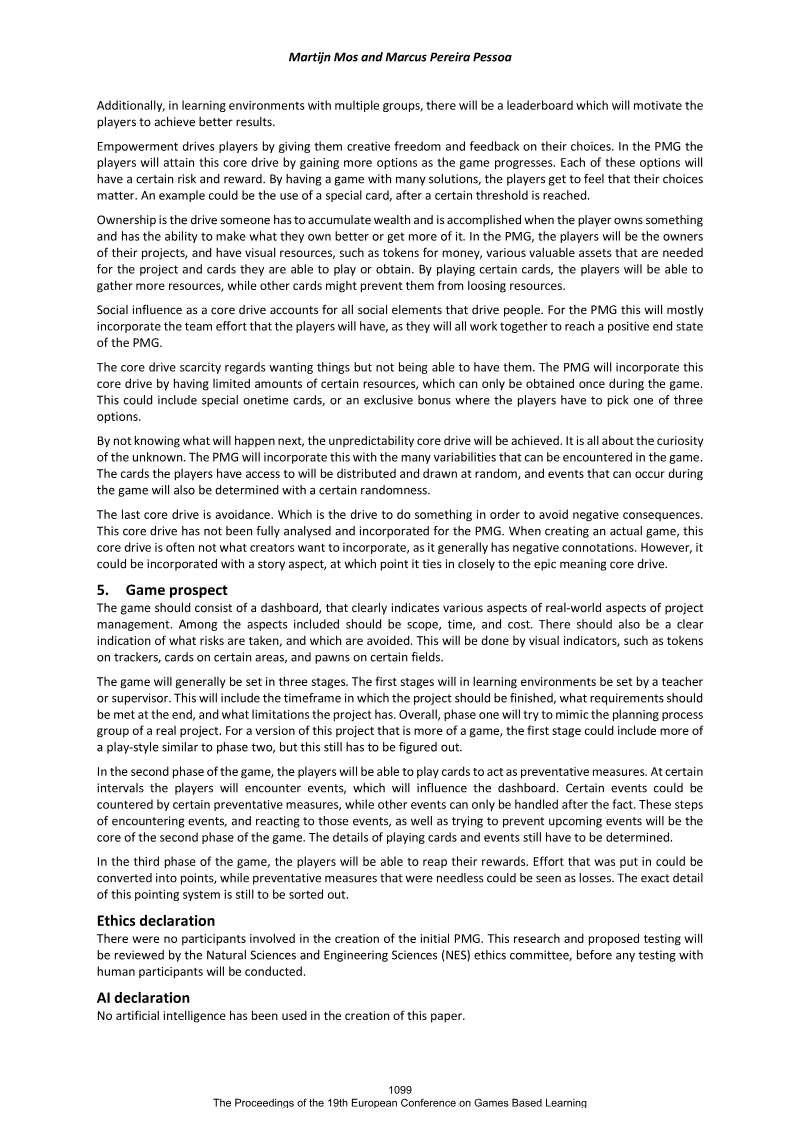
- The game's learning goals are derived from the ISO 31000:2009 risk management principles, and the design is structured around Chou's Octalysis framework, with each of its eight core drives mapped to concrete features.
A Physical Chemistry Escape Room With 4 Metals
This paper presents a physical chemistry escape room centered on four metals (aluminium, copper, iron, and zinc), designed to make chemistry more accessible and engaging for young learners.
- The paper presents a physical chemistry escape room built around four metals (aluminium, copper, iron, and zinc), comprising five task stations of roughly 3-4 square metres each that can be played sequentially or in parallel rotation.
- Stations combine riddles with hands-on activities such as density determination via Archimedes' principle, cleaning copper coins, and building a lemon battery to light a lamp, alongside crosswords and numeric or pictorial codes.
- The design aims to teach metal properties (density, magnetism, colour) and alloys while encouraging scientific reasoning and mathematical thinking, on the premise that gamified problem-solving raises motivation and enables learning without participants necessarily noticing.
Learning While Developing a Game: The Case of an Introductory Course on Industrial Engineering and Management
This paper presents a case study of first-year students in the Industrial Engineering and Management (IEM) undergraduate program at the University of Aveiro, Portugal, who designed non-digital educational games as a core assignment in the Introduction to Industrial Engineering and Management course during the 2024/2025 academic…
- A case study of 78 first-year Industrial Engineering and Management students at the University of Aveiro, Portugal (2024/2025) found that designing non-digital educational games as a core assignment was highly successful, with grades ranging from 14 to 19 out of 20.
- The assignment marked the first time the course shifted from its traditional Challenge-Based Learning approach to Game-Based Learning, with students working in groups of four or five to create games introducing high school audiences to the IEM program.
- Students reported growing enthusiasm and deeper knowledge of IEM subject areas and the university, while developing written and oral communication skills.

Secret Hacker: A Learning-Based Cybersecurity Game for Group-Based Settings
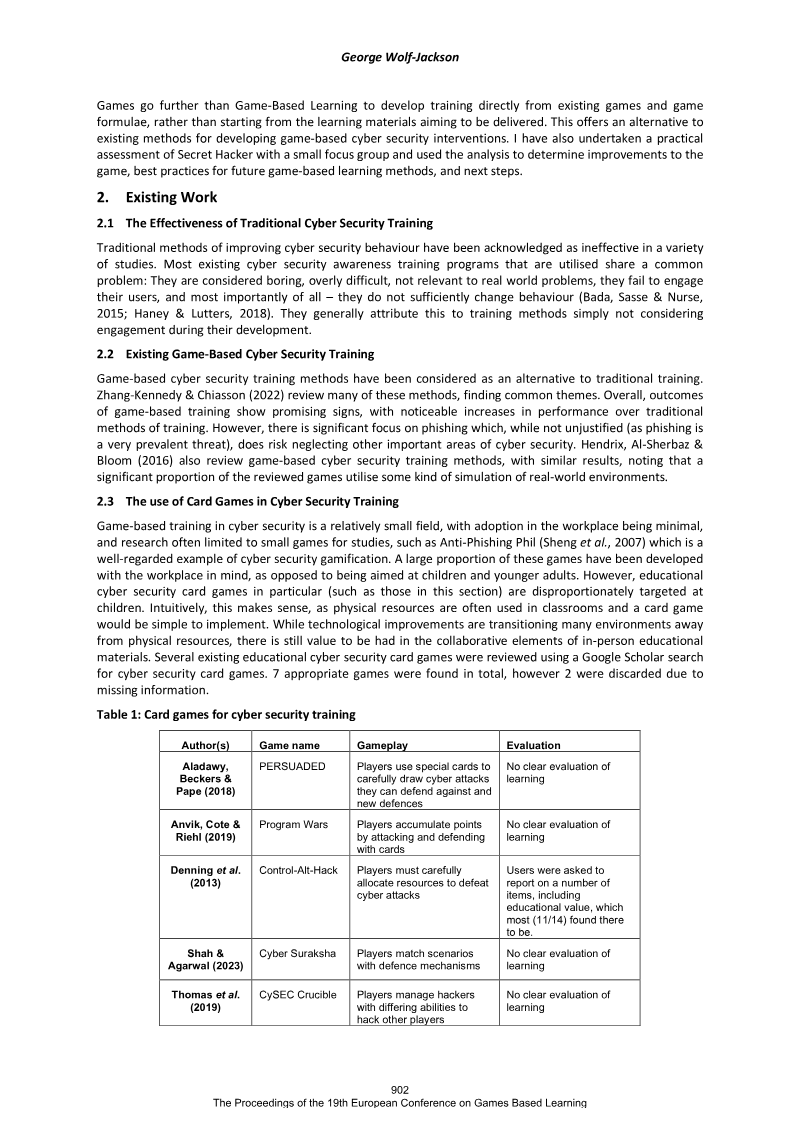
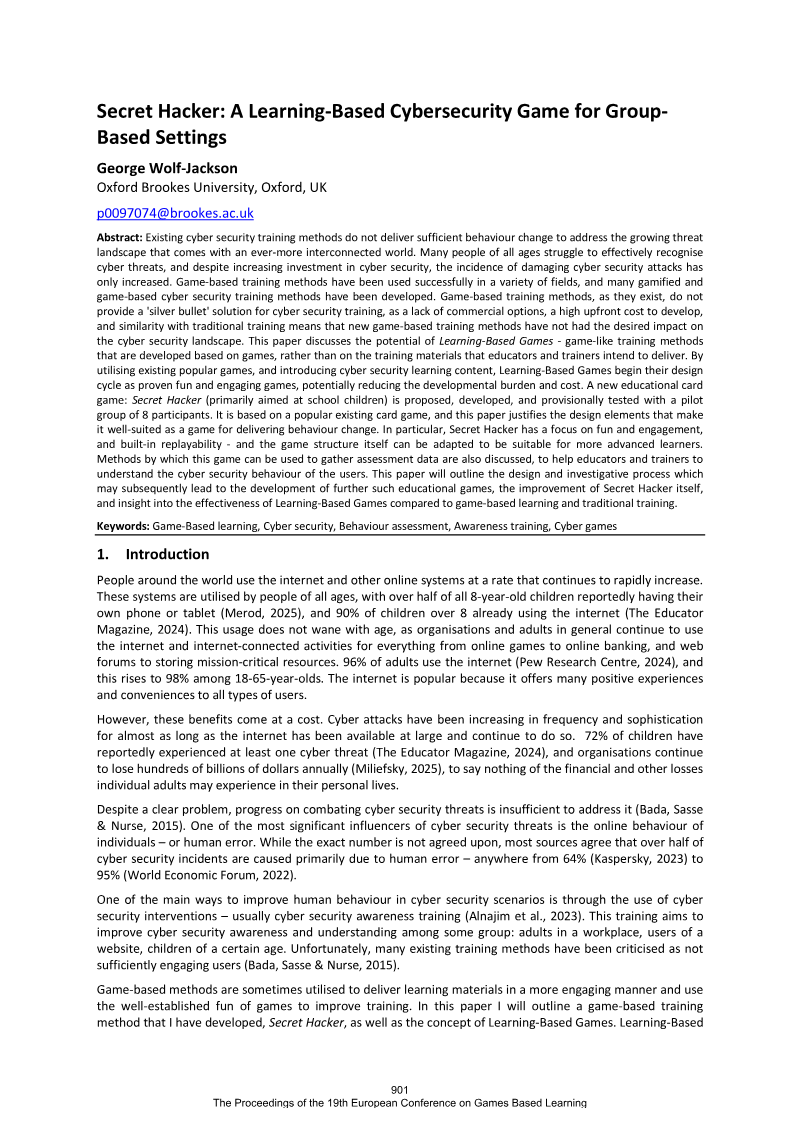
Secret Hacker is a card-based cybersecurity training game adapted from the social-deduction game Secret Hitler, designed to teach players to distinguish safe from risky online behaviours across password, phishing, and secure-browsing topics.
- Secret Hacker is a card-based cybersecurity training game adapted from the social-deduction game Secret Hitler, with 51 behaviour cards aimed primarily at school-aged children learning in groups, covering password, phishing, and secure-browsing topics.
- The authors advocate a "Learning-Based Games" approach that starts with an already engaging game and layers in educational content, arguing this can lower development costs and sustain engagement better than traditional training or gamified approaches.
- Evidence is preliminary: a focus group of six participants (mostly adults, four of them staff members) rated the game 8.8/10 for enjoyment and 7/10 for learning potential, though the author concedes the learning score may be inflated.

Threat Forge: Using a Narrative Game to Explore Future Societal Challenges
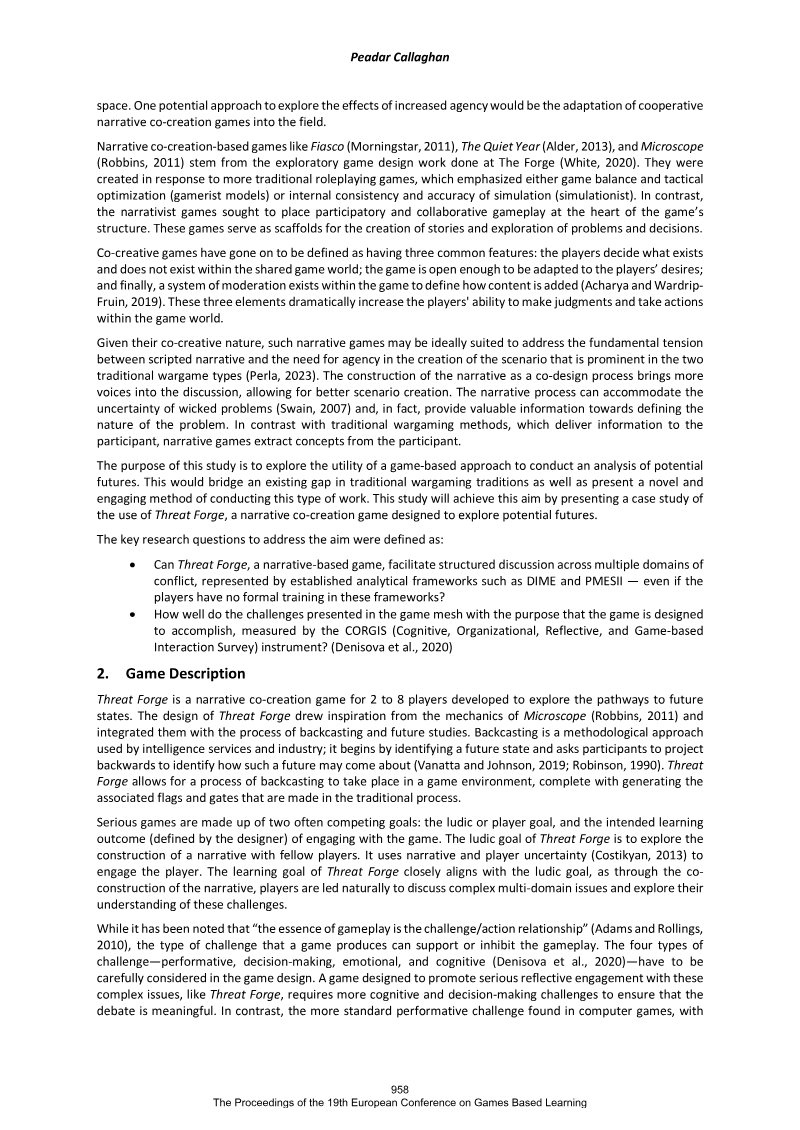
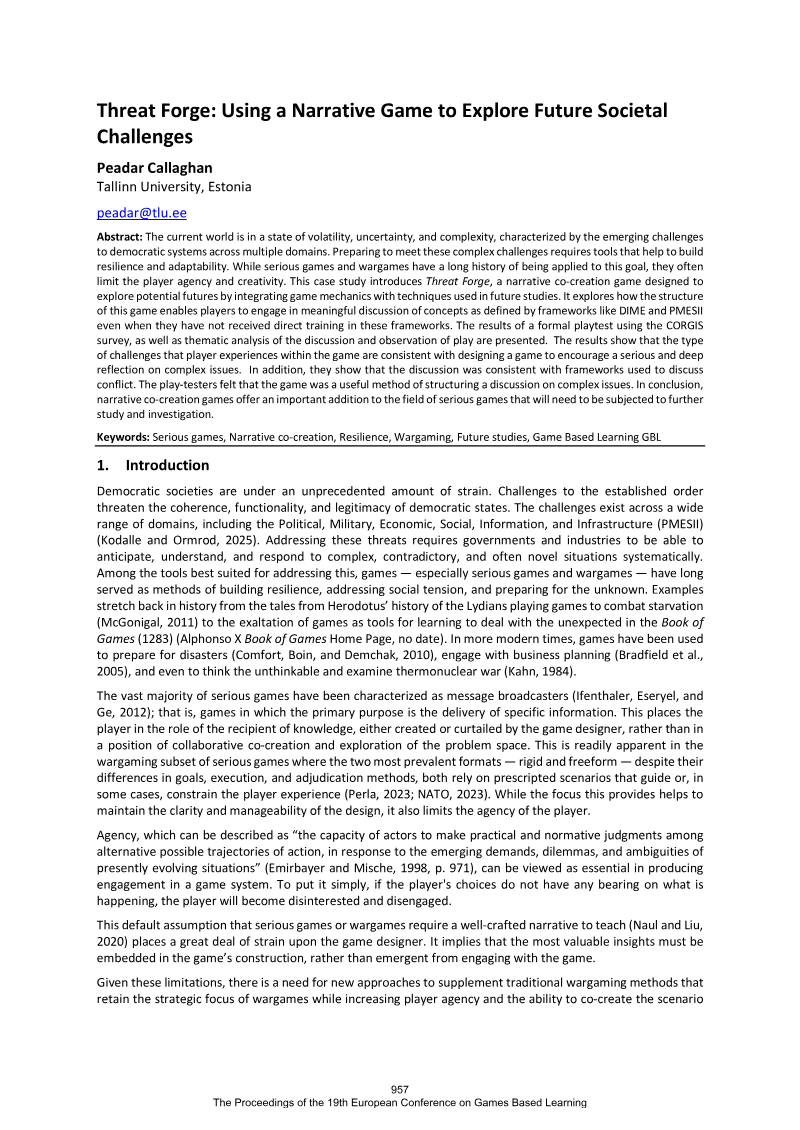
Threat Forge is presented as a narrative co-creation game designed to explore potential futures, positioned as an alternative to traditional scripted wargames that tend to limit player agency.
- Threat Forge is a narrative co-creation game that blends Microscope-style collaborative storytelling with backcasting, letting players place event cards on a timeline between a fixed present and a defined end state, each marked as raising or lowering the probability of that end state.
- In a pilot with three postgraduate students without military backgrounds, the game scored highest on cognitive challenge (mean 5.16 on a seven-point CORGIS scale) and lowest on performative challenge (mean 2.2), matching its design intent of prompting deliberate reflection over quick reactions.
- Retrospective coding of player moves against the DIME and PMESII frameworks found diplomatic, economic, and social moves dominated, while information and infrastructure received comparatively little attention.
Framing the Development of a Gamified App for m-Health and Well-Being
This paper lays out the theoretical and design rationale for a gamified mobile application, developed under the WE CARE project, that aims to support mental health and well-being among health professionals.
- Web-based health interventions suffer very high dropout rates, ranging from 35% to 99%, which the WE CARE authors cite as a core problem their gamified app aims to address.
- Prior gamified health apps often lacked theoretical grounding, leaned heavily on extrinsic rewards, and were inconsistently categorised, limiting comparability of findings across studies.
- The app's design is grounded in Self-Determination Theory (including Organismic Integration and Basic Psychological Needs Theory), Nicholson's meaningful gamification framework, and Cugelman's mapping of gamification strategies to behaviour-change techniques.

Tiers of Engagement II: Profiling the Characteristics of User Engagement and Motivational Tiers in Business Simulators
This study, "Tiers of Engagement II," by Guttormsen and Weines, extends an earlier framework for understanding student engagement with business simulators.
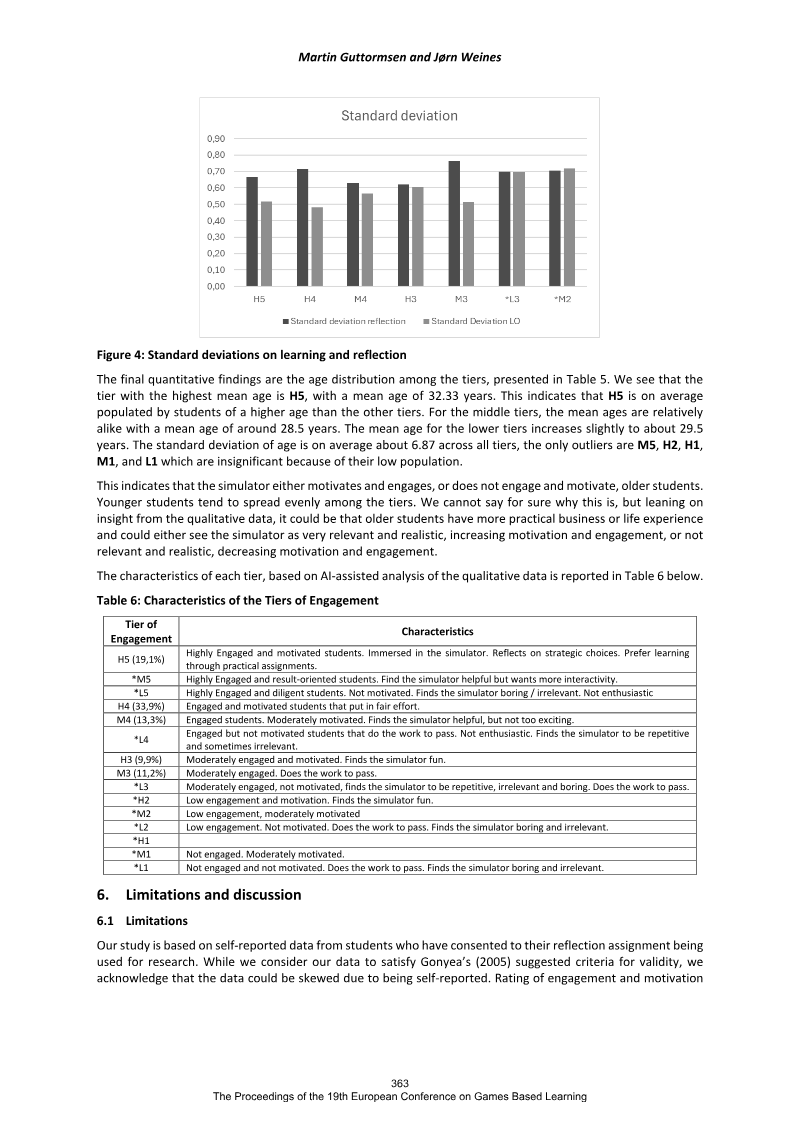
- High intrinsic motivation is closely associated with the highest engagement levels in business simulators, and perceived learning declines steadily down the tiers, from roughly 4.40 in the top high-motivation group to about 3.40 in the lower medium-motivation tiers.
- Students in the upper engagement tiers value narrative assignments for linking theory to practice, whereas students in the lowest tiers describe the simulator as boring, irrelevant, or something completed only to pass.
- About 9.7% of respondents fall in the lowest engagement tiers, while the largest group, nearly half the sample, sits at engagement level 4.
Immersive Game-Based Experiential Learning for International Business Challenges
This paper presents an educational innovation designed to address declining access to real-world international trade environments in business education.
- The paper is a conceptual proposal, not an empirical study: it reports no learner sample, outcome data, or evaluation results, and implementation and impact assessment are left as future work.
- It proposes two immersive VR simulations at Tecnológico de Monterrey: a solo escape-room scenario on exporting automotive parts from Puebla to Germany via the Interoceanic Corridor, and a team activity on producing and exporting the Caja de Olinalá, a protected-origin craft from Guerrero, Mexico.
- The central argument is that these simulations can scalably substitute for field visits to international trade sites, which have been restricted since 2023 when Mexican customs zones were militarized.
The Role of Gamification in Learning Transfer: Does Early Skill Learning Predict Performance in Complex Tasks?
This study examines whether gamification enhances learning transfer in a physics-based educational game, and whether the efficiency of early skill acquisition predicts later performance on more complex tasks.
- Gamified and standard training conditions produced no significant differences in efficiency, points earned, or conceptual quiz gains across roughly 180 secondary students and participants.
- Early foundational efficiency across the first four game levels reliably predicted performance on later complex tasks, explaining about ten percent of the variance in composite transfer outcomes.
- The strongest predictive effects of early skill acquisition appeared at Levels 5 and 7, where it accounted for significant portions of performance on advanced challenges.

Game Design and Teaching for Understanding
This paper argues that game design can serve as a more effective assessment method than traditional essays in humanities and social science education, and that the Teaching for Understanding (TfU) framework offers a better pedagogical foundation than Bloom's taxonomy-based learning outcomes.
- The paper argues that game design is a more effective assessment method than traditional essays in humanities and social science education, because essays let students meet disciplinary expectations without demonstrating genuine understanding, while game design forces learners to decompose problems and translate narratives into explicit, quantifiable rules.
- It proposes the Teaching for Understanding (TfU) framework, centred on generative questions and performances of understanding, as a better pedagogical foundation than Bloom's taxonomy-based learning outcomes, which it critiques as imposing misleading precision (citing Richard Pring's 1971 argument) and predating constructivist learning theories.
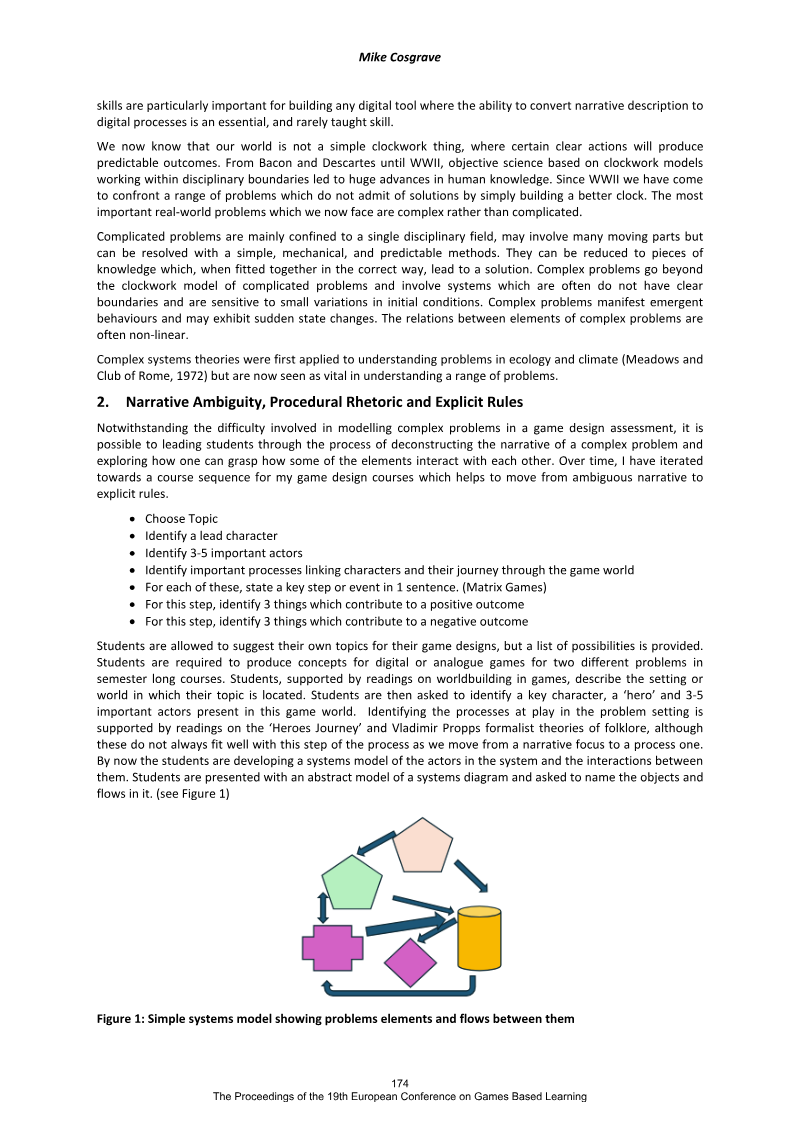
- The paper sets out a stepwise course sequence moving from narrative description to procedural model: identifying actors and processes, mapping systems relationships, expressing events as matrix game statements, and assigning probabilities using dice distributions, GURPS attributes, and Sherman Kent's estimative probability language.