1 free read left. Create a free account for unlimited reading + AI research.
Create free accountArticle European Conference on Games Based Learning (ECGBL)
1 free read left. Create a free account for unlimited reading + AI research.
Create free accountArticleEuropean Conference on Games Based Learning (ECGBL)
Stations combine crossword puzzles, numeric and pictorial codes, and combinatory questions with experiments such as density determination via Archimedes' principle and cleaning copper coins.
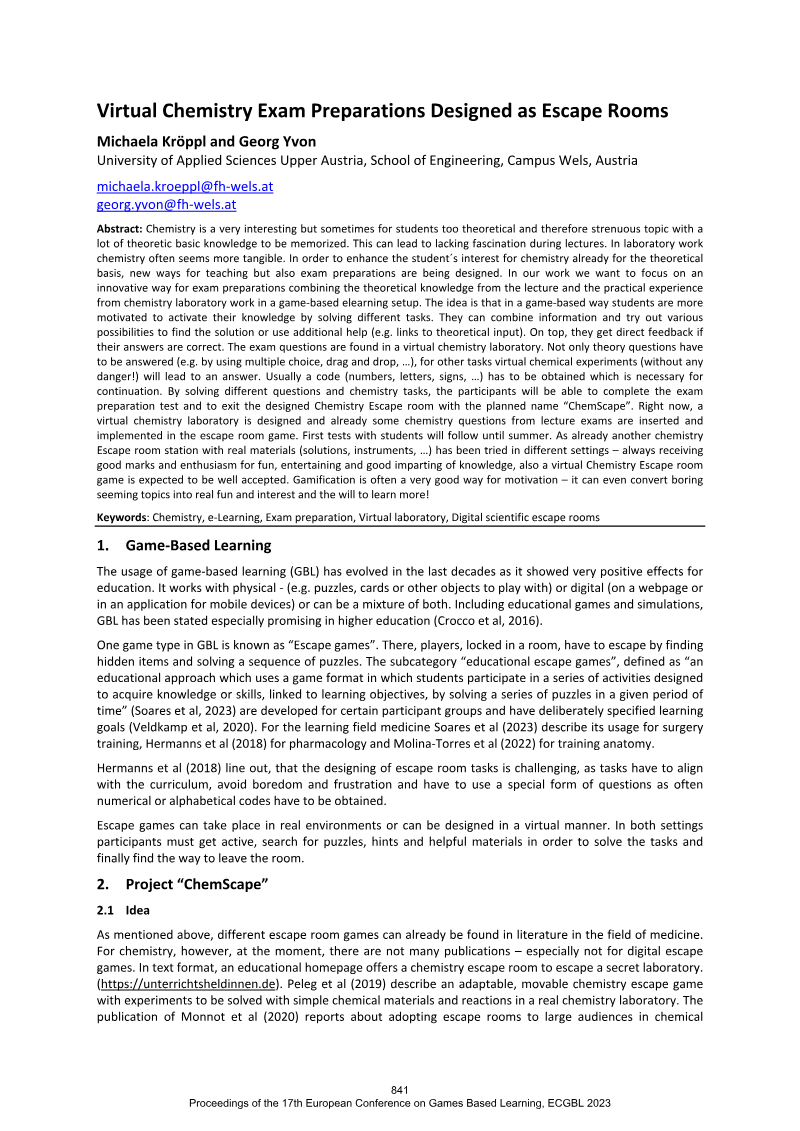
This paper presents a physical chemistry escape room centered on four metals (aluminium, copper, iron, and zinc), designed to make chemistry more accessible and engaging for young learners. The game consists of five task stations, each roughly 3-4 square metres, that can be played sequentially or in a parallel rotation format. Players solve riddles using information posters and materials at each station, completing activities such as crossword puzzles, numeric and pictorial codes, combinatory questions, and hands-on experiments including density determination via Archimedes' principle, cleaning copper coins, and constructing a lemon battery to light a lamp.
The design draws on the premise that gamified, problem-solving environments increase motivation and let participants learn without necessarily realizing it. Learning objectives include introducing properties of common metals and alloys (density, magnetism, colour) and encouraging scientific reasoning and mathematical thinking. A full run typically lasts two to two-and-a-half hours, with each station requiring 15 to 30 minutes depending on participant age.
The escape room was tested in more than 15 workshops in 2023 and 2024 with children aged 6 to 12, usually in groups of 16 to 20. The evaluation was informal, with no formal pre- and post-testing; the author relies on observation and anecdotal feedback, which reported high engagement, improved team collaboration, and enthusiasm strong enough that additional workshops were organized. The author notes that the approach may suit older learners with pacing adjustments and plans future adaptations for secondary school content and quantitative assessment of learning outcomes.



European Conference on Games Based Learning (ECGBL) · 2026



European Conference on Games Based Learning (ECGBL) · 2026



European Conference on Games Based Learning (ECGBL) · 2026



European Conference on Games Based Learning (ECGBL) · 2026



European Conference on Games Based Learning (ECGBL) · 2026



European Conference on Games Based Learning (ECGBL) · 2026



European Conference on Games Based Learning (ECGBL) · 2026



European Conference on Games Based Learning (ECGBL) · 2026



European Conference on Games Based Learning (ECGBL) · 2026



European Conference on Games Based Learning (ECGBL) · 2026



European Conference on Games Based Learning (ECGBL) · 2026



European Conference on Games Based Learning (ECGBL) · 2026



European Conference on Games Based Learning (ECGBL) · 2026



European Conference on Games Based Learning (ECGBL) · 2026
European Conference on Games Based Learning (ECGBL) · 2026