1 free read left. Create a free account for unlimited reading + AI research.
Create free accountWhitepaper European Conference on Games Based Learning (ECGBL)
1 free read left. Create a free account for unlimited reading + AI research.
Create free accountWhitepaperEuropean Conference on Games Based Learning (ECGBL)
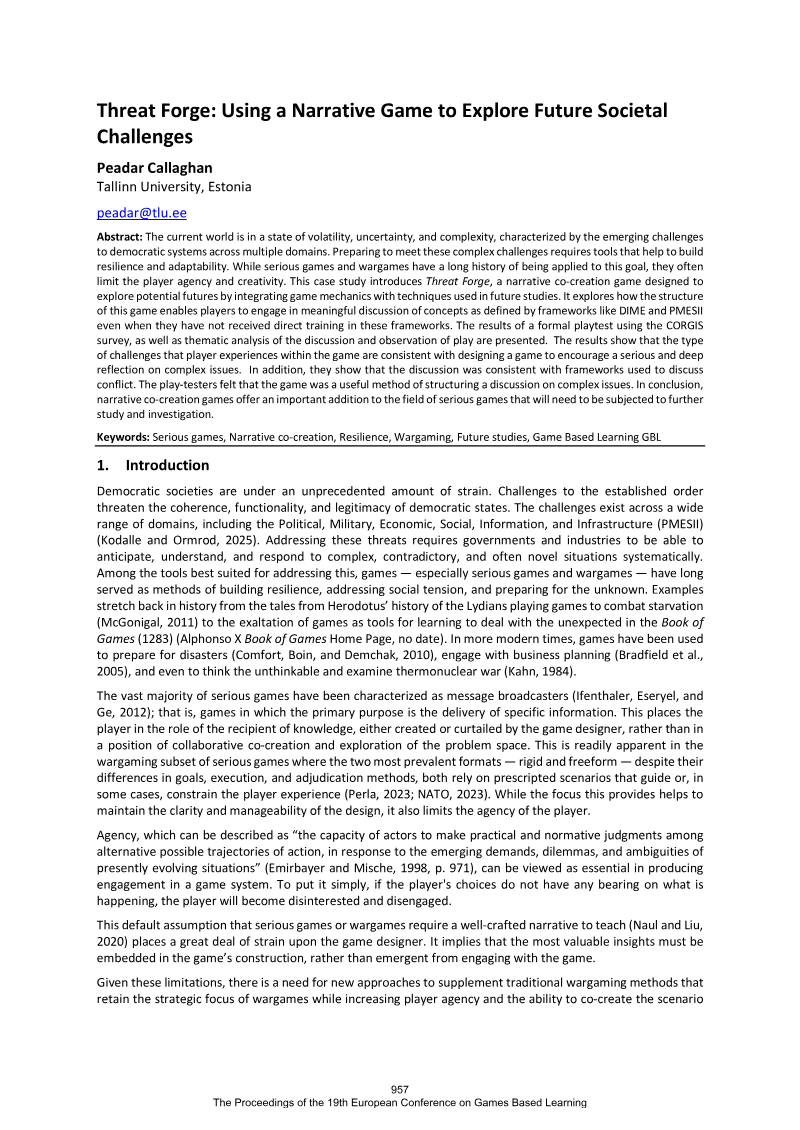
The paper positions Threat Forge as an alternative to scripted wargames, which it says tend to limit player agency.
Threat Forge is presented as a narrative co-creation game designed to explore potential futures, positioned as an alternative to traditional scripted wargames that tend to limit player agency. The game blends the collaborative storytelling mechanics of tabletop designs such as Microscope with backcasting, a future-studies method in which participants start from a defined end state and reason backward to plausible causes. Players place event cards along a timeline bounded by a fixed present-day starting point and a defined final state, with each card marked as increasing or decreasing the probability of reaching that end state. The study argues that this structure can support multi-domain reasoning about security and societal challenges.
The formal evaluation was a small pilot with three postgraduate students who had no military background, playing a scenario about an authoritarian state invading a small Western democracy. Responses on the CORGIS challenge survey, a seven-point instrument, were highest for cognitive challenge (mean 5.16) and lowest for performative challenge (mean 2.2), matching the design intent of prompting deliberate reflection rather than quick reactions. Retrospective coding of the game's moves against the DIME and PMESII frameworks found that diplomatic, economic, and social moves dominated, while information and infrastructure received comparatively little attention. Participants reported the game as useful for brainstorming and logic-building and continued discussing it informally days later.
The authors acknowledge that the sample was very small, drawn from a narrow audience, and that the analysis relied on the researcher's own categorization of moves, so the findings are preliminary. They call for larger, more diverse playtests, testing across different scenarios such as technological or environmental change, and longitudinal studies of effects on planning. The study concludes that narrative co-creation games can complement traditional wargames and future-studies practice, though this claim rests on limited evidence.
European Conference on Games Based Learning (ECGBL) · 2025
European Conference on Games Based Learning (ECGBL) · 2025
European Conference on Games Based Learning (ECGBL) · 2025
European Conference on Games Based Learning (ECGBL) · 2025
European Conference on Games Based Learning (ECGBL) · 2025
European Conference on Games Based Learning (ECGBL) · 2025
European Conference on Games Based Learning (ECGBL) · 2025
European Conference on Games Based Learning (ECGBL) · 2025
European Conference on Games Based Learning (ECGBL) · 2025
European Conference on Games Based Learning (ECGBL) · 2025
European Conference on Games Based Learning (ECGBL) · 2025
European Conference on Games Based Learning (ECGBL) · 2025
DiGRA · 2025