1 free read left. Create a free account for unlimited reading + AI research.
Create free accountWhitepaper DiGRA
1 free read left. Create a free account for unlimited reading + AI research.
Create free accountWhitepaperDiGRA
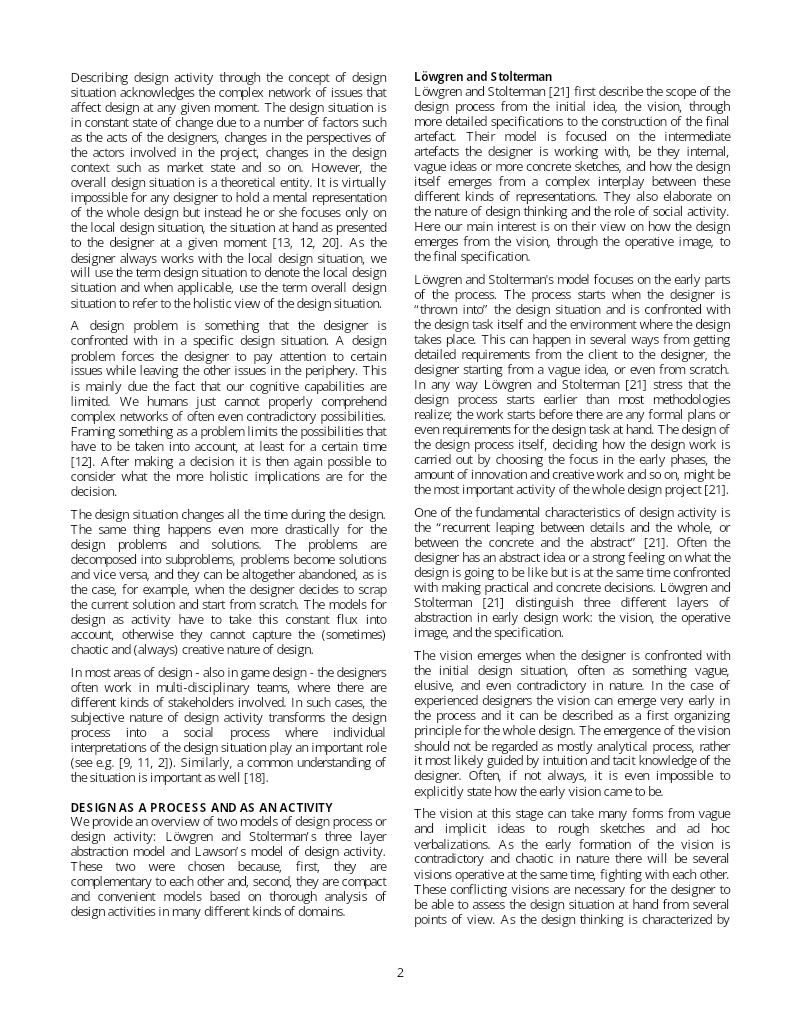
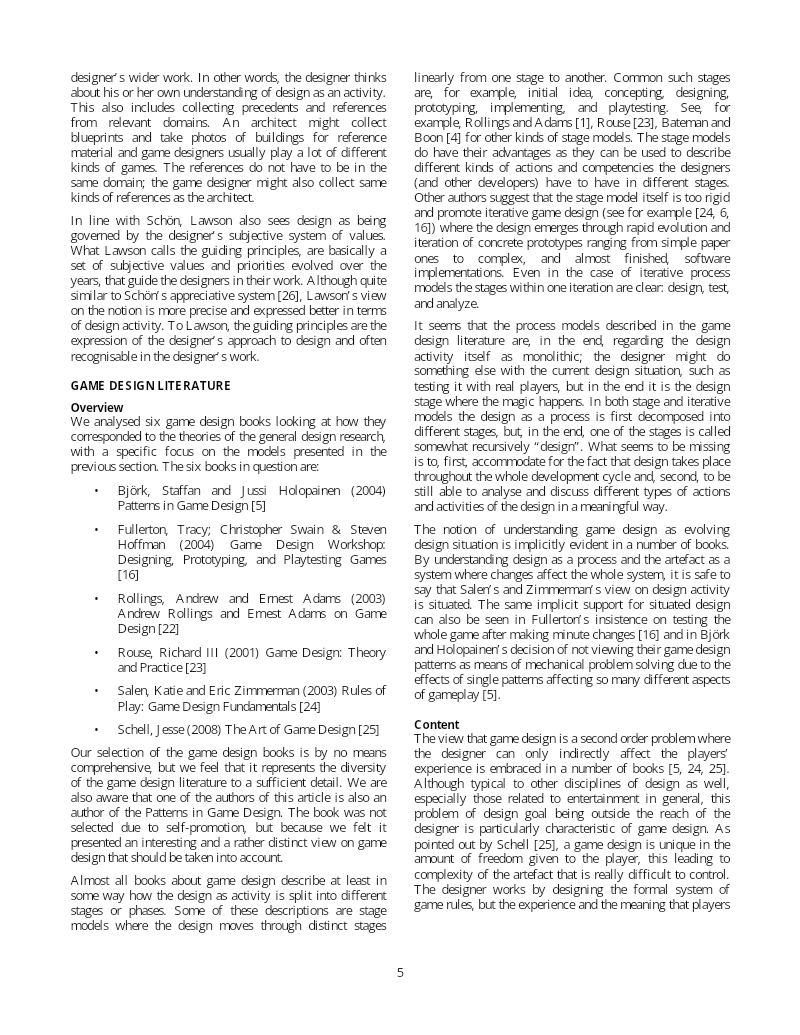
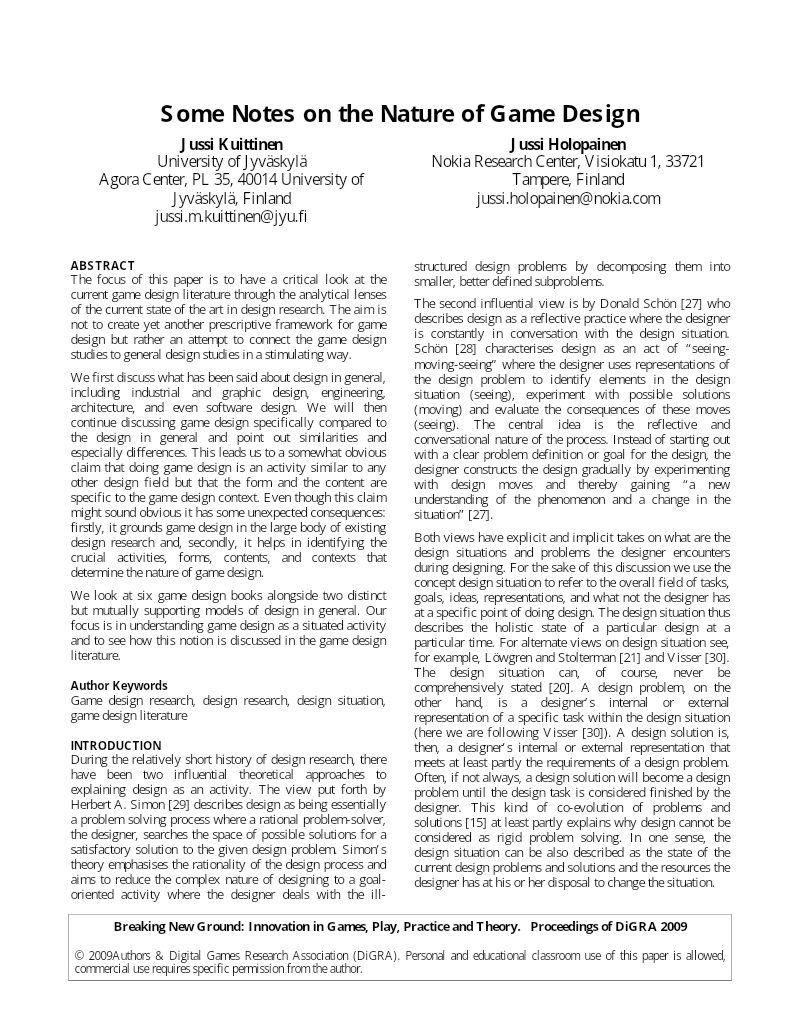
The paper argues that game design is situated, reflective and non-linear, rather than rigid stage-based problem solving. Designers continually reshape both the problem and its solution as their understanding evolves.
Kuittinen and Holopainen's paper argues that game design should be understood as a situated, reflective, and non-linear activity, rather than as rigid, goal-oriented problem solving or a sequence of fixed stages. Drawing on established design theory, including Simon's problem-solving perspective, Schön's "seeing-moving-seeing" model, Löwgren and Stolterman's abstraction layers, and Lawson's work on framing and expert cognition, the authors contend that designers continually reshape both the problem and its solution as their understanding evolves. Their central thesis is that adequate models of game design must capture this creative, chaotic, and co-evolving character of the process.
The authors support this position with an analysis of six major game design books, finding that these texts rely heavily on precedents, prototypes, and conceptual frameworks while rarely examining representation or the role of references in depth. Their review further reveals that reflection-on-action is implicit throughout most of the literature and explicitly treated only by Schell. Playtesting emerges as the primary method for objective evaluation, whereas subjective judgment is largely left to the designer's intuition, or "gut feeling." Team communication and group dynamics receive comparatively little attention, with Fullerton et al. and Schell as the principal exceptions.
Overall, the paper concludes that the existing literature gives disproportionate weight to gameplay, the game object, and the teaching of design principles and elements, while neglecting the broader activities through which designers actually work. The scope is focused on the game design discipline as represented in influential English-language practitioner literature of the period, with the analysis oriented toward cognitive and procedural aspects of design rather than specific genres, platforms, or market segments. The authors call for research models that encompass the full range of design-thinking activities, including formulating, moving, evaluating, and reflecting, and that define the designer more broadly than a creator of gameplay alone.
DiGRA · 2016
DiGRA · 2016
DiGRA · 2016
DiGRA · 2016

DiGRA · 2016
DiGRA · 2016
DiGRA · 2016
DiGRA · 2016
DiGRA · 2016
DiGRA · 2016
DiGRA · 2016

DiGRA · 2016












Comments