
DiGRA
The Digital Games Research Association: the international association of academics and professionals who study digital games. Its Digital Library holds the proceedings of the DiGRA conferences since 2002.
Documents
Making Sense in Ludic Worlds: The Idealization of Immersive Postures in Movies and Video Games
Making Sense in Ludic Worlds argues that video games and fiction films should be understood on a common footing rather than as fundamentally different kinds of experience.
- The report argues that video games and fiction films should be understood on a common footing, both unified by an "optimization of experience" in which immersion arises from a balance of skills and challenges within clearly bounded, self-contained worlds, drawing on Csikszentmihalyi's flow model and Schaeffer's theory of mimetic immersion.
- It rejects teleological narratives of game evolution, including those from scholars Aarseth and Juul and Nintendo's marketing, which portray games as steadily converging toward reality, arguing instead that mimetic games depend on selective modeling of reality rather than faithful reproduction.
- Following Schaeffer and Carroll, fiction is treated as a playful, mutually accepted framing of illusion rather than deception, and both film and games rely on hypernormal simplifications, causal clarity, and overt guidance from an editorial intelligence.
Agency and the Free Will Debate
This paper examines the term "agency" within Game Studies, arguing that it is frequently used as a synonym for interactivity when it deserves a more precise meaning.
- The paper argues that 'agency' in Game Studies is often conflated with interactivity, and that it deserves a more precise meaning requiring a further level of player empowerment beyond manipulating an interface to control a presence in a gamespace.
- The central conclusion is that agency is a valid and useful term for Game Studies, with its value lying less in establishing whether a player acts and more in examining what actions a game permits and whether those actions can usefully be called agency.
- Drawing on the philosophical free will debate, the paper treats the player as an agent, invoking Aristotle's 'mover unmoved', while cautioning that the game itself acts as a cause upon the player, and where that causal influence is unavoidable, the possibility of agency is removed.
Patterns of Play: Play-Personas in User-Centred Game Development
"Patterns of Play: Play-Personas in User-Centred Game Development" proposes an adaptation of Alan Cooper's human-computer interaction persona framework to game design, introducing "play-personas" as clusters of preferred interaction and navigation behaviors.
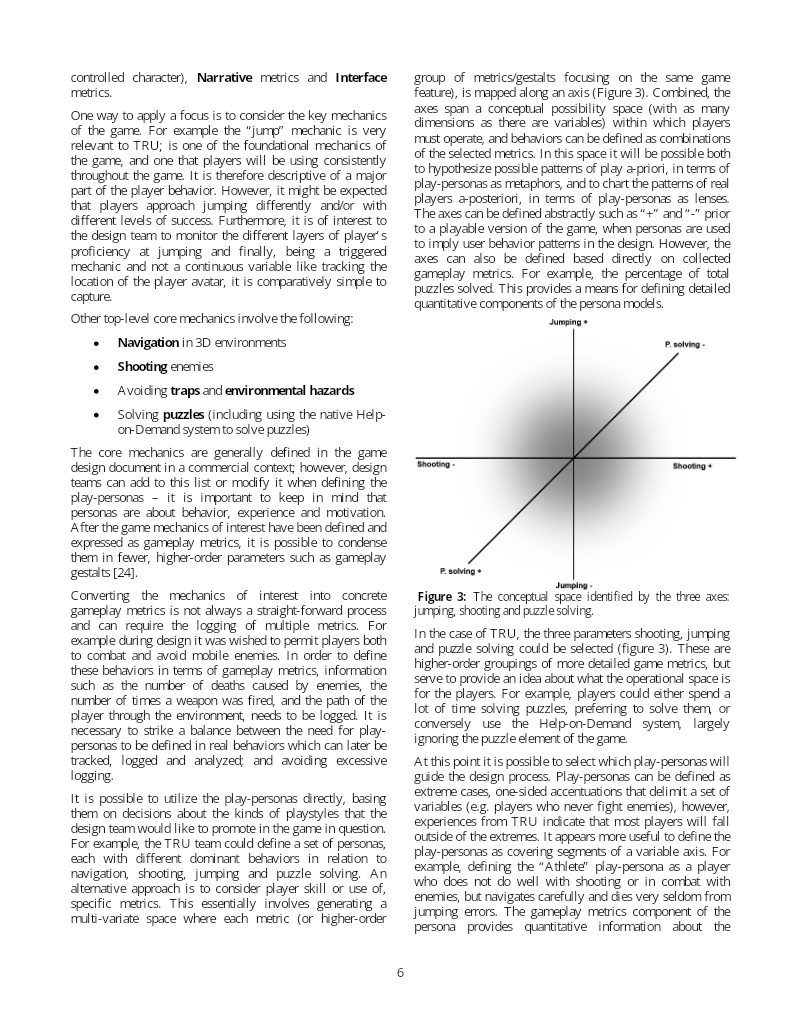
- The report adapts Alan Cooper's HCI persona framework to games by introducing "play-personas," which are clusters of preferred interaction and navigation behaviors that let designers keep authorial control while giving players meaningful agency.
- The authors argue personas should shift from narrative-driven, committee-designed archetypes to data-driven models validated against observed play, justified by cognitive and literary theory such as the pattern-seeking drive and Iser's implied reader.
- Play-personas operate both as design metaphors encoding designers' behavioral expectations and as analytical lenses built from high-frequency gameplay metrics.
The Player Character as Performing Object
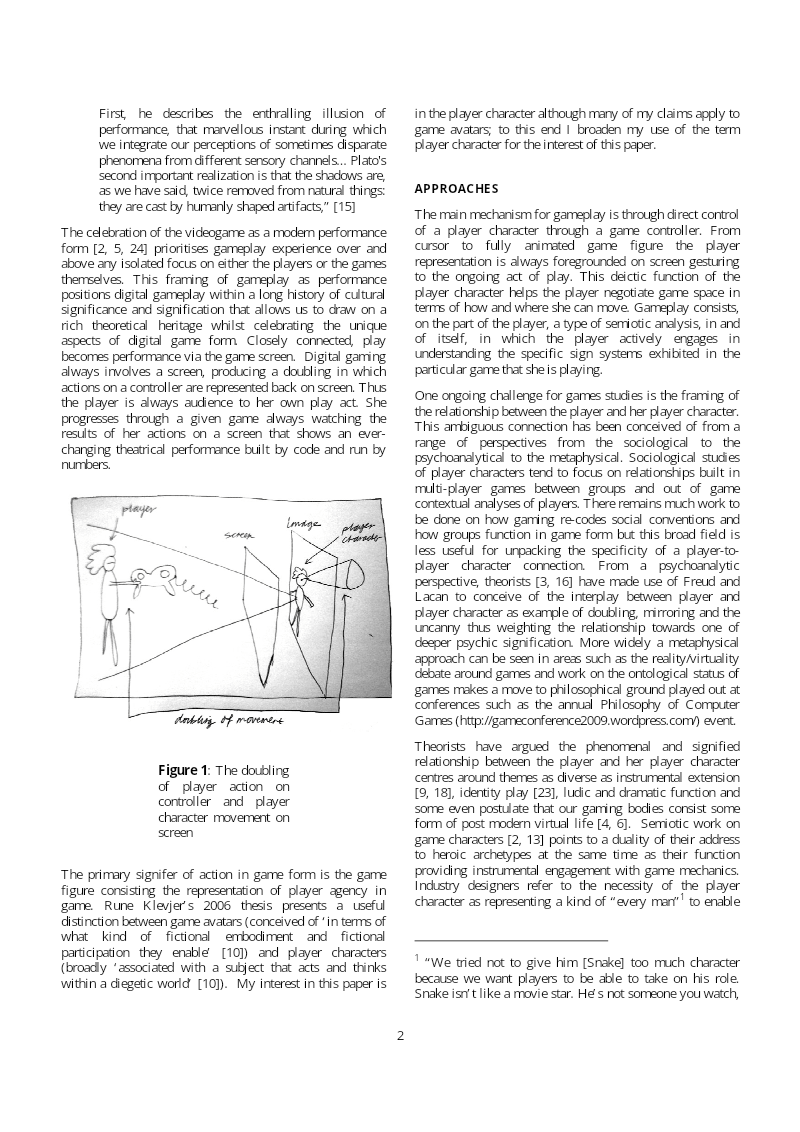
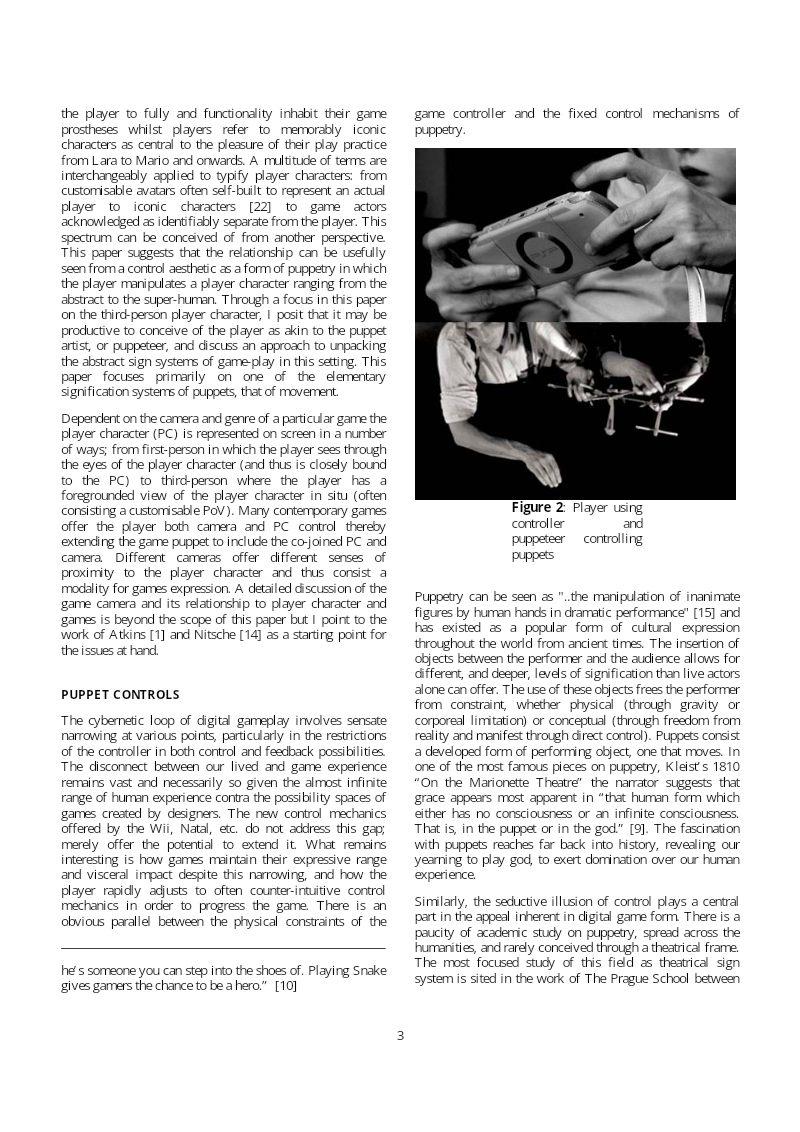
This paper argues that the player's relationship to her player character can be productively understood through the lens of puppetry, with the player cast as a puppeteer manipulating a digital figure that ranges from the abstract to the superhuman.
- The paper argues that the player's relationship to a player character is best understood through puppetry, with the player as puppeteer manipulating a digital figure that doubles as a perceived object and an imagined life.
- Movement is treated as the primary signifying system of the player character, with exaggeration techniques such as amplification, interruptible animation loops, and constant responsiveness helping players suspend disbelief and identify with the figure.
- The author contends that the 'figureness' of the player character, rather than realism, is what allows players to bind with the game interface, and that movement design either extends or disrupts play depending on how well it is judged.
In Search of a Minimalist Game
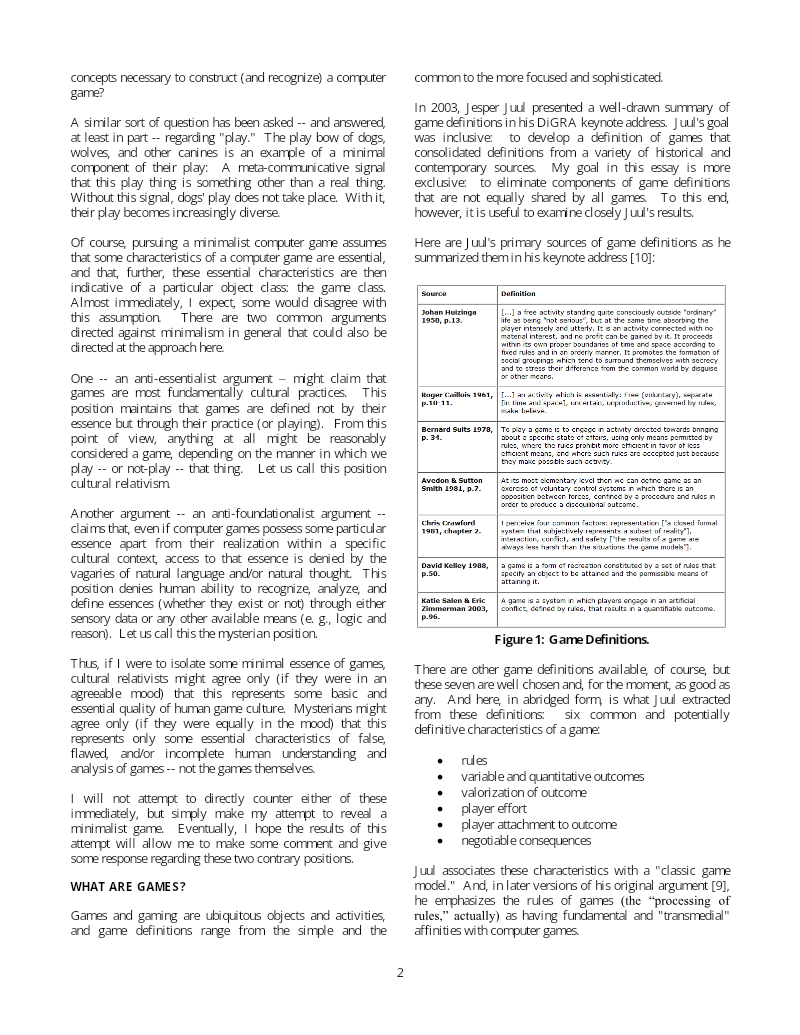
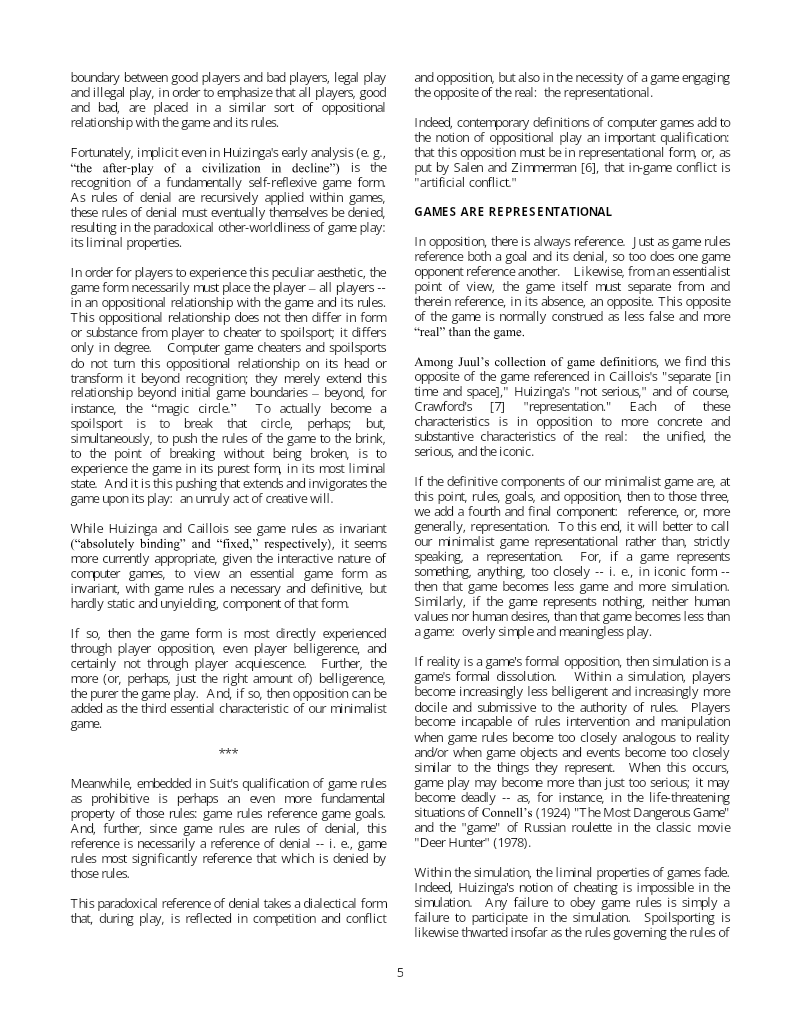
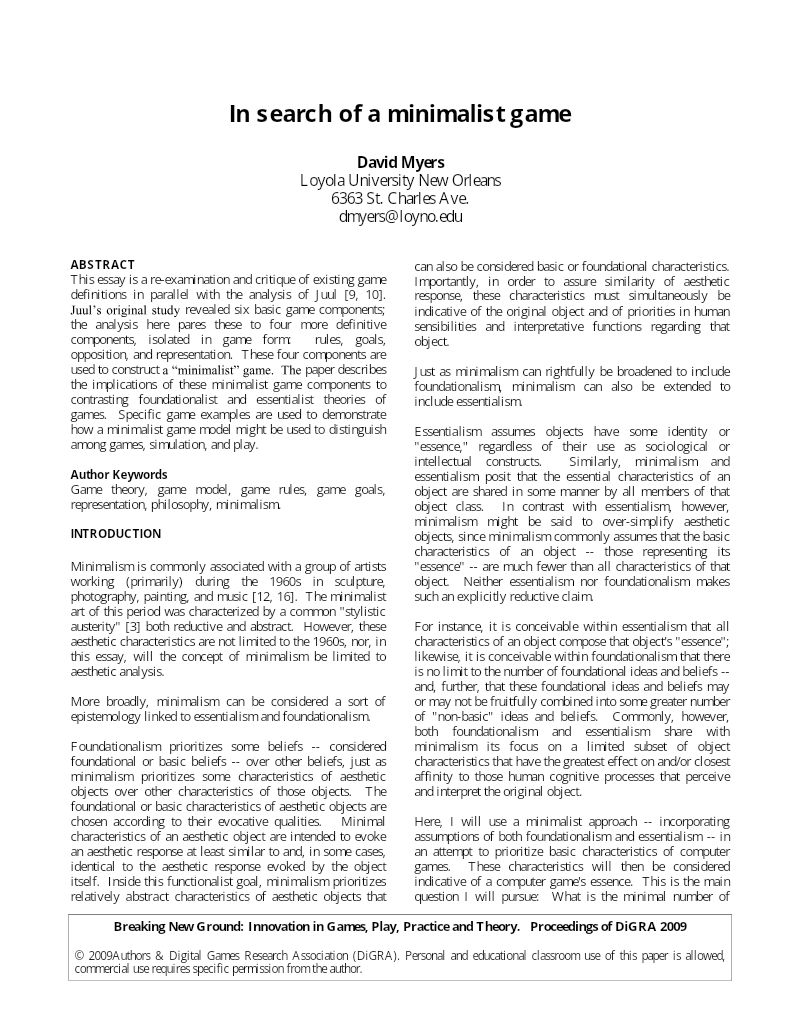
David Myers' essay seeks to isolate a minimalist definition of games by reducing Jesper Juul's six components to four essential elements: prohibitive rules, goals, opposition between player and rules, and representation.
- Myers reduces Jesper Juul's six components of games to four essential elements: prohibitive rules, goals, opposition between player and rules, and representation.
- The model treats rules and goals as the most formally observable core, setting aside player effort, attachment, and cultural context because they are difficult to measure.
- Drawing on Bernard Suits and Wittgenstein, Myers argues that game rules are fundamentally 'rules of denial' that prohibit the most efficient means of reaching a goal, and this self-reflexive prohibition generates the opposition that defines play.
Play as Transgression: An Ethnographic Approach to Queer Game Cultures
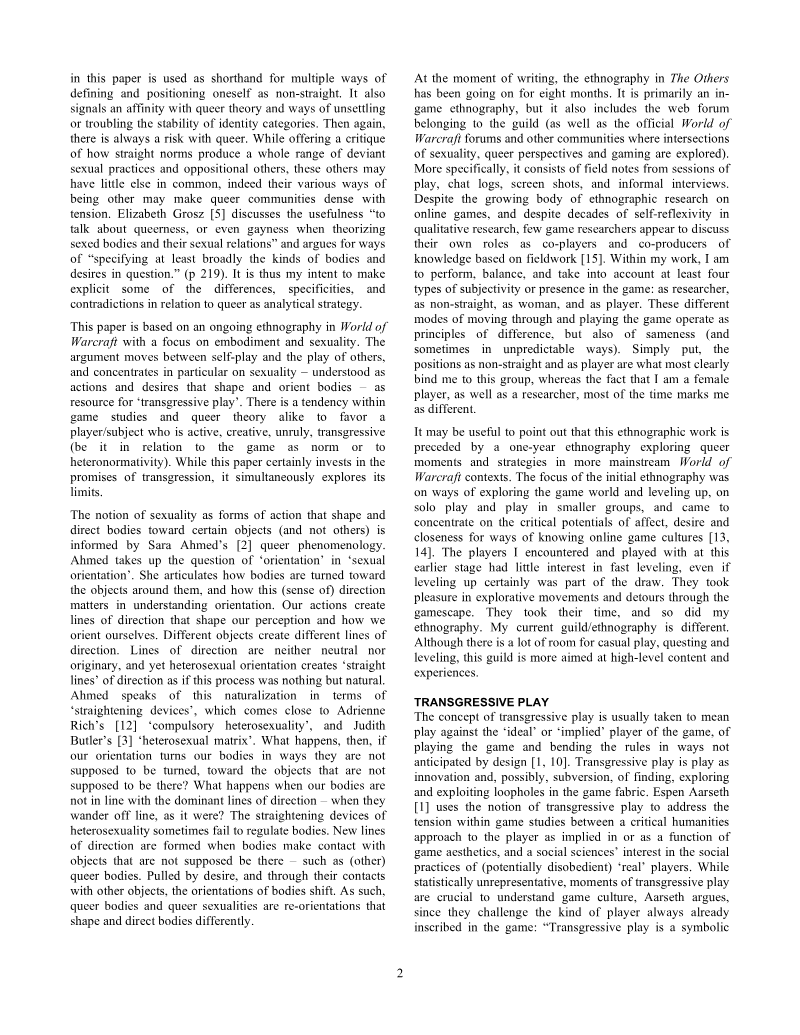
Jenny Sundén's paper offers an ethnographic examination of queer gaming culture, centered on a GLBT guild within World of Warcraft.
- Sundén's participant-observer ethnography of a GLBT guild in World of Warcraft argues that queer players' "transgressive play" exposes the implicit assumption that game design and community norms are built around a straight, male "ideal player."
- The central case, the European guild "The Others", had roughly 200 members, about thirty of whom were active, with sexuality functioning as a bonding point expressed through flirtation, queer banter, and in-game perfume mechanics enabling cross-gender romantic play.
- The 2006 Sara Andrews incident, in which a GLBT-friendly guild announcement drew a warning from Blizzard, illustrates how "straightening devices" regulate queer visibility in online games even as such guilds offer members relief and acceptance.
Digital Art in the Age of Social Media: The Politics of Personalization via Cute Culture
Larissa Hjorth's paper argues that "cute culture," or kawaii, offers an essential analytical lens for understanding personalization, vernacular creativity, and produsage within digital art and the global games industry.
- Kawaii (cute culture) is presented as an essential analytical lens for understanding personalization, vernacular creativity, and produsage in digital art and the global games industry, evolving from a 1970s Japanese youth subculture into a dominant force across digital art, gaming, and social media.
- The paper argues that cuteness humanizes technology through affective design, gendered play, and localized customization, and that cute customization functions as affective cultural capital shaping identity, gender performance, and community.
- Japan's "electronic individualism," exemplified by the Walkman, the Game Boy, and keitai (mobile phone) culture, is positioned as central to the shift toward personalization in technology.
Age Differences in Associations with Digital Gaming
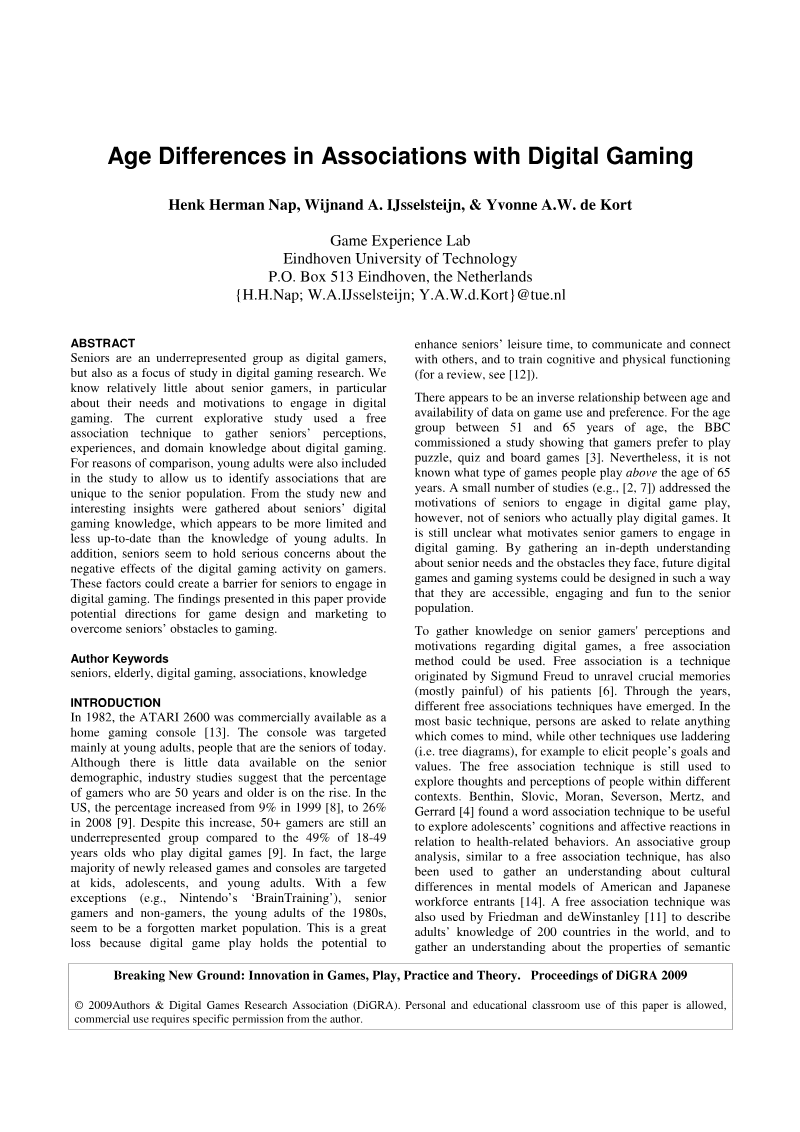
This exploratory study examines how seniors and young adults differ in their associations with digital gaming, using a free association technique to surface perceptions, experiences, and domain knowledge.
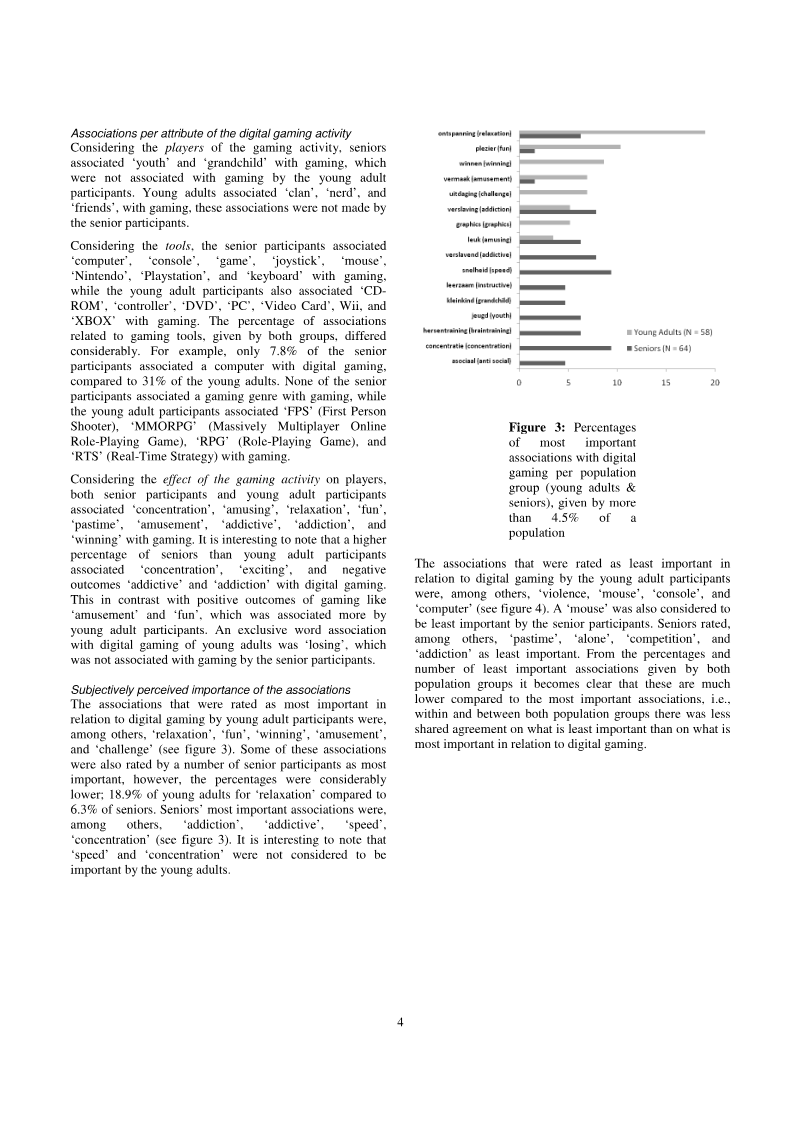
- Young adults produced nearly twice as many free associations with digital gaming as seniors (mean 19.4 versus 10.3) in this Dutch study of 64 seniors (mean age 65.2) and 58 young adults (mean age 23.4).
- Seniors' associations were more often framed around family and generations (e.g., "youth" and "grandchild"), and they rarely named gaming genres or current consoles such as the Wii or Xbox.
- Seniors placed greater weight on negative outcomes, especially addiction and addictive qualities, while young adults emphasized positive experiences such as relaxation, fun, challenge, and amusement.
Gameplay Design Patterns for Game Dialogues
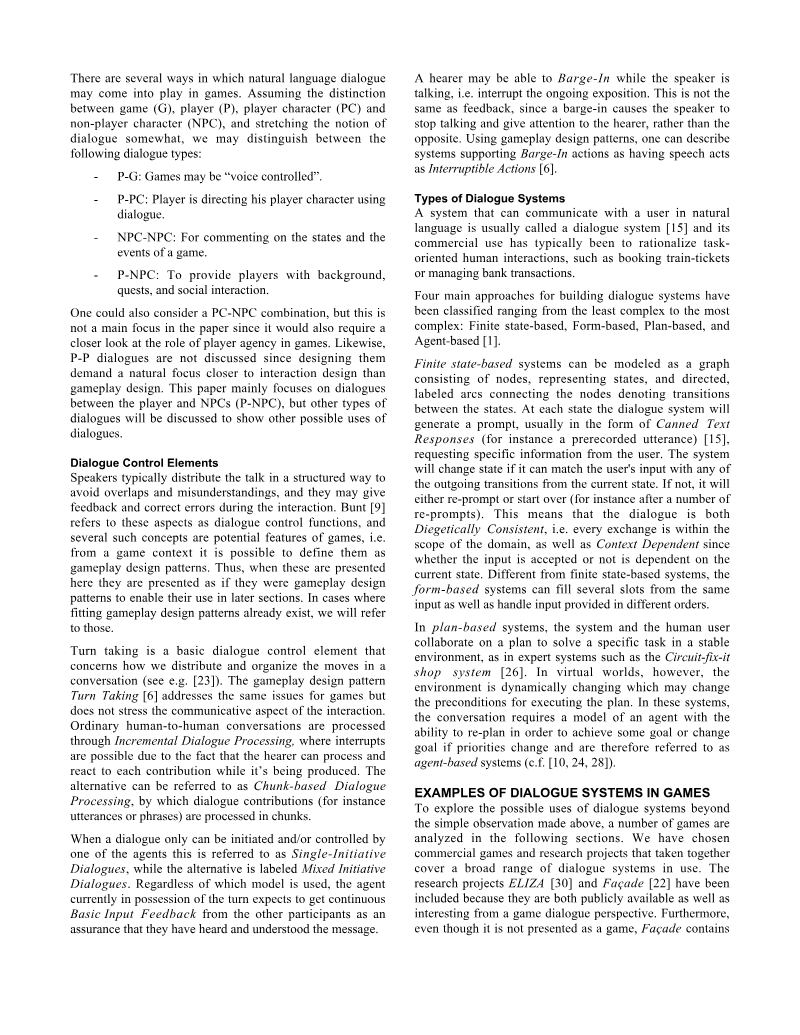
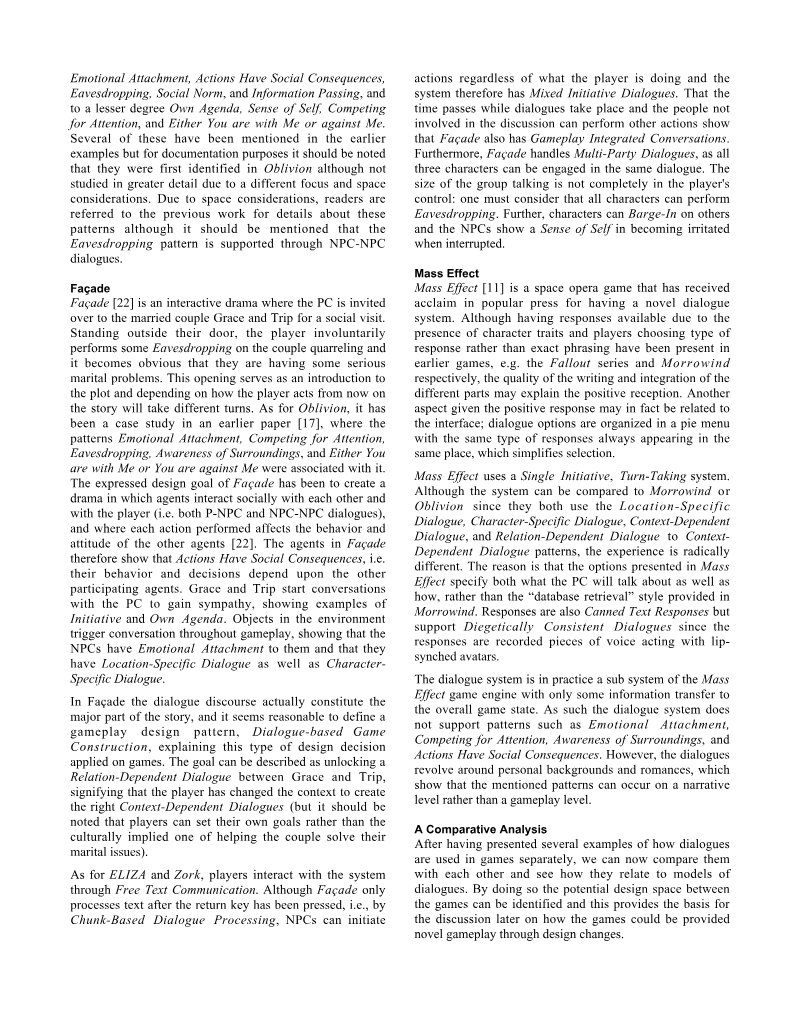
Brusk and Björk's "Gameplay Design Patterns for Game Dialogues," presented at DiGRA 2009, argues that dialogue systems drawn from computational linguistics can be translated into explicit, reusable gameplay design patterns.
- Brusk and Björk argue that computational linguistics dialogue systems (finite state, form-based, plan-based, and agent-based) can be translated into explicit, reusable gameplay design patterns for game dialogue.
- Existing linguistic categories fit game dialogue only partially, because game dialogues serve varied purposes, from pure gameplay (ELIZA) to interface (Zork), which motivates a Game State-based approach rather than direct transfer of linguistic models.
- The authors derive named patterns including Canned Text Responses, Illocutionary Interface, Diegetically Consistent Dialogue, and Context-Dependent Dialogue, and propose speculative extensions such as Incremental Input Processing, Gameplay Integrated Conversations, and Colloquial Mastery.
Exploring Aesthetic Ideals of Gameplay
"Exploring Aesthetic Ideals of Gameplay" develops a theoretical framework for understanding how game rules and player interaction combine to produce aesthetic experiences.
- The paper argues that gameplay aesthetics is a distinct subfield that designers can deliberately shape through rules, mechanics, and player interaction, rather than an incidental byproduct of play.
- Its main contribution is a taxonomy of seven aesthetic ideals (Pottering, Emergence, Light Games, Player Adaptability, Meditation, Reenactment, and Camaraderie), each defined by a characteristic combination of gameplay properties and illustrated with representative titles.
- The ideals are intentionally loose categories analogous to art movements rather than formal genres, and the authors acknowledge they are not exhaustive and await empirical validation.
"How Many Headshots You've Done": Achievement as Discursive Practice in Videogame Play
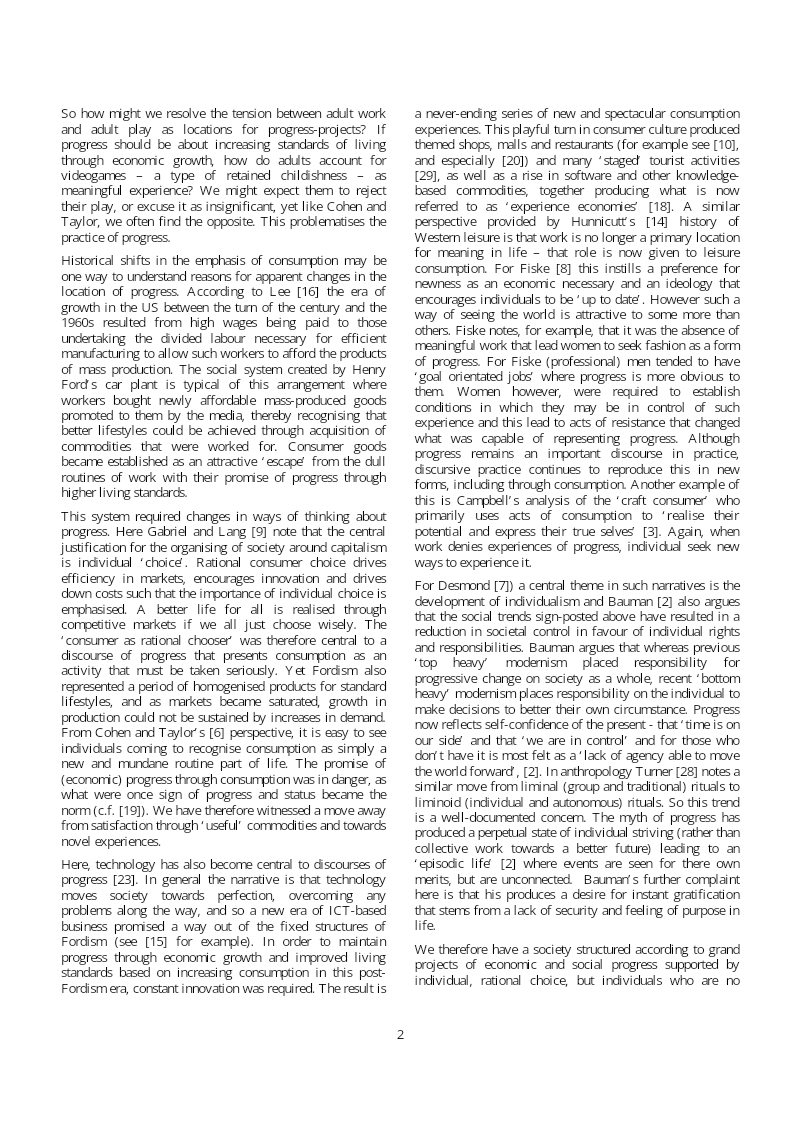
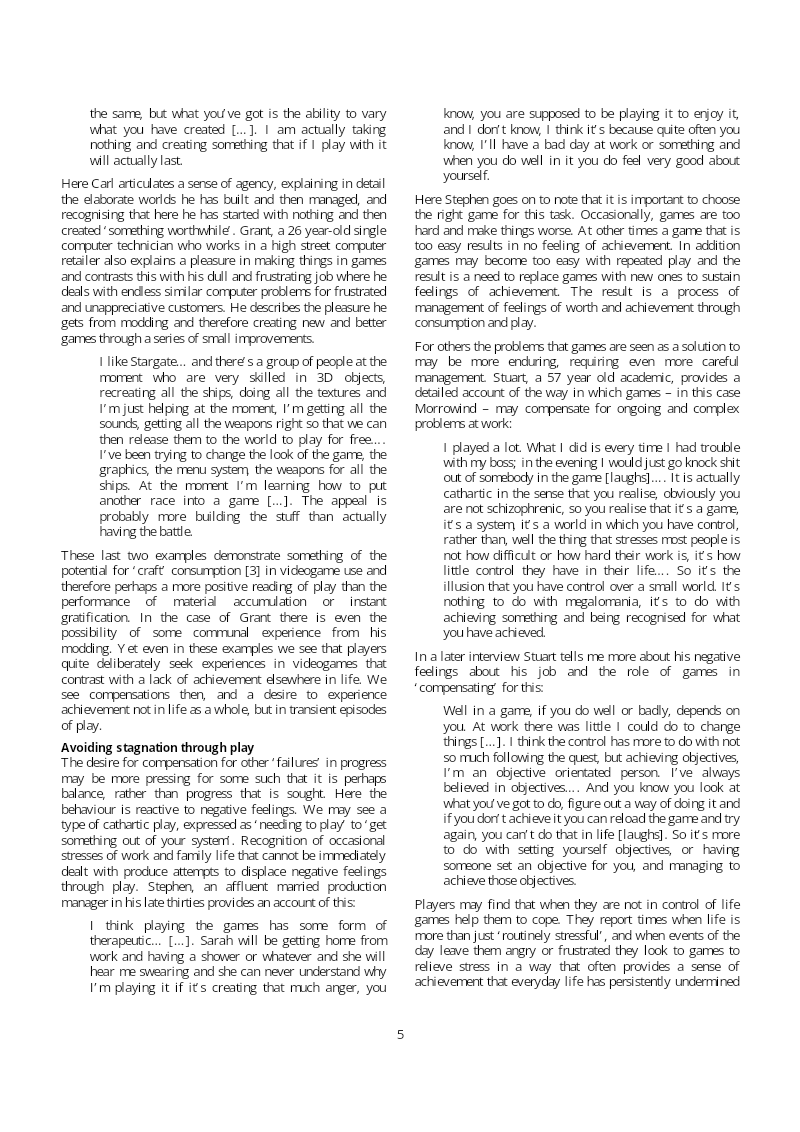
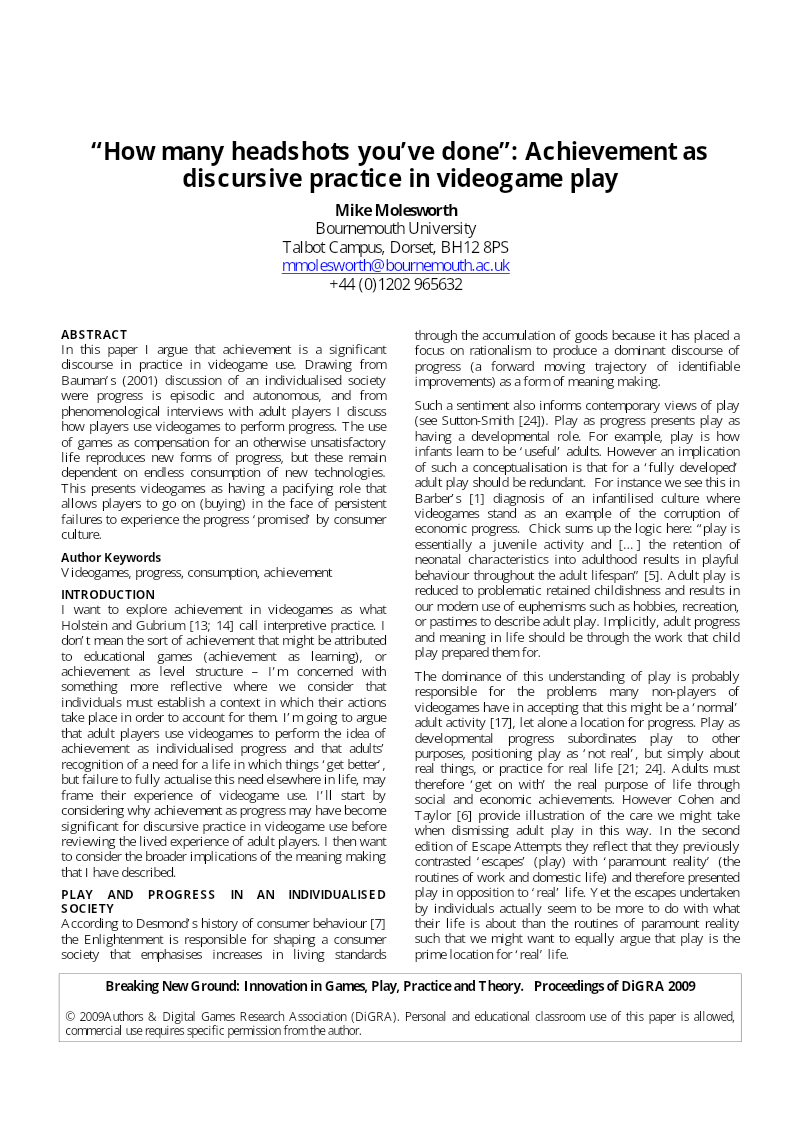
Molesworth's paper argues that achievement in videogame play functions as a discursive practice through which adults reproduce a sense of individualised progress that is otherwise lacking in their work and consumer lives.
- The paper argues that achievement in videogame play acts as a discursive practice that lets adults recreate a sense of individualised progress missing from their work and consumer lives, drawing on Bauman's account of an episodic, individualised society.
- The study is based on 24 phenomenological interviews with adult players in southern England, conducted between June and October 2006, comprising roughly 50 hours of recordings.
- Three recurring themes emerged: anticipating new hardware and releases, experiencing progress through accumulating in-game achievements or crafting something from nothing, and using play to offset work and domestic stress and boredom.
What Sort of Fish Was It?: How Players Understand Their Narrative in Online Games
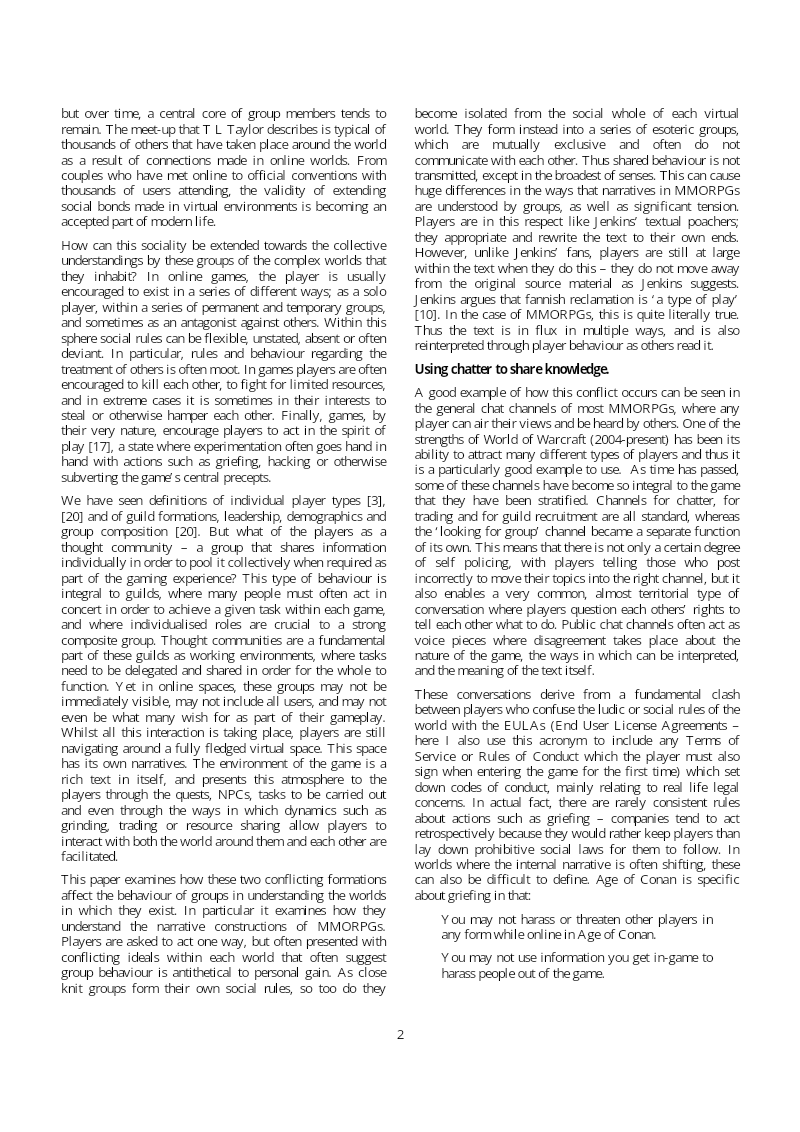
This paper examines how players of massively multiplayer online role-playing games (MMORPGs) interpret and reshape game narratives, drawing on the concept of "textual poaching" from fan studies.
- Online gaming communities are treated as legitimate, complex social entities that justify their conduct by drawing on competing rule sets: in-game norms, end-user license agreements, and informal community codes.
- Players in MMORPGs such as World of Warcraft operate within a text they simultaneously critique and rewrite, a condition the paper calls 'narrative flux', drawing on fan-studies concepts of 'textual poaching'.
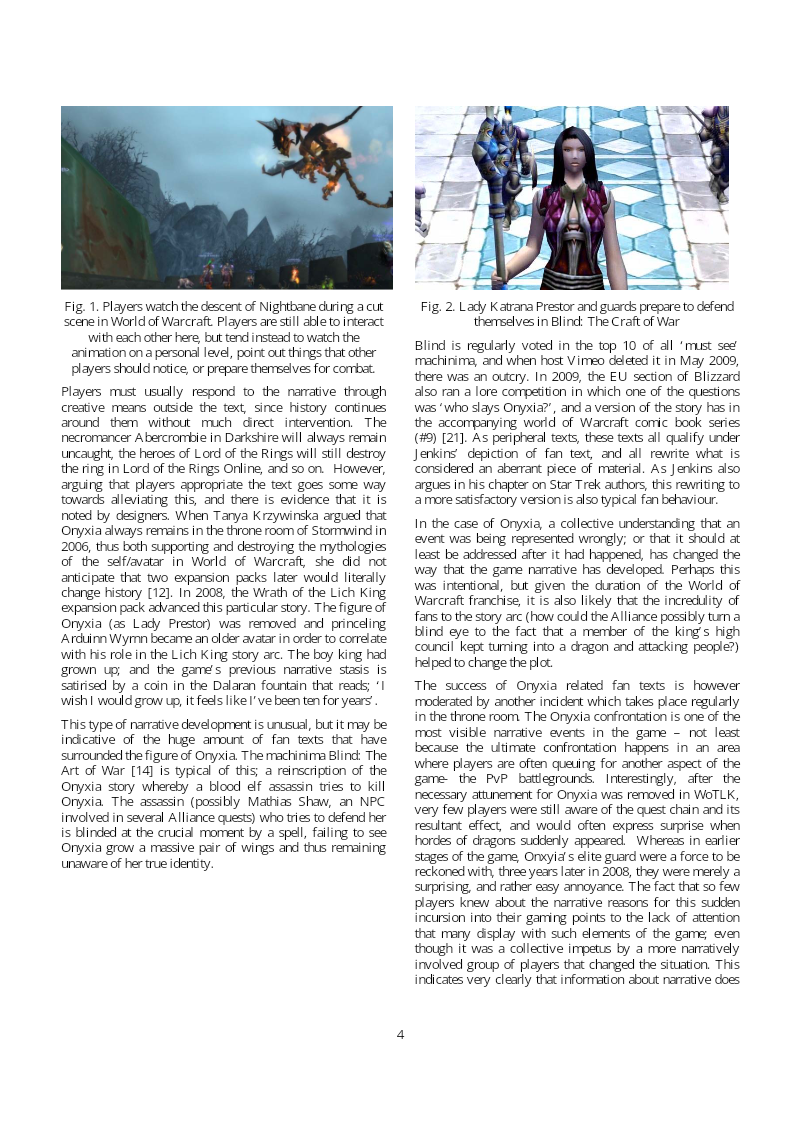
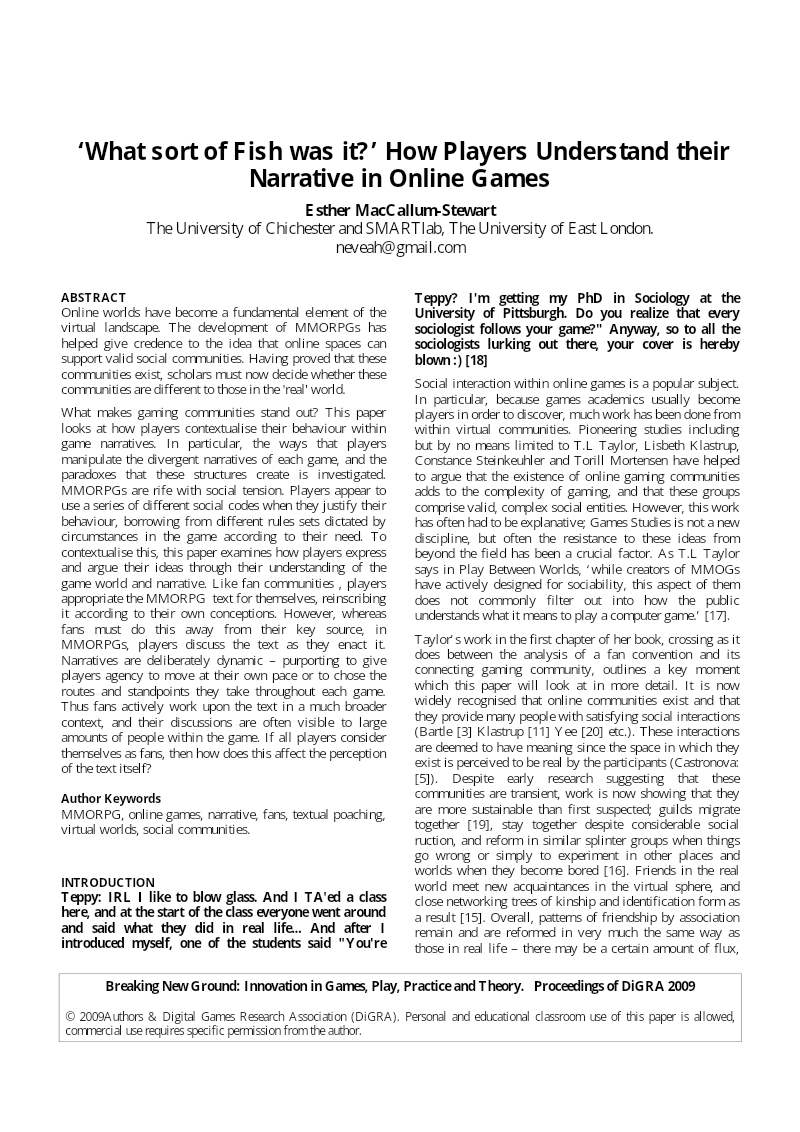
- In the Onyxia case, a narratively engaged minority of players altered the game's storyline while most players remained largely unaware of the underlying quest chain and its consequences.