1 free read left. Create a free account for unlimited reading + AI research.
Create free accountWhitepaper DiGRA
1 free read left. Create a free account for unlimited reading + AI research.
Create free accountWhitepaperDiGRA
The paper argues that dialogue systems from computational linguistics can be translated into explicit, reusable gameplay design patterns.
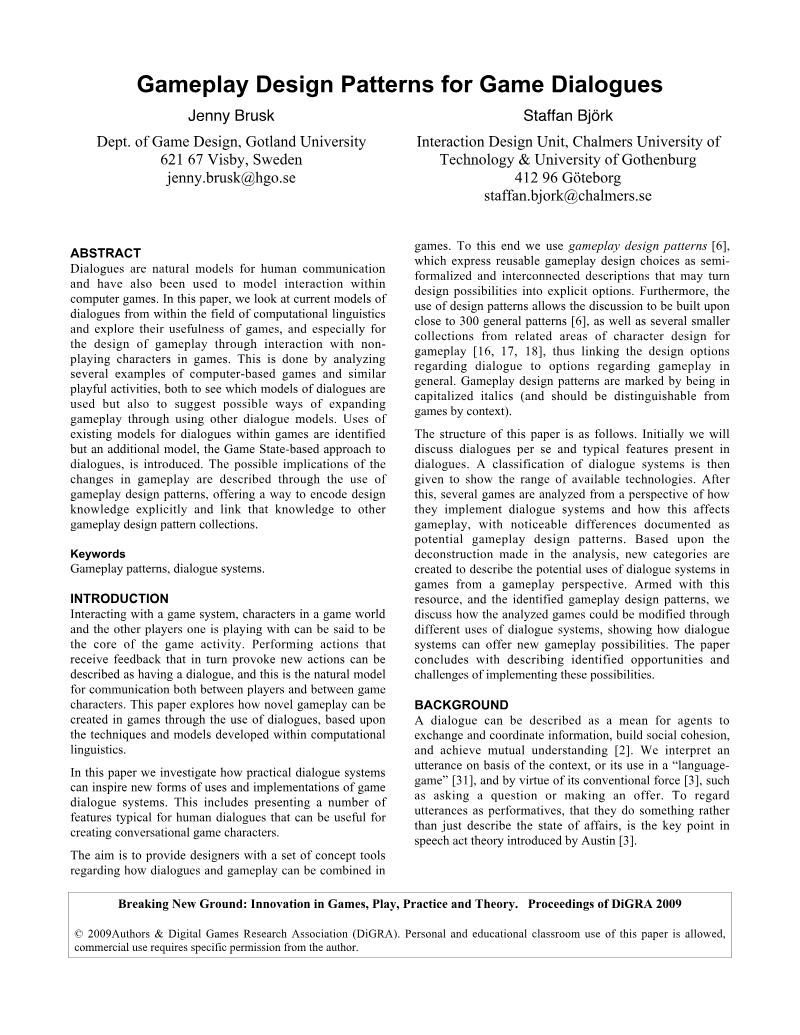
Brusk and Björk's "Gameplay Design Patterns for Game Dialogues," presented at DiGRA 2009, argues that dialogue systems drawn from computational linguistics can be translated into explicit, reusable gameplay design patterns. The authors classify dialogue systems into finite state, form-based, plan-based, and agent-based categories, and distinguish dialogue types such as player-to-game, player-to-player-character, NPC-to-NPC, and player-to-NPC. Their analysis draws on a range of games spanning early text adventures to contemporary role-playing titles, including Zork, ELIZA, Grim Fandango, Morrowind, Oblivion, Mass Effect, and the research system Façade. The work covers primarily digital games of the period of roughly 1966 through 2009, with the emphasis on console and PC role-playing and adventure genres.
A central finding is that existing computational linguistics categories fit game dialogues only partially. The authors observe that game dialogues serve purposes that range from pure gameplay, as in ELIZA, to acting as an interface, as in Zork, and this variety motivates a Game State-based approach rather than a direct transfer of linguistic models. From this analysis they derive named patterns such as Canned Text Responses, Illocutionary Interface, Diegetically Consistent Dialogue, and Context-Dependent Dialogue, and they propose speculative design-space extensions including Incremental Input Processing, Gameplay Integrated Conversations, and Colloquial Mastery.
The paper also examines the consequences of natural language input for play. It identifies challenges such as Delicate Phrasing, in which players must communicate without offending characters or disclosing sensitive information. While natural language offers expressive advantages, the authors caution that misinterpretation can frustrate players. To address this, they recommend mitigations including multiple input modalities, system-guided learning, and adaptive NPC behavior. Overall, the work contributes a pattern-based vocabulary intended to connect dialogue design with existing game design pattern collections.



DiGRA · 2016
Game Developers Conference · 2020