
DiGRA
The Digital Games Research Association: the international association of academics and professionals who study digital games. Its Digital Library holds the proceedings of the DiGRA conferences since 2002.
Documents
WADs, Bots and Mods: Multiplayer FPS Games as Co-creative Media
This paper examines multiplayer First-Person Shooter (FPS) games as "co-creative media," arguing that the final game product is a collaborative assemblage resulting from the input of both developers and players.
- The paper argues that multiplayer FPS games such as Quake, Half-Life and Counter-Strike are 'co-creative media,' shaped jointly by developers and players rather than by either alone, extending beyond the participatory-media framing common in fan studies.
- Wolfenstein 3-D (1992) and Doom (1993) set the foundation for the genre, and Doom's source-code release and multiplayer capabilities enabled a durable mod scene.
- Player contributions materially influenced development: early public betas and leaked alphas produced bug reports and patches, volunteer-built anti-cheat tool PunkBuster was later adopted by publishers, and mod authors behind ThreeWave CTF and Counter-Strike were hired or commercially acquired.

Tiny Patches of Peace: Signs of Agency in Digital Games
Cindy Poremba's study examines how player-created modifications function as a form of authorship in digital games, with particular attention to peace-themed works produced after September 11, 2001.
- Player-created modifications are framed as an independent form of authorship that both expresses and reinforces the player's legitimacy as an author, with the study focusing on peace-themed mods made after September 11, 2001.
- Cindy Poremba's analysis centers on two cases: the anti-war Counter-Strike modification "Velvet-Strike" and the anti-war posters "Tiny Signs of Hope" created for The Sims.
- Velvet-Strike adopts a "gamer" persona to gain credibility within the combative first-person shooter community while aiming its message at an outside audience of artists and activists.
All Your Base Are Belong to Us: Videogame Culture and Textual Production Online
Research on videogame culture has long challenged the assumption that play is a solitary, isolating pursuit.
- Heavy videogame players are often socially engaged, challenging the stereotype of the reclusive, isolated gamer; the report argues this image rests more on presupposition than empirical evidence.
- Fan communities establish canonicity largely through developer involvement, as shown in Sonic the Hedgehog forums, where fans mine game code and pre-release material for "palimpsests" to build elaborate theories.
- Fans treat narrative inconsistencies in official texts by attributing gaps to localization or translation problems, while producing fan art, fangames, and walkthroughs that extend and reinterpret franchises.

A Multidimensional Typology of Games
Aarseth, Smedstad, and Sunnanå propose a multidimensional typology for classifying games set in simulated virtual environments, aiming to replace the ad hoc genre labels used by the gaming industry and popular press with a more rigorous analytical framework.
- Aarseth, Smedstad, and Sunnanå propose a multidimensional typology of virtual-environment games to replace ad hoc industry and press genre labels with a more rigorous analytical framework.
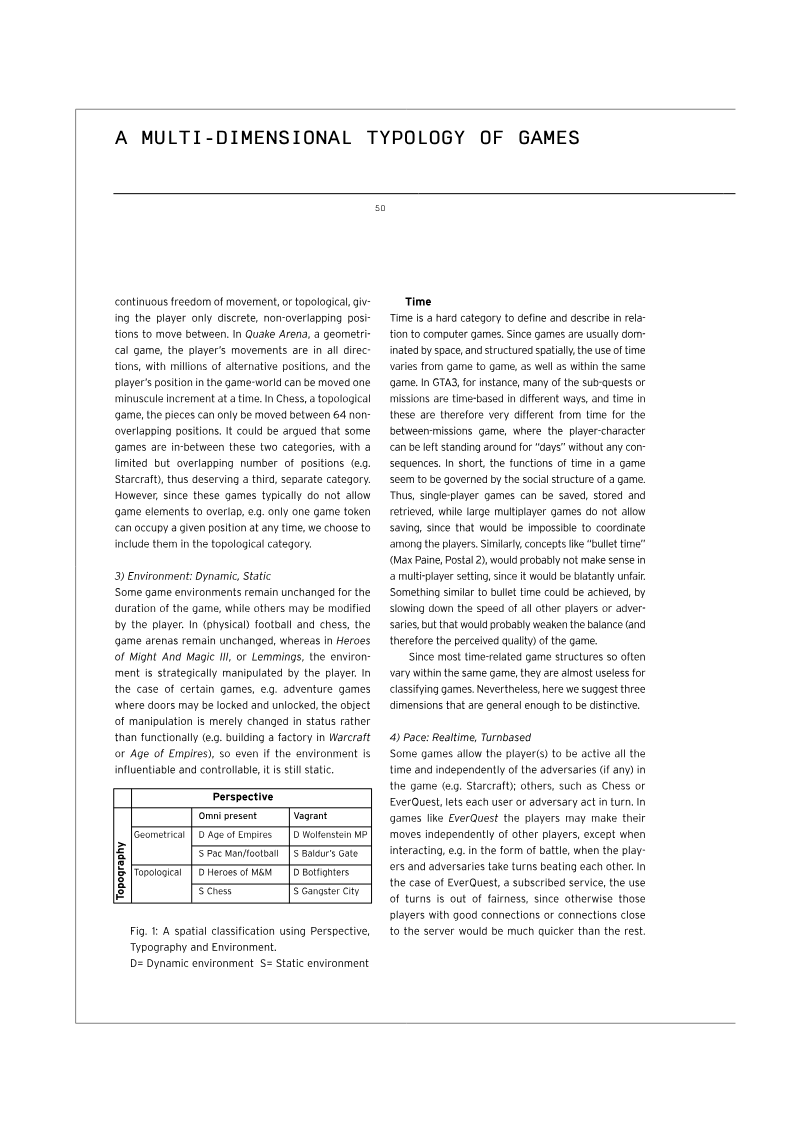
- The typology comprises fifteen dimensions grouped under Space, Time, Player-structure, Control, and Rules, including perspective (omni-present vs. vagrant), pace (realtime vs. turnbased), and teleology (finite vs. infinite).
- The dimensions were derived by comparing pairs of similar games, such as Morrowind and Diablo, and extracting principles intended to apply broadly across games.

The Game, the Player, the World: Looking for a Heart of Gameness
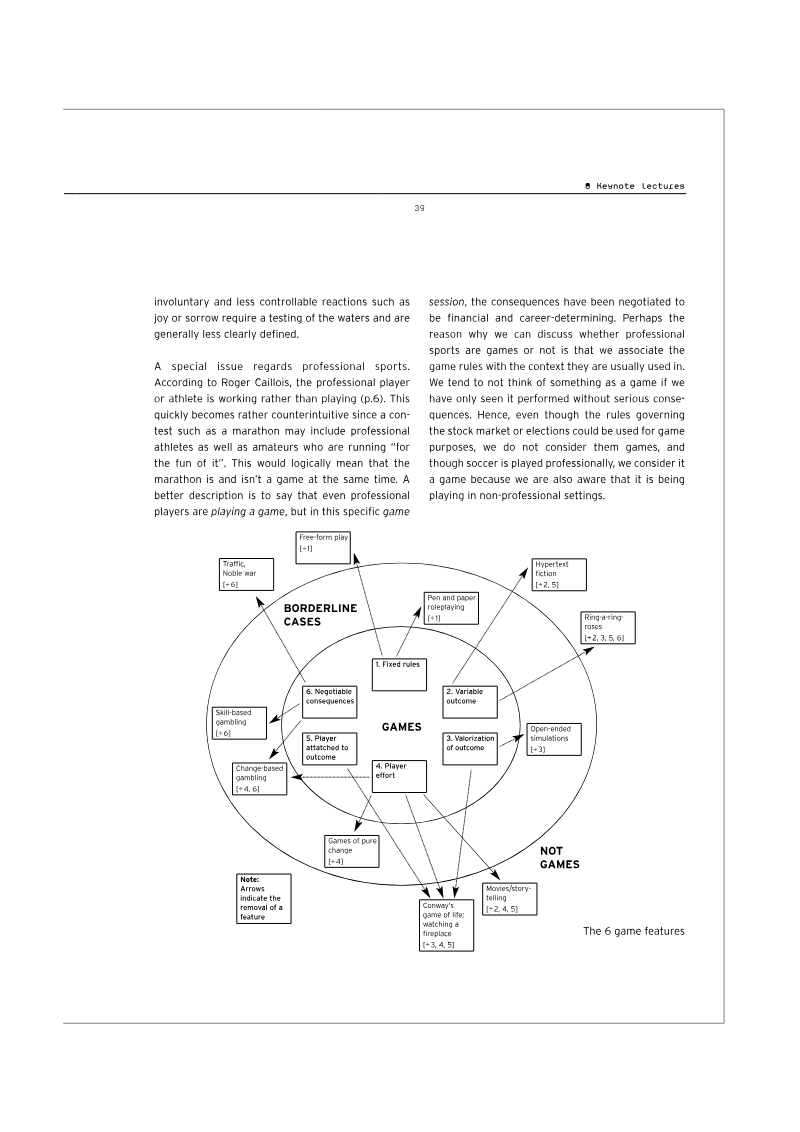
"The Game, the Player, the World: Looking for a Heart of Gameness" posits a comprehensive definition of games, arguing they are fundamentally rule-based systems with variable and quantifiable outcomes, where these outcomes are assigned different values, requiring player effort and attachment, and possessing negotiable…
- Juul's classic game model defines a game as any activity carrying six formal features: fixed rules, variable and quantifiable outcomes, valorized outcomes, player effort, player attachment to the outcome, and negotiable real-world consequences.
- Games are best understood as a transmedial family rather than a single medium, with board games, card games, sports, and digital systems all sharing the same core features.
- The unifying element across game media is computation: rules must be upheld by some process, whether performed by humans, computers, or physical laws.

Ludologists Love Stories, Too: Notes From a Debate That Never Took Place
Gonzalo Frasca argues that the much-publicized ludology versus narratology debate in game studies never genuinely occurred, because it rested on a tangle of misunderstandings about who the participants were and what they believed.
- The 'ludology versus narratology' debate in game studies never truly took place; Frasca argues it rests on misunderstandings about terminology, positions, and intentions.
- The label 'ludology' was not coined by Espen Aarseth or by Frasca, and it was defined in ways that many later scholars wrongly took to mean a rejection of narrative.
- Few scholars actually self-identify as narrativists, making the supposed opposing camp difficult to locate.

In Search of a "Fifth Dimension"
Maaike Lauwaert contends that Roger Caillois's four game dimensions, agôn (competition), alea (chance), mimicry (simulation), and ilinx (vertigo), remain useful for analyzing digital games but cannot fully account for the unexpectedness, discovery, narrative, and progression that define them.
- Maaike Lauwaert argues that Roger Caillois's four-category taxonomy of play (agôn, alea, mimicry, ilinx) is insufficient for analyzing digital games and proposes a fifth dimension, "repens," defined as sequentially embedded surprise deliberately programmed into a game's progression.
- Repens differs from chance because its surprises are intentionally placed rather than randomly generated, with examples including medical packs appearing in Tomb Raider and back-attacks in Final Fantasy.
- The paper's central thesis is that repens distinguishes digital games from non-digital games and enables them to combine multiple play dimensions at once, with No One Lives Forever and Tony Hawk's Pro Skater 3 offered as illustrative cases.

Making and Breaking Games: A Typology of Rules
The document, "Making and Breaking Games: A Typology of Rules," proposes a novel framework for understanding the fundamental structure of games by analyzing their constituent rules.
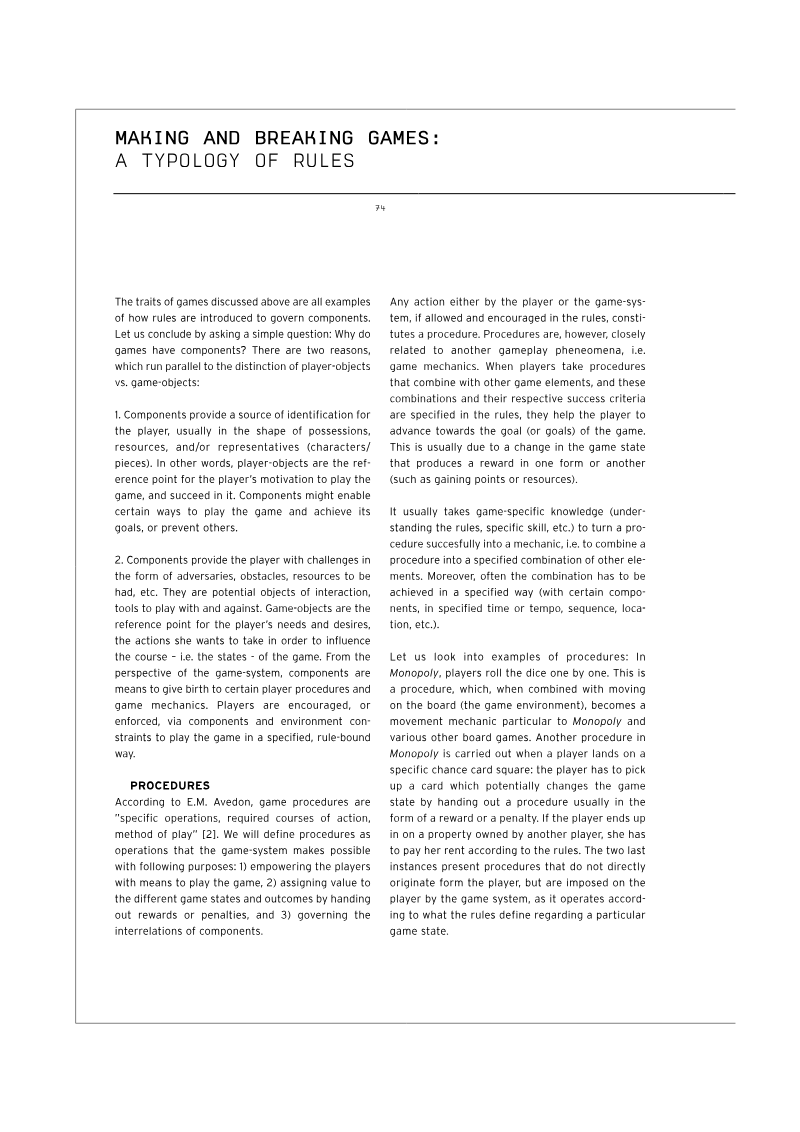
- Järvinen's framework treats games as state machines, where rules define the possible states of play, the transitions between them, and the conduct permitted to players, with rules rather than theme forming the fundamental structure of games.
- Rules are organized around five game elements: components, procedures, environments, themes, and interfaces, of which components and procedures are mandatory for any game while environment, theme, and interface rules are optional layers built on that core.
- The Chess-with-Star-Wars-characters example illustrates that theme sits on a separate layer from the underlying ruleset, so changing the theme does not change the game's rules.


The Gaming Landscape: A Taxonomy for Classifying Games and Simulations
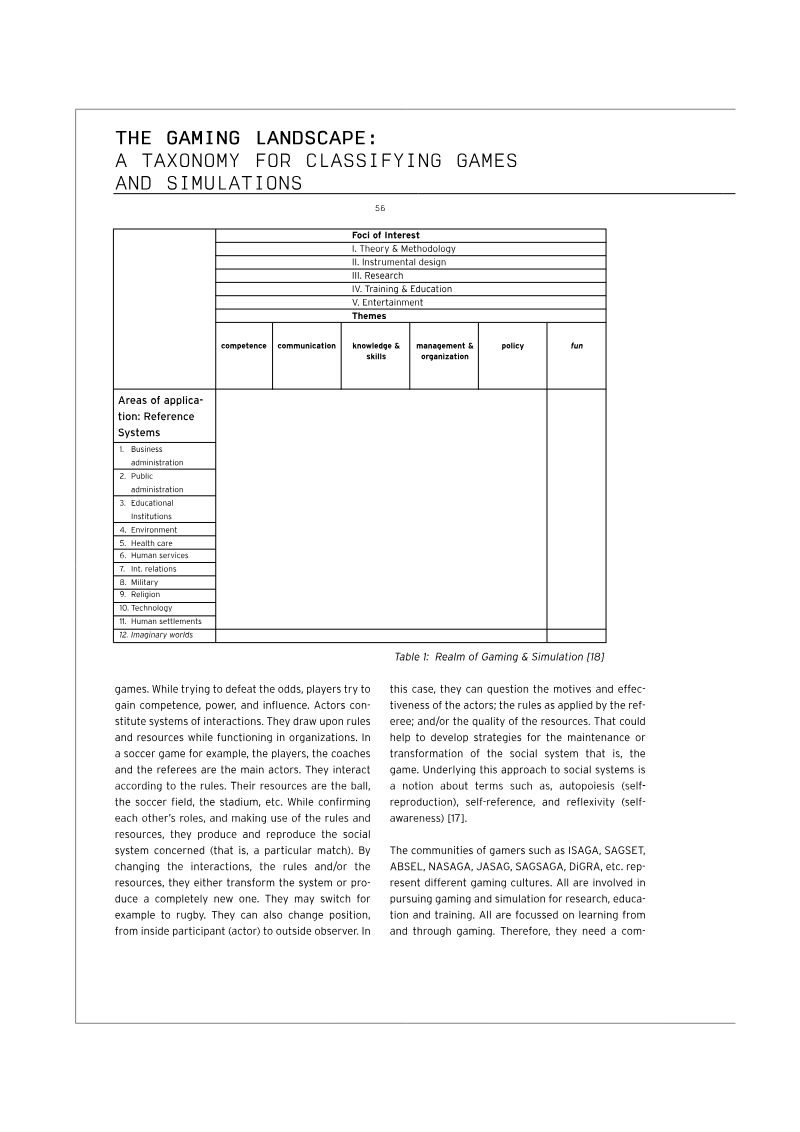
The document establishes a comprehensive taxonomy for classifying games and simulations, positing that understanding the "play element of culture" is fundamental to analyzing their diverse applications in education, training, and research.
- The paper argues that existing game classifications, which emphasize function and format, miss the underlying architecture of games, and proposes treating games as socially constructed systems built from actors, rules, and resources.
- It contrasts an acquisition metaphor of learning (knowledge as a commodity transferred to learners) with an interaction metaphor (learning as participation within a system), grounding the latter in the paper's framing of how learning occurs through play.
- Games are proposed to be distinguished as allopoietic (steered by external control) or autopoietic (capable of reproducing and sustaining themselves), a basis the author claims is more coherent than genre- or medium-based classifications for separating gaming from simulation.

Game Design Patterns
"Game Design Patterns" by Björk, Lundgren, and Holopainen addresses a gap between games research and industry practice: the absence of a shared language for describing and designing games.
- The report proposes an interaction-centered model for describing and designing games, addressing the lack of a shared vocabulary between games research and industry practice, rather than framing games around narrative.
- The model pairs a structural framework (game instances, sessions, and components grouped into bounding, temporal, and objective categories) with a collection of reusable interaction patterns.
- The patterns were derived from interviews with nine professional designers and a five-step harvesting method that produced over 200 pattern candidates.

Where Have All the Video Game Console Artists Gone?
This paper examines the emerging phenomenon of artists who use, incorporate, or subvert video game aesthetics and technology, with particular attention to console-based subversion, a form the author argues is seen far less often than sampling, mods, and machinima.
- Console-based artistic subversion is rarer than sampling, mods, and machinima, and the paper asks why, locating the answer in practical obstacles facing artists who work directly with console hardware.
- The two principal obstacles are technical and legal: console manufacturers rarely publish technical information for general use and license proprietary development kits only to third-party developers, while the Digital Millennium Copyright Act creates legal risk for reverse engineering and circumventing copyright protections.
- Sampling faces few technical barriers, and mods and machinima are often supported by tools released by developers themselves, which makes those forms easier to pursue than console work.

Uncle Roy All Around You: Mixing Games and Theatre on the City Streets
The document describes "Uncle Roy All Around You," an experimental pervasive game that blends elements of games and live theatre.
- The 2003 London production of 'Uncle Roy All Around You' ran in May and June 2003 as a pervasive game blending street performance with online play, involving 272 street players and over 200 online players.
- Street players searched the city for an elusive character named Uncle Roy using handheld computers and wireless networking, while online players tracked them through a parallel 3D model of London and could help or hinder them via text, audio and chat.
- Street participation was capped at ten simultaneous players due to technical and human resource constraints, and the production required more than ten actors and crew to support just twenty players at a time.