
DiGRA
The Digital Games Research Association: the international association of academics and professionals who study digital games. Its Digital Library holds the proceedings of the DiGRA conferences since 2002.
Documents
The Diversity of Attitudes Towards Play at the Workplace: A Case of an Academic Community
This study explores the diverse attitudes towards play and playfulness within an academic workplace, specifically focusing on a Finnish university community.
- Attitudes toward workplace play are varied and often ambiguous, so a community's existing views must be understood before any playful initiative is introduced.
- Many respondents see work and play as mutually exclusive, even while recognizing benefits such as improved well-being, creativity, and collaboration.
- Key obstacles to workplace playfulness include limited time, rigid organizational culture, pressure for concrete results, and the difficulty of shifting into a playful mindset.
Enacting Aporia: Roger Caillois' Game Typology as Formalist Methodology
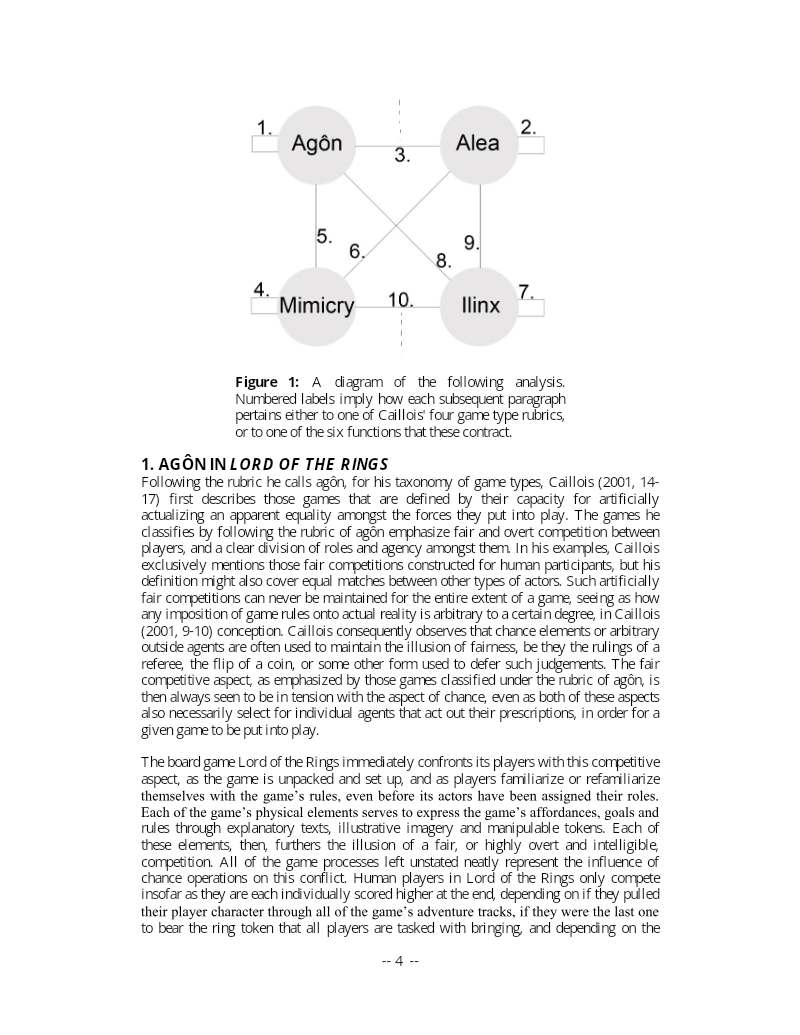
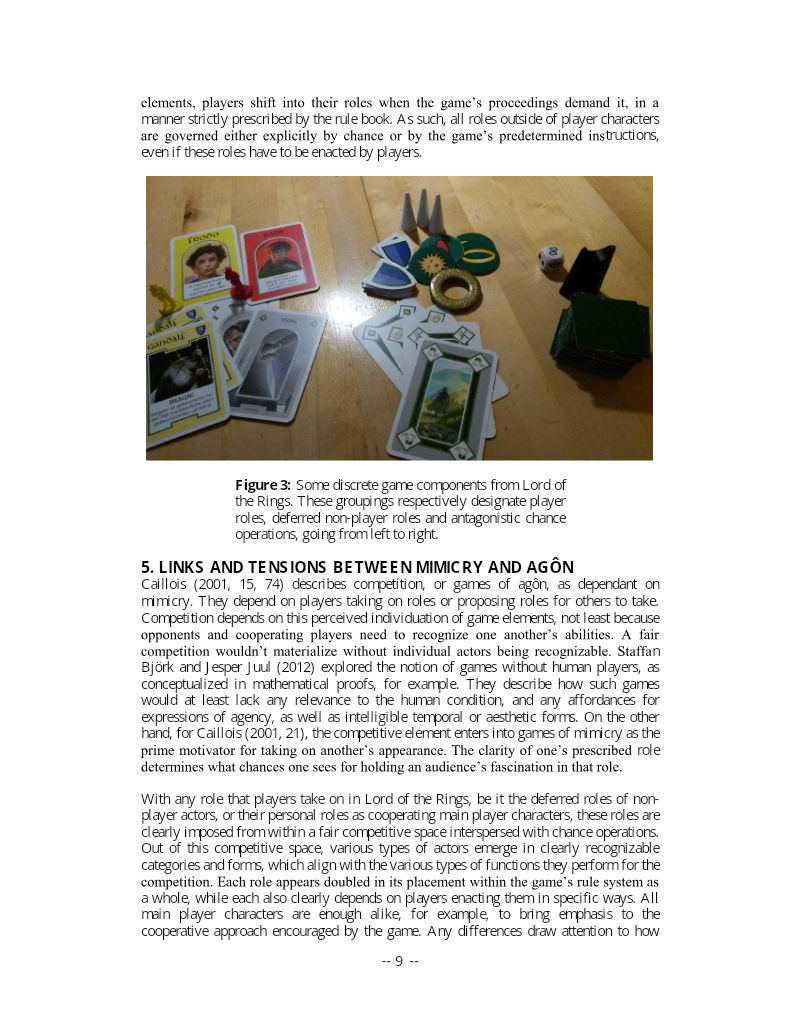
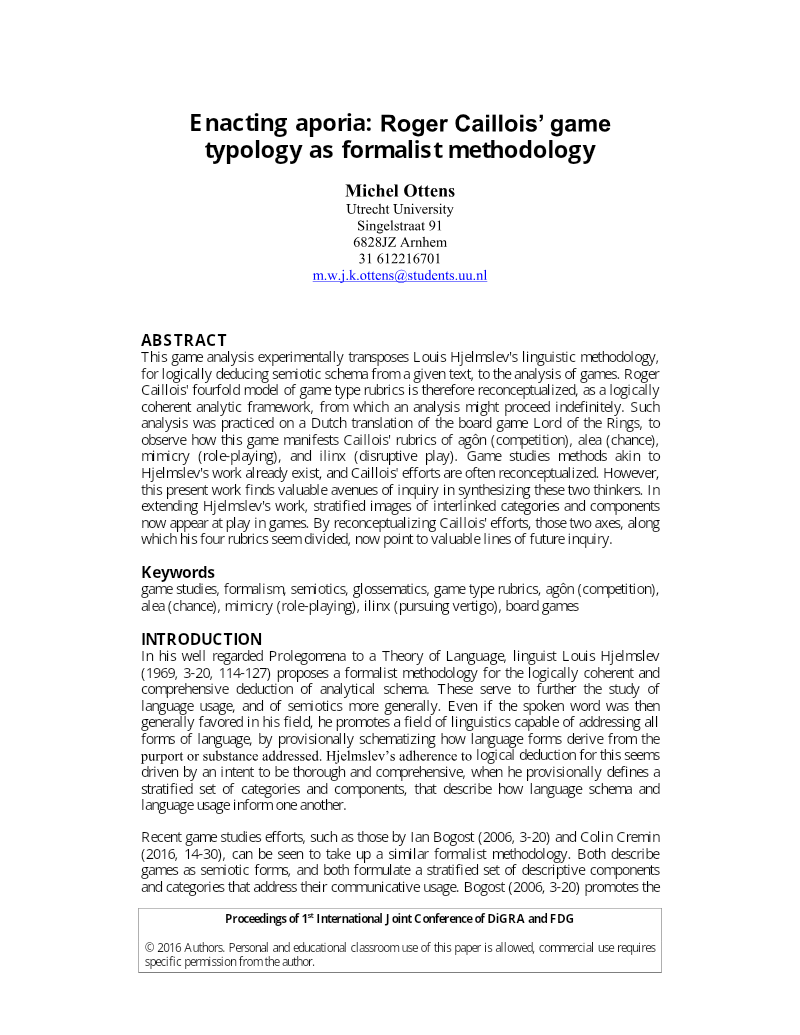
The analysis, "Enacting Aporia: Roger Caillois' Game Typology as Formalist Methodology," reinterprets Roger Caillois' four game rubrics—agôn, alea, mimicry, and ilinx—as a formal analytic framework, applying Louis Hjelmslev's linguistic methodology to game studies.
- The article proposes a formalist method that adapts Louis Hjelmslev's glossematics to Roger Caillois' four-part game typology (agôn, alea, mimicry, ilinx) as a foundation for analysing games.
- Its central thesis is that game dynamics emerge from tensions among Caillois' categories rather than from the dominance of any single category.
- The case study is a Dutch edition of the board game Lord of the Rings (2000), which the author reads as a title where no single category prevails.
Making the Familiar Unfamiliar: Techniques for Creating Poetic Gameplay
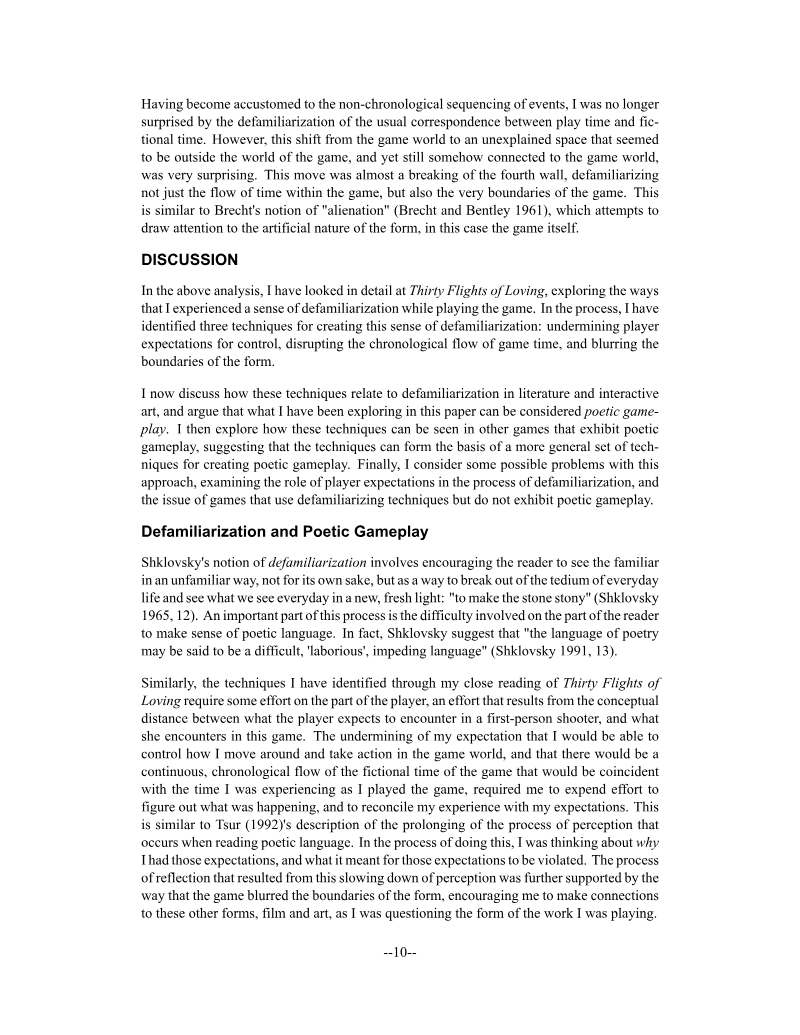
The document explores "poetic gameplay" as a design philosophy that leverages formal structures to create a "defamiliarizing" effect, compelling players to engage with and reflect upon the game's form itself.
- The paper argues games can achieve "poetic gameplay" by applying Shklovsky's concept of defamiliarization: deliberately making familiar game structures strange so players attend to the game's form and reflect on it.
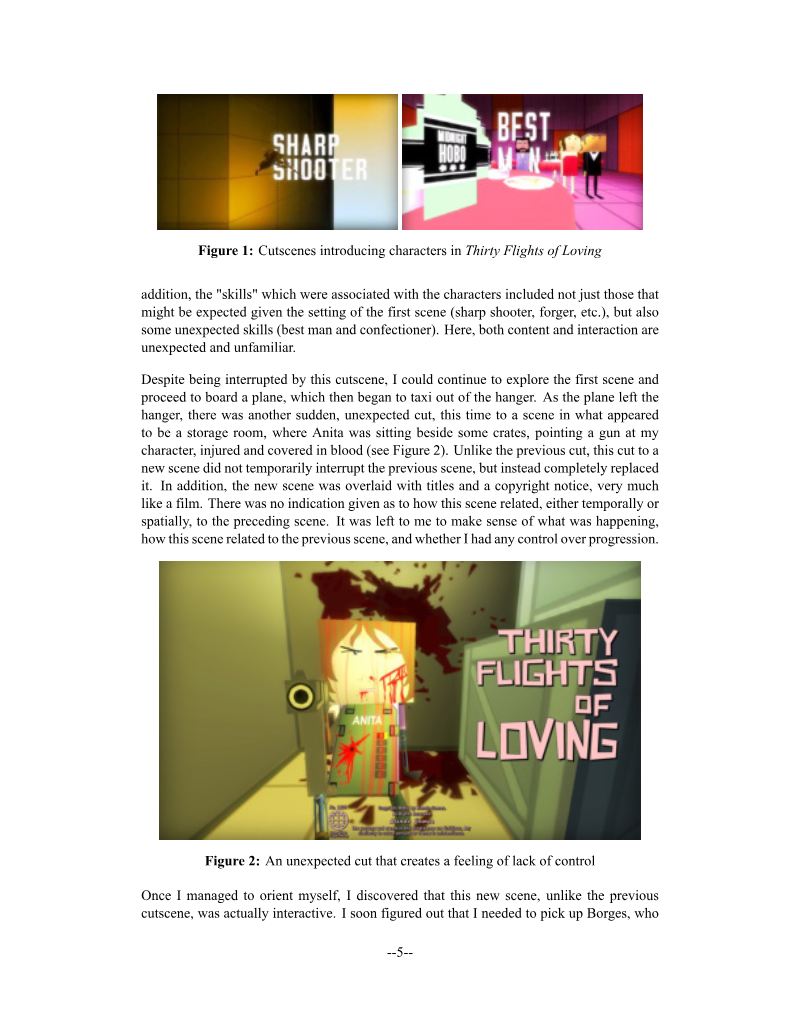
- Three core techniques are identified: undermining player control, disrupting the chronological flow of game time, and blurring the boundaries between game, film, and art.
- The findings rest on a close reading of Thirty Flights of Loving and the author's repeated play and analysis, making them qualitative rather than based on quantitative measurement.
Paratextual Play: Unlocking the Nature of Making-of Material of Games
The document explores the phenomenon of "paratextual play" in digital games, asserting that "making-of" materials have transitioned from external marketing tools to integrated, in-game features that profoundly influence player engagement and perception.
- Making-of material for digital games, such as documentaries, concept art, and audio commentaries, has shifted from a peripheral marketing extra to an integral part of the play experience, and it is never a neutral account of development but a curated, celebratory one.
- Game paratexts are woven into gameplay, with access tied to playing and succeeding: Star Wars: Episode I – Battle for Naboo hid material behind cheat codes, and Rare Replay locked its "Rare Revealed" section, unlike film DVD extras that are typically reached through menus.
- Achievement systems such as Xbox Gamerscore and PlayStation Trophies, along with medal points and in-game currency, gate bonus content like the "Tech Dive" video in Uncharted 2, which costs $120,000 in-game to unlock, turning collecting this material into a goal in itself.
Conventions Within eSports: Exploring Similarities in Design
The document explores the foundational design characteristics that contribute to a competitive game's success as an esport, positing that a select set of shared features are critical for achieving prominence.
- The study identifies five shared structural characteristics across successful competitive eSports, using League of Legends and CS:GO as case studies: a Match Based Structure, a Player Evaluation System, Explicit User Interfaces, Player Performance Feedback, and the Game Client.
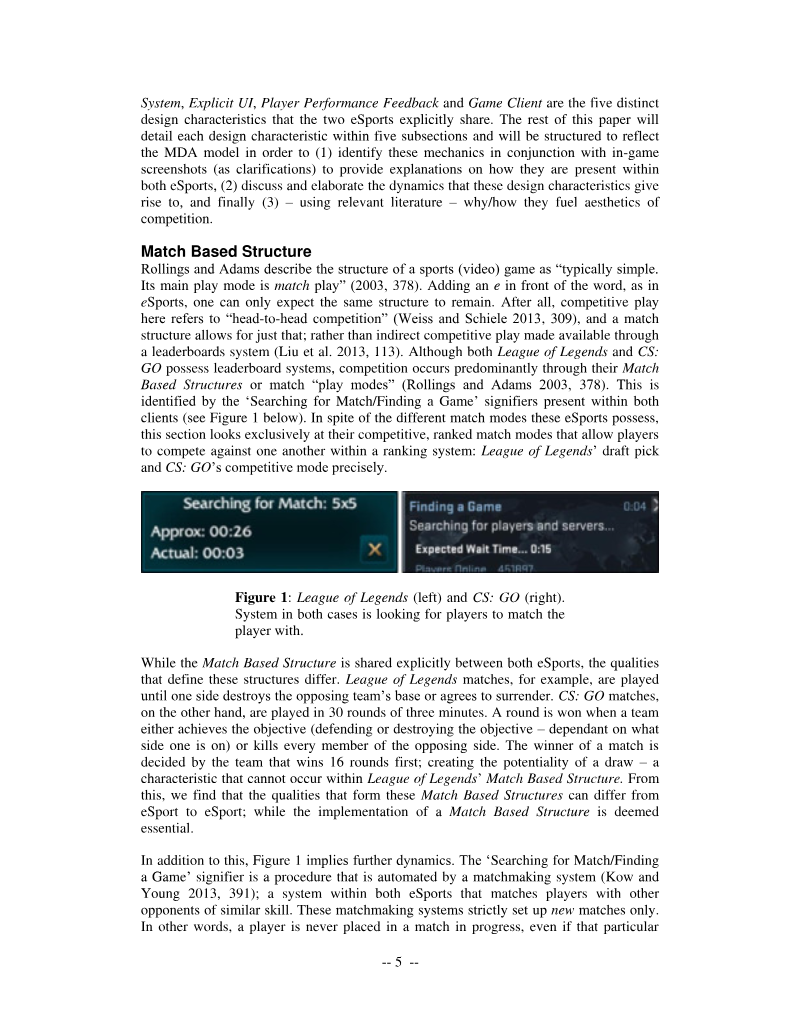
- Both games use head-to-head matches with automated matchmaking that places players only in new matches, though their rules differ, such as base destruction in League of Legends versus thirty three-minute rounds in CS:GO, where draws are possible only in the latter.
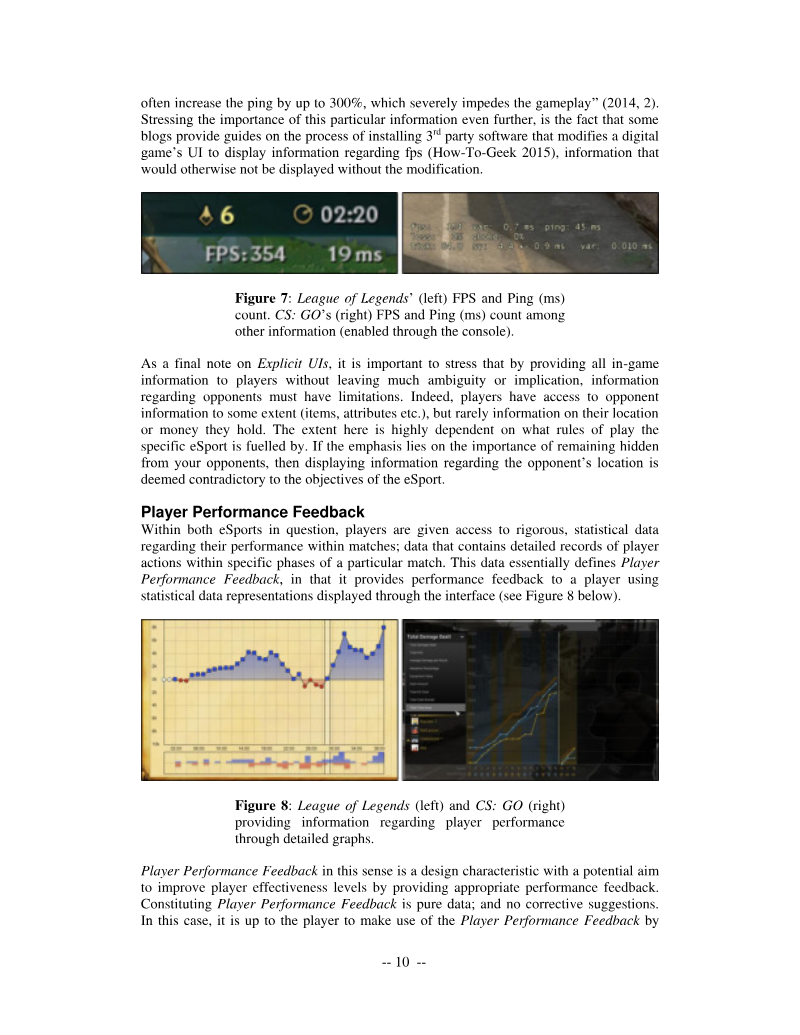
- Both titles rank players by skill, with rank changes driven by win and loss records, and present gameplay information clearly through their interfaces.
You Say Jump, I Say How High? Operationalising the Game Feel of Jumping
This paper presents a novel methodology for empirically analyzing and modeling the "game feel" of jumping in 2D platformer games.
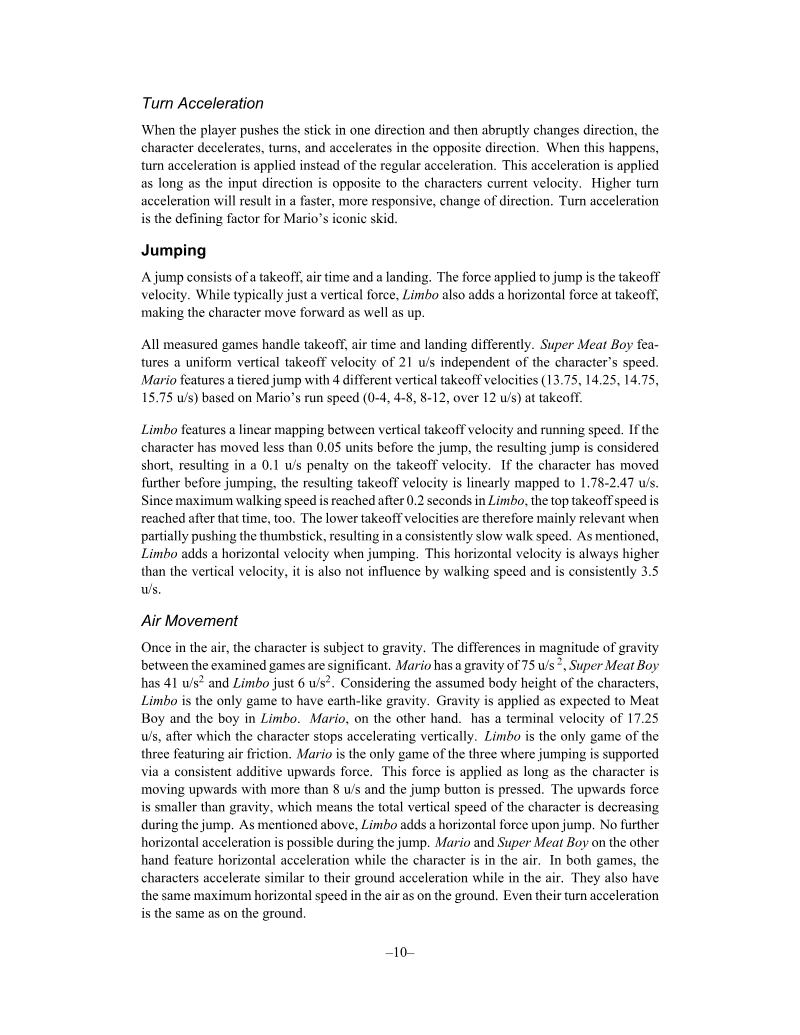
- Gravity differs sharply across the three games studied: Mario at 75 units/s², Super Meat Boy at 41, and Limbo at just 6, making Limbo the only title with earth-like proportions.
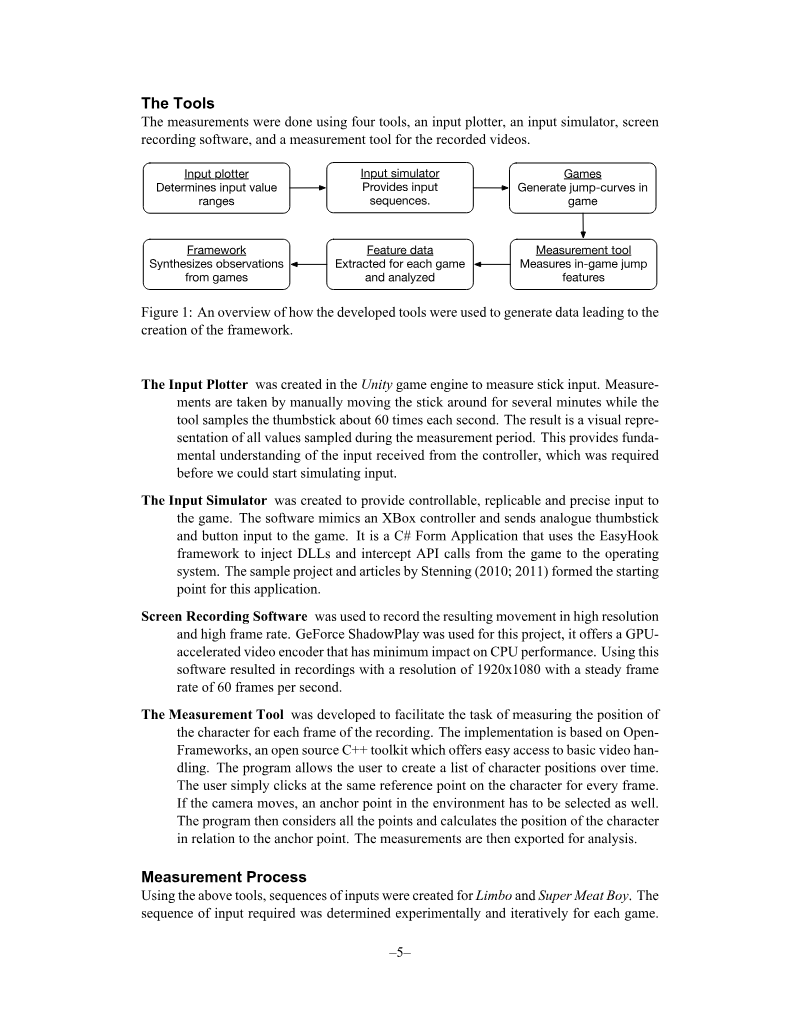
- The authors model jump mechanics empirically via input simulation, frame-by-frame video analysis, and model fitting, with Limbo's jump fitting tightly (RMSD 0.025) and Super Meat Boy's fitting looser (RMSD 0.109).
- All tested controllers overshoot their expected input limits, and blowback (the stick bouncing past center after release) occurs in every game examined but is handled in none of them.
The Journey to Nature: The Last of Us as Critical Dystopia
Farca and Ladevèze argue that The Last of Us is a critical dystopia: a genre that pairs a bleak world with a utopian enclave offering hope, here a return to nature and a life in balance with it.
- The report reads The Last of Us as an ecological critical dystopia that counter-narrates its own official dystopian order, drawing on ecocriticism and Sargent's and Baccolini's concept of the critical dystopia, which preserves room for hope and resistance.
- The game is argued to diagnose the failures of bureaucratic consumer capitalism and to propose a return to nature as the path toward utopia, set in a world where a mutated Cordyceps fungus has devastated humanity.
- The analysis rests on symbolic oppositions: cities are linked to violence, entrapment, decay, stasis and fire, while nature is linked to calm, balance and regeneration, extended to indoor/outdoor space, water, and seasons.
Designing Unconventional Use of Conventional Displays in Games: Some Assembly Required
The document explores the design space of utilizing conventional video game hardware in unconventional ways to create novel, installation-like game experiences in public, co-located settings, emphasizing social play.
- The paper argues that unconventional spatial arrangements of conventional display hardware form an underexplored design space for social, installation-like games, with physical placement of screens and player positioning shaping both social dynamics and strategy.
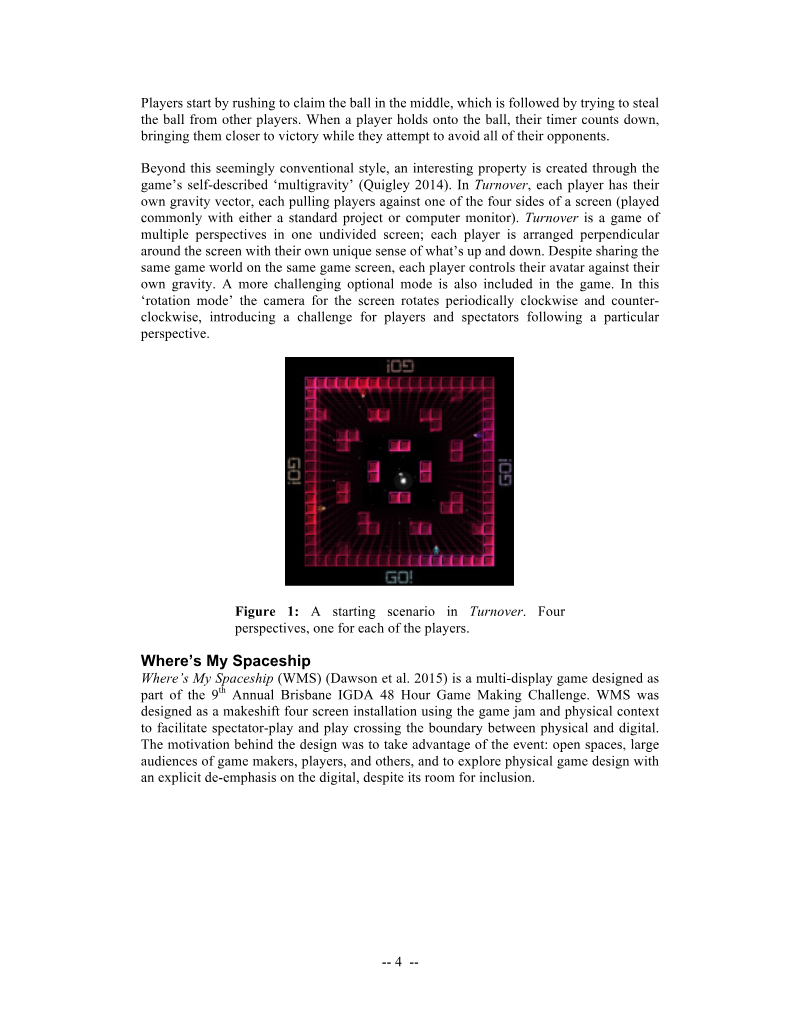
- Two co-located experimental multiplayer games, Turnover and Where's My Spaceship, serve as the case studies, using horizontal and perpendicular multi-screen configurations to create multi-screen asymmetry without any custom sensing hardware.
- The games occupy roughly 20 square meters and rely only on commercially available displays, controllers, and projectors, and both originated in game jams before being refined for public exhibition.
Playing RPG Maker?: Amateur Game Design and Video Gaming
The document explores the under-researched phenomenon of amateur game design, particularly focusing on the use of accessible tools like RPG Maker.
- Amateur game makers using tools like RPG Maker are best understood as extending video game play rather than as a path toward professionalization or formal education, according to Hurel's study.
- Most amateur creators make games primarily for personal enjoyment and to share their playing style with friends, designing their projects as personal versions of genres or franchises they love, with design choices mirroring what they find pleasurable as players.
- The study's findings rest on exploratory interviews with twelve respondents, mostly men aged 25 to 42 based largely in Belgium and France, plus forum analysis and autoethnography, and are presented as preliminary rather than a formal theory.
Game Essays as Critical Media and Research Praxis
The document, "Game Essays as Critical Media and Research Praxis," proposes that the creation of "game essays" serves as a significant critical media and research practice within the digital humanities.
- Game essays are proposed as a legitimate form of critical media and humanities research, analogous to the established video essay in film studies, using playable, interactive works to interrogate game culture and the processes behind game creation.
- The author grounds the 'game essay' in Adorno's conception of the essay as an anti-methodical, exploratory form, treating game essays as experimental research instruments that test hypotheses rather than finished products.
- The work adopts a 'thinking through making' digital humanities perspective, arguing that the design process itself produces valid knowledge and deriving a concept called 'ludic a posteriori knowledge' as an anti-method opposed to instrumental and formalist game research.
Who Am 'I' in the Game?: A Typology of the Modes of Ludic Subjectivity
The document proposes a typology of "ludic subject-positioning" to analyze how players construct an "I" within digital game worlds, addressing a gap in existing game studies.
- Vella proposes a typology of 'ludic subject-positions' grounded in phenomenology (Sartre, Merleau-Ponty), arguing the player's sense of self in a game is an experiential Gestalt built from interacting formal mechanisms rather than a single existing framework like point of view or Wilhelmsson's 'Game Ego'.
- The embodied subject-position is structured by four linked aspects: spatial standpoint, capabilities, goal-orientation, and passion.
- The typology identifies five variants: singular embodied (e.g., Tomb Raider, Pac-Man), multiple embodied (e.g., Valkyria Chronicles), distributed (e.g., Baldur's Gate), semi-transcendent (e.g., FTL, Warcraft II), and pure transcendent (e.g., SimCity, Black & White).
Selling Out the Magic Circle: Free-to-Play Games and Developer Ethics
This study investigates the ethical implications of the free-to-play (F2P) business model in massively multiplayer online role-playing games (MMORPGs), focusing on the power dynamics between developers and players.
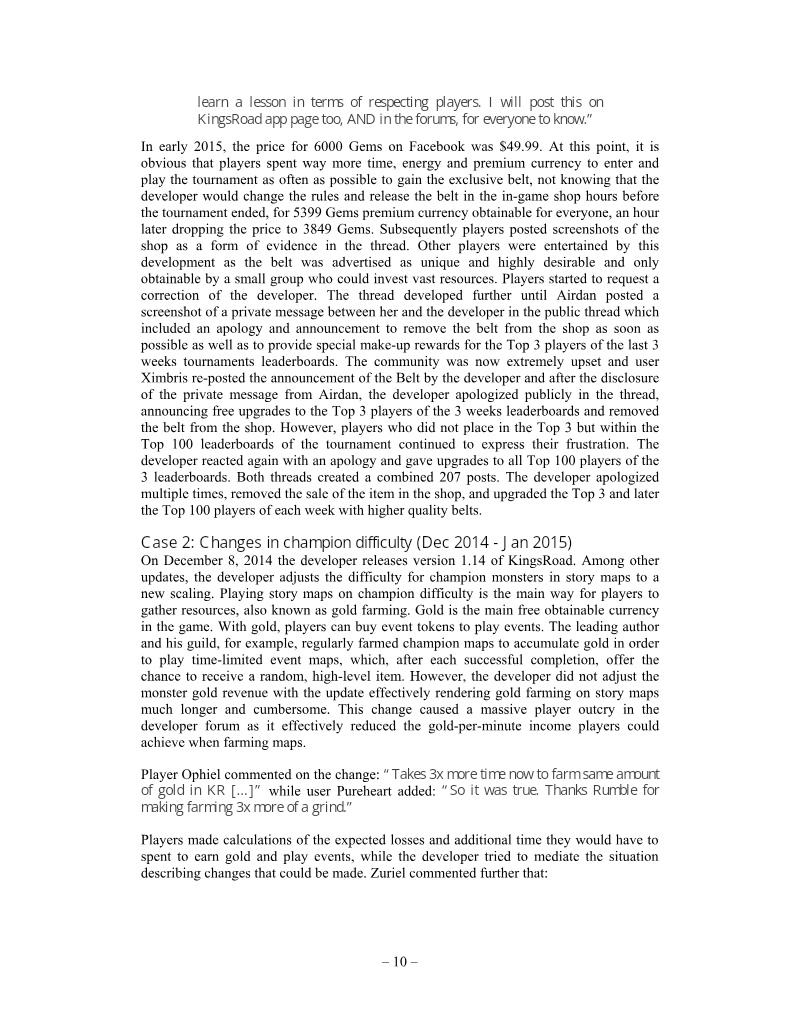
- The study argues that KingsRoad's developer repeatedly broke an implicit contract with players by making unannounced or vaguely announced changes to economy, rules, and difficulty, disrupting the 'magic circle' that separates play from commerce.
- The central case, the 'Doomsayer belt fiasco' of October and November 2014, placed a tournament-exclusive belt in the in-game shop for premium currency only hours before the competition ended.
- Five purposively sampled cases of community upheaval were analysed, including a gold-income nerf, a hidden attack speed cap, a doubled lockbox price, and a secret raid 'bot' system suspected of levying a hidden tax.
Do you work at DiGRA? Get a free report of how these documents are read and cited here.