
DiGRA
The Digital Games Research Association: the international association of academics and professionals who study digital games. Its Digital Library holds the proceedings of the DiGRA conferences since 2002.
Documents
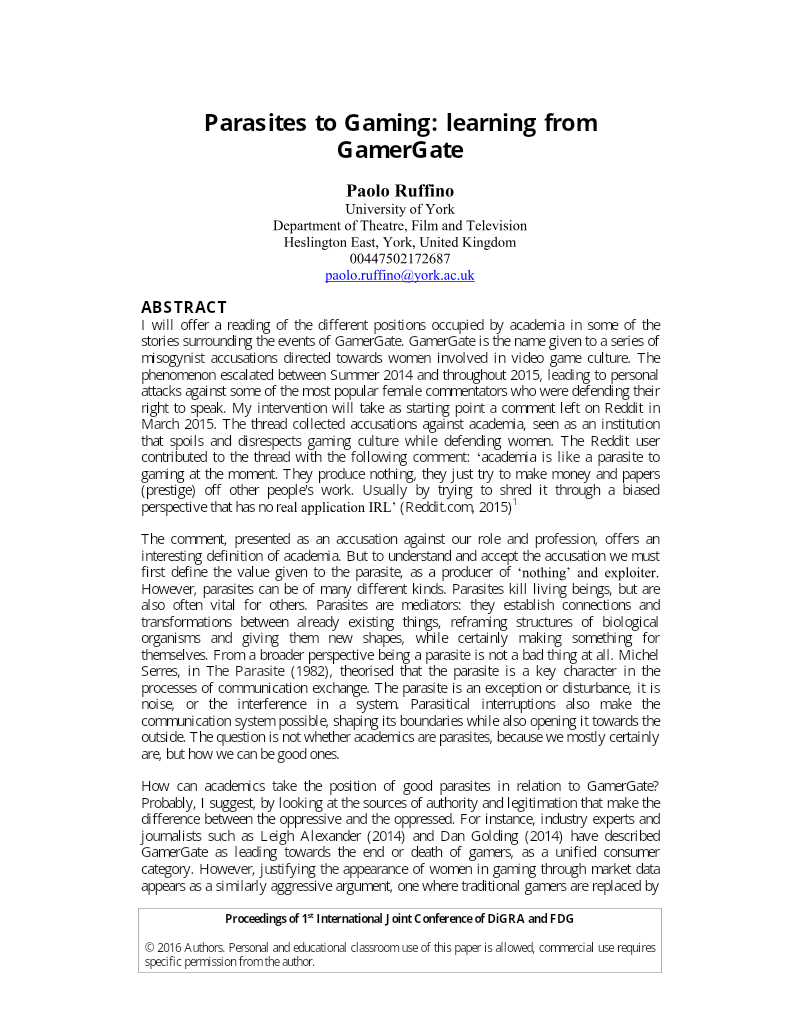
Parasites to Gaming: Learning from GamerGate
This document explores the role of academia in the context of GamerGate, a series of misogynistic accusations directed at women in video game culture that escalated from Summer 2014 through 2015.
- Paolo Ruffino reframes the Reddit accusation that academics are "parasites" to gaming by drawing on Michel Serres's theory of the parasite as a mediator and disruptor, arguing the real question is how academics can be "good" parasites rather than whether they are parasites at all.
- GamerGate, which escalated from summer 2014 into 2015 with harassment of prominent women in games, was framed by industry commentators as signaling the end of "gamers" as a unified consumer category.
- Ruffino argues that justifying women's presence in gaming through market data is itself an aggressive argument, because it swaps one consumer category for another while leaving the underlying discourse that treats games as industry products and participants as consumers intact.
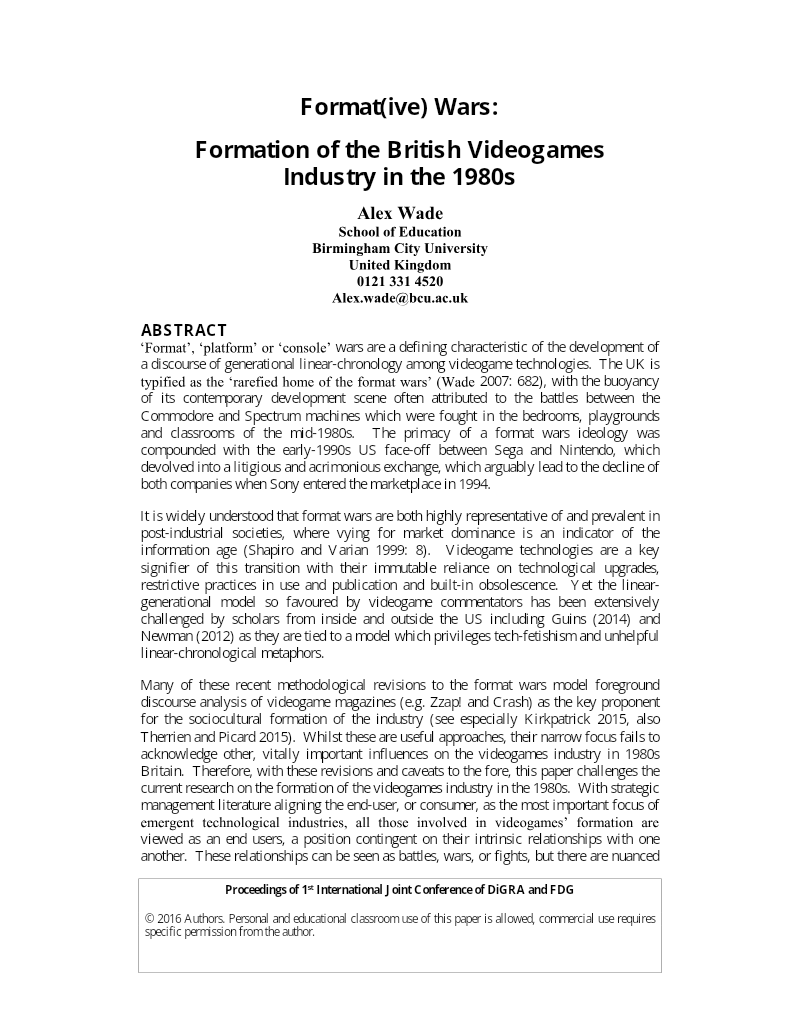
Format(ive) Wars: Formation of the British Videogames Industry in the 1980s
The document analyzes the formation of the British videogames industry in the 1980s, challenging the prevailing "format wars" model as the sole explanatory framework.
- The paper argues the familiar 'format wars' narrative, centred on the Commodore versus Sinclair Spectrum rivalry, is an incomplete account of how the British videogames industry formed in the 1980s, and that linear, generational histories overemphasise technology.
- It reframes the industry as an interdependent network of developers, publishers, distributors, high street retailers and journalists, rather than a story driven by hardware alone.
- The author identifies specific business practices of the era, including the 'chain of approval' linking gamers, retailers, publishers, software houses and developers, and the publisher acting as an 'Artist and Repertoire' agent for developers.
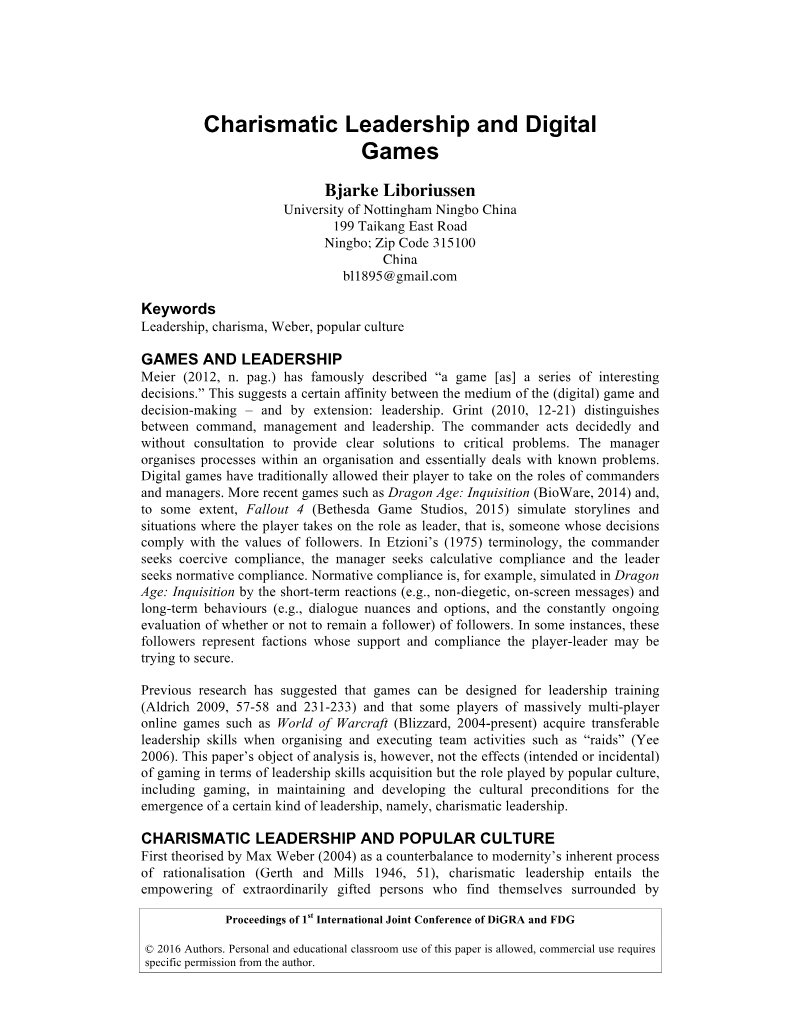
Charismatic Leadership and Digital Games
Digital games have long cast players as commanders who act decisively on critical problems or managers who organise processes toward known ends.
- The paper argues that the media through which audiences encounter leadership shape how they understand it, rather than studying skills players gain from games.
- Its central thesis is that different media formats support different models of charismatic leadership, based on Max Weber's theory: early twentieth-century cinema centres the charismatic individual with little role for followers, while serialised comics, television and digital games give the inner circle a much larger part.
- Digital games, especially role-playing titles, let players occupy a leader whose authority rests on normative compliance, drawing on Etzioni's typology of coercive, calculative and normative compliance.
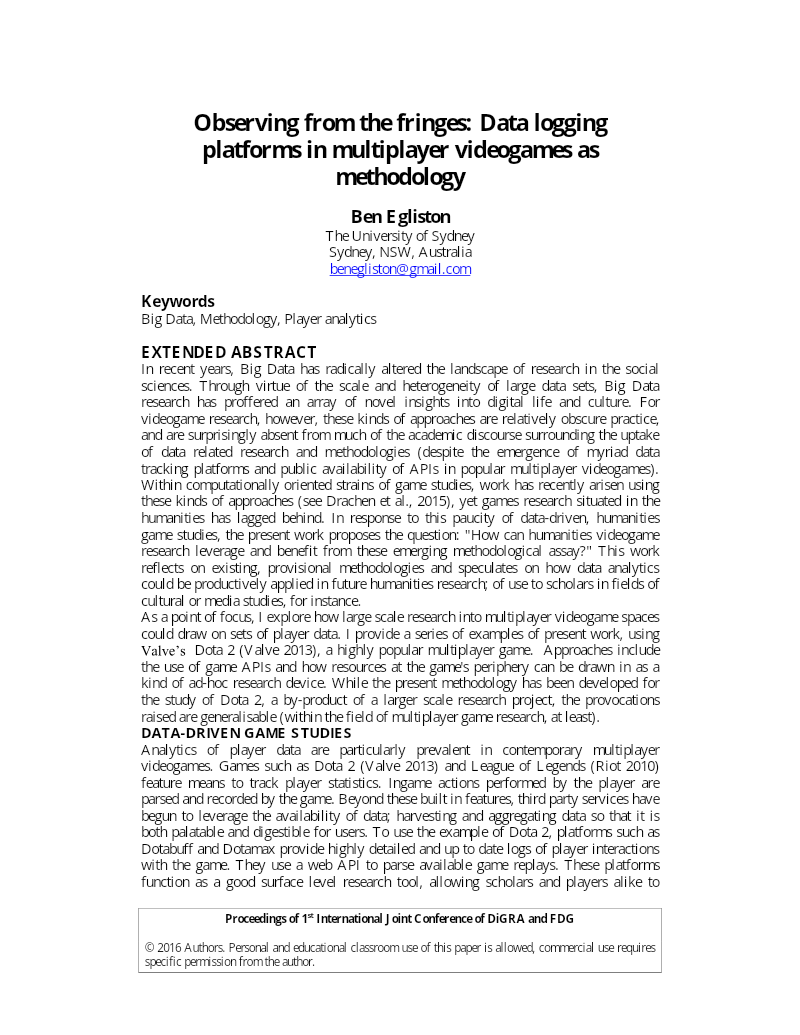
Observing from the Fringes: Data Logging Platforms in Multiplayer Videogames as Methodology
The document explores the potential of leveraging data logging platforms and Big Data methodologies for humanities-based videogame research, particularly in multiplayer online games.
- The paper argues that humanities-based game studies have been slow to adopt Big Data and player analytics, even though popular multiplayer games generate large volumes of usable data.
- Its central proposition is that player data harvested through game APIs and third-party platforms can offer perspectives unavailable through established cultural and media studies frameworks.
- Using Valve's Dota 2 as its example, the paper describes how services such as Dotabuff and Dotamax parse replays via web APIs to log player actions, and how API-scraping tools enable analysis of entire datasets to reveal collective engagement patterns.
Grounded Theory in Games Research: Making the Case and Exploring the Options
The document advocates for the increased and proper utilization of Grounded Theory Methodology (GTM) within the nascent field of Game Studies.
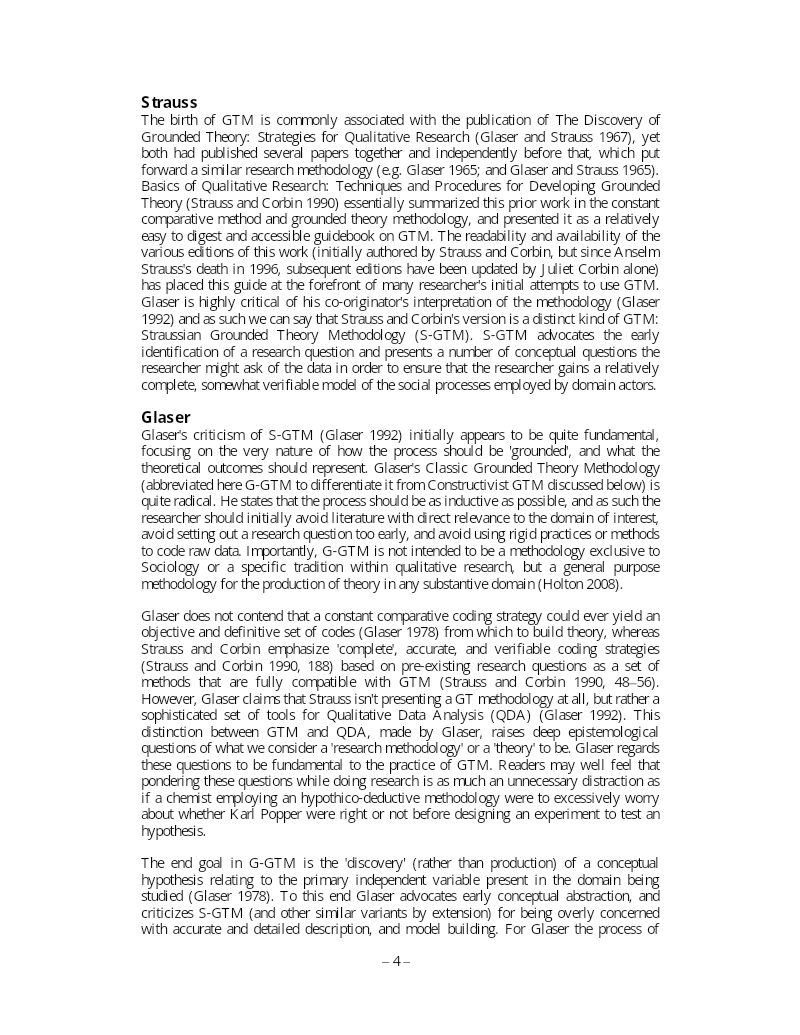
- Grounded Theory Methodology is a family of variants, not a single method: Glaser's Classic GTM seeks one key hypothesis, Strauss and Corbin's Straussian GTM produces a model of interacting variables, and Charmaz's Constructivist GTM yields a conceptual account incorporating participant narratives, and these philosophical differences substantially shape research outcomes.
- Many games studies invoke GTM without specifying which variant they follow, and the authors call for greater transparency in reporting methodological choices.
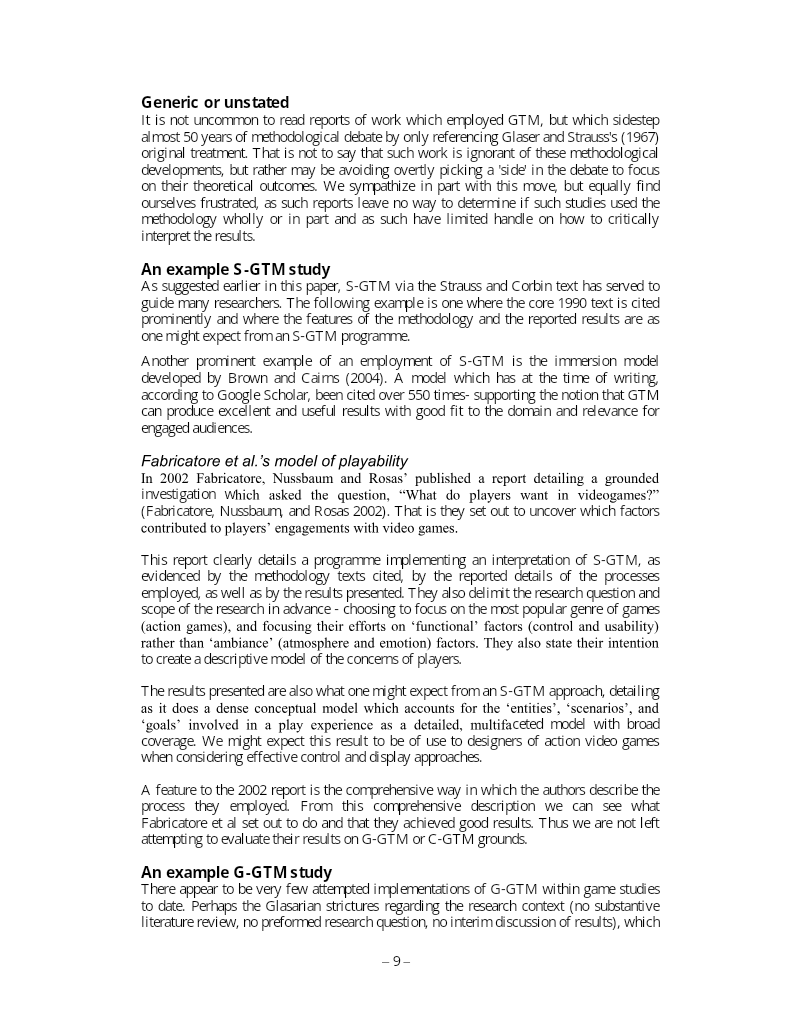
- Applications of GTM in games research are concentrated in the Straussian tradition (e.g., Fabricatore et al., 2002; Brown and Cairns, 2004), Glaser-based studies are rare, and Charmaz-influenced work such as Bowers (2011) foregrounds participant narratives.
Walking Simulators: The Digitisation of an Aesthetic Practice
Walking simulators such as Year Walk, Gone Home, and Dear Esther digitise an older aesthetic practice: walking as a means of exploration, discovery, and meaning-making in the Romantic tradition.
- The report argues that walking simulators such as Dear Esther, Gone Home, and Year Walk continue a Romantic tradition of walking as aesthetic and spiritual practice, making digital walking a legitimate extension of that tradition.
- The central claim is that movement through space, whether physical or virtual, generates meaning, and the contested label "walking simulator" may still be an apt description of these works.
- Environmental storytelling embeds narrative in landscape and architecture rather than delivering it through cutscenes, so players uncover story through observation and movement.
Ruinensehnsucht: Longing for Decay in Computer Games
The document, "Ruinensehnsucht: Longing for Decay in Computer Games," explores the pervasive presence of ruins, corrosion, and decay in contemporary computer games, arguing that this phenomenon transcends mere realism and points to a deeper "longing for decay" among designers and players.
- Mathias Fuchs argues that the abundance of ruins, dust, rust, and decay in computer games cannot be explained by technical necessity or realism, since many games display more decay than reality would produce.
- The paper proposes 'Ruinensehnsucht' (longing for decay): a melancholic yet compelling affective attachment to disintegrating environments, examined through media history, art history, psychoanalytic theory, and the concept of a transmedia megatext.
- Early games, constrained by limited resolution and processing power, rendered clean, simplified worlds, while later graphics hardware made fog, dust, and weathering possible and eventually a defining aesthetic.
Bridging the Physical Learning Divides: A Design Framework for Embodied Learning Games and Simulations
This document introduces a comprehensive design framework for embodied learning games and simulations, aiming to unify diverse conceptualizations of "embodiment" across research domains.
- The paper proposes a unified design framework for embodied learning games and simulations, built to resolve the conflicting definitions of 'embodiment' across HCI, learning sciences, and related fields that made existing systems hard to compare.
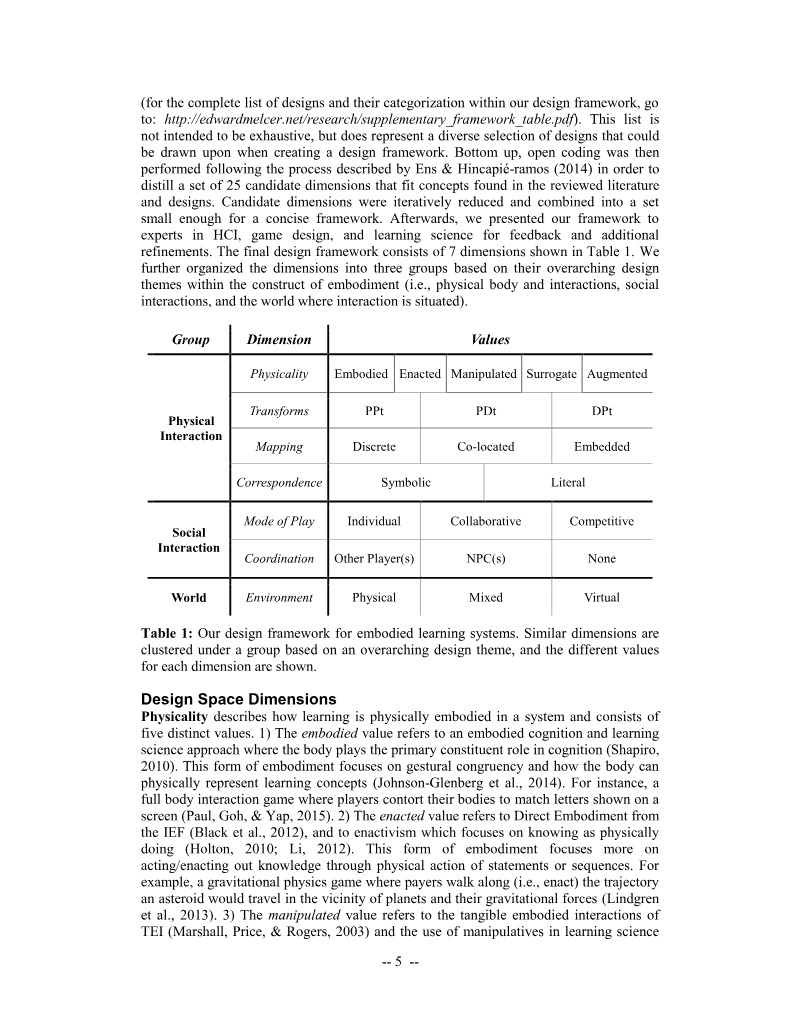
- The framework was derived from a literature review of 48 published embodied learning designs, reducing 25 candidate dimensions to seven through open coding, refined with feedback from HCI, game design, and learning science experts.
- The seven dimensions are grouped into physical body and interactions, social interactions, and the world of interaction, with Physicality, Transforms, and Correspondence forming the analytical backbone.
Sustainable Life Cycle Game Design: Mixing Games and Reality to Transform Education
The document proposes a "sustainable life cycle game design" (SLC) framework to address the challenges of high development costs and limited adoption in educational games, despite their proven learning benefits.
- Educational games see low adoption and dissemination because development costs are high and their useful life is short, and the Sustainable Life Cycle (SLC) model proposes designing them for reuse, adaptation, and embedding within existing teaching contexts rather than as single-use products.
- The SLC framework draws on the cradle-to-cradle model from manufacturing and argues that games and education can form two linked cycles in which assets, code, and the design process itself keep generating value over time.
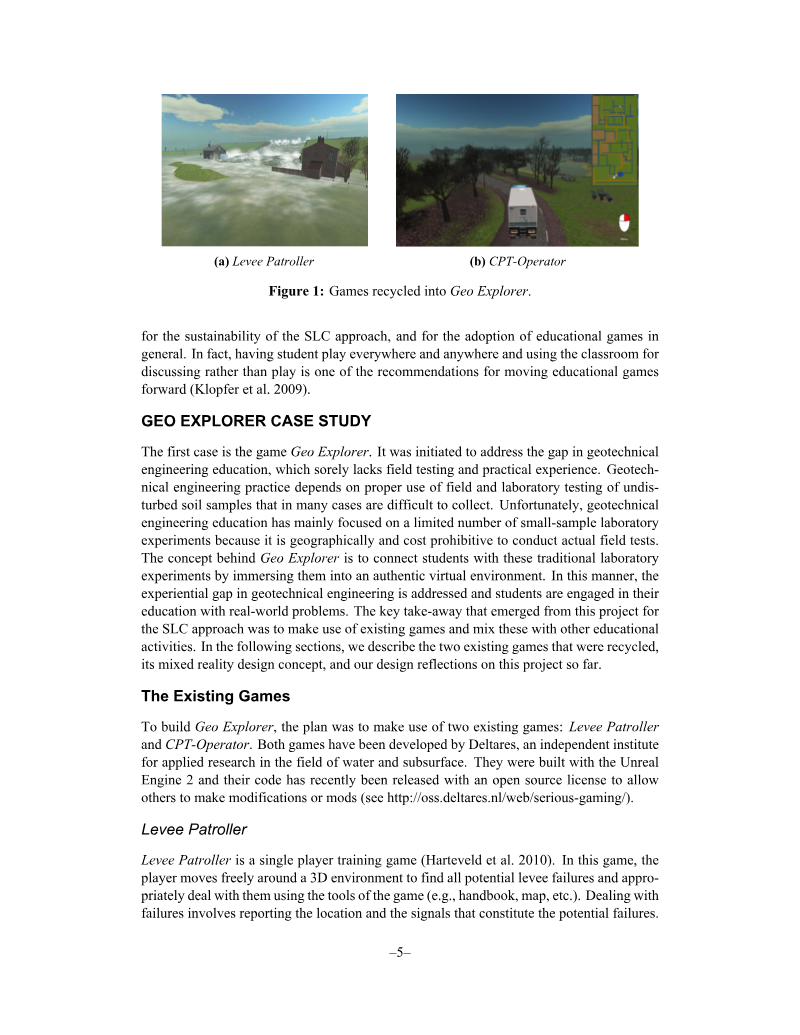
- The Geo Explorer case recycles two Deltares geotechnical engineering games (Levee Patroller and CPT-Operator) through a mobile app that combines virtual and physical environments, and it encountered difficulties with asset reuse and limited laboratory access.
What Does It Mean to Be Orlanthi?: Hermeneutic Challenge in King of Dragon Pass
"What Does It Mean to Be Orlanthi?: Hermeneutic Challenge in King of Dragon Pass" explores how the video game King of Dragon Pass (KoDP) utilizes cultural interpretation as a fundamental game mechanic, compelling players to engage in a continuous "hermeneutic process" to succeed.
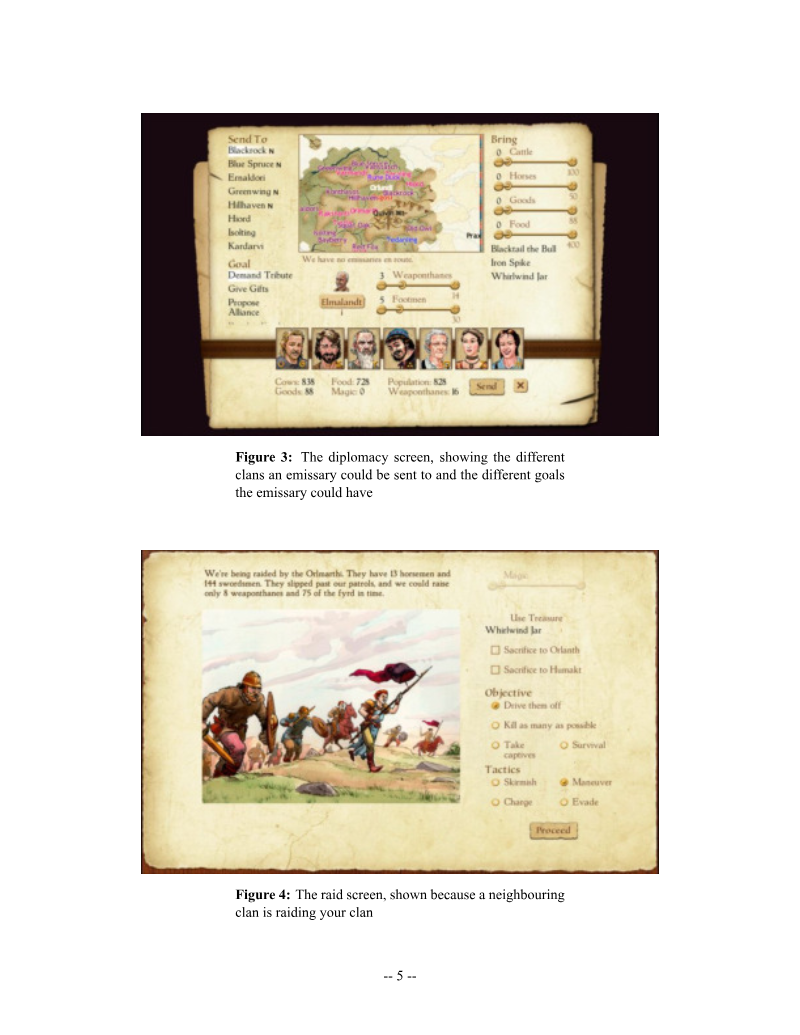
- The paper's central argument is that playing King of Dragon Pass requires a "real-time hermeneutic" process, in which players continually test their own ethical and governance assumptions against Orlanthi values, drawing on Gadamer's philosophical hermeneutics.
- The game's distinctive mechanism is the "hermeneutic challenge": success depends on players interpreting and internalizing culture-specific norms such as honor-based feuding, customary favor exchanges, and wergild, rather than relying mainly on strategic or kinaesthetic skill.
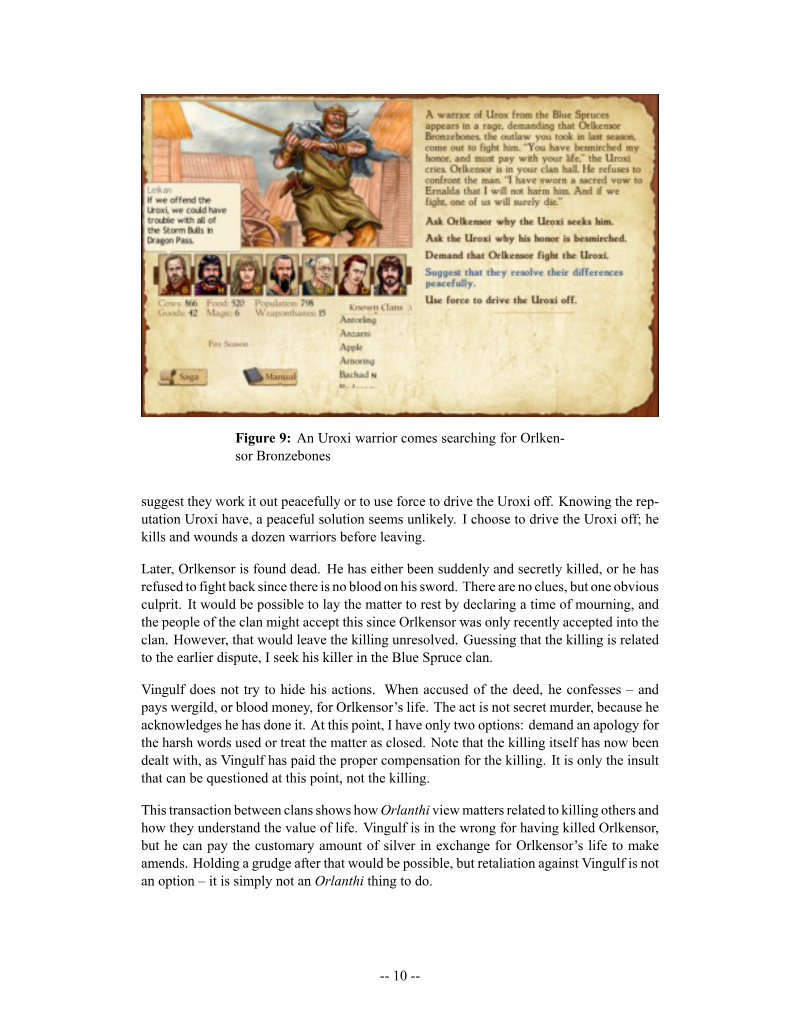
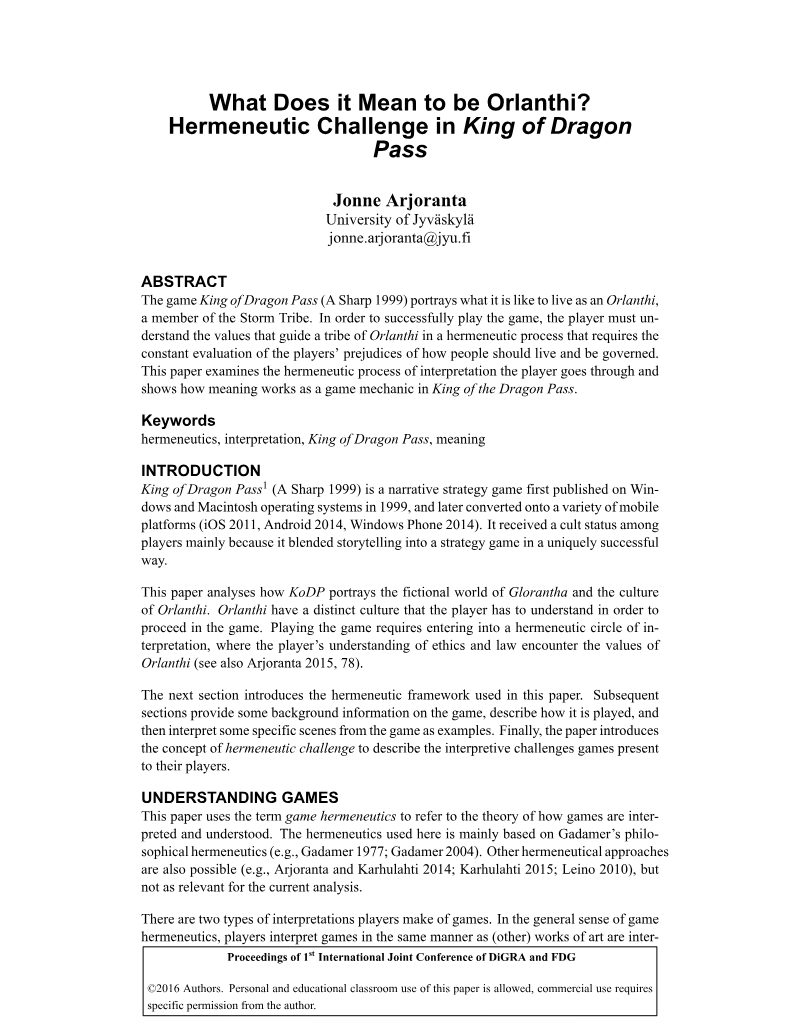
- Concrete examples such as a feud, a twenty-cow favor, and a murder resolved through blood money illustrate how player choices are judged against these cultural norms.
Selling the Imperium: Changing Organisational Culture and History in EVE Online
"Selling the Imperium: Changing Organisational Culture and History in EVE Online" examines the dynamics of organizational culture and identity within the player-driven universe of EVE Online.
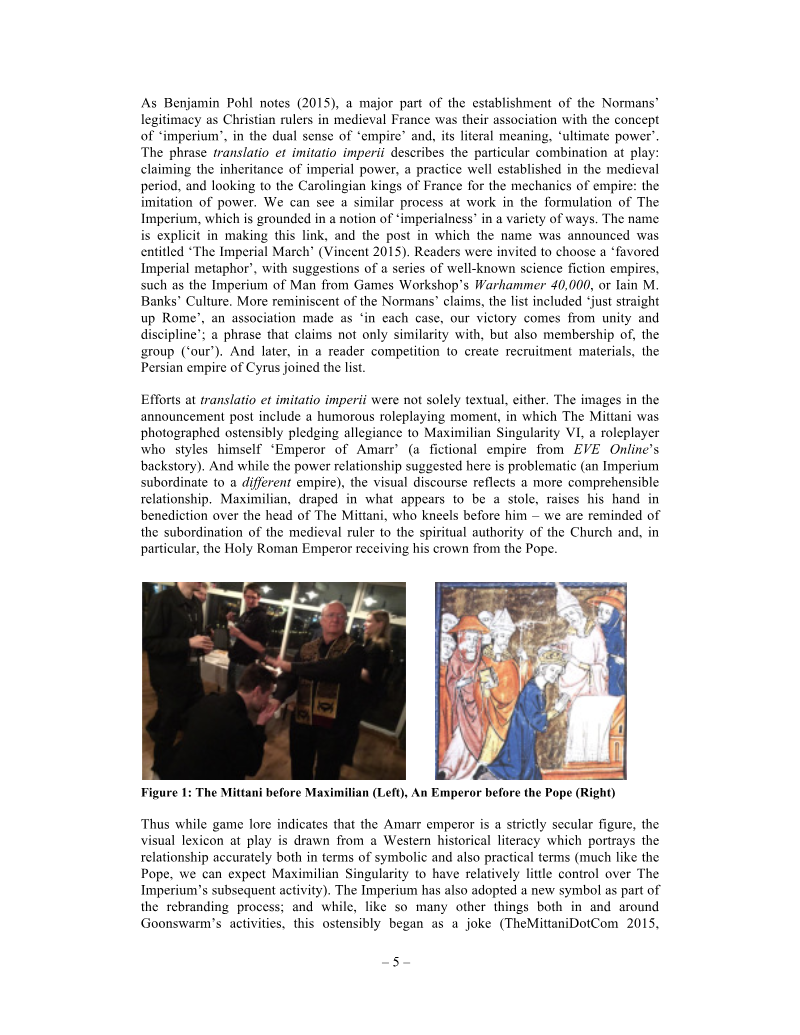
- The 2015 renaming of the Clusterfuck Coalition (CFC) to "The Imperium" drew on imperial and Western historical symbolism, such as the Black Eagle emblem, the Maximilian pledge image, and viceroyalty structures, to build a "usable past" that conferred legitimacy and an impression of maturity.
- The authors compare the Imperium's dynastic project to the medieval Norman model and read the largely muted community response to the rebranding as implicit acceptance of leadership's direction.
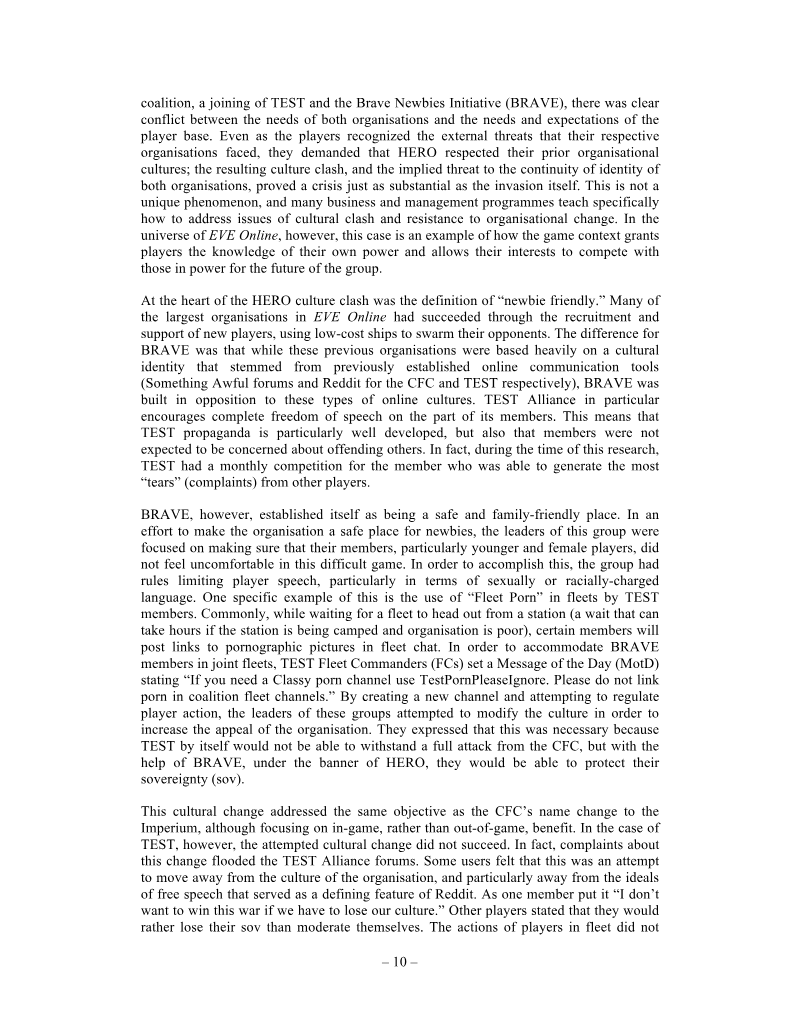
- The crowdfunded Fountain War history book failed on Kickstarter amid widespread community distrust of The Mittani's motives, with players fearing propaganda or revisionism and viewing commercialisation and perceived real-money trading as eroding the alliance's historic identity.
Playing with Data: Procedural Generation of Adventures from Open Data
This document outlines a novel system for procedurally generating adventure games, drawing inspiration from titles like "Where in the World is Carmen Sandiego?".
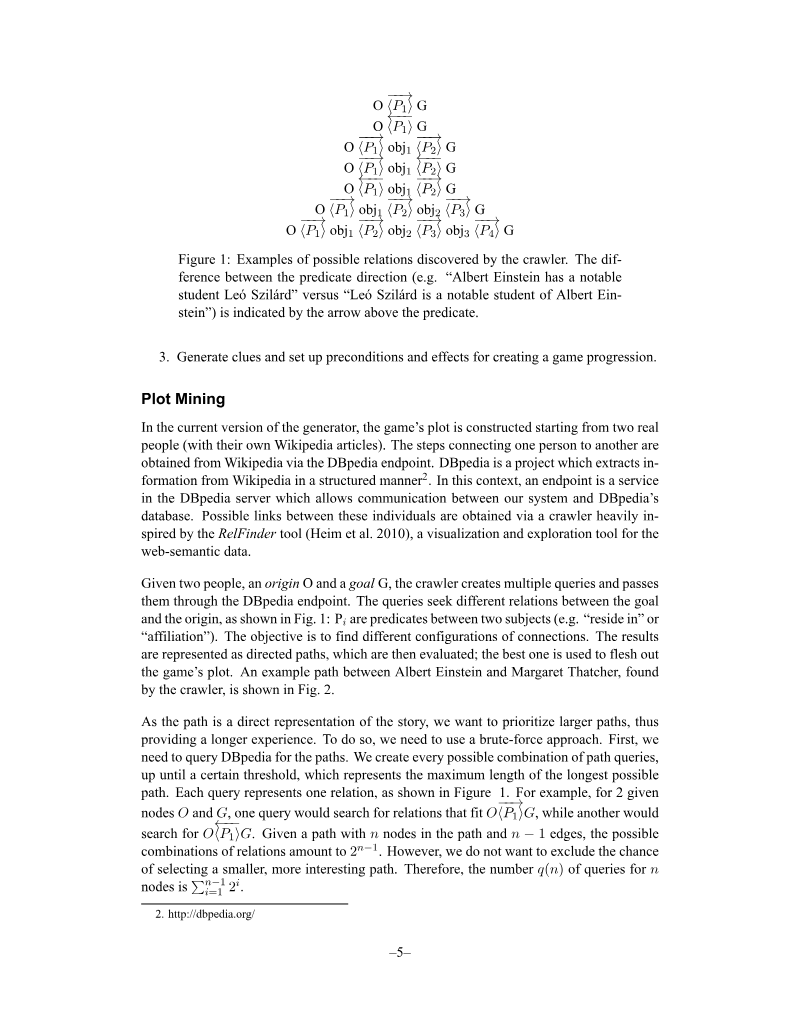
- The system generates playable adventure games by mining relationship paths between two real people from DBpedia (Wikipedia structured data), then turning those paths into NPCs, locations, and items enriched with OpenStreetMap geodata and Wikimedia Commons imagery.
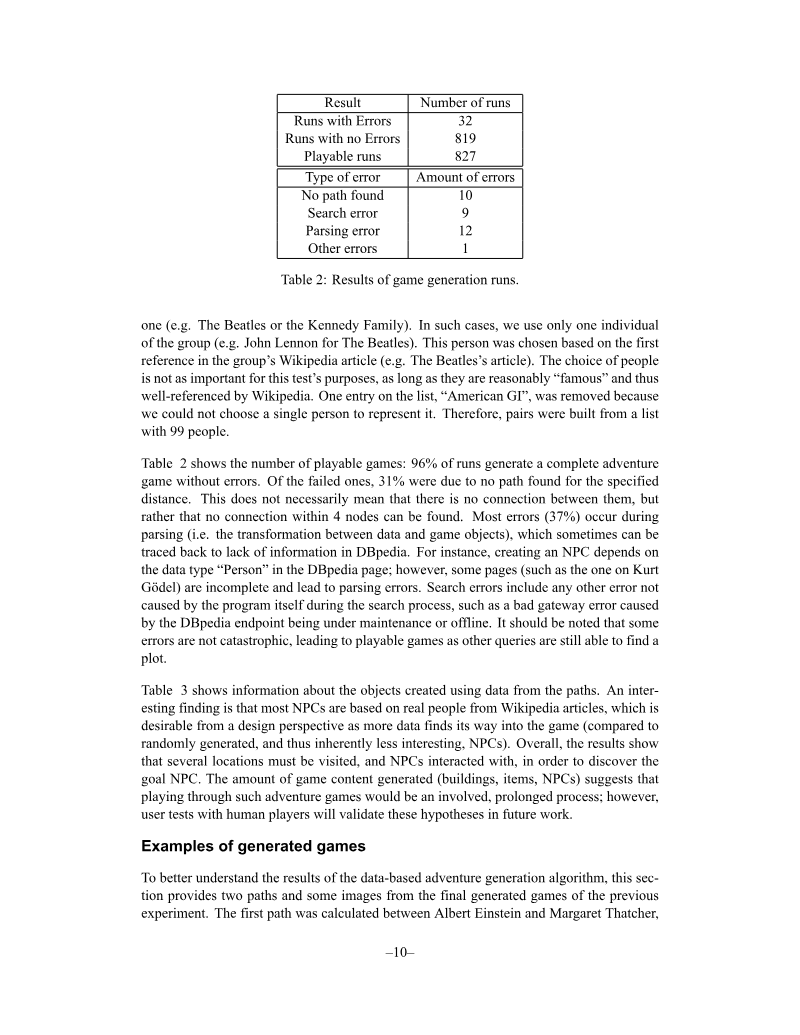
- In testing across 851 runs using Time's 100 Most Important People of the 20th Century, the generator produced playable games in 96% of cases (827 runs), with failures mostly due to parsing errors and missing DBpedia paths.
- Generated games averaged about 8.3 nodes per path, and 74% of NPCs corresponded to real people; the brute-force crawler enumerates 2^(n-1) relation-direction combinations per n-node path and scores candidates by length and uniqueness.
Do you work at DiGRA? Get a free report of how these documents are read and cited here.