
DiGRA
The Digital Games Research Association: the international association of academics and professionals who study digital games. Its Digital Library holds the proceedings of the DiGRA conferences since 2002.
Documents
Game Jams as an Opportunity for Industry Development
This paper investigates the role of game jams as a bottom-up mechanism for fostering community and industry development within weak game development ecosystems, specifically focusing on Tasmania, Australia.
- Game jams are proposed as a bottom-up way to connect isolated developers in Tasmania, a small Australian state with a weakly supported, poorly visible games sector, with the authors arguing community-building must precede formal industry growth.
- The two 2015 state-wide jams drew 60 participants forming 16 teams at TasJam:Voices and 80 participants producing 14 games over 32 hours at TasJam:Health.
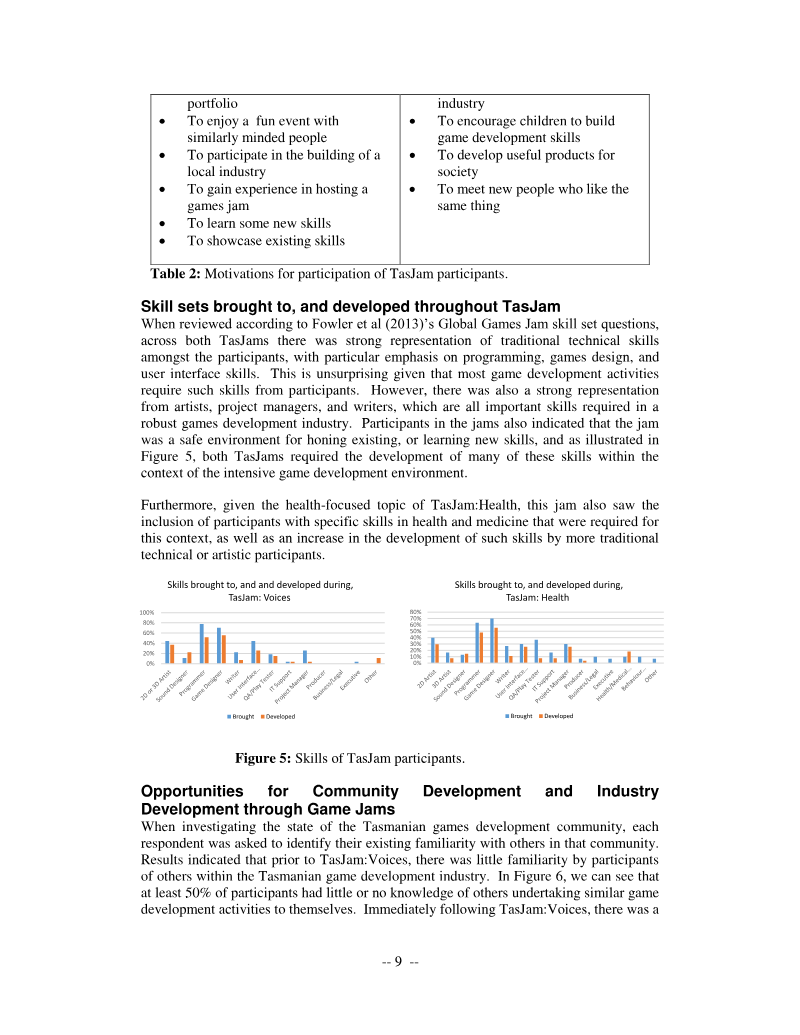
- Familiarity among local developers was low before the jams and rose markedly afterward, with over 70% of respondents reporting increased familiarity and most reporting new professional and personal contacts.
Environmental Storytelling, Ideologies and Quantum Physics: Narrative Space and the BioShock Games
Space in the BioShock trilogy is not a mere backdrop but a core narrative device operating on three levels: the storyline, the storyworld, and the narrative universe.
- Environmental design in the BioShock trilogy is treated as a core narrative element rather than backdrop, with the game space itself functioning as a thematized story that carries meaning.
- Using a three-level framework of storyline, storyworld, and narrative universe, the study argues that game narratives should be analyzed across these layers, positioning environmental design as a primary bearer of story and ideology in interactive fiction.
- In the original BioShock, a 'Rapture narrative' is assembled gradually by the player from non-chronologically ordered audio diaries and environmental clues alongside the player's own storyline.
A Lightweight Videogame Dialogue Manager
The document introduces a lightweight, procedural dialogue manager for video games, presenting it as an alternative to traditional branching dialogue systems.
- The paper presents a lightweight procedural dialogue manager for videogame NPCs that extends the Talk of the Town framework so knowledge exchanges between characters render as naturalistic conversations rather than symbolic transfers.
- The approach aims to avoid the authoring burden, limited player agency, and weak state-responsiveness of conventional branching dialogue, relying on speech-act-like "dialogue moves," preauthored conversational goal plans, and stackable conversational frames activated by world-state preconditions.
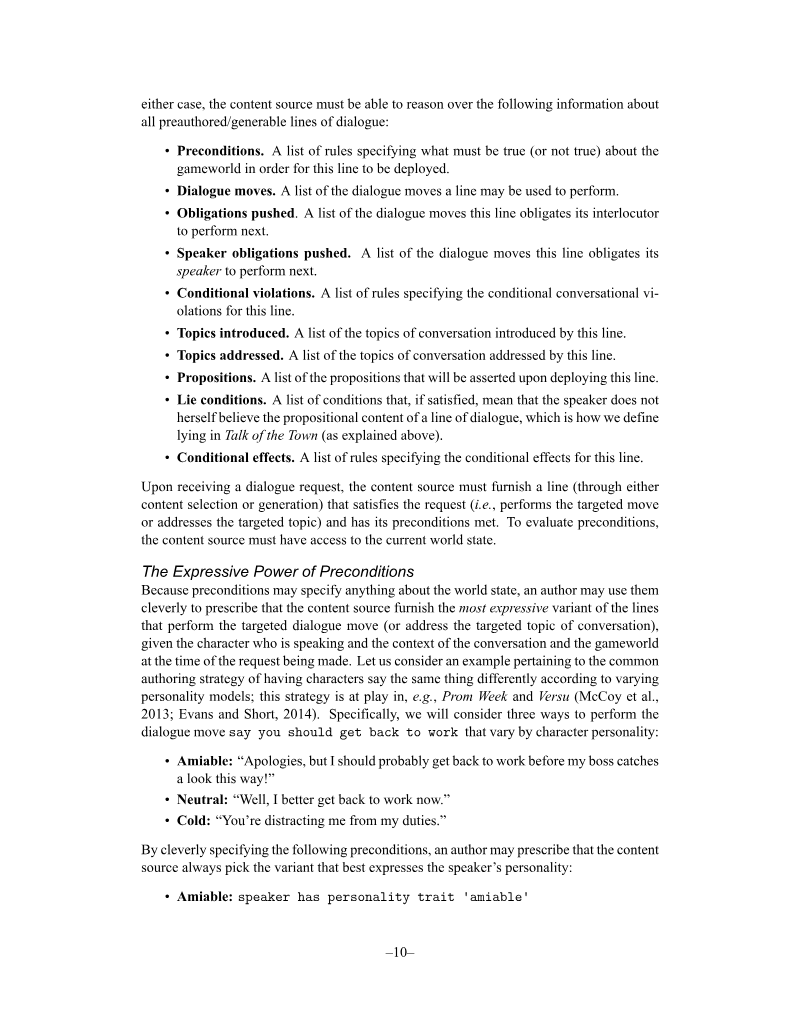
- The system models four knowledge-propagation evidence types (statement, declaration, lie, and eavesdropping) and uses per-line metadata for preconditions, moves, obligations, lie conditions, and effects, with obligations governing local coherence and goals governing global coherence.
The Tapper Videogame Patent as a Series of Close Readings
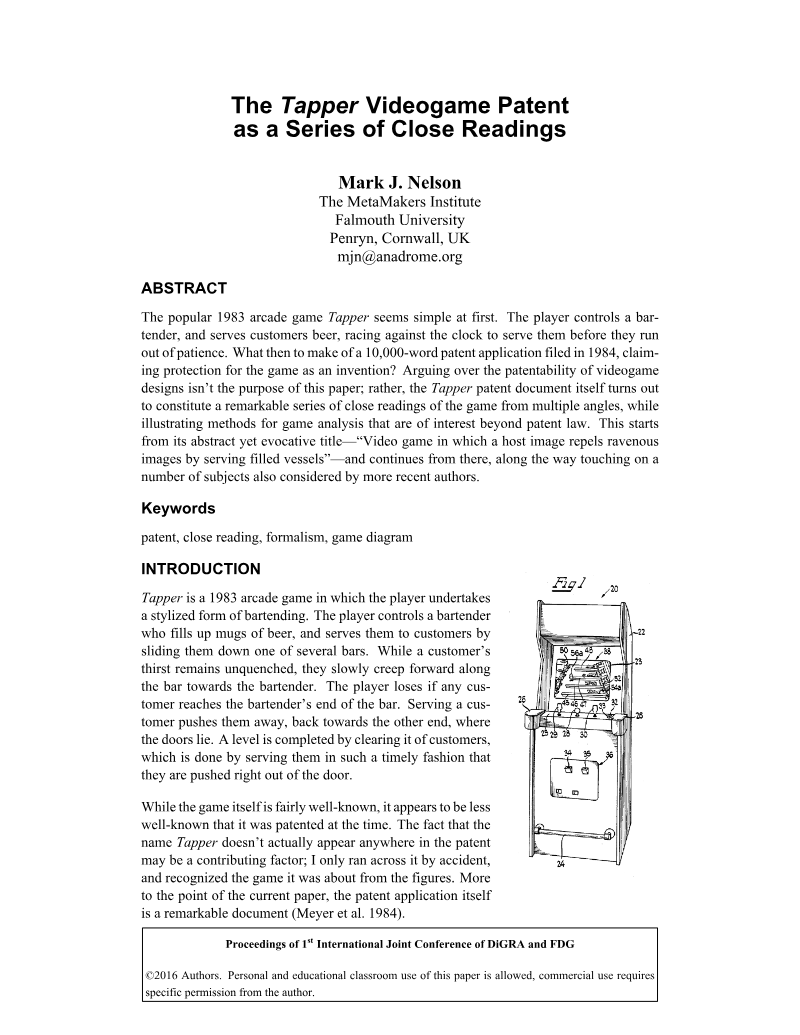
Mark Nelson reads the 1984 patent for Bally Midway's Tapper (1983) as a series of close readings of the game itself, setting aside any argument about patentability.
- The work treats the 1984 Tapper patent (U.S. 4,643,421) as a rich object for close reading, reading its title, abstract, field of invention, description, claims, drawings, and flowchart as successive layers that produce a formalist analysis of the 1983 arcade game.
- The patent's title frames Tapper as a "reskinnable game space" rather than a single fixed product, illustrated by the Budweiser-to-root-beer reskin, suggesting it is better understood as a generalizable system.
- The patent's field of invention classifies Tapper as a nonviolent shooter, a categorization the author contrasts with order-fulfillment relatives such as BurgerTime and Diner Dash.
Collegiate E-sports as Work or Play
This study explores the perceptions of collegiate esports athletes regarding their competitive gameplay, specifically whether they view it as work or play, through the lens of Stebbins' serious leisure perspective.
- The study frames competitive gaming as resistant to simple classification as work or play, arguing that its mix of intrinsic enjoyment and demanding, structured routines blurs the boundary, drawing on philosophical accounts from Kant, Schiller, Huizinga, and Suits.
- The empirical core is based on twelve interviews with collegiate players at two North American universities: one scholarship-based program under athletics and one volunteer-run club, interpreted through Stebbins' serious leisure framework.
- Players described competitive gaming as fun and exciting, with winning and creative strategic play central to their enjoyment, yet reported a work-like seriousness that was especially pronounced in the scholarship environment, where coaches offered guidance and feedback rather than strict control.

Playing the System: Comparing the Efficacy and Impact of Digital and Non-Digital Versions of a Collaborative Strategy Game
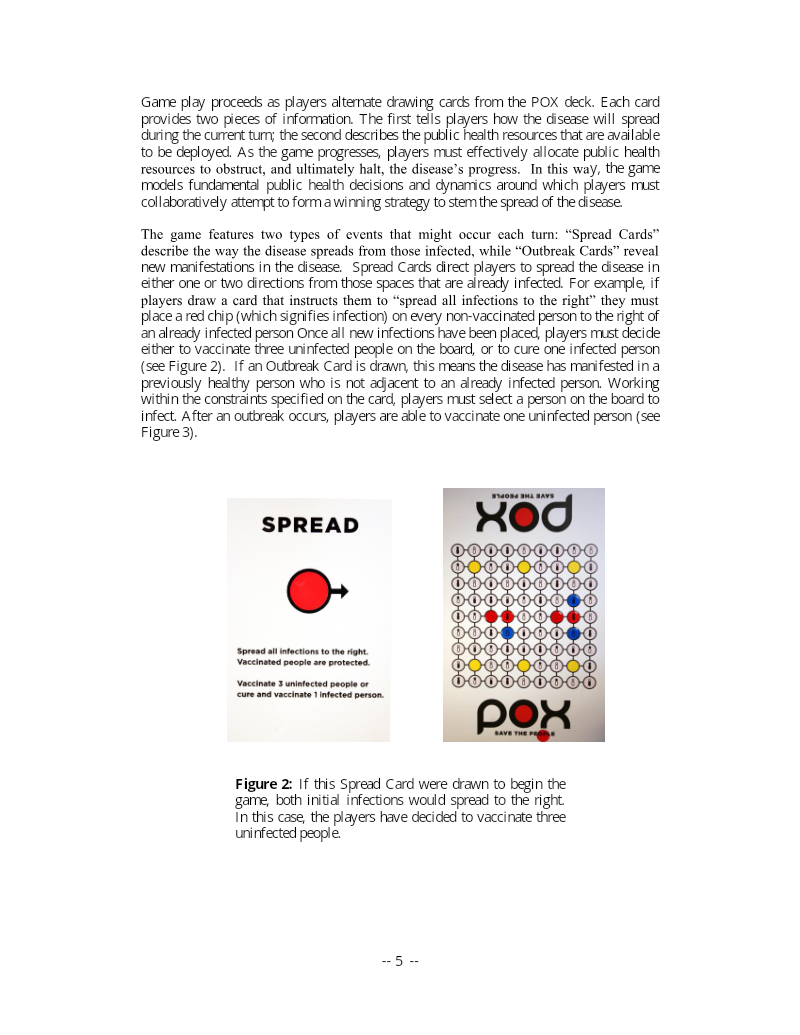
This study investigates the comparative efficacy of digital and non-digital versions of "POX: Save the People," a collaborative public health strategy game, on youth aged 11-17.
- The study tested POX, a cooperative public health strategy game, in non-digital and nearly identical iPad versions with 88 U.S. students aged 11 to 17 randomly assigned to a version or a no-game control.
- Players of the physical board game scored significantly higher than the digital group on the Department Store Task, a measure of systems thinking, and the authors present this as the first causal evidence that a game can improve systems thinking.
- Non-digital players allocated more resources toward vaccination and held more favorable views of vaccination than controls, while the digital version produced no such gains.

Finding Meaning in Abstract Games: A Deep Reading of Sage Solitaire
The document proposes a methodology for interpreting the meaning of abstract games, which are characterized by minimal thematic assets, through their rules and dynamics.
- Mike Treanor proposes a four-stage methodology for interpreting abstract games (those lacking text, images, or sound): implement the game as code, build a simulated player embodying a plausible human strategy, run large numbers of simulations, and analyze the resulting patterns to draw interpretive conclusions.
- The method locates an abstract game's meaning in its rules and the dynamics players experience, and is positioned as a humanistic practice distinct from sociological, historical, or AI-optimizing approaches, since the simulated player is designed to illuminate player experience rather than play perfectly.
- Applied to Zach Gage's iOS card game Sage Solitaire (Single Deck mode), the deliberately unsophisticated simulated player averaged 517 points across thousands of games, with a high of 890, and cleared the full deck about 5% of the time.
Integrating Curiosity and Uncertainty in Game Design
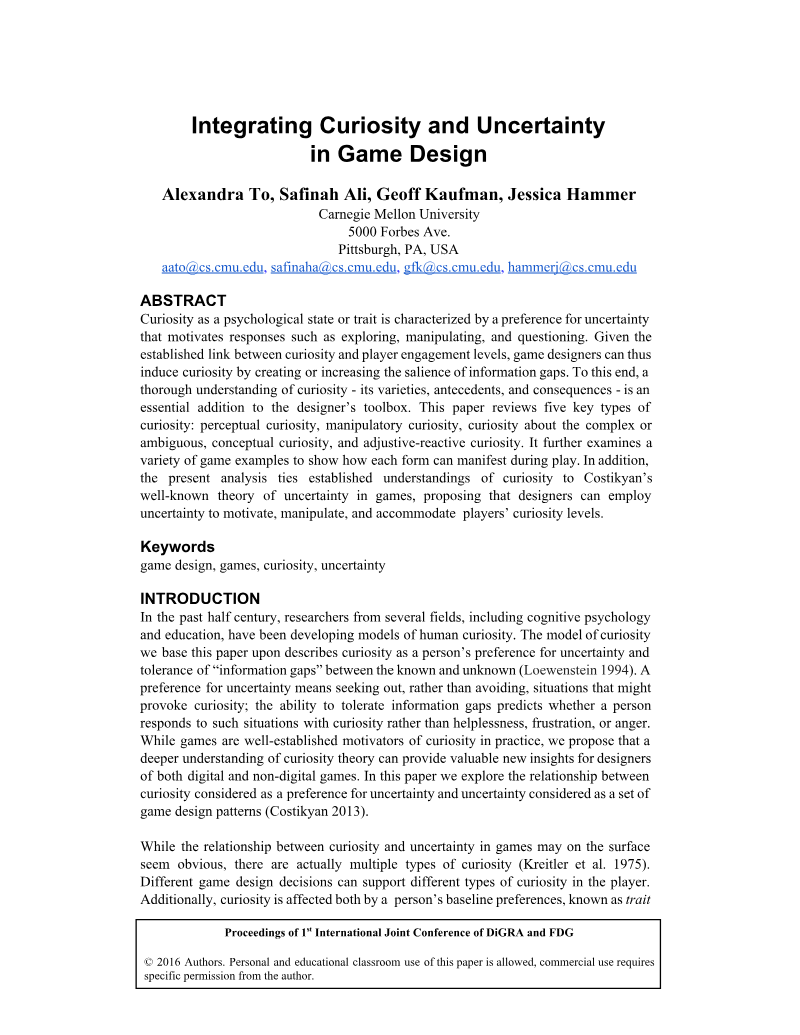
The document, "Integrating Curiosity and Uncertainty in Game Design," posits that curiosity, understood as a preference for uncertainty, is a fundamental driver of player engagement and can be strategically leveraged by game designers.
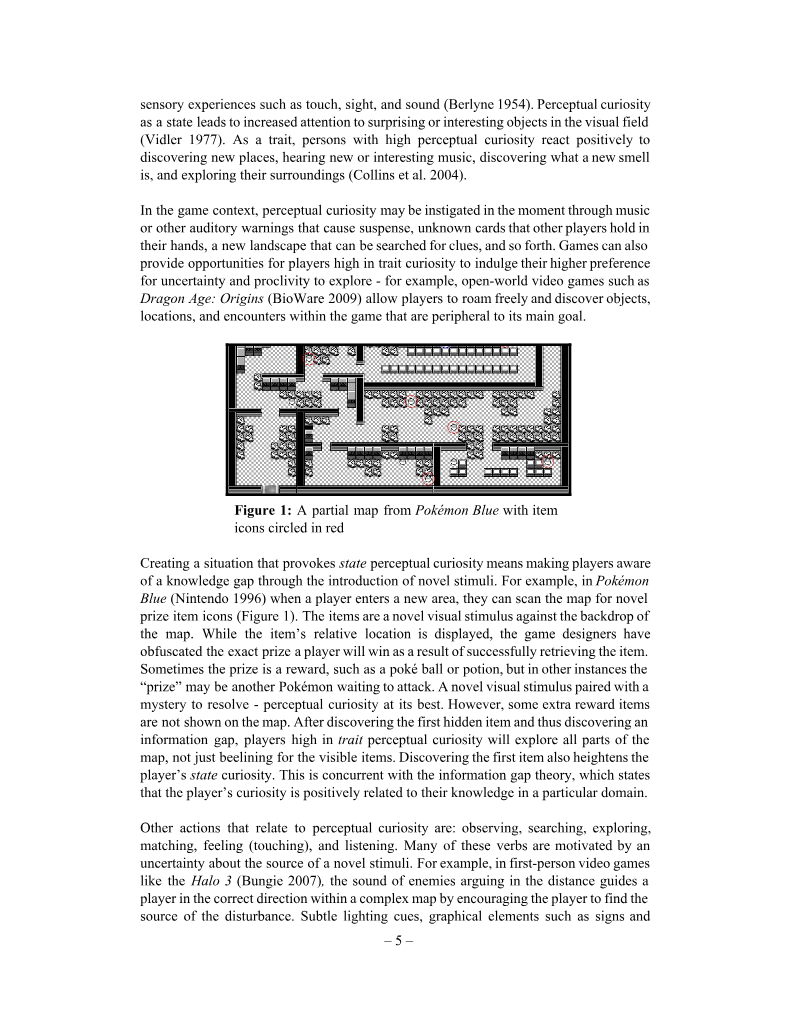
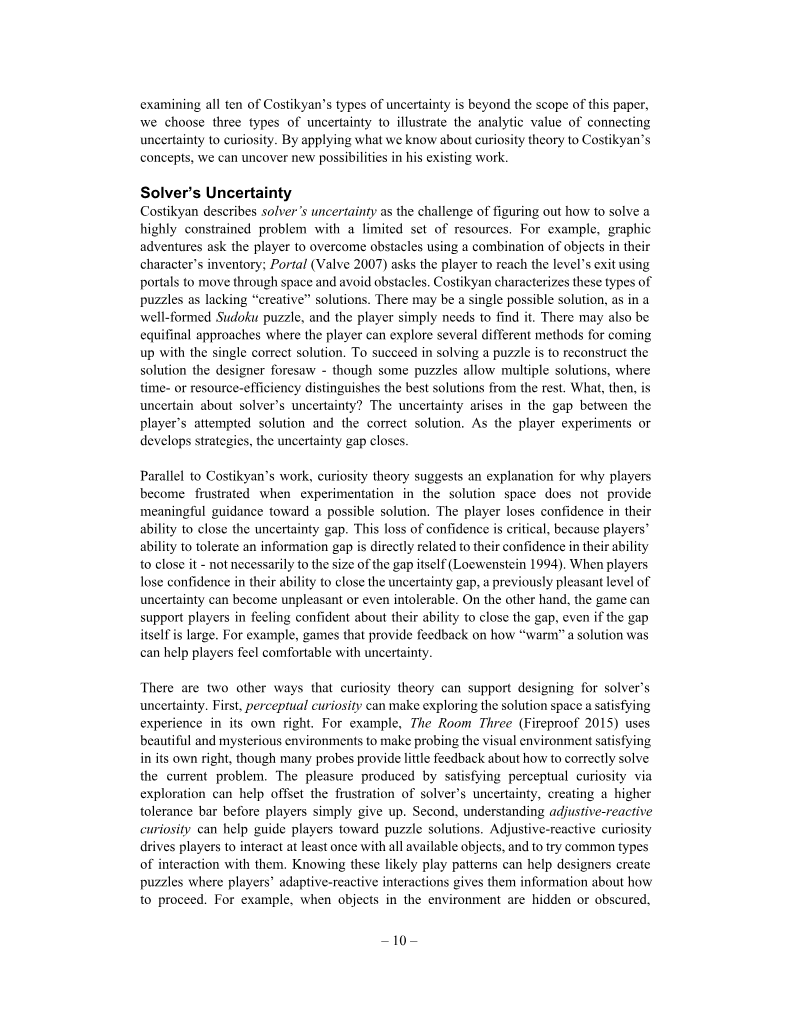
- The report argues that curiosity in game design should be split into five distinct forms (perceptual, manipulatory, complexity/ambiguity-based, conceptual, and adjustive-reactive), each responding to a different kind of uncertainty, rather than being treated as a single construct.
- Tolerance for uncertainty depends less on the size of a knowledge gap than on the player's confidence that the gap can be closed, so feedback mechanisms such as 'warmth' indicators in puzzles make uncertainty more enjoyable by raising that confidence.
- The authors contend that existing player-engagement models, such as Lazzaro's Four Keys and the MDA framework, miss this differentiation and would benefit from integrating curiosity theory with Costikyan's typology of uncertainty.
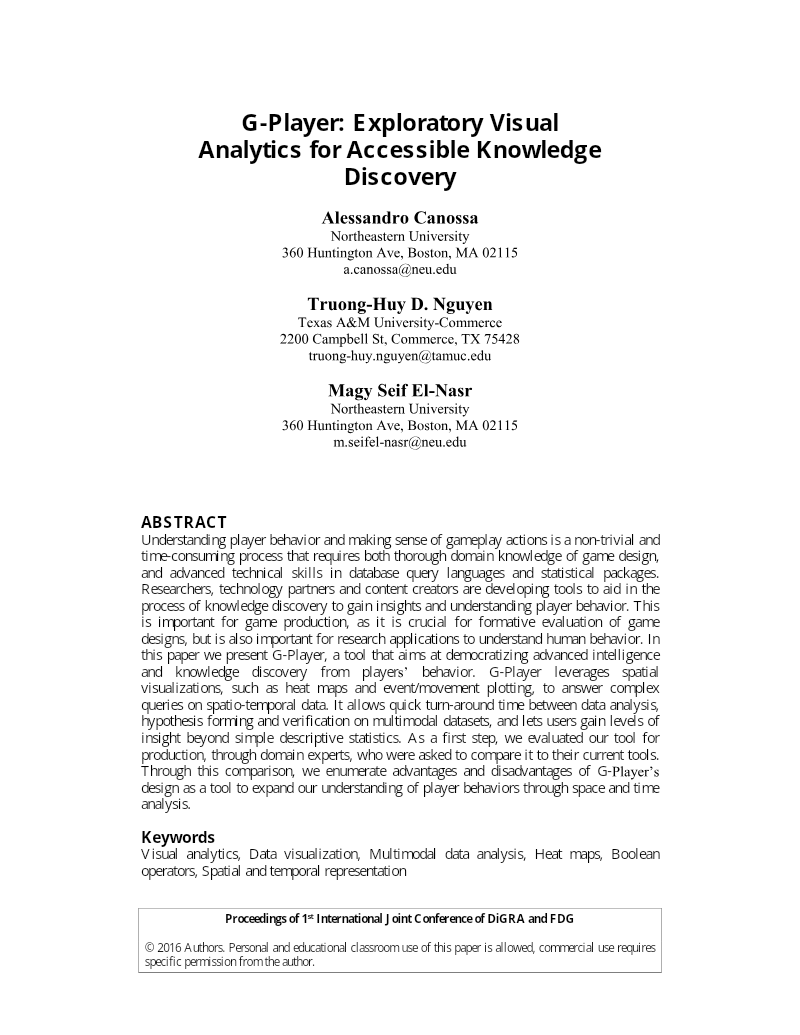
G-Player: Exploratory Visual Analytics for Accessible Knowledge Discovery
G-Player is an exploratory visual analytics tool designed to democratize the complex process of understanding player behavior in video games.
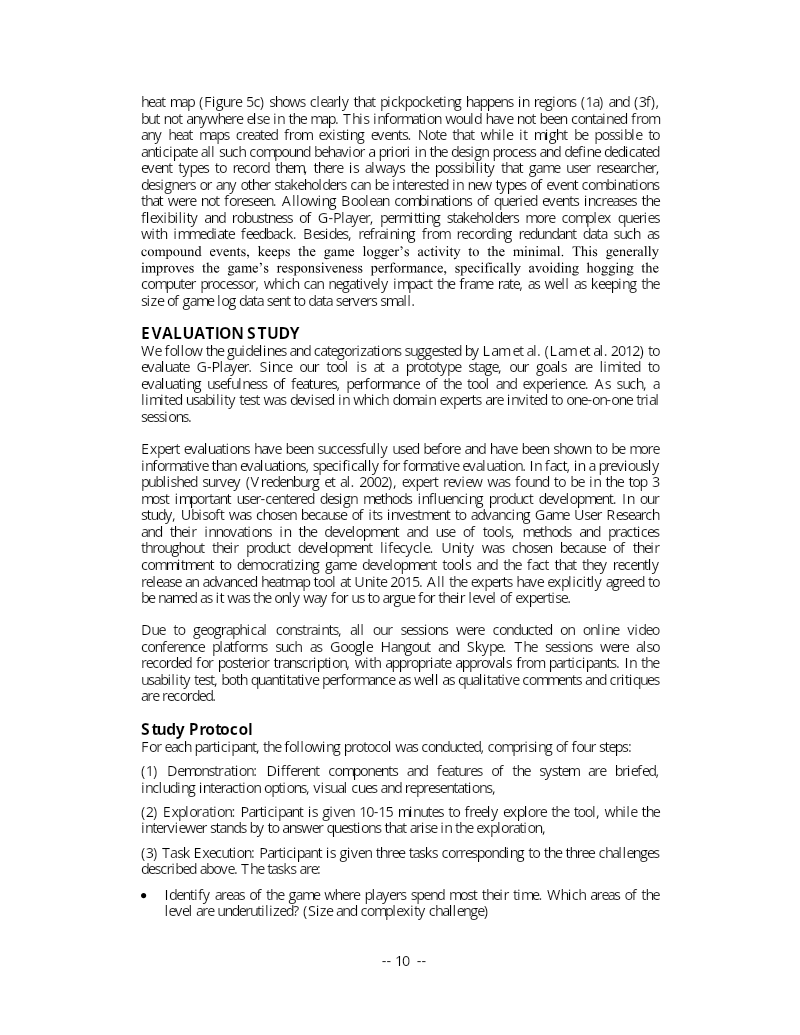
- G-Player is a spatio-temporal visual analytics prototype that makes game telemetry analysis accessible to non-experts by combining heat maps, movement plots, and Boolean operators, addressing the gap between aggregated statistics (which lose individual detail) and individual trace viewers (which don't scale).
- Its central contributions are space-time constraints and Boolean-compound heat maps, which let users filter and compare player behavior patterns with precision.
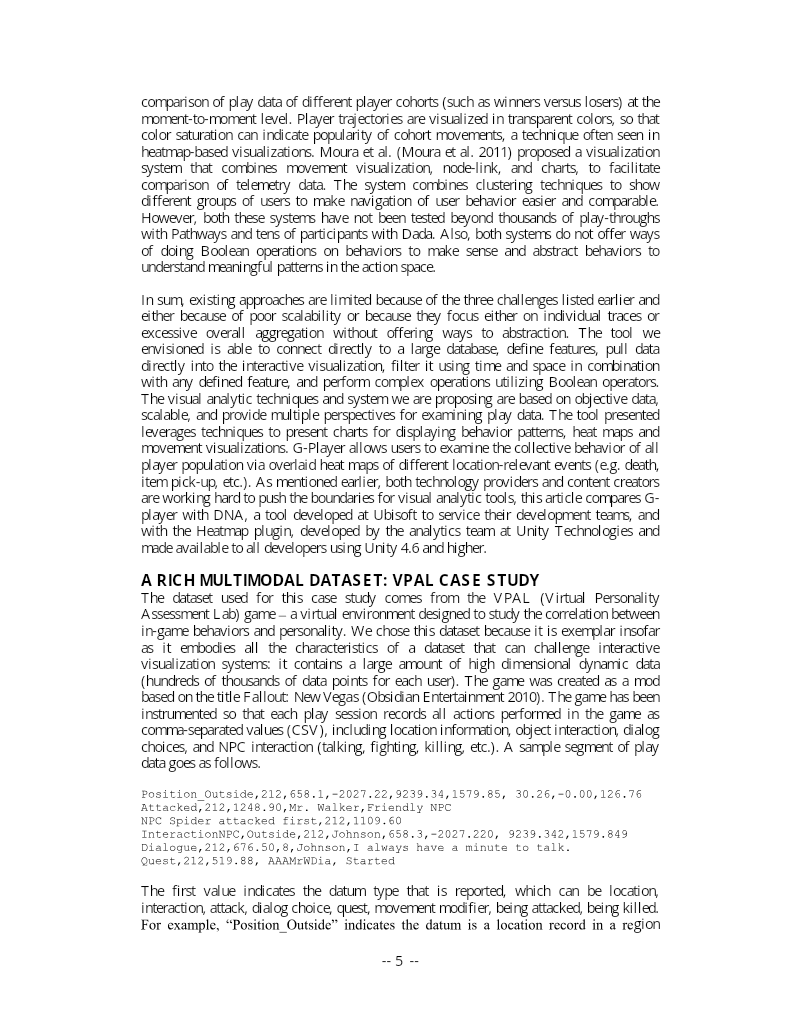
- The tool was demonstrated on a pickpocketing example from the VPAL case study, a Fallout: New Vegas modification that generates extensive per-user logs, with the system designed to handle hundreds of thousands of logged data points per user.
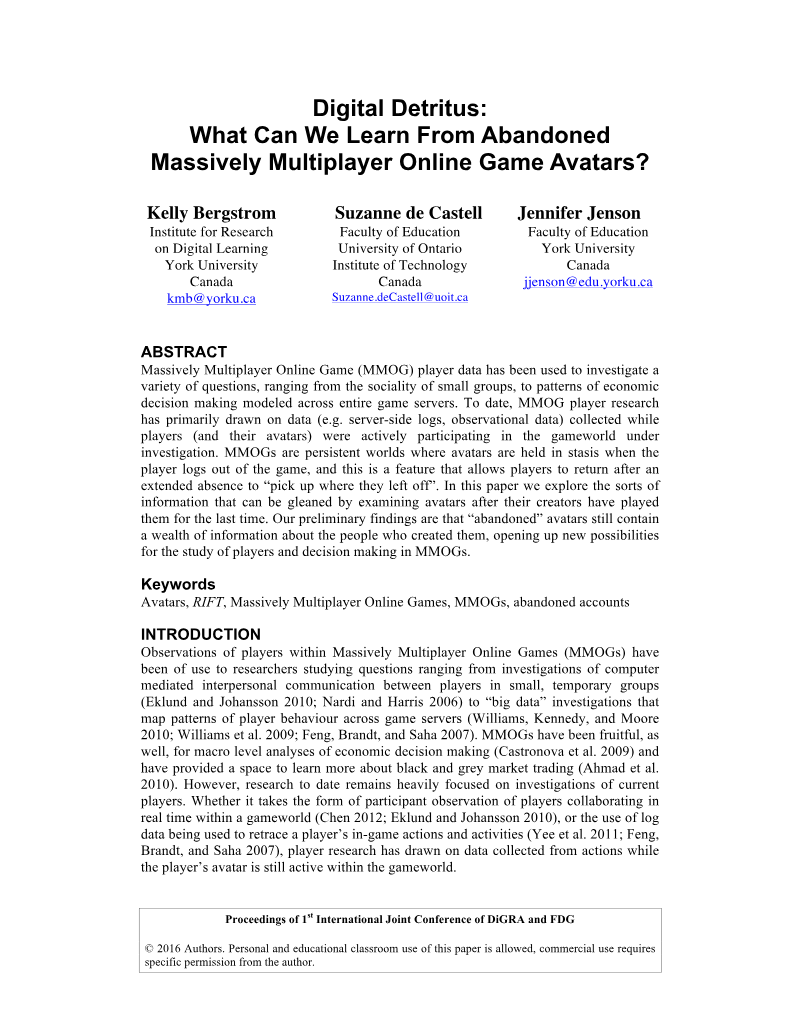
Digital Detritus: What Can We Learn From Abandoned Massively Multiplayer Online Game Avatars?
The document, "Digital Detritus: What Can We Learn From Abandoned Massively Multiplayer Online Game Avatars?", proposes a novel research methodology: analyzing abandoned massively multiplayer online game (MMOG) avatars as "digital time capsules" to gain insights into player behavior and decision-making.
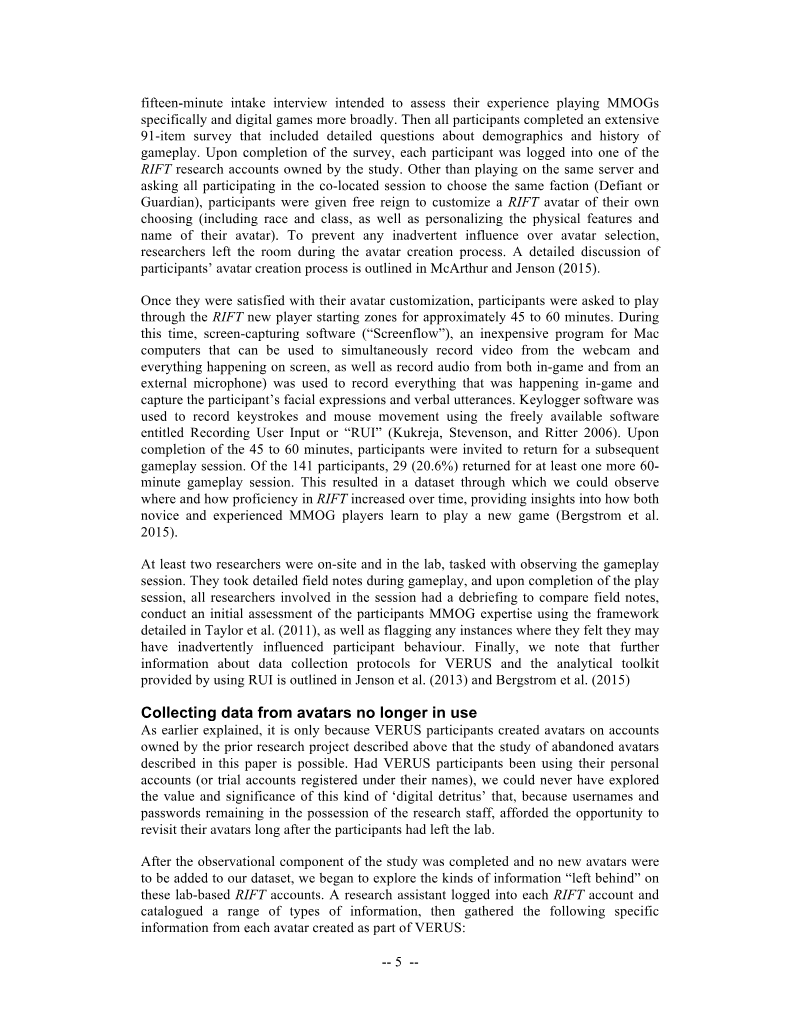
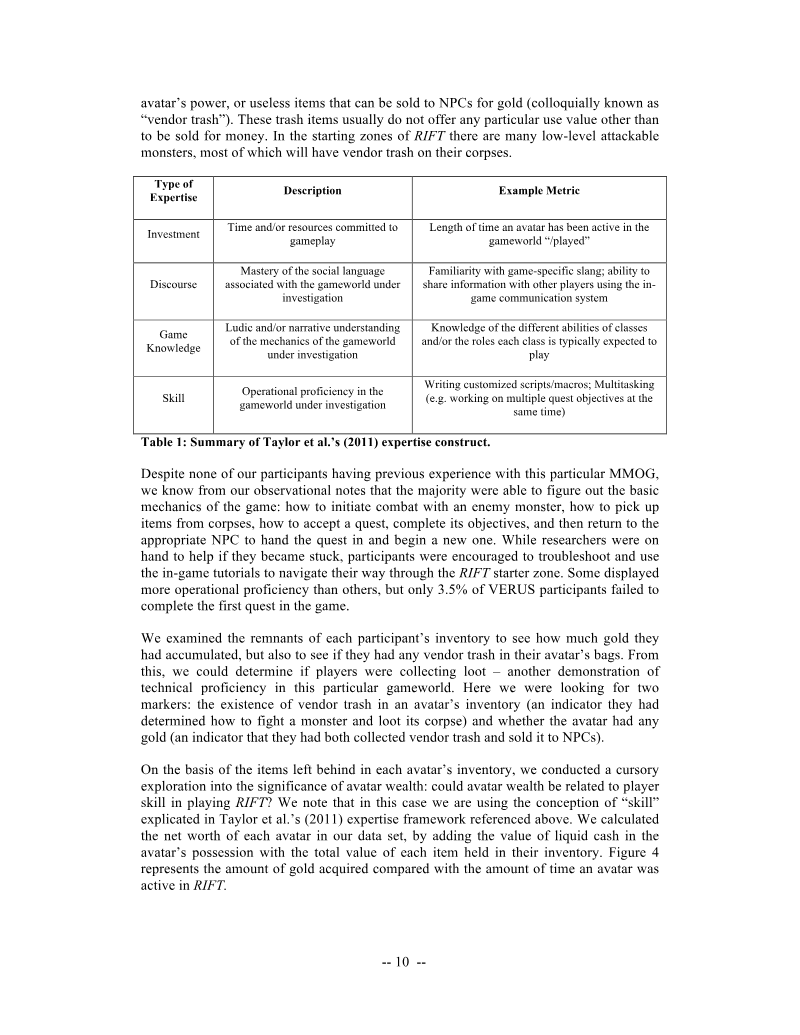
- Abandoned MMOG avatars retain a detailed record of player decisions about equipment, currency, quest progress, skill trees, and inventory, which the authors term "digital detritus" and propose studying through trace ethnography alongside server-side logging and observational research.
- The VERUS project studied 141 participants playing the MMOG RIFT in a laboratory, with 29 returning for additional sessions, and researchers recovered their avatars after the players could no longer access the accounts.
- Customization was near-universal among participants, with only 3.5 percent skipping the soul quest.
Playful Fandom: Gaming, Media and the Ludic Dimensions of Textual Poaching
Mavridou argues that fandom has a ludic dimension that deserves study from a game studies perspective, and that fan studies and game studies would benefit from sharing theory and methods.
- The paper argues that fandom has a ludic (playful) dimension that deserves systematic study within game studies, and that the overlapping theories and methods of fan studies and game studies remain underexploited.
- Drawing on Salen and Zimmerman's definition of play as "free movement within a more rigid structure," the author frames fan activity both as game-like systems (e.g., Jenkins's account of the Survivor spoiler community) and as resistant or transformative play against media industry rules.
- The central conclusion is that resistant fan play tends to be transformative rather than radically subversive, because fandom remains dependent on the centralised structures it engages with.
Developing Ideation Cards for Mixed Reality Game Design
The document introduces a novel ideation tool, "Mixed Reality Game Cards," designed to facilitate the collaborative development of Mixed Reality Games (MRGs).
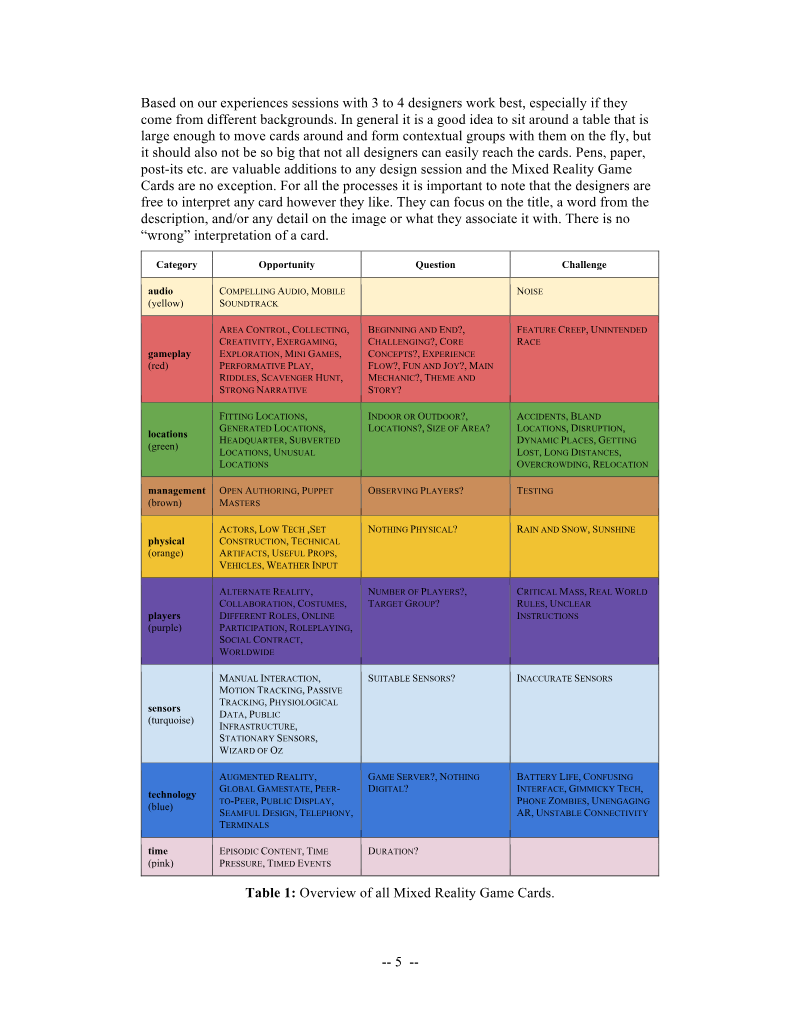
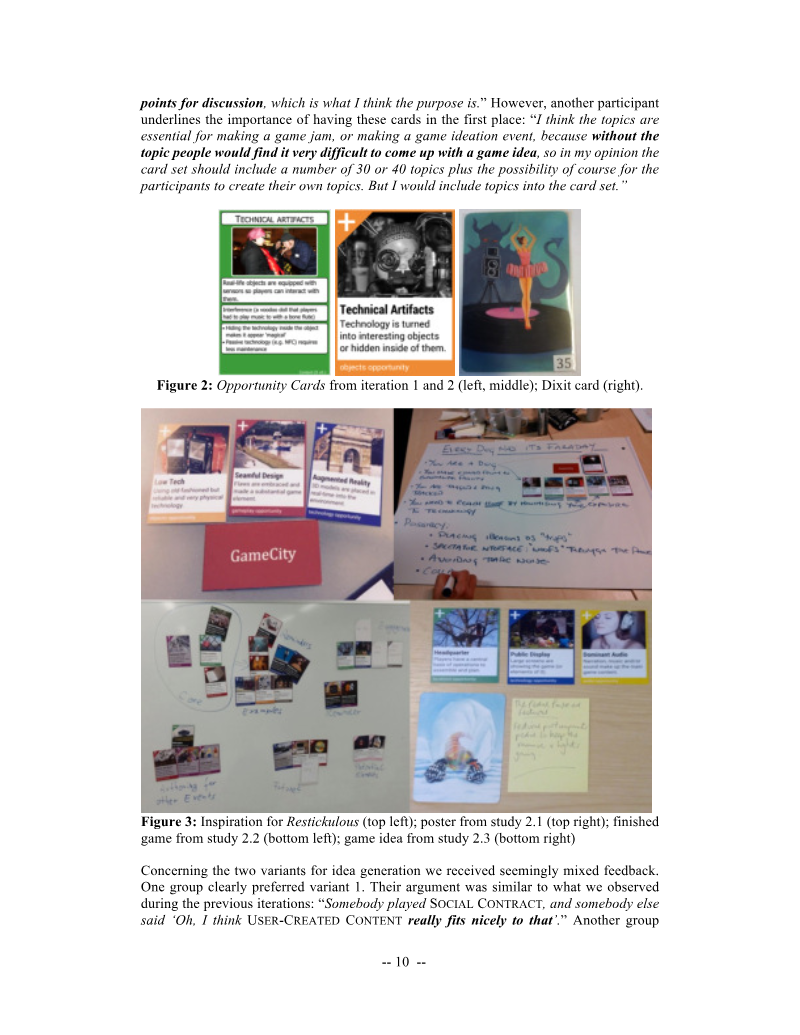
- The Mixed Reality Game Cards deck contains 93 cards in three functional types: 51 Opportunity, 18 Question, and 24 Challenge cards, separating idea creation, reflection, and risk-checking, unlike single-type tools such as PLEX, VNA, the IDEO Method Cards, and the Deck of Lenses.
- The deck was developed iteratively across six studies and is recommended for collaborative sessions of three to four designers, with flexible card interpretation.
- Early participant questionnaire means ranged from about 3.6 to 4.33 on a five-point scale, with early criticism of heavy text and weak graphics that later iterations addressed.
Do you work at DiGRA? Get a free report of how these documents are read and cited here.