
DiGRA
The Digital Games Research Association: the international association of academics and professionals who study digital games. Its Digital Library holds the proceedings of the DiGRA conferences since 2002.
Documents
Mama Ludens Ex Domo: Using Feminist Methods to Diversify Game Culture
The document outlines a qualitative research approach, inspired by feminist critical action research, aimed at diversifying game culture by including traditionally overlooked participants, specifically older women and mothers.
- The paper argues that explicitly feminist, qualitative action research can both generate research insight and raise consciousness among marginalized women, positioning these methods as a tool for leveling the playing field across gender and age in game culture.
- Its empirical basis is the "Mama Ludens" project on gaming mothers, examining how they manage time and leisure within family life, using in-depth home and online interviews, participant observation, play diaries, a research blog, and planned "pizza parties" to foster exchange.
- A life-line interviewing tool adapted from Davies helped many participants recognize themselves as long-term rather than accidental gamers, with some reporting more than twenty years of play.
Players, Diverse Bodies and Embodied Interpretation: Issues in Research Design
The document outlines the research design for a study investigating how disabled players interpret science fiction-themed games, focusing on the dynamic relationship between bodies, lived experience, knowledge, and interpretation.
- Carr's paper argues that play is an embodied activity and that accounts of player embodiment assuming a standardized or universal body are inadequate.
- The study aims to build an account of embodied meaning-making grounded in the dynamic relationship between bodies, lived experience, knowledge, and interpretation, drawing especially on critical disability studies.
- The paper challenges the prevailing portrayal of disability in science fiction and games as something cured or augmented by technology, and clinical models that treat disability as an individual deficit to be hidden or fixed.
Improving Interaction With Non-Player Characters Through Physiological Data
This document proposes an experimental design to enhance non-player character (NPC) interaction in video games by leveraging physiological data to estimate player emotional states.
- The paper proposes using physiological signals to estimate players' emotional states so NPCs can respond to how players feel, not just to their prior choices, filling a gap in conventional NPC design that lacks access to emotional cues.
- The prototype is built in Unity and connected to an Arduino via the eHealth toolkit, using galvanic skin response as an estimate of arousal and electromyography as an estimate of valence, mapped onto the Russell arousal-valence plane.
- Baseline physiological measures are recorded during calm phases before key choices, and NPCs then present one of four dialogue options with matching gestures based on the detected emotional position.
Sarmatian Gamified: Sarmatism in Contemporary Polish Gaming Culture
The document analyzes the portrayal of Sarmatism, a significant cultural formation of Polish and Lithuanian nobility from the 16th to 18th centuries, within contemporary Polish gaming culture.
- The paper argues that Polish players and designers have built a coherent image of sarmatism, the ideology of the Polish-Lithuanian nobility from the 16th to 18th centuries, through analog and tabletop products, and that this image often conflicts with how foreign-produced, largely digital games depict the same region and era.
- The central corpus is the tabletop role-playing game "Dzikie Pola" (1997), the card game "VETO!" (2004, 2007), and the wargame "Ogniem i Mieczem" (2009/2010) with its expansions, compared against Paradox's "Europa Universalis 3" (2007), "Reign: Conflict of Nations" (2009), and "Mount & Blade: With Fire and Sword" (2011).
- The author contends that appeals to "historical accuracy" by Polish communities tend to reaffirm the core elements of the sarmatian self-image rather than challenge it.
Singularity: Designing a Cooperative Mixed Reality Game for a Co-located Setting
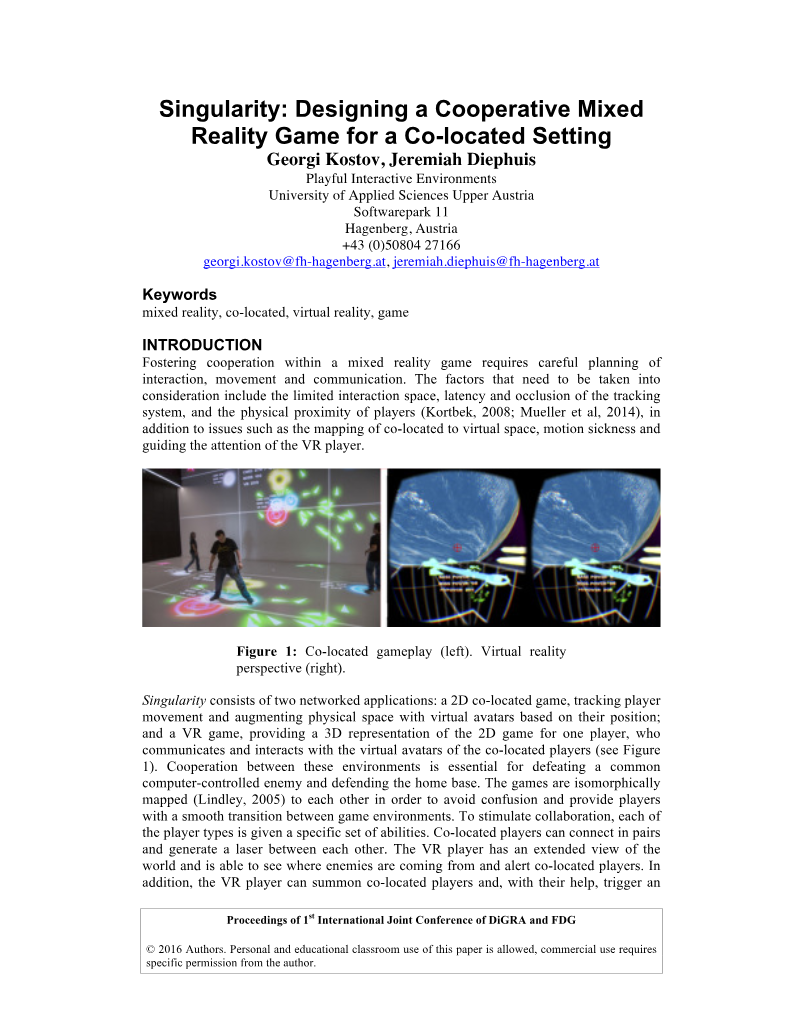
The document details the design and evaluation of "Singularity," a cooperative mixed reality game intended for co-located players.
- Singularity networks a 2D physical-space game with tracked co-located players to a single VR player, using isomorphic mapping between the two environments to support smooth transitions and cooperation.
- Each player type receives distinct abilities to encourage teamwork: co-located players form laser connections, while the VR player summons allies for an area attack.
- Expert review by two VR specialists supported the proof-of-concept but identified areas for improvement; the evaluation is a small qualitative study of a single prototype, so it yields design insight rather than generalizable quantitative results.
Delicate Subjects: Vulnerability and Validation in Action Adventure Games
Diane Carr's paper examines the protagonists of action adventure games and the tension between their vulnerability and the validation they receive through play.
- Diane Carr argues that action adventure protagonists endure spectacular suffering while their ability is continually quantified through achievements, points, progression and collectables, creating a tension between vulnerability and validation.
- The paper's central claim is that protagonists hold privileged positions in game fictions, but this privilege is conditional on continual demonstration of ability, making their status anxious and fragile.
- The analysis uses Thomson's concept of the "normate" from critical disability theory, which describes how unmarked, privileged bodies are sustained by everyday institutions while other bodies are constructed as marginal or deviant.
Operational Logics, Paratexts and the Production of Knowledge: The Diablo III Case
Mateusz Felczak examines how internet-based paratexts, specifically Reddit threads and official Battle.net forum posts, shape the evolving game state of Diablo III and its expansion Reaper of Souls (2014).
- Mateusz Felczak's paper treats fan-generated paratexts (Reddit and Battle.net forum posts, in-game chat transcripts, community guides, YouTube) as an "undecided zone between the inside and the outside" of a work, arguing they belong to the game's diegesis and actively shape evolving game states.
- The study adopts Noah Wardrip-Fruin's operational logics framework, tracing interplay among data, process, surface, interaction, author, and audience, and treats patterns between computational elements equally with human-computer interaction rather than privileging either layer.
- The case study is Diablo III: Reaper of Souls (2014), chosen for its always-online model of updates, patches, and minor adjustments, which the author uses to examine how data moves from cloud-based computation into the game interface.
Playful Fabrication: Speculative Game Designs for 3D Printers
The document outlines a research program called "Playful Fabrication," which aims to reframe personal fabrication technologies, particularly 3D printers, by prioritizing expressiveness, playfulness, and communication over practicality and utility.
- The paper argues personal fabrication (3D printing) is stuck in a utilitarian, engineer-oriented phase and proposes a "Playful Fabrication" research agenda that prioritizes expressiveness, play, and communication over practicality.
- The authors draw an analogy to early personal computing, where a shift from calculation to creative and playful use, partly driven by games, helped bring computers into homes and classrooms, and argue fabrication needs similar catalysts such as accessible interfaces and entertaining applications before reaching a broad consumer market.
- Current fabrication workflows, including the tools used to create and send instructions to printers, still require substantial engineering expertise, and existing use is largely limited to one-off parts, repairs, and rapid prototyping in business and design settings.
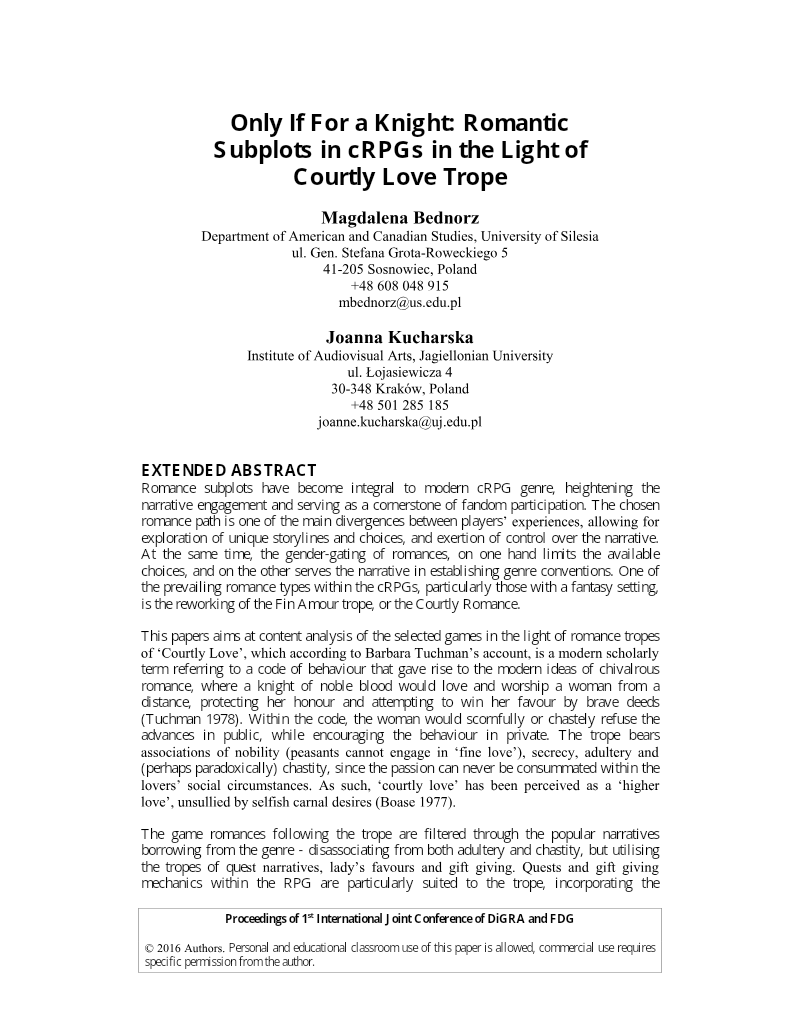
Only If For a Knight: Romantic Subplots in cRPGs in the Light of Courtly Love Trope
This paper conducts a content analysis of romantic subplots in selected computer role-playing games (cRPGs), specifically examining how they adapt the "Courtly Love" or "Fin Amour" trope.
- Modern fantasy cRPGs adapt the medieval courtly love trope, keeping its emphasis on quests, favours, and gift-giving while dropping its associations with adultery and chastity.
- The courtly love framework maps naturally onto RPG mechanics, which is why it is a common foundation for romance design in the genre.
- Romance paths are a key point of divergence in players' experiences and a driver of narrative engagement and fandom participation.
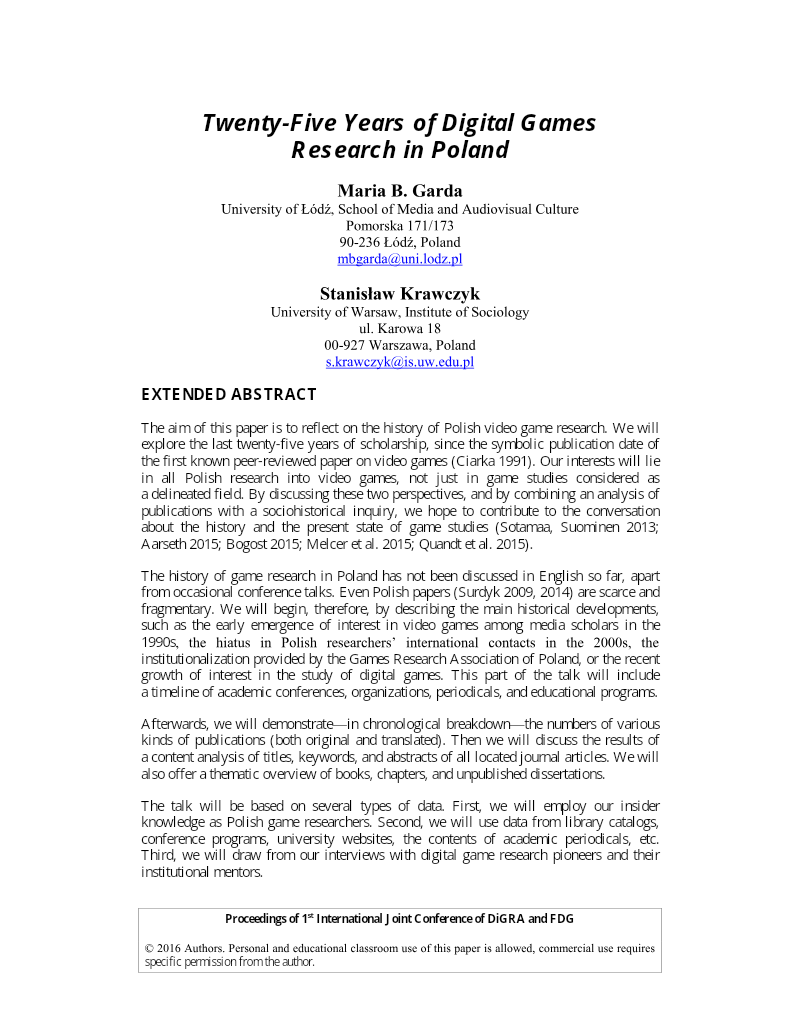
Twenty-Five Years of Digital Games Research in Poland
This paper provides a historical overview of digital games research in Poland over the past twenty-five years, beginning with the first known peer-reviewed publication in 1991.
- The history of Polish video game research is traced over roughly twenty-five years, beginning with what the authors identify as the first known peer-reviewed Polish paper on video games, published in 1991.
- The study takes a broad scope, covering all Polish research into video games rather than only work identifying with a delineated game studies field, and combines a sociohistorical account with analysis of publications including titles, keywords, and abstracts of journal articles.
- Key developments identified include early interest among media scholars in the 1990s, a hiatus in international contacts during the 2000s, institutionalization through the Games Research Association of Poland, and recent growth in research activity.
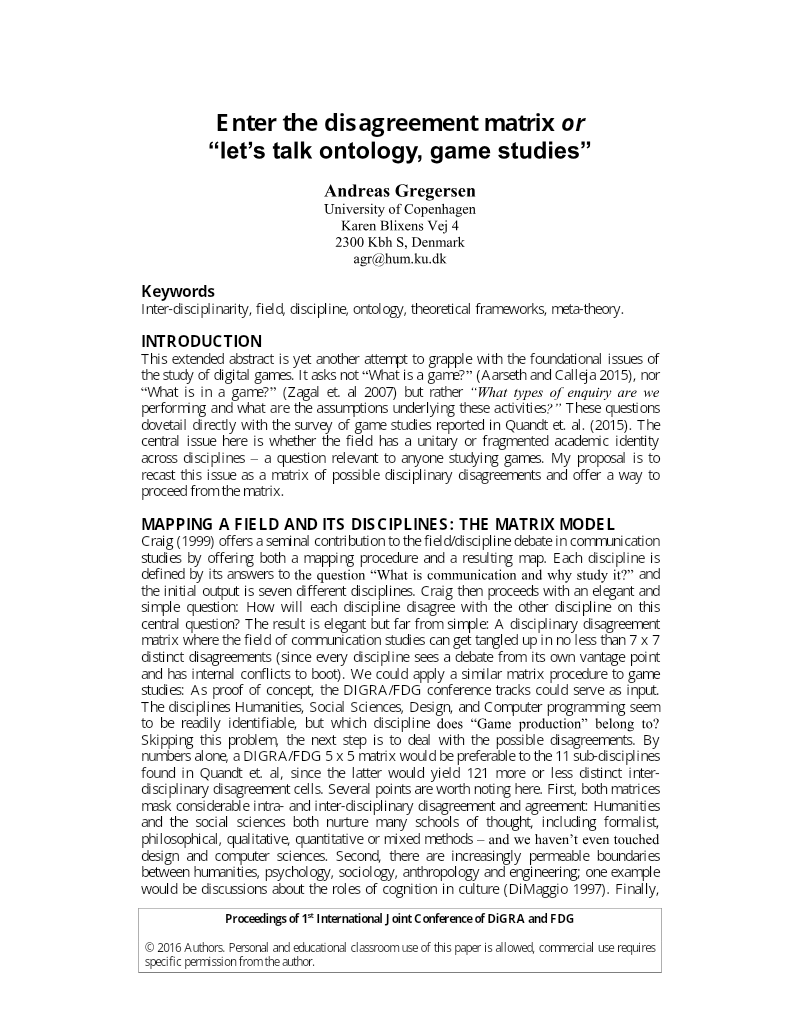
Enter the Disagreement Matrix or "Let's Talk Ontology, Game Studies"
This paper argues that game studies needs a clearer account of its own foundational assumptions, proposing a "disagreement matrix" as a way to map its disciplinary landscape.
- The paper argues game studies needs explicit accounts of its foundational assumptions, proposing a "disagreement matrix" that crosses disciplines against one another to locate where scholars actually disagree, shifting the core question from "what is a game?" to "what kinds of enquiry are we performing and what assumptions underlie them?".
- Mapping the field's five broad disciplines (humanities, social sciences, design, computer programming, game production) yields a 5 x 5 matrix of about 25 cells, versus roughly 121 cells if the 11 sub-disciplines from Quandt et al. (2015) were crossed, making the broad version more tractable.
- The central issue the paper identifies is whether game studies has a unitary or fragmented academic identity, and the matrix is proposed as a way to answer that question.
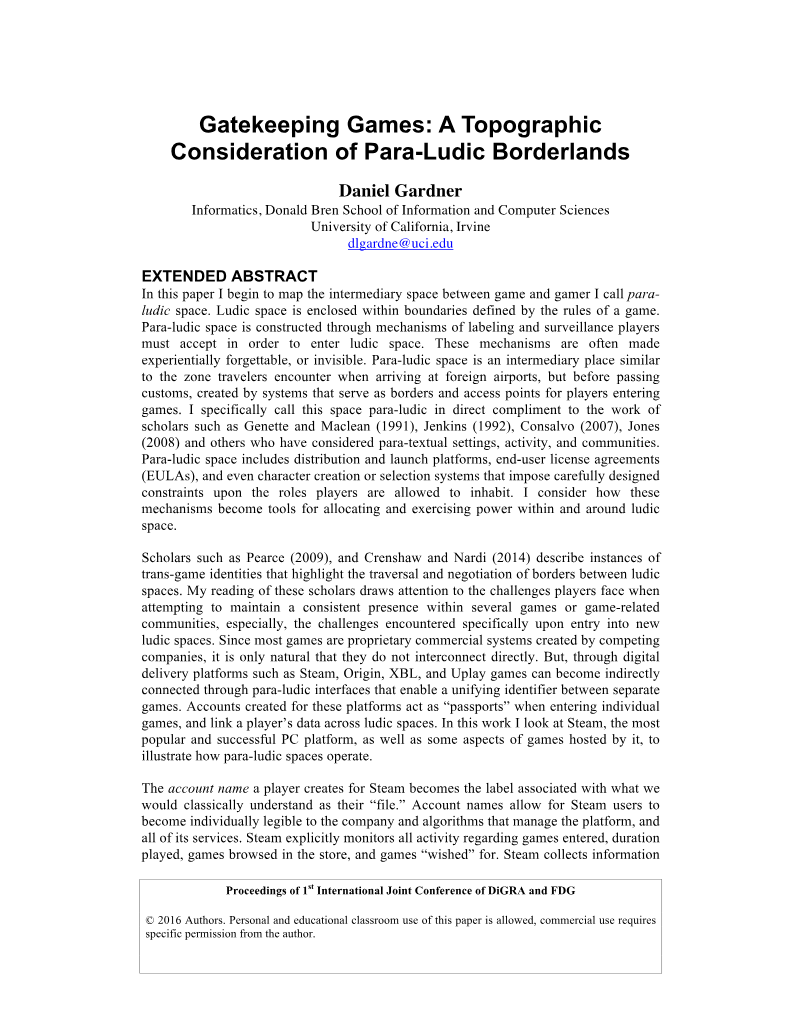
Gatekeeping Games: A Topographic Consideration of Para-Ludic Borderlands
The document introduces the concept of "para-ludic space," defining it as the intermediary zone players navigate between their real-world identity and entering a game's defined "ludic space."
- The paper introduces 'para-ludic space,' the intermediary zone between a game's rule-bound interior and the wider player experience, and argues that distribution platforms, EULAs, and character creation systems function like customs checkpoints that make players visible and classifiable before play begins.
- Steam is the central case study: the author treats its account names as administrative identifiers analogous to surnames in early modern state record-keeping (per James Scott), and its tracking of play time, browsing, and wishlists as serving personalized recommendation and purchase shaping rather than taxation.
- Digital storefronts like Steam are framed as 'passports' that link a player's data across otherwise unconnected games made by competing companies.
Do you work at DiGRA? Get a free report of how these documents are read and cited here.