
DiGRA
The Digital Games Research Association: the international association of academics and professionals who study digital games. Its Digital Library holds the proceedings of the DiGRA conferences since 2002.
Documents
The Mechanic Is Not the (Whole) Message: Procedural Rhetoric Meets Framing in Train & Playing History 2
The document analyzes how procedural rhetoric in serious games is influenced by audio-visual and media framing, leading to divergent audience responses despite similar core mechanics.
- The central thesis is that a serious game's mechanics do not fully determine how its message is received; audio-visual framing and the social frames surrounding public circulation play a decisive role in shaping meaning.
- The divergent receptions of Train (2009, Brenda Brathwaite) and Playing History 2: Slave Trade (2015) correlate with how each was presented to the public rather than with their nearly identical procedural rhetoric.
- Train circulated mainly through a carefully composed photograph of its board on a shattered glass window against a black background, which signaled seriousness and unease and positioned it as an adult art piece, activating an art frame that licenses uncomfortable engagement.
Surviving Fallout 4: A Design Fiction
The document analyzes Fallout 4 as a "design fiction" that offers a compelling vision of a likely future shaped by current unsustainable human activity.
- The paper argues that Fallout 4 (Bethesda Game Studios, 2015) works as a design fiction: a plausible near-future vision shaped by unsustainable resource consumption, climate pressure, and collapsing infrastructure.
- The authors frame the game as a rehearsal space where players can explore survivalist practices and sustainable behavior without the heavy-handed moralizing typical of environmental messaging.
- The analysis credits the game's believable world-building to a design process that asked what it would truly take to produce each object, structure, and settlement system, citing details like functional rain barrels and water-pumping mechanisms.
I Wasn't Looking at His Nice Ass: Female Gaze and Video Games
The document explores the concept of the female gaze in video games, challenging the traditional understanding of video game characters as solely objects of heterosexual male desire.
- The paper argues that Laura Mulvey's male gaze is not tied to biological masculinity and can be applied to male video game characters as objects of desire, reframing the gaze as a flexible analytical tool.
- The author contends that women can engage in objectifying gazes toward male characters, and that the concept remains useful when detached from the biological gender of either viewer or viewed.
- Using Nathan Drake of the Uncharted series as its central case, the paper presents him as a male counterpart to Lara Croft, one of the most discussed female characters in gender and game studies.
Spatial Presence, Psychophysiology, and Game(play) Emotions
This extended abstract proposes a classification for "residual affect" in immersive Virtual Reality (VR) experiences, specifically focusing on innate, autonomic responses like vertigo and startles.
- The paper proposes a new subcategory of game emotion, "I emotions," to describe involuntary, autonomic affect (such as vertigo, startle, and reflexive withdrawal) provoked by immersive VR, which the author argues fits none of the existing categories of fiction, gameplay, or artefact emotions.
- The central claim is that VR-induced reflexes occur before conscious acknowledgement of the game's diegesis, gameplay, or apparatus, because players respond to simulated threats as though they were real.
- The author uses the widely replicated "pit demo," where a convincing illusion of a sheer drop causes dizziness despite the user's rational awareness of their physical surroundings, as a key illustrative example.
Increasing Coherence in Impact: Crossing Disciplines and Framing
This document addresses the growing fragmentation in the "games for impact" sector, particularly concerning communication and comparison of impact among researchers, designers, and funders.
- The field of game design for impact is growing rapidly but fragmenting, making it hard for researchers, designers, and funders to compare proposals and communicate effectively.
- The authors propose new umbrella language and shared frames to enable meaningful comparison across domains and improve impact outcomes, framing this as an open, iterative conversation rather than finished solutions.
- An earlier report, based on dozens of interviews with mainly U.S. sector leaders, identified five areas of concern, including a widening gulf between research and practice and the need for common language to compare impact across domains.
Resisting Patches and Errata: Motivations and Tactics
This paper explores player resistance to patches and errata in video games, challenging the notion that all updates are universally welcomed.
- Patches and errata are framed as rhetorical documents rather than neutral technical fixes: they shape and enforce preferred play styles while retroactively labeling other play as aberrant.
- The study centers on mainstream PC and home console games, comparing single-player and multiplayer contexts, and anchors its analysis in four cases.
- The 2012 Call of Duty: Black Ops 2 balance update weakened sniper rifles and quickscoping, provoking threats against its design director.
Emptiness Beckons: The Allure of Space in Speculative Game Fictions
This paper proposes applying Graham Harman's concept of "allure," drawn from Speculative Realism and specifically Object-Oriented Ontology, to explain why in-game spaces attract players and function as attractive elements of games in their own right.
- The paper applies Graham Harman's Object-Oriented Ontology concept of 'allure' (objects signalling hidden depths that withdraw from full comprehension) to explain why in-game spaces attract players as attractive elements in their own right.
- Its central claim is that the Mass Effect trilogy's distinctive strength lies less in its characters or narrative than in the sense of vastness invested in its universe.
- The author identifies specific settings as producing this allure, including empty moons and planets, abandoned bases and warehouses, and the protagonist's apartment, despite games' tendency to conservatively circumscribe locations.
Gift Players or Playbourers? Who Is Playing Citizen Science Games?
Sonia Fizek's paper examines citizen science games, sometimes called games with a purpose or human-based computation games, in which players contribute to research by solving puzzles, classifying data, or tagging content.
- Citizen science games (games with a purpose or human-based computation games) let players contribute to research by solving puzzles, classifying data, or tagging content, with EteRNA, where more than 38,000 player-scientists assemble RNA shapes, as the central example.
- The paper argues that existing frameworks for unpaid digital activity, centred on free labour, monetization, and "playbour," fail to explain why citizen science players participate.
- Players are framed as "gift players" who take part in an economy of reciprocal giving and receiving, drawing on Marcel Mauss's theory of the gift and Malinowski's account of the kula exchange, rather than as capital-oriented "playbourers."
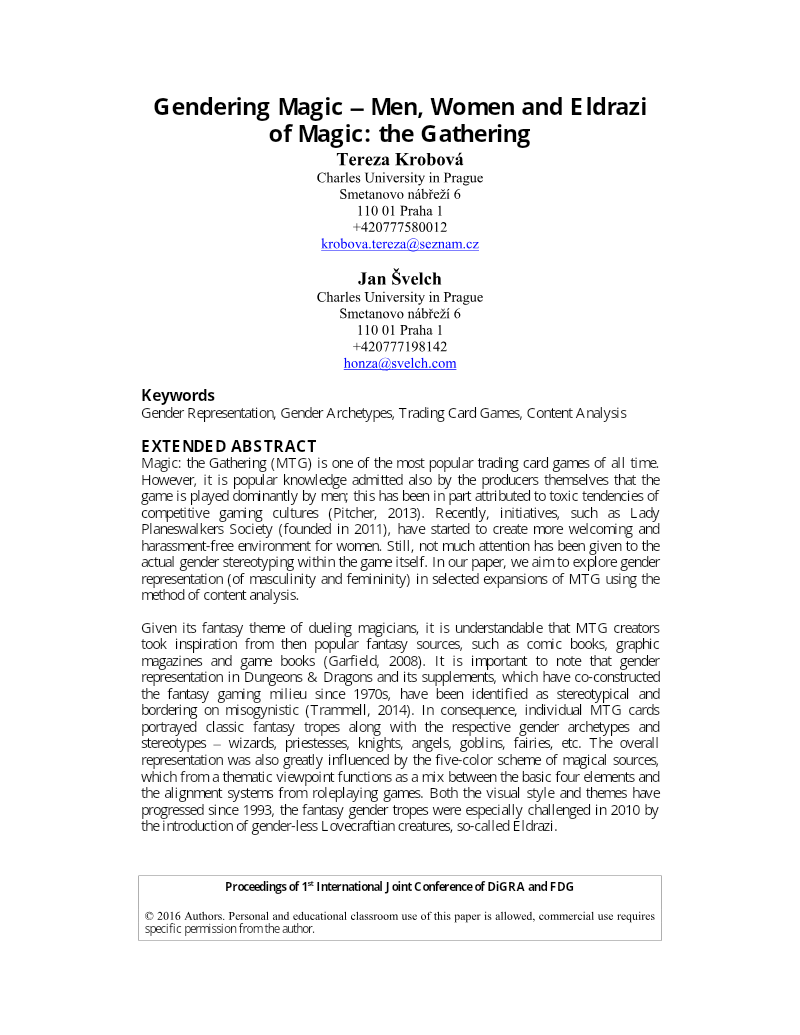
Gendering Magic: Men, Women and Eldrazi of Magic: the Gathering
This document outlines a research paper analyzing gender representation in Magic: The Gathering (MTG) through content analysis of selected card sets.
- The paper analyzes how masculinity and femininity are encoded in Magic: The Gathering's own content (card visuals, flavor text, abilities, creature types, and color identities), rather than focusing on player demographics or community harassment.
- Content analysis covers 1,135 cards drawn from a library of more than 13,000, sampled across four expansion sets: Limited Edition Alpha (1993), Urza's Saga (1998), Ravnica: City of Guilds (2005), and Oath of the Gatewatch (2016).
- The framework combines Pratt's archetypal theory of female roles (maiden, mother, grandmother versus the witch) with Bourdieu's theory of symbolic power, emphasizing power relations central to the game's theme of competing magicians.
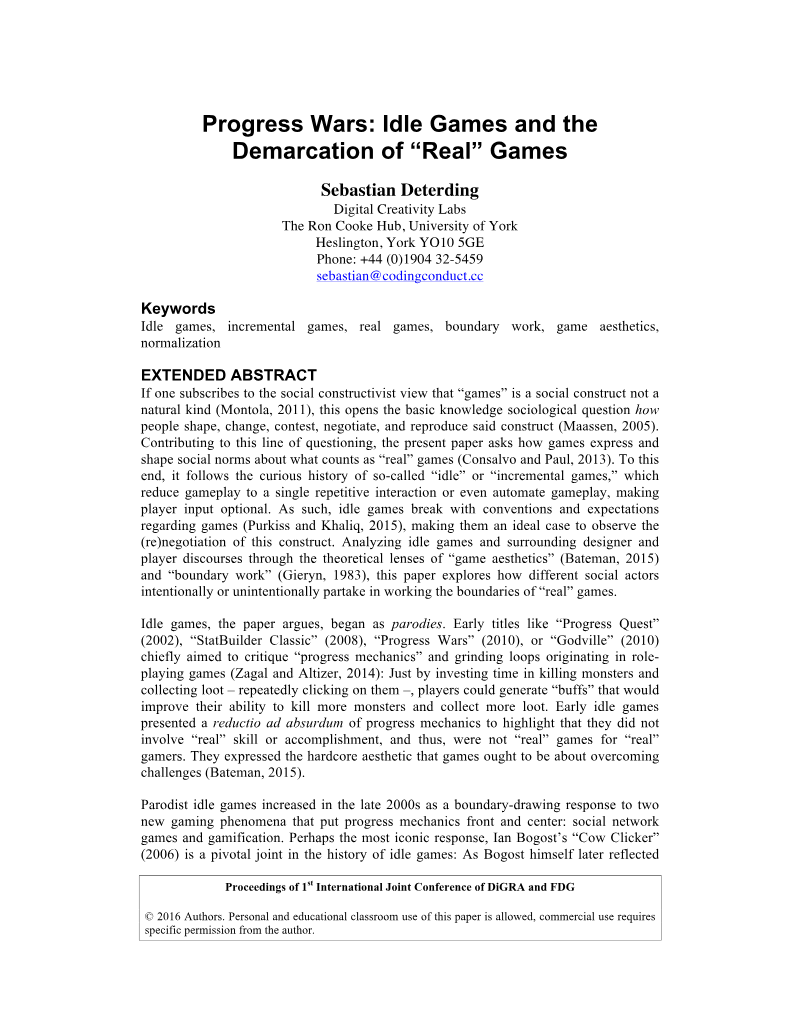
Progress Wars: Idle Games and the Demarcation of "Real" Games
This paper examines how idle games have influenced and redefined the social construct of what constitutes a "real" game.
- The paper argues that the category of "real" games is not a natural given but is actively produced through contested practices of designers, players, and critics, drawing on social constructivist views of games.
- Idle games began as parody: titles like Progress Quest (2002), StatBuilder Classic (2008), Progress Wars (2010), and Godville (2010) used reductio ad absurdum on RPG grinding mechanics to argue such progress involved no real skill.
- Ian Bogost's satirical Cow Clicker (2006) unexpectedly became hugely popular, revealing an absorptive "being in the zone" appeal that its critical intent had not anticipated.
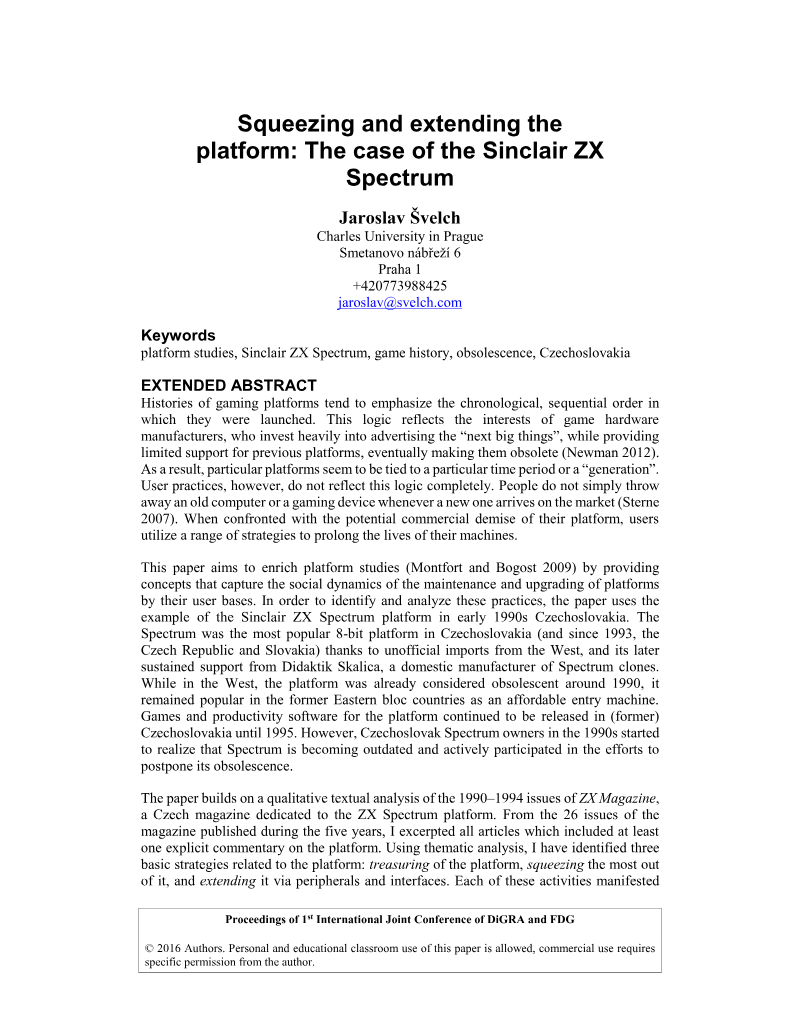
Squeezing and Extending the Platform: The Case of the Sinclair ZX Spectrum
This paper examines how users sustained the commercial life of the Sinclair ZX Spectrum in early 1990s Czechoslovakia, long after the platform had been declared obsolete in Western markets.
- The Sinclair ZX Spectrum became the most popular 8-bit platform in early 1990s Czechoslovakia, sustained largely by unofficial Western imports and by domestic manufacturer Didaktik Skalica's Spectrum clones, even as it was declared obsolete in Western markets.
- The paper argues that manufacturer-driven launch-and-replace cycles fail to capture how user communities actively maintain, modify, and upgrade hardware, challenging the logic of perpetual obsolescence in platform histories.
- Owners pursued three recurring strategies: treasuring (preserving and modifying classic games to affirm the platform's place in national computing history), squeezing (exploiting undocumented features as programmers kept extracting more capability), and extending (hardware modifications, peripherals, and interfaces often beyond the designers' intentions).
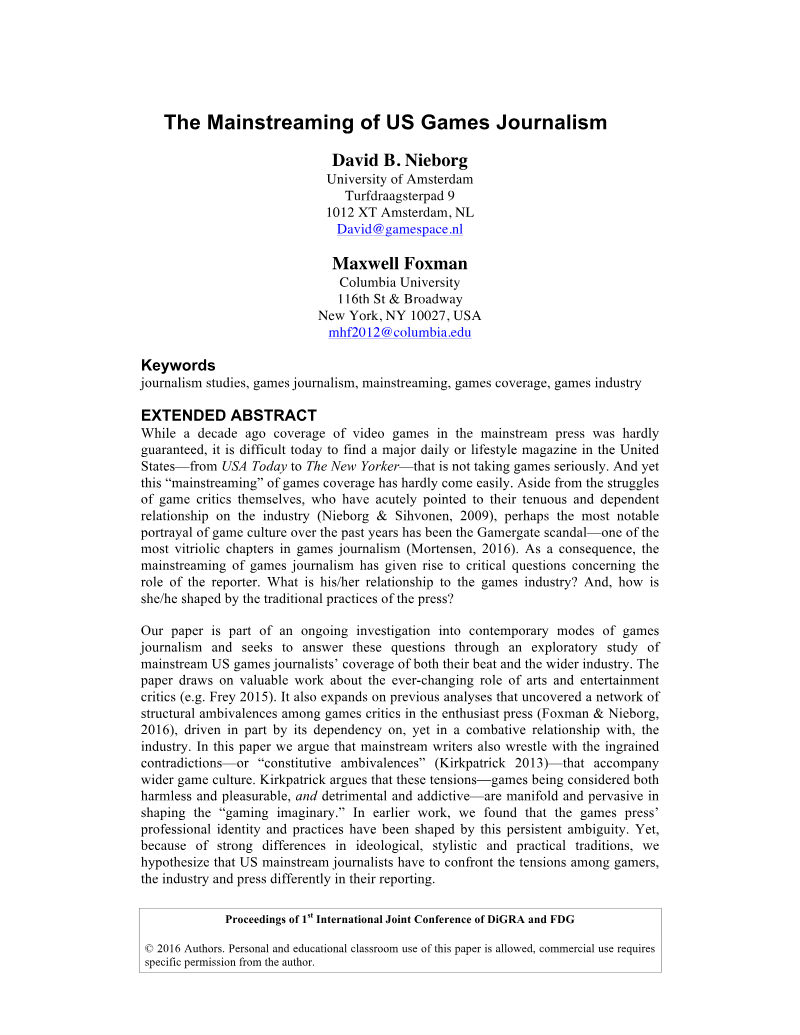
The Mainstreaming of US Games Journalism
This paper examines how mainstream American newspapers and lifestyle outlets have come to take video games seriously, a shift that was far from assured a decade ago.
- Mainstream American newspapers and lifestyle outlets have come to take video games seriously, a shift the authors argue was far from assured a decade before the study.
- The paper's central hypothesis is that mainstream journalists handle the tensions among gamers, the industry, and the press differently from enthusiast writers, due to distinct ideological, stylistic, and practical traditions.
- Mainstream reporting appears to lack the self-reflection tradition found in enthusiast games writing, which is why the study focuses on journalistic rather than critical coverage.
Do you work at DiGRA? Get a free report of how these documents are read and cited here.