PC reports and market data
Documents

Suddenly My Game Is Fun Again!
The development of the real-time strategy game Ovus Nova has undergone significant mechanical refinements to improve player agency and overall engagement.
- The developer transitioned from randomized unit movement to a swipe-based system, granting players direct control over egg-hatching directions and tactical navigation.
- The upgrade bar now fills automatically, with a mechanic that accelerates progression three times faster when no eggs are present on the screen to create a strategic trade-off.
- Core gameplay was simplified by removing slow-hatching red eggs and implementing a restriction against stacking eggs to reduce user frustration.

Let's Make a Viral Game: WILL YOU SNAIL? - (Easy Peasy!)
The development of the platformer Will You Snail serves as a practical experiment to test theories regarding viral game design.
- The core design strategy for 'Will You Snail' prioritizes 'rage-inducing' difficulty and high watchability to foster a 'one-more-time' feedback loop that encourages player persistence and streamer engagement.
- The game features an AI antagonist that actively predicts player movement to spawn lethal obstacles, utilizing a visual 'predictive shadow' to show players where the AI expects them to be in 0.5 seconds.
- The project was developed as a rapid prototype using Game Maker Studio 2, with the core mechanics established in only a few hours.

Dear YoYo Games...
The current business model for GameMaker Studio 2 faces significant criticism for its restrictive free-tier limitations, which threaten the engine's long-term competitiveness against industry rivals like Unity and Unreal Engine.
- GameMaker Studio 2’s current business model, which imposes a $40 fee to remove object and sprite count limitations, creates significant friction that discourages new users.
- The engine’s restrictive free-tier model is causing beginners to migrate toward competitors like Unity and Unreal Engine, which offer more robust free versions for experimentation.
- By prioritizing short-term revenue over user acquisition, GameMaker risks alienating the youth demographic, which serves as the primary pipeline for future professional developers.

Another Brick In The Wall! - Pathfinding for OVUS NOVA - (Part 2)
The development of the PC strategy game Ovus Nova has reached a significant milestone with the successful implementation of wall mechanics and a highly optimized pathfinding algorithm.
- The Ovus Nova pathfinding system now supports stable performance of 140 to 200 FPS, even when managing large unit counts simultaneously.
- The implementation of wall mechanics and optimized collision detection has enabled complex level design, including support for destructible environments and varied terrain.
- Development in GameMaker was hindered by the lack of native, efficient tools for migrating scripts and assets between projects, necessitating manual workarounds.

Helping It All Emerge: Managing Crowd AI in Watch Dogs 2
The creation of a living, reactive urban environment in Watch Dogs 2 centers on the implementation of an Anecdote Factory, a system designed to generate unscripted, emergent narrative moments.
- Ubisoft managed civilian behavior in Watch Dogs 2 using a logic-based system containing approximately 700 rules that, through combinatorial complexity, generated billions of potential behavioral outcomes.
- The AI decision-making process utilizes a multi-factor evaluation where agents weigh personal relationships, emotional states, and environmental context to determine whether to ignore, observe, flee, or fight during an incident.
- To maintain performance and prevent chaotic feedback loops, the team implemented 'limiters' on loud, high-impact behaviors to ensure that emergent interactions between NPCs remained within manageable, finite limits.

OVUS NOVA Is a Board Game Now! - (Turn Based)
The transition of the game Ovus Nova into a turn-based strategy format serves as a case study for evaluating core gameplay mechanics and accessibility.
- The developer rejected the turn-based pivot for Ovus Nova, concluding that the original real-time design better preserves the game's core identity and tension.
- Transitioning to a turn-based format successfully addressed player confusion and visual readability issues but sacrificed the exponential growth mechanics central to the original experience.
- The turn-based prototype utilized a three-action-per-turn system—move, convert to eggs, or detonate—which improved strategic clarity but risked creating predictable, infinite defensive gameplay loops.
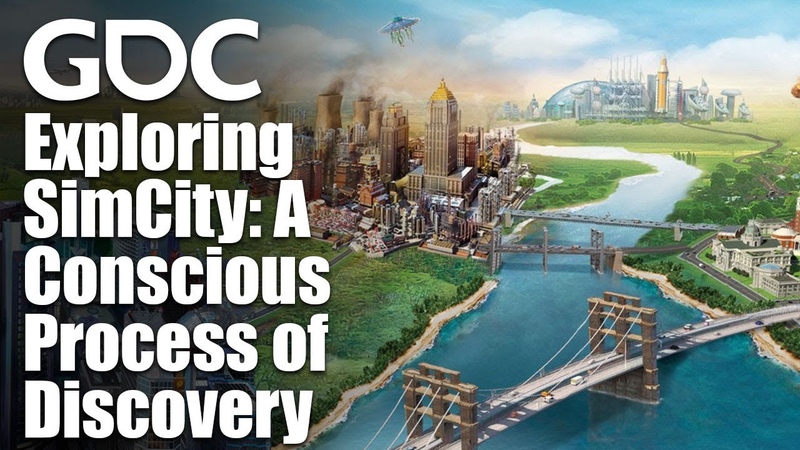
Exploring SimCity: A Conscious Process of Discovery
The development of SimCity centers on the philosophy that sandbox games thrive when built upon simple, modular systems that encourage emergent gameplay.
- Sandbox game development should follow a breadth-first approach, layering core mechanics, feedback, and player tools incrementally to justify development effort through actual gameplay experience rather than theoretical design.
- Avoid the 'complexity rabbit hole' by keeping individual simulation components simple; early prototypes for SimCity (2013) showed that over-engineering systems like power plants created unmanageable UI and performance requirements.
- Performance in sandbox simulations requires avoiding global loops; instead, use bucketed systems and round-robin scheduling to propagate navigation and agent information across frames.
Retro Platformer: Midget Mager - Jonas Plays Your Game! #008
The analysis of the 2D retro platformer Midget Mager evaluates core game design principles, specifically focusing on player engagement, level pacing, and the balance between challenge and frustration.
- Player retention is primarily determined within the first two minutes of gameplay, requiring the rapid introduction of diverse mechanics like power-ups and new enemies to maintain engagement.
- Level design must prioritize fair and predictable challenges, as sparse checkpoint placement forces repetitive play that shifts the experience from rewarding to frustrating.
- Enemy behavior should be highly predictable, utilizing clear visual telegraphing to signal attacks or movement changes so players can rely on skill rather than luck.

The Pathfinding for OVUS NOVA! (Walls) - Part 1
The development of an efficient pathfinding system for the real-time strategy game Ovus Nova requires balancing complex navigation with high-performance demands.
- The pathfinding system for Ovus Nova utilizes a flood-fill algorithm to pre-calculate shortest paths from every grid cell to target 'eggs', allowing units to follow directional data rather than calculating individual routes.
- To resolve severe performance bottlenecks that caused frame rates to drop to zero, the project migrated from the Game Maker Studio 2 Virtual Machine to the YoYo Compiler (YYC).
- Computational load was further optimized by spreading pathfinding calculations across 60 frames instead of attempting to update the entire map in a single frame.

Streaming: Concept Art Fails!
The development of Ovus Nova centers on the critical intersection of character design and gameplay readability.
- The development of Ovus Nova prioritizes functional gameplay readability over high-fidelity detail to ensure players can immediately distinguish between friendly and hostile units.
- Designers utilize distinct, recognizable silhouettes and clear elemental mechanics to resolve player confusion caused by overly complex or ambiguous assets.
- The creative workflow relies on rapid sketching and layout management to define the evolutionary lifecycle and behavioral traits of space-themed creatures.

Should We Do Endless Mode? - Ovus Nova
The development of the strategy game Ovus Nova involves an experimental transition from a structured, level-based progression system to a roguelike endless mode.
- The transition to an endless roguelike mode for Ovus Nova was abandoned because it failed to provide the strategic depth and engagement found in the original level-based design.
- Procedural generation in the prototype led to inconsistent difficulty, characterized by unfair spikes and stagnant gameplay loops that lacked intentional design.
- The development team struggled to balance exponential growth, resulting in gameplay that oscillated between being overly punishing early on and trivial as the player population expanded.
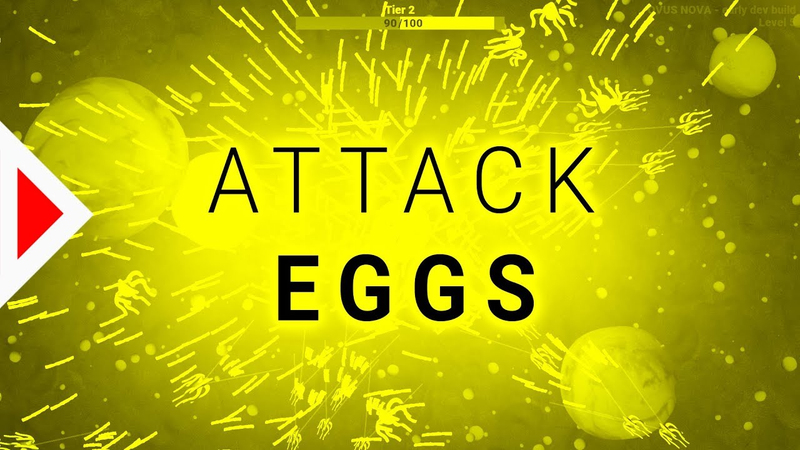
Attack Mode & Upgrades - Ovus Nova
The development of Ovus Nova has shifted from an action-oriented experience to a tactical strategy game through the implementation of a turret-based combat system and a tiered upgrade mechanic.
- Ovus Nova has pivoted from a reflex-based action game to a tactical strategy title by replacing explosive unit mechanics with a persistent, turret-based combat system.
- The new progression system uses research points, accumulated through idling, to force a strategic trade-off between immediate defensive unit detonation and long-term power-up acquisition.
- Combat depth is driven by a tiered upgrade pool featuring specialized options like turret mode for duration, instant attack for burst damage, and attack eggs for defensive utility.