Mobile
Documents
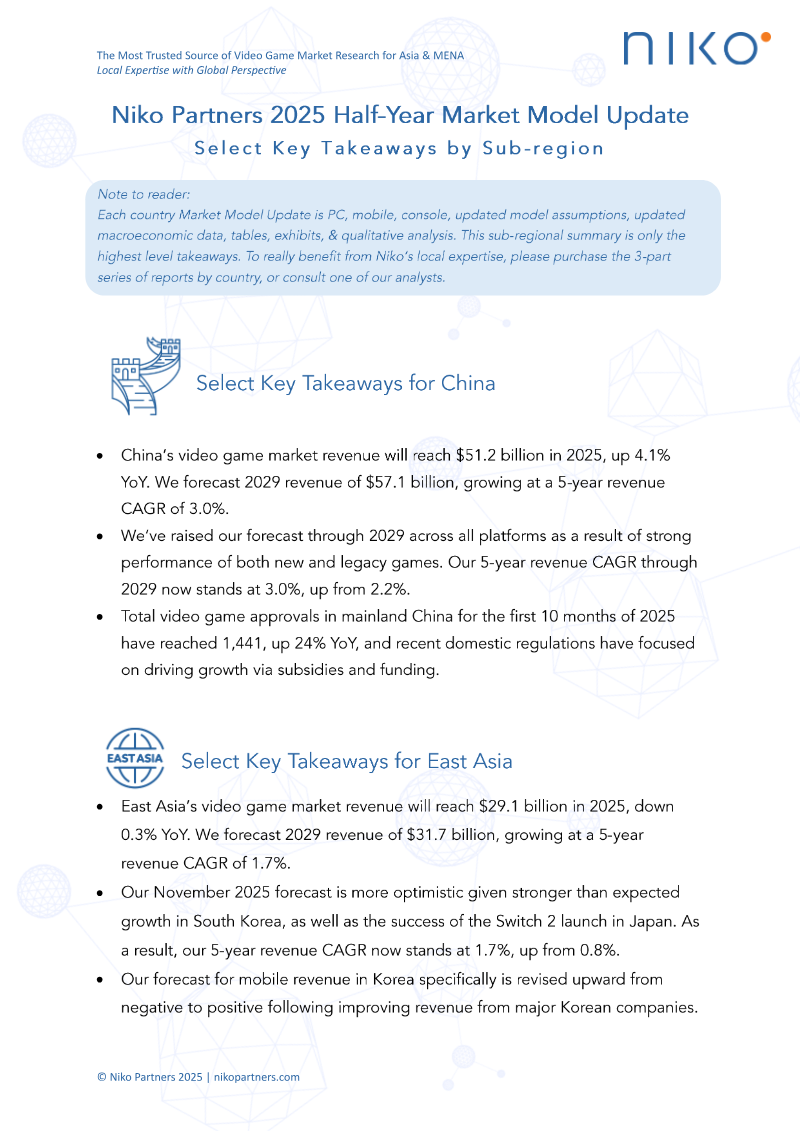
2025 Half-Year Market Model Update: Asia & MENA
The 2025 Half-Year Market Model Update provides a comprehensive assessment of the video game industry across Asia and the Middle East and North Africa (MENA) region. By synthesizing macroeconomic data, platform-specific performance metrics, and regulatory developments, the analysis offers updated revenue forecasts through 2029 for key markets, including China, East Asia, India, Southeast Asia, and the MENA-3 region. The primary objective is to adjust long-term growth expectations based on recent industry performance, government policy shifts, and evolving consumer behavior.
Regional performance varies significantly, with India emerging as a high-growth market, projected to reach $1.1 billion in 2025 with a robust 12.9% five-year compound annual growth rate (CAGR). China remains the dominant market, with 2025 revenue expected to hit $51.2 billion, supported by a 24% year-over-year increase in game approvals. Conversely, East Asia and Southeast Asia show more moderate growth trajectories, with five-year CAGRs of 1.7% and 3.5%, respectively. The MENA-3 region is forecasted to reach $2.2 billion in 2025, though long-term projections have been tempered by economic headwinds in Egypt and slower mobile growth in Saudi Arabia and the UAE.
Methodologically, these insights are derived from proprietary market models that integrate platform-specific data for PC, mobile, and console segments. The analysis highlights the critical role of government intervention, such as the PROG act in India and regulatory subsidies in China, in shaping market expansion. By updating previous forecasts to reflect current fiscal realities and hardware cycles, such as the Switch 2 launch in Japan, the findings offer a refined outlook for stakeholders navigating the complex regulatory and economic landscapes of these diverse geographic segments.
- China remains the dominant regional market with projected 2025 revenue of $51.2 billion, bolstered by a 24% year-over-year increase in game approvals.
- India is positioned as a high-growth market expected to reach $1.1 billion in 2025 with a 12.9% five-year compound annual growth rate (CAGR).
- The MENA-3 region is forecasted to reach $2.2 billion in 2025, though long-term growth is tempered by economic headwinds in Egypt and slowing mobile performance in Saudi Arabia and the UAE.
- East Asia and Southeast Asia exhibit moderate growth trajectories, with five-year CAGRs of 1.7% and 3.5%, respectively.
- Market expansion across these regions is increasingly driven by government policy, including the PROG act in India and regulatory subsidies in China.

Take Rates in China: Will Quality Development Beat Out Traditional Distribution?
The Chinese mobile gaming market is currently undergoing a significant shift in distribution dynamics as developers increasingly challenge the traditional 50% take rates imposed by domestic Android app stores. While global discourse remains focused on the 30% take rate standard contested in the Epic v. Apple litigation, Chinese developers face a more restrictive domestic environment where smartphone manufacturers and major tech firms consolidate power through the Mobile Hardcore Alliance and the Global Developer Service Alliance. These entities justify high fees by providing integrated marketing and distribution services, yet these costs have become a primary point of contention for major studios.
To circumvent these high fees, prominent developers such as miHoYo, Lilith Games, and NetEase are increasingly adopting direct-to-consumer distribution models. By leveraging high-quality intellectual property, substantial marketing budgets, and community-driven platforms like TapTap and Bilibili, these studios can bypass traditional stores entirely. This strategy allows developers to retain significantly higher gross profit margins—often exceeding 95%—compared to the 50% margin typically realized through standard distribution channels. The success of these titles has begun to force concessions, as evidenced by Xiaomi offering reduced take rates to high-profile games like Genshin Impact.
The industry landscape is bifurcated, as smaller developers often remain dependent on traditional stores for the reach and infrastructure necessary to sustain their operations, viewing the 50% fee as an acceptable cost of doing business. However, the rise of direct distribution and community-centric marketing signals a broader trend where quality content and brand loyalty are becoming more influential than traditional store placement. As developers continue to prioritize direct engagement and alternative platforms, the dominance of traditional Android app stores in China faces mounting pressure, potentially reshaping the economic model of the global mobile gaming industry.
- Major Chinese developers like miHoYo, Lilith Games, and NetEase are bypassing traditional Android app stores to achieve gross profit margins exceeding 95%, compared to the 50% margin typical of standard distribution.
- The Chinese mobile gaming market is dominated by a 50% take rate imposed by smartphone manufacturers and tech firms organized under the Mobile Hardcore Alliance and the Global Developer Service Alliance.
- High-profile titles are successfully leveraging direct-to-consumer models and community platforms like TapTap and Bilibili to circumvent traditional distribution fees.
- The shift toward direct distribution has forced some concessions from traditional stores, such as Xiaomi offering reduced take rates for high-profile games like Genshin Impact.
- The market is bifurcated, as smaller developers remain dependent on traditional stores for necessary infrastructure and reach, accepting the 50% fee as a standard cost of business.
Guide to Growing Chinese Gaming Apps Overseas
Chinese gaming developers are aggressively expanding their global footprint by leveraging sophisticated monetization models and high-volume, AI-driven marketing strategies. The primary objective for these publishers is to balance the high revenue potential of mature markets like the United States, Japan, and South Korea against the rising costs of user acquisition. By prioritizing video advertising, which currently yields the highest Day 7 return on ad spend at 21%, developers are successfully capturing market share in competitive strategy and RPG segments.
Success in these international territories is increasingly predicated on hyper-localization and technological integration. Publishers are utilizing generative AI to streamline the production of localized ad creatives, voice-overs, and performance-tested copy, allowing for rapid iteration and regional customization. Leading titles demonstrate that high-engagement gameplay loops—such as the inclusion of social hangout spaces, customizable home systems, and minigame integrations—are essential for sustaining long-term retention. These efforts are further bolstered by strategic partnerships with local influencers and the implementation of innovative, time-limited gacha mechanics.
To maintain consistent growth, developers are diversifying their engagement tactics through gamified live events, including seasonal collections and interactive board-style challenges. These features, combined with trial character systems, allow publishers to cater to varied player motivations while maintaining a steady revenue stream. By synthesizing competitive intelligence with agile content updates, Chinese gaming apps are effectively navigating the complexities of global expansion, ensuring that both monetization and user interest remain high across diverse geographic regions.
- Video advertising is the most effective monetization channel for Chinese developers in mature markets, currently yielding a 21% Day 7 return on ad spend.
- Generative AI is being deployed at scale to automate the production of localized ad creatives, voice-overs, and performance-tested copy to reduce costs and speed up regional market entry.
- Long-term player retention is increasingly driven by integrating social hangout spaces, customizable home systems, and minigames into core gameplay loops.
- Developers are prioritizing expansion into high-revenue mature markets, specifically the United States, Japan, and South Korea, to offset rising global user acquisition costs.
- Engagement is being sustained through gamified live events, such as seasonal collections and interactive board-style challenges, alongside trial character systems.

The Gaming App Insights Report 2025: Unlocking Growth Opportunities for Mobile Marketers
The mobile gaming industry is entering a period of strategic recalibration, projected to reach $126.1 billion in revenue by 2025. This growth is underpinned by a transition toward hybrid monetization models and the integration of AI-powered personalization to combat persistent retention challenges. While global install volume grew by 4% in 2024, the market exhibits a distinct geographic divide; North American and European markets face stagnation, whereas Latin America and the Middle East and North Africa regions demonstrate robust expansion. Success in this evolving landscape requires developers to move beyond traditional acquisition, favoring diversified channels such as Connected TV and localized, player-centric engagement strategies.
Data from early 2025 indicates that user tracking remains a pivotal operational hurdle, with global App Tracking Transparency opt-in rates hovering at 37.9%. Although arcade games have seen notable improvements in opt-in performance, the United States remains relatively static at 32%, underscoring the necessity for refined messaging strategies to maintain visibility. Concurrently, the industry is grappling with a complex financial environment characterized by rising costs per install and declining average revenue metrics. These headwinds are forcing a shift in marketing tactics, as developers increasingly rely on a broader array of acquisition partners and data-informed creative experimentation to sustain growth.
Ultimately, the path to profitability in 2025 lies in prioritizing long-term player value over short-term acquisition metrics. By leveraging AI-driven optimization and fostering community-building initiatives, developers can mitigate the impact of declining revenue per user. The industry is clearly moving toward a more sophisticated, data-reliant ecosystem where the ability to measure performance across fragmented channels—including mobile and Connected TV—is essential for maintaining a competitive advantage in a maturing global market.
- The mobile gaming market is projected to reach $126.1 billion in revenue by 2025, driven by a shift toward hybrid monetization and AI-powered personalization.
- Global install volume grew by 4% in 2024, but growth is geographically polarized with stagnation in North America and Europe contrasted by expansion in Latin America and the MENA region.
- Global App Tracking Transparency (ATT) opt-in rates remain low at 37.9%, with the United States market stagnant at a 32% opt-in rate.
- Developers face a challenging financial environment defined by rising costs per install and declining average revenue metrics, necessitating a shift toward long-term player value over short-term acquisition.
- To sustain growth, developers must diversify acquisition channels beyond traditional mobile ads, specifically integrating Connected TV and data-informed creative experimentation.

Interactive Entertainment: Global Market Sizing & Forecast 2025
The global interactive entertainment market is poised for a recovery in 2025, with total consumer spending projected to reach $250.2 billion, representing a 4.6% year-over-year growth. This rebound follows a period of cyclical transition, characterized by a significant contraction in console hardware sales and a strategic shift toward efficiency and transmedia integration among major industry players. The analysis, which synthesizes company financials and industry data, highlights a market moving toward next-generation experiences while navigating economic uncertainty.
Software publishing remains the primary revenue driver, expected to total $196 billion in 2025. Mobile gaming continues to lead as the largest segment, with $115.7 billion in projected 2025 revenue, despite ongoing challenges related to market saturation and rising user acquisition costs. Conversely, the hardware sector is experiencing a sharp 31% decline in console revenue for 2024, signaling the end of the current console cycle. However, this is partially offset by resilient growth in gaming PC components and a consistent demand for gaming accessories, which are forecasted to grow by 5% in 2025.
Emerging technologies, including virtual reality, blockchain gaming, and web-based platforms, show potential for growth but remain secondary to established software markets. Meanwhile, the esports and live-streaming sectors face persistent profitability challenges, with esports revenue trending downward. In response to these pressures, major entertainment conglomerates are pivoting toward transmedia strategies and in-game advertising, leveraging established intellectual property to engage audiences across digital worlds. Industry leadership remains optimistic, focusing on operational efficiency and high-profile content releases to sustain long-term growth through 2025 and beyond.
- The global interactive entertainment market is projected to reach $250.2 billion in 2025, marking a 4.6% year-over-year recovery.
- Software publishing remains the dominant revenue driver at $196 billion, with mobile gaming leading the sector at $115.7 billion despite rising user acquisition costs.
- The console hardware sector is in a significant downturn, evidenced by a 31% decline in revenue during 2024 as the current cycle concludes.
- Gaming PC components and accessories are providing a buffer against hardware losses, with a forecasted growth rate of 5% in 2025.
- Major industry players are shifting toward transmedia strategies and in-game advertising to leverage existing intellectual property amid economic uncertainty.

2025 Mobile Gaming Benchmarks
The mobile gaming landscape in 2024 faced significant challenges regarding player loyalty, as 75 percent of titles failed to maintain a 3 percent retention rate by the 28th day. This decline underscores a critical industry shift where long-term viability is increasingly tethered to sophisticated content pacing, refined progression systems, and seamless onboarding experiences. Because retention serves as the primary engine for both user acquisition return on investment and sustainable monetization, developers must prioritize data-backed strategies to mitigate rising churn rates across the global market.
Engagement metrics reveal a nuanced performance gap between platforms and regions. While iOS continues to demonstrate superior early-stage engagement compared to Android, regional behaviors vary significantly; the Middle East currently leads in retention, whereas Africa and Oceania report the highest average playtime and session lengths, respectively. Genre-specific performance further complicates these trends, as Board and Card games exhibit robust long-term retention, contrasting sharply with Multiplayer titles that struggle to retain users despite commanding the longest average session durations of 8 to 9 minutes.
These insights, derived from an expansive dataset of over 100,000 active games, highlight the necessity of granular performance benchmarking. By comparing individual game metrics—including monetization, engagement, and retention—against global standards filtered by genre and player spending habits, studios can effectively optimize their development cycles. Ultimately, the industry is moving toward a model where success is no longer defined by broad acquisition, but by the precise, data-driven calibration of the player experience to ensure longevity in an increasingly competitive mobile ecosystem.
- 75 percent of mobile games failed to achieve a 3 percent retention rate by day 28 in 2024, highlighting a widespread struggle to maintain long-term player loyalty.
- Retention is the primary driver for both user acquisition ROI and sustainable monetization, making it the most critical metric for long-term viability.
- Multiplayer titles command the longest average session durations of 8 to 9 minutes but struggle significantly with long-term user retention.
- Board and Card games currently demonstrate the most robust long-term retention performance compared to other genres.
- Regional engagement varies significantly, with the Middle East leading in retention, while Africa and Oceania lead in average playtime and session length, respectively.

The State of Puzzle Games: An Analysis of the Puzzle Category in Mobile Gaming
The mobile puzzle game market is undergoing a significant structural evolution, characterized by a shift in product models and a notable rise in hybridcasual gaming. This analysis, covering global data from January 2018 through June 2023, examines the performance of various puzzle sub-genres, including swap, blast, chain, and pair mechanics. By leveraging store intelligence and download estimates from the Apple App Store and Google Play, the findings highlight how developers are increasingly integrating meta-features and diversified monetization strategies to sustain revenue in a maturing landscape.
A central finding is the remarkable growth of the hybridcasual product model, which saw a 430% increase in revenue between early 2022 and early 2023. While traditional casual games continue to dominate overall market share through consistent operations and robust meta-features, they have experienced modest declines in both downloads and revenue. Conversely, hybridcasual titles—particularly within the pair sub-genre—have successfully captured user interest by blending accessible gameplay with more sophisticated monetization tactics, such as in-app purchases, which were previously less common in hypercasual-leaning segments.
The data indicates that sub-genres like pair have emerged as high-growth areas, with hybridcasual revenue in this category rising from $7 million in the first quarter of 2022 to $40 million by the first quarter of 2023. Meanwhile, other established sub-genres, such as merge and physics, have seen download declines as their reliance on hypercasual models wanes. Successful top-tier games across all categories now frequently employ a combination of live operations, season passes, and social clans to drive engagement. Ultimately, the puzzle market is moving toward a hybrid approach, where the simplicity of casual mechanics is increasingly supported by the deeper monetization and retention frameworks typically associated with mid-core titles.
- The hybridcasual puzzle model experienced a 430% revenue increase between early 2022 and early 2023, signaling a major shift in market structure.
- Hybridcasual revenue in the 'pair' sub-genre grew from $7 million in Q1 2022 to $40 million in Q1 2023.
- Traditional casual puzzle games are experiencing modest declines in both downloads and revenue despite maintaining overall market share through robust meta-features.
- Established sub-genres like merge and physics are seeing download declines as their reliance on hypercasual models diminishes.
- Top-tier puzzle games are increasingly adopting mid-core retention and monetization strategies, including live operations, season passes, and social clans.

Target, Connect, Engage: Driving Profitable App Growth
Achieving sustainable mobile app growth in a privacy-centric digital landscape requires a sophisticated integration of precise measurement tools and advanced advertising optimization. The primary objective of modern mobile marketing is to shift focus from simple installation metrics toward high-value user engagement and long-term profitability. By leveraging Mobile Measurement Partners (MMPs) in tandem with platform-specific optimization features, brands can navigate complex cross-channel user journeys, mitigate ad fraud, and significantly improve their return on ad spend.
Data-driven strategies, specifically those utilizing App Event Optimization and Value-Based Optimization, serve as the foundation for scaling performance. These methodologies allow advertisers to move beyond broad acquisition tactics, instead employing granular audience segmentation and real-time tracking to identify and retain high-value users. Case studies involving major global brands such as Burger King, Rappi, and Carrefour demonstrate that this technical synergy consistently yields substantial improvements in conversion rates and overall revenue. For instance, integrated campaigns have successfully driven multi-fold increases in return on investment, proving that technical precision directly correlates with commercial success.
The scope of these strategies encompasses global mobile markets, focusing on the intersection of social media advertising and third-party attribution. Success in this environment relies on a structured, agile approach that prioritizes diversified creative testing and consistent budget management. By combining the analytical depth of an MMP with the reach and targeting capabilities of platforms like TikTok, developers can effectively lower customer acquisition costs while maximizing user lifetime value. Ultimately, the integration of these technologies is essential for any organization seeking to maintain a competitive edge in the evolving mobile ecosystem.
- Mobile marketing strategy must shift from simple installation metrics to prioritizing high-value user engagement and long-term profitability to ensure sustainable growth.
- Integrating Mobile Measurement Partners (MMPs) with platform-specific optimization tools is essential for navigating cross-channel journeys, mitigating ad fraud, and improving return on ad spend.
- App Event Optimization and Value-Based Optimization are the primary methodologies for scaling performance through granular audience segmentation and real-time tracking.
- Global brands including Burger King, Rappi, and Carrefour have achieved substantial improvements in conversion rates and multi-fold increases in ROI by utilizing integrated, data-driven campaigns.
- Lowering customer acquisition costs while maximizing user lifetime value requires a combination of analytical depth from MMPs and the reach of social media platforms like TikTok.

Insights Into Global Mobile Game Marketing Trends
The analysis demonstrates that mobile‑game marketing is increasingly driven by real‑time, AI‑enhanced creative data sourced from a global platform covering more than 80 countries and 1.6 billion daily‑updated assets. This infrastructure enables marketers to identify high‑quality, short‑form clips—particularly TikTok‑style and live‑action videos—that accelerate testing cycles and reduce acquisition costs. User acquisition remains the primary lever for installs, while retargeting is essential to sustain engagement and monetization. Emerging formats such as non‑intrusive in‑game audio ads and custom product pages are gaining traction, reflecting a broader shift toward data‑driven, AI‑augmented strategies.
Genre‑level insights reveal that role‑playing games dominated advertising in the first half of 2025, with a competitive creative volume of 224 monthly assets per genre. Casino titles experienced a 14.5 % year‑over‑year increase in advertiser share, while tower‑defense gameplay surged across top titles. Geographic intensity is highest in North America and Europe, with Southeast Asia following closely; all regions exhibit a pronounced move toward AI‑generated creatives. North American advertisers grew 25.8 % in H1 2025, deploying over 5 million creatives and favoring high‑quality portrait formats (720×1280, 52 s) that drive strong engagement metrics.
The study identifies a critical mismatch between creative freshness and acquisition costs, noting that many campaigns suffer from delayed updates and poorly targeted landing pages. Recommendations emphasize increasing creative refresh rates, refining audience segmentation, and rigorous A/B testing to sustain novelty and improve return on investment. Overall, the findings underscore a mobile‑gaming ecosystem that is rapidly adopting AI‑driven creative production and diversified monetization tactics, with North America and Europe leading in both volume and innovation.
- Mobile game marketing is shifting toward AI-enhanced creative production, leveraging global platforms to identify high-performing short-form, live-action, and TikTok-style video assets.
- North American advertising activity grew by 25.8% in H1 2025, with advertisers deploying over 5 million creatives, predominantly favoring 720x1280 portrait formats.
- Role-playing games led advertising volume in H1 2025 with 224 monthly assets per genre, while casino titles saw a 14.5% year-over-year increase in advertiser share.
- Campaign performance is currently hampered by a mismatch between creative freshness and acquisition costs, necessitating higher refresh rates and more rigorous A/B testing.
- User acquisition remains the primary driver for installs, though retargeting is essential for sustaining long-term engagement and monetization.

SensorTower Report: Southeast Asia Mobile Game Market Insights 2025
SensorTower’s Southeast Asia Mobile Game Market Insights 2025 positions the region as a pivotal growth engine for mobile gaming, with 1.93 billion new installs and $625 million in IAP revenue reported for Q1 2025. The analysis draws on App Store and Google Play data, classifying titles by genre and tracking revenue while excluding ad income. Casual genres such as Arcade and Simulation dominate download volumes, whereas Strategy, Shooters, and social‑driven RPGs generate the bulk of monetization. Mobile Legends: Bang Bang and Garena Free Fire remain revenue leaders, while newer IPs like Ragnarok M: Classic and Magic Chess: Go Go rapidly climb both download and revenue charts, illustrating the market’s receptiveness to fresh, socially rich experiences.
Vietnam exemplifies deep localization success: Roblox leads downloads while Garena Free Fire dominates revenue, and local titles such as “Trò Vẽ Vui Tuổi Thơ” fuel organic growth. In the Philippines, hyper‑casual “Block Blast!” captures the largest download share, yet Mobile Legends: Bang Bang sustains top revenue. Across both markets, robust community engagement and localized content underpin strong monetization even as casual download volumes fluctuate.
From 2017 through Q1 2025, Southeast Asian titles have consistently topped global download and revenue charts. Vietnamese and Singaporean publishers now rank among the world’s top download leaders, with titles like Free Fire and Car Race expanding genre breadth. The region’s high mobile penetration, community‑driven marketing, and IP collaborations enable SEA publishers to scale player engagement and revenue on a global stage. Overall, the report underscores Southeast Asia’s emergence as both a production hub and a lucrative monetization frontier for mobile games worldwide.
- Southeast Asia generated 1.93 billion new mobile game installs and $625 million in in-app purchase revenue during Q1 2025.
- Casual genres like Arcade and Simulation drive the highest download volumes, while Strategy, Shooters, and social-driven RPGs account for the majority of monetization.
- Mobile Legends: Bang Bang and Garena Free Fire remain the region's top revenue-generating titles, though newer IPs like Ragnarok M: Classic and Magic Chess: Go Go are rapidly gaining market share.
- Vietnam and Singapore have emerged as global publishing hubs, with local developers consistently ranking among the world's top leaders for both downloads and revenue.
- Market success in the region is heavily dependent on deep localization and community-driven engagement, as evidenced by the dominance of specific titles like Roblox in Vietnam and Block Blast! in the Philippines.

Match-3 Genre Snapshot Report: May 2021
The document presents a comprehensive analysis of the mobile match‑3 puzzle segment for Q1 2021, focusing on revenue performance, genre characteristics, and player motivations. It identifies the top five match‑3 titles—Candy Crush Saga, Homescapes, Project Makeover, Gardenscapes, and Toon Blast—detailing their market share changes, revenue per download (Rev/DL), and year‑over‑year growth. Candy Crush Saga leads with a 16.74% share and a Rev/DL of $11.27, while Project Makeover shows the strongest growth at 10.57% share and a Rev/DL of $45.51, reflecting its premium monetization strategy.
The analysis breaks down genre features, noting that Royal Match and Project Makeover exemplify modern match‑3 design: fast‑paced gameplay, quick animations, and a progression system tied to home or makeover themes. Monetization models emphasize consumable boosters, lives, and continue options, with special events such as guilds, recurring tournaments, and exclusive levels driving engagement. The document also highlights unique mechanics—bonus “no‑fail” levels, mystery boxes, and avatar customization—that differentiate titles within the subgenre.
Player motivation data from a US sample classify drivers into escapism, mastery, social interaction, and management. Match‑3 games score high on mastery (completing milestones) and escapism, while social competition scores lower. The report’s methodology relies on GameRefinery’s SaaS dashboard, aggregating download and revenue metrics across the US market for Q1 2021. Overall, the document underscores that successful match‑3 titles combine rapid core loops with layered progression and event systems to sustain high monetization rates.
- Candy Crush Saga remains the market leader with a 16.74% share and a revenue per download (Rev/DL) of $11.27 as of Q1 2021.
- Project Makeover demonstrates the most aggressive growth in the sector, capturing a 10.57% market share with a high-premium monetization strategy yielding a $45.51 Rev/DL.
- Modern match-3 success is driven by fast-paced core loops, quick animations, and progression systems integrated with home or makeover themes, as seen in titles like Royal Match and Project Makeover.
- Monetization in the genre relies heavily on consumable boosters, lives, continue options, and recurring engagement events like guilds and tournaments.
- Player motivation data indicates that match-3 users are primarily driven by mastery of milestones and escapism, while social competition remains a lower priority.

Japan Game Market Insights 2025
The analysis demonstrates that Japan’s mobile gaming sector has reached a mature equilibrium, with download volumes stabilising after 2020 while in‑app purchase (IAP) revenue continues to grow, largely driven by high‑spending iOS users. Domestic publishers hold a dominant position in downloads—capturing roughly one‑third of the market—and command more than half of total IAP revenue, underscoring Japan’s robust monetisation models and loyal consumer base. Genre preferences have shifted toward strategy titles such as Pokémon TCG Pocket and SD Gundam G Generation ETERNAL, alongside puzzle games that now lead download charts.
Live‑ops and event‑driven monetisation prove highly effective, as illustrated by Last War: Survival’s H1 2025 performance. Aggressive daily offers and themed events produced a 2.7‑fold increase in downloads and significant revenue spikes during campaigns like Double Joy, confirming that adaptive event strategies resonate with Japanese players. Anime‑style IPs maintain a commanding presence, accounting for 42 % of in‑app purchase revenue from January to July 2025. Legacy franchises—Monster Strike, Fate/Grand Order, Umamusume—continue to perform strongly, while new titles such as Shadowverse: Worlds Beyond and Honkai: Star Rail expand the ecosystem, illustrating the enduring commercial relevance of anime IP.
Digital advertising remains tightly coupled with gaming, with mobile action/strategy titles consuming 63 % of ad spend in H1 2025. LINE dominates the channel landscape, delivering approximately 40 billion impressions and over 80 % of mobile ad exposure. Cross‑IP collaborations and event‑driven campaigns sustain long‑term monetisation, reinforcing gaming’s role as a core growth driver for digital advertising in Japan. Overall, Japanese publishers retain global leadership through strong IP‑driven franchises across PC, console, and mobile platforms, with culturally resonant engagement and targeted advertising underpinning sustained revenue growth. Sensor Tower’s comprehensive analytics platform provides the critical insights that enable stakeholders to navigate this mature yet dynamic market.
- Domestic publishers maintain a dominant market position, capturing roughly one-third of total downloads and over 50% of all in-app purchase (IAP) revenue in Japan.
- Anime-style intellectual property remains the primary revenue driver, accounting for 42% of total IAP revenue between January and July 2025.
- Mobile action and strategy titles accounted for 63% of total digital advertising spend during the first half of 2025.
- The LINE platform is the primary advertising channel in Japan, generating approximately 40 billion impressions and accounting for over 80% of mobile ad exposure.
- Live-ops and event-driven strategies are highly effective, evidenced by 'Last War: Survival' achieving a 2.7-fold increase in downloads during H1 2025 through aggressive daily offers and themed campaigns.