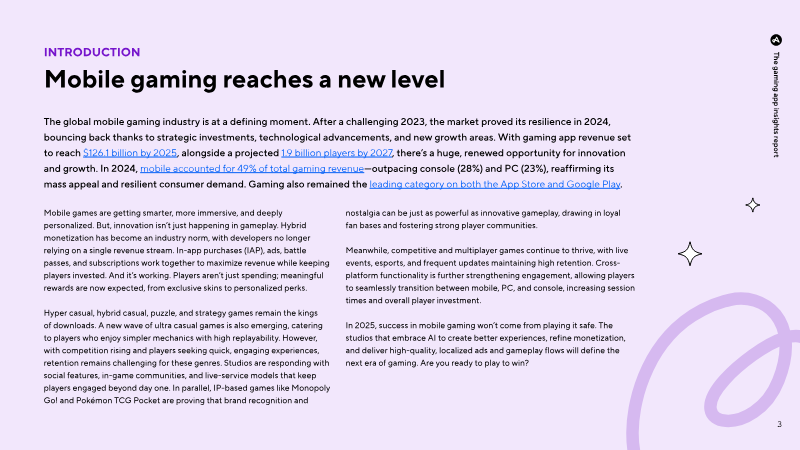
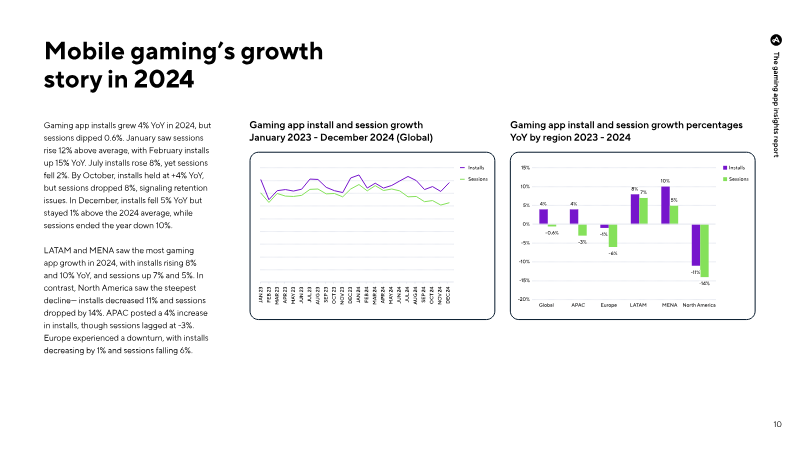
The mobile gaming industry is entering a period of strategic recalibration, projected to reach $126.1 billion in revenue by 2025. This growth is underpinned by a transition toward hybrid monetization models and the integration of AI-powered personalization to combat persistent retention challenges. While global install volume grew by 4% in 2024, the market exhibits a distinct geographic divide; North American and European markets face stagnation, whereas Latin America and the Middle East and North Africa regions demonstrate robust expansion. Success in this evolving landscape requires developers to move beyond traditional acquisition, favoring diversified channels such as Connected TV and localized, player-centric engagement strategies.
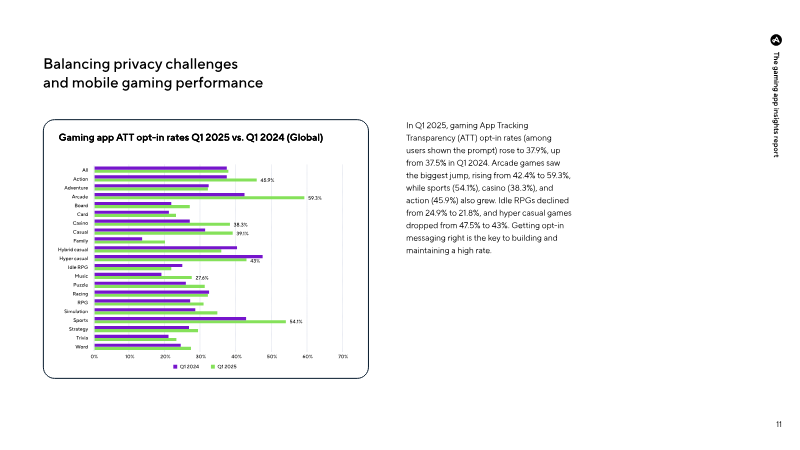
Data from early 2025 indicates that user tracking remains a pivotal operational hurdle, with global App Tracking Transparency opt-in rates hovering at 37.9%. Although arcade games have seen notable improvements in opt-in performance, the United States remains relatively static at 32%, underscoring the necessity for refined messaging strategies to maintain visibility. Concurrently, the industry is grappling with a complex financial environment characterized by rising costs per install and declining average revenue metrics. These headwinds are forcing a shift in marketing tactics, as developers increasingly rely on a broader array of acquisition partners and data-informed creative experimentation to sustain growth.
Ultimately, the path to profitability in 2025 lies in prioritizing long-term player value over short-term acquisition metrics. By leveraging AI-driven optimization and fostering community-building initiatives, developers can mitigate the impact of declining revenue per user. The industry is clearly moving toward a more sophisticated, data-reliant ecosystem where the ability to measure performance across fragmented channels—including mobile and Connected TV—is essential for maintaining a competitive advantage in a maturing global market.