Market Analysis reports and market data
Documents

Podcast: Quantifying the advertising value of cookies (with Garrett Johnson and Shunto Kobayashi)
The transition away from third-party cookies in digital advertising presents a substantial economic challenge for publishers, resulting in revenue declines ranging from 29% to 35%.
- Google’s Privacy Sandbox increases ad latency by 100%, with median ad rendering times rising from 1 second under status quo conditions to 2 seconds, leading to a 3% loss of total ad impressions due to users navigating away before ads load.
- Privacy-enhancing technologies (PETs) like the Privacy Sandbox currently fail to fully bridge the revenue gap caused by the removal of third-party cookies, with the effectiveness of these tools heavily dependent on widespread adoption by adtech firms.
- The revenue impact of privacy restrictions is more severe in markets with fewer alternative identifiers, such as the European Union, where the Privacy Sandbox performs better because it faces less competition from traditional header bidding channels.
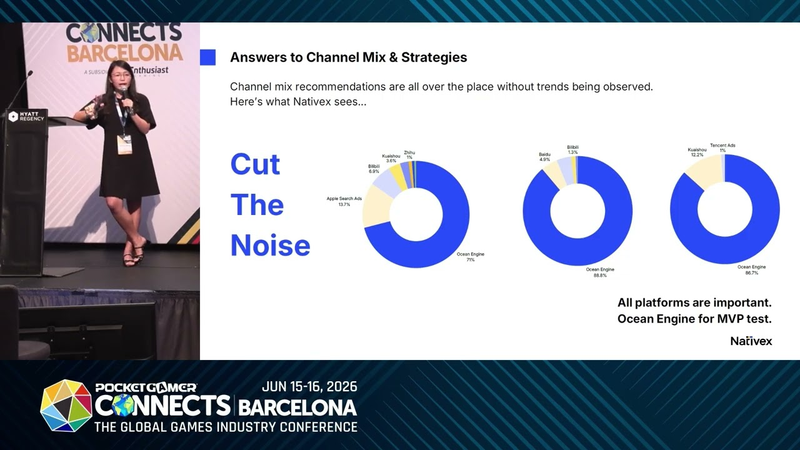
Session: Demystifying China UA: Reverse-Engineering AI Advice (Fact vs. Fiction) - Yolanda Huang.
The presentation evaluates the reliability of large language models (LLMs) in providing strategic guidance for user acquisition (UA) in the Chinese gaming market.
- Mainstream AI tools currently provide inconsistent, contradictory, and often inaccurate advice regarding China market entry, failing to serve as a reliable source of truth for UA strategies.
- Contrary to common industry misconceptions, a full ISBN license is not required for initial market testing; a software copyright license allows foreign entities to conduct paid media and influencer marketing tests.
- Ocean Engine, the ad platform powered by ByteDance, is the primary and most scalable channel for testing mobile game performance in the Chinese market.
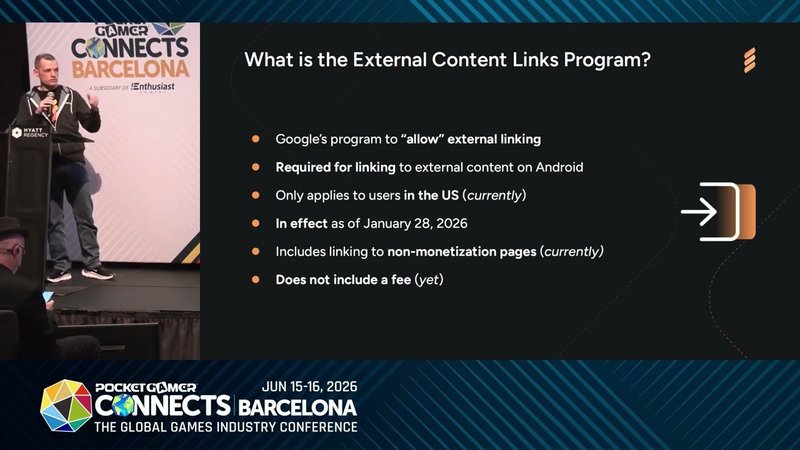
Session: D2C In 2026: Global Growth In Web Stores - Chip Thurston, FastSpring.
The direct-to-consumer (D2C) landscape for mobile gaming is undergoing a significant transformation driven by global regulatory shifts and evolving platform policies.
- Direct-to-consumer (D2C) revenue for mature gaming studios currently ranges between 27% and 44% of total earnings, highlighting a significant and successful shift toward web-based monetization.
- Publishers operating on Android in the United States must enroll in Google’s 'External Content Links' program to avoid app update rejections when linking to external web stores.
- The pending Epic vs. Google settlement proposes a new fee structure that splits the traditional 30% platform fee into a 5% billing fee and a 20-25% distribution fee, depending on the date of the app install.
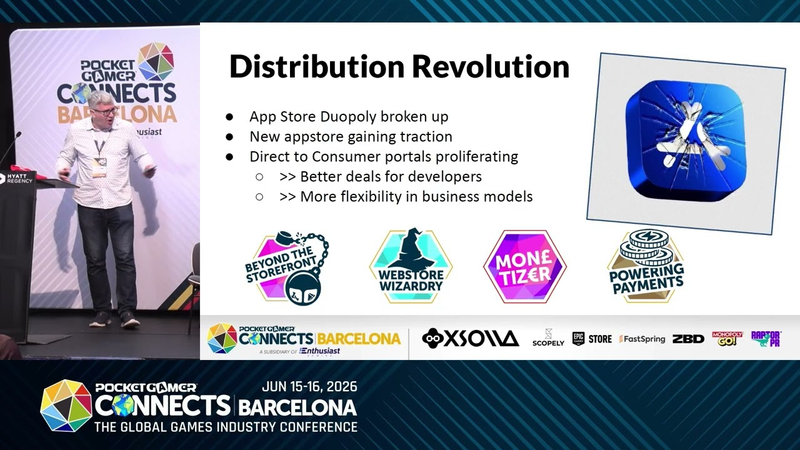
Welcome to Pocket Gamer Connects Barcelona 2026 - Chris James, Steel Media.
Pocket Gamer Connects Barcelona 2026 serves as a global industry gathering, bringing together representatives from 48 nations to facilitate business development, networking, and knowledge sharing.
- The games industry remains the world's largest entertainment sector, with total market value exceeding $200 billion, though this figure excludes significant revenue streams like console hardware sales and advertising.
- Direct-to-consumer (D2C) solutions are a critical growth area for mobile developers, currently generating an estimated $1.2 billion in annual run rate.
- User-Generated Content (UGC) platforms like Roblox are commanding massive engagement, with Roblox's attention time now competing directly with major streaming services like Netflix.

The News After Sharma's First 100 Days
The recent leadership changes and strategic shifts at Xbox, occurring during Asha Sharma’s first 100 days, signal a fundamental transition for the division.
- Microsoft is restructuring Xbox toward a leaner, more profitable model by prioritizing high-impact intellectual property over smaller, niche projects and reducing its first-party studio profile.
- Leadership is exploring the potential divestiture of the Xbox division into an independent entity supported by private equity or sovereign wealth funds.
- The strategic pivot shifts Xbox from a platform-management approach to a platform-operator model focused specifically on daily active users and long-term financial profitability.

Making Indie Games Is Like Buying A Lottery Ticket
The transition from corporate game development to independent game creation is frequently misunderstood as a viable alternative to industry layoffs.
- The indie game market is hyper-saturated, with over 21,000 games released on Steam in 2025 alone, making commercial viability difficult even for critically acclaimed titles.
- Transitioning to independent development is a high-risk financial endeavor rather than a stable career pivot, as it frequently requires personal savings, grants, or family support to cover years of development costs.
- The 'starving artist' model of indie development is functionally inaccessible to mid-career professionals who have significant financial obligations like mortgages and dependents.

Puzzle Monthly #4: $60M Marketing, $65M Revenue, What Happened to Good Job Games?
Good Job Games represents a cautionary case study in the mobile puzzle market, illustrating the limitations of prioritizing rapid asset exits and visual polish over sustainable, player-centric design.
- Good Job Games' title Match Villains generated $65 million in lifetime revenue but likely operated at a loss, as marketing expenditures for the project reached $83 million.
- The studio's failure to compete with industry leaders like Royal Match stems from a reliance on aggressive, punishing level design that prevents the retention of high-value users.
- Match Villains suffered from flat revenue-per-download metrics and an over-reliance on lower-tier geographic markets, preventing the game from achieving necessary scale.

Why did PlayStation buy Bungie in the first place?
The acquisition of Bungie by PlayStation for $3.6 billion in 2022 serves as a case study in the challenges of pivoting toward a live-service business model.
- PlayStation acquired Bungie for $3.6 billion in 2022 to accelerate its transition into the live-service market, but the strategy has resulted in approximately 700 layoffs and underwhelming performance for projects like Marathon.
- The console market is experiencing a period of stagnation, with U.S. hardware unit sales hitting record lows for both PlayStation and Xbox due to rising component costs and repeated price hikes.
- U.S. gaming revenue showed only a marginal 1% year-over-year increase in May, reflecting a broader cooling trend as consumers delay spending while anticipating the next generation of consoles expected in 2028.

🧠 Copy vs Execute: the creative trend everyone's chasing
The mobile gaming industry is currently defined by a strategic shift toward a copy-and-execute model, where developers prioritize the rapid adaptation of proven hyper-casual hooks to lower cost-per-install metrics.
- The mobile gaming industry has shifted toward a 'copy-and-execute' model that prioritizes rapid adaptation of proven hyper-casual hooks to lower cost-per-install metrics.
- Publishers are utilizing AI to generate thousands of unique ad variations monthly, focusing on high-intensity or humorous 30-to-60-second video formats to drive global downloads.
- The reliance on misleading gameplay elements in onboarding flows creates a fundamental tension between short-term user acquisition and long-term player retention.

Direct-to-consumer banks $17 billion and Google rolls out fee changes | Week in Mobile Games podcast
Direct-to-consumer (DTC) platforms have emerged as a critical pillar of the mobile gaming economy, currently generating $17 billion in annual revenue and capturing 15% of the global market.
- Direct-to-consumer (DTC) platforms now generate $17 billion annually, accounting for 15% of the global mobile gaming market.
- While 92% of publishers expect DTC growth, only 25% of organizations currently possess the mature infrastructure required to scale these operations.
- The mobile gaming industry is experiencing a period of significant contraction, marked by recent layoffs at Electronic Arts, operational consolidation at Kabam, and anticipated restructuring at Xbox.

Grand Theft Absent, Steam Machine Caught in the RAM racket & Bungie’s Bad Day | Games For Breakfast
The gaming industry is currently navigating a period of significant volatility characterized by aggressive monetization strategies, widespread workforce instability, and hardware market challenges.
- Grand Theft Auto 6 will launch with a $79.99 standard edition price point and lacks physical media, a move that may set an industry precedent for other publishers to follow.
- The $55 billion acquisition of Kadokawa involves $20 billion in loan financing, highlighting the high levels of debt-based leverage currently used in major gaming industry mergers.
- Bungie is facing significant internal challenges, including layoffs and criticism regarding its monetization strategies, such as the implementation of multiple currencies and gated content in Destiny.
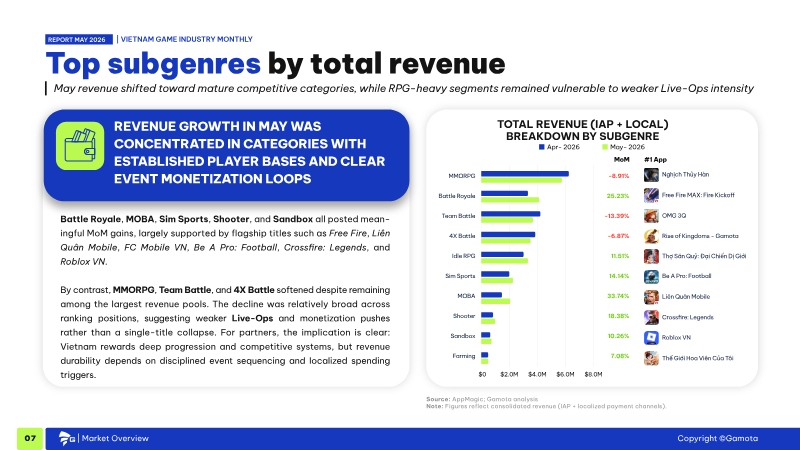
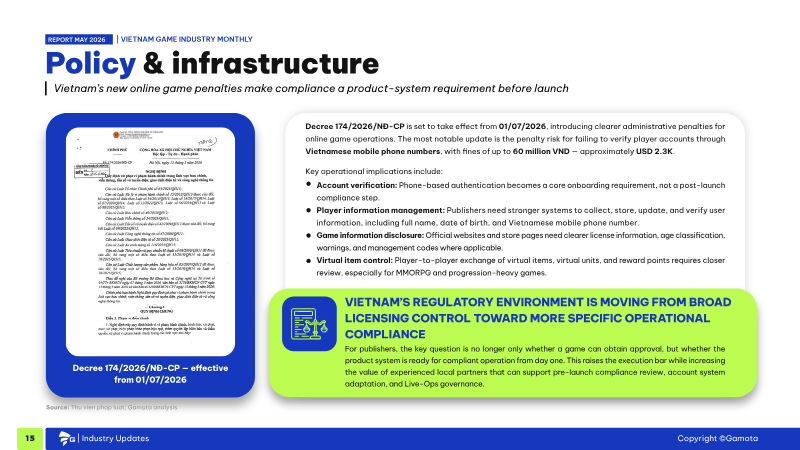

Vietnam Game Industry Monthly Report: May 2026
The Vietnam Game Industry Monthly Report for May 2026 provides a comprehensive analysis of the mobile gaming landscape, highlighting a shift in market dynamics from pure volume-based acquisition to a focus on operational depth and regulatory compliance.
- Vietnam's mobile IAP revenue grew by 3.13% MoM in May 2026, driven by strong monetization in long-lifecycle genres like Battle Royale, MOBA, and Sim Sports rather than new user acquisition.
- Midcore total revenue reached its highest level between January and May 2026, rising 4.44% MoM as established titles like Free Fire MAX, Liên Quân Mobile, and Roblox VN leveraged recurring Live-Ops and event-based spending.
- New game success in Vietnam is increasingly dependent on cultural fit, with titles featuring wuxia/xianxia settings, football fandom, or nostalgic IP—such as Giang Hồ Kỳ Ngộ and Total Football VNG—outperforming generic Western fantasy products.