Looter Shooter reports and market data
Documents
Blending Autonomy and Control: Creating NPCs for Tom Clancy's The Division
The development of artificial intelligence for Tom Clancy’s The Division centers on the integration of server-side behavior trees within the proprietary Snowdrop engine to create a dynamic, tactical combat experience.
- The Division features 36 unique combat AI variations categorized into 11 distinct archetypes, designed to create 'combat puzzles' where enemies synergize their skills to force specific player tactics.
- NPC behavior is built on a modular, priority-based system that evaluates critical events (like grenades or status effects) before executing scripted level-design orders or dynamic objectives.
- The AI detection system utilizes five alert levels—ranging from idle to combat investigation—governed by audio and visual stimuli defined by specific archetype vision cones.
Lessons Learned Creating UI for The Division
The user interface for The Division represents a significant shift in development methodology, moving away from traditional canvas-based systems toward a node-based, immediate-mode architecture within the Snowdrop engine.
- The Snowdrop engine UI system uses a node-based visual scripting architecture instead of a traditional canvas, allowing for 5,500 nodes to be utilized across game systems by the time of the Survival DLC release.
- Prioritizing rapid iteration is a core pillar of the engine, supported by keeping compile times around one minute and ensuring editor startup times remain within a few seconds.
- Moving loop execution from the node-based script system into the underlying C++ code can yield massive performance gains, such as reducing a specific graph's execution time from 20 milliseconds to 0.6 milliseconds.
Shared World Shooter: Destiny's Networked Mission Architecture
The architecture underpinning Destiny represents a strategic evolution in shared-world shooter design, prioritizing a seamless, always-online experience that balances the responsiveness of a single-player shooter with the social connectivity of a massive multiplayer environment.
- Bungie implemented a hybrid networking architecture for Destiny that combined cloud-hosted 'activity hosts' with peer-to-peer networking to support over 10,000 players per server with only a few hundred data center machines.
- Activity hosts run a stripped-down, authoritative simulation of mission scripts in the cloud, ensuring game state consistency and security while offloading high-latency physics tasks to player consoles.
- To manage state during frequent peer-to-peer host migrations—which occurred on average every 160 seconds in public bubbles—the system uses 'sensors' to reconcile only the minimal, essential game state between the physics host and the cloud.
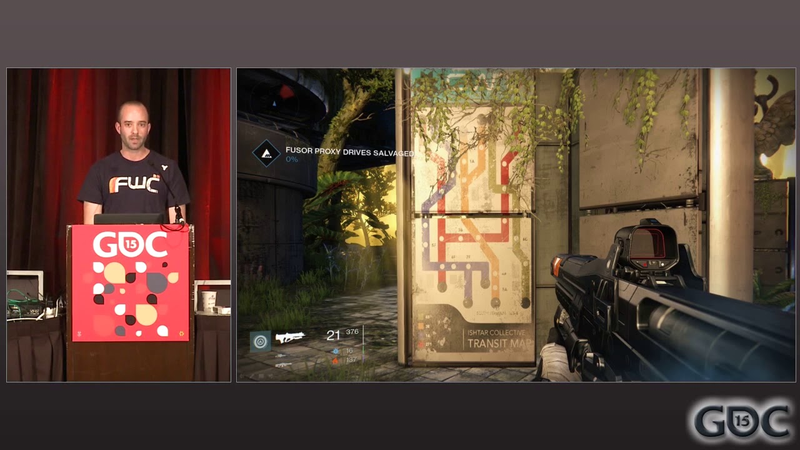
Localizing Bungie's Destiny for the World
The global expansion of the Destiny franchise relies on a strategic commitment to cultural inclusivity and technical scalability, moving away from traditional industry practices that treat localization as a late-stage afterthought.
- Bungie transitioned from treating localization as a late-stage task to establishing an internal department that integrates linguistic experts directly into the early design process.
- To minimize the need for region-specific art assets, the team utilized iconography and fictionalized signage instead of English text, ensuring a consistent visual experience across seven platforms.
- The studio employs a hybrid operational model that combines internal editors with external in-country translators to maintain the rapid release cycles required for a live service environment.
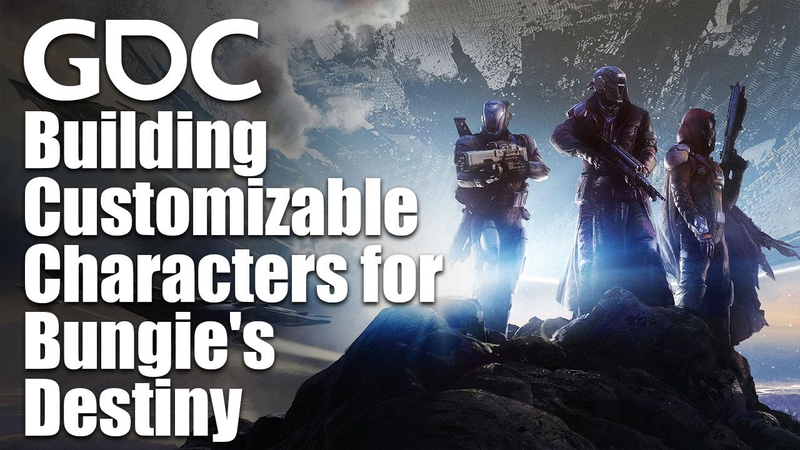
Building Customizable Characters for Bungie's Destiny
The transition from the singular hero archetype of the Halo franchise to the player-centric design of Destiny necessitated a fundamental shift in character development.
- Bungie developed a modular character customization system for Destiny that broke character designs into base elements called 'bits,' allowing artists to swap gear pieces without needing to re-skin or re-animate models.
- The system enabled artists to create complex new character assets, such as a helmet, in approximately 20 minutes by assembling pre-defined modular bits.
- To maintain performance across four platforms, the toolset provided real-time memory profiling for both textures and geometry, allowing artists to adjust resolution or swap bits to stay within strict hardware budgets.
User Research on Destiny
The development of Destiny necessitated a fundamental shift in user research methodology, moving away from traditional testing frameworks toward a highly integrated, automated system.
- Bungie implemented strict security measures—including metal detectors and locked-down testing platforms—to allow for playtesting six months earlier than would have been possible otherwise.
- To ensure data accuracy, Bungie used post-stratification weighting to align their lab sample with the general player population, confirming that internal playtest data yielded the same directional results as external agency-recruited participants.
- The development team utilized a 'frustration button' feature during playtests, allowing players to log specific moments of difficulty that were then mapped against XYZ coordinates and video footage to identify pain points and highlight 'awesome moments.'

Destiny is Gaming's "Law & Order" - Video Game Comfort Food - Extra Credits
The primary thesis of this analysis is that Destiny functions as the "Law & Order" of the video game industry, succeeding not through singular moments of brilliance, but by providing a consistently reliable, accessible, and high-quality "comfort food" experience.
- Destiny succeeds as a 'comfort food' title by prioritizing a consistent, high-quality experience across all activities rather than attempting to master a single niche.
- The game functions as a unifying platform for diverse friend groups by integrating PvE and PvP progression, allowing players with different preferences to engage in the same ecosystem.
- Destiny offers a low-friction, evergreen model that provides long-term investment value, contrasting with the finite nature of single-player games or annual franchise releases.