Investment
Documents
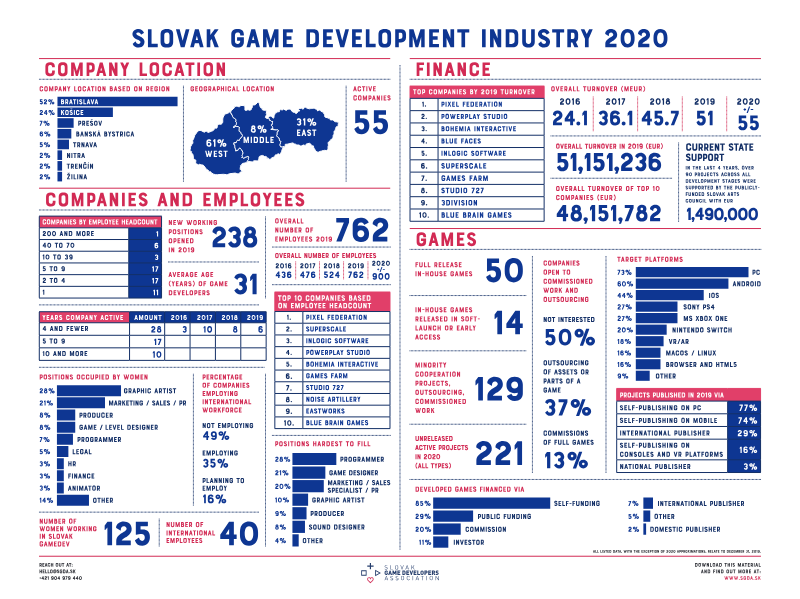
Slovak Game Industry Infographic
The Slovak game industry demonstrates consistent growth and professional maturation, characterized by a robust increase in both turnover and workforce capacity. As of the end of 2019, the sector comprised 55 active companies, with a significant geographic concentration in Bratislava, which hosts 52 percent of all firms, followed by Košice at 24 percent. The industry’s economic footprint is substantial, with the top ten companies generating over 48 million euros in annual turnover. Workforce development has kept pace with this expansion, as the total number of employees rose from 436 in 2016 to 762 by 2019, supported by the creation of 238 new positions in the final year of the reporting period.
Development activity remains diverse, with a strong emphasis on PC and mobile platforms. PC development leads the market at 73 percent, followed closely by Android and iOS at 60 percent and 44 percent, respectively. While self-publishing remains the dominant business model—utilized by 77 percent of companies for PC and 74 percent for mobile—the industry also leverages a mix of public funding, which supports 29 percent of projects, and commissioned work. Despite this growth, the sector faces talent acquisition challenges, particularly in filling roles for programmers, game designers, and marketing specialists.
The industry maintains a global outlook, with 40 international employees and a significant portion of the workforce engaged in outsourcing and international collaboration. Women represent a notable segment of the industry, occupying 129 positions, primarily within graphic arts, marketing, and production roles. With 221 active projects reported in 2020 and ongoing support from the Slovak Arts Council, the industry is positioned for continued development, balancing in-house creative output with strategic international partnerships and a diversified platform strategy.
- The Slovak game industry experienced significant workforce expansion between 2016 and 2019, growing from 436 to 762 employees.
- The top ten companies in the sector generated over 48 million euros in annual turnover as of 2019.
- The industry is geographically concentrated, with 52 percent of the 55 active companies based in Bratislava and 24 percent in Košice.
- PC development is the primary focus for 73 percent of companies, followed by Android at 60 percent and iOS at 44 percent.
- Self-publishing is the dominant business model, utilized by 77 percent of PC developers and 74 percent of mobile developers.
White Paper on Spanish Video Game Development 2020
Promoted by: With support from: Promoted by: With support from: LÍNEA Covid-19<sub>CULTURA</sub> One more year, DEV, the Spanish Association of Video Games and Entertainment Software Producers and Development Companies, keeps its commitment to the sector it represents by publishing the White Paper on Spanish Video Game Development, the leading report that makes an in-depth analysis of the video game industry in our The White Paper, this year celebrating its seventh edition, is aimed at dev...
- The Spanish video game industry billed 920 million euros in 2019, a 13% increase from 2018, and is projected to exceed 1.7 billion euros by 2023 with an annual growth rate of 17%.
- Employment in the sector grew by 6.1% in 2019, reaching 7,320 professionals, and is estimated to reach 8,500 direct jobs by 2023.
- Despite being the fifth European and tenth global market, 86% of Spanish studios bill below 2 million euros annually, with 61% billing under 200,000 euros, indicating a prevalence of small companies.
- Catalonia leads in both billing (51%) and employment (46%) within the Spanish video game industry, followed by Madrid (28% billing, 26% employment).
- A significant 66% of the industry's revenue comes from international markets, highlighting its export-oriented nature.
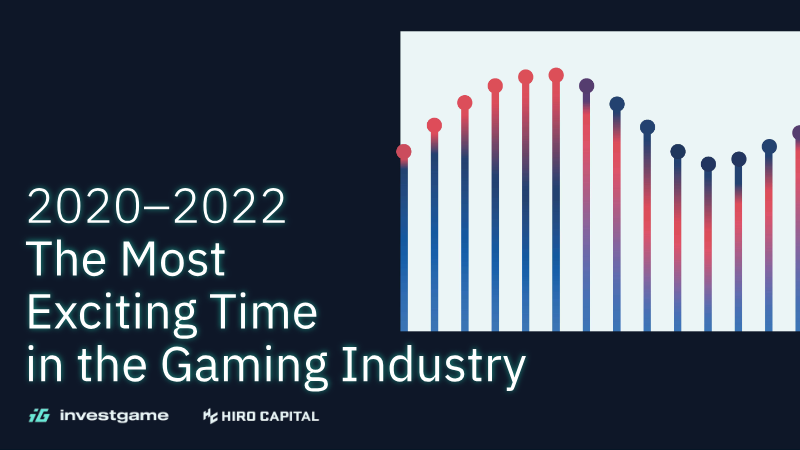
2020–2022: The Most Exciting Time in the Gaming Industry
This analysis examines global investment and merger and acquisition (M&A) activity within the video game industry from 2020 through 2022. The primary thesis posits that the industry has passed a historic peak of deal-making and is now entering a "Great Reset" characterized by market cooling, lower valuations, and a shift in investor priorities. While the era of massive public offerings and late-stage venture capital (VC) surges has slowed due to macroeconomic headwinds like inflation and rising interest rates, the industry remains fundamentally strong with significant "dry powder" available for early-stage startups and strategic consolidations.
The data reveals a volatile three-year cycle. M&A activity reached a zenith in 2022 with $37.7 billion in closed deals—a 199% increase in value from 2021—driven by massive consolidations such as Take-Two’s acquisition of Zynga. Conversely, public offerings plummeted by 82% in 2022 as the IPO and SPAC windows effectively closed. Private investments also saw a 16% decline in value in 2022 after doubling the previous year. Despite these drops, early-stage VC remained resilient, with over $6.2 billion raised by gaming-focused funds ready for deployment.
Geographically and segmentally, the scope is global, with specific attention paid to the decline of mobile gaming hype post-IDFA and the rising interest in PC, console, and AI-driven startups. The report highlights a stark cooling in Web3 gaming, where investor "FOMO" has been replaced by a focus on fundamental gameplay and infrastructure. Gender diversity remains a challenge in the sector; 89% of funded or acquired companies were led by men in 2022, a negligible change from 90% in 2021.
Methodologically, the findings are based on tracked closed transactions across video game publishers, developers, and hardware providers. Data was aggregated from public media, S&P Capital IQ, and partner insights, utilizing a weighted ranking system to identify the most active investors. The analysis concludes that while the "peak wave" has passed, the industry is transitioning into a more disciplined phase of the investment cycle.
- M&A activity reached a historic peak in 2022 with $37.7 billion in closed deals, representing a 199% increase over 2021, largely driven by major consolidations like Take-Two’s acquisition of Zynga.
- Public offerings for gaming companies collapsed in 2022, with an 82% decline in value as IPO and SPAC windows effectively closed due to macroeconomic headwinds.
- Private investment value fell by 16% in 2022 following a doubling of investment the previous year, signaling a shift toward a more disciplined, cooling market.
- Despite the broader market slowdown, early-stage venture capital remains robust, with over $6.2 billion in dry powder currently available for deployment into new startups.
- Investor interest has shifted away from Web3 gaming and mobile gaming—the latter impacted by post-IDFA challenges—toward PC, console, and AI-driven development.
Global Video Game Deals Report 2020
The 2020 fiscal year marked a historic period of consolidation and capital infusion for the global video game industry, largely catalyzed by the COVID-19 pandemic and the resulting surge in at-home entertainment. Total deal value reached $33.6 billion across 664 transactions, encompassing mergers and acquisitions, private investments, and public offerings. The United States and China emerged as the primary geographical drivers, collectively representing 63% of the total deal value. The market demonstrated significant resilience, recovering from a stagnant first quarter to reach record-breaking activity levels in the second half of the year.
M&A activity was a primary pillar of this growth, totaling $12.6 billion across 219 deals. This sector was dominated by public strategic acquirers such as Tencent, Embracer Group, Stillfront, and Zynga, who accounted for 60% of the total M&A value. Private investment also reached new heights, with $5.9 billion raised through venture capital and corporate rounds, specifically targeting multiplatform developers and mobile studios. Public markets followed a similar trajectory; after a quiet start to the year, public offerings surpassed $15.1 billion, supported by high-profile IPOs from companies like Unity Software and Kakao Games, as well as significant fixed-income activity as firms moved to refinance debt at lower interest rates.
The analysis segments the industry into gaming, platform technology, and esports. While gaming remained the most active sector, platform and tech saw substantial late-stage investments in companies like Roblox and Epic Games. Looking forward, the industry is expected to see continued consolidation led by Nordic and Chinese firms, increased competition between traditional venture capital and large strategic investors, and a robust pipeline of IPO candidates. This data was compiled by tracking closed transactions across public media and financial databases, excluding pure gambling and betting entities to focus on the core video game ecosystem.
- The global video game industry reached a record $33.6 billion in total deal value across 664 transactions in 2020, driven by pandemic-induced demand for at-home entertainment.
- Public offerings were the largest financial contributor at $15.1 billion, bolstered by high-profile IPOs from Unity Software and Kakao Games alongside corporate debt refinancing.
- Mergers and acquisitions totaled $12.6 billion across 219 deals, with Tencent, Embracer Group, Stillfront, and Zynga accounting for 60% of that value.
- The United States and China served as the primary market drivers, collectively representing 63% of the total global deal value.
- Private investment reached $5.9 billion, with venture capital and corporate funding rounds specifically targeting mobile studios and multiplatform developers.
Games Industry 2019/20
Germany stands as Europe’s largest video‑game market and the world’s fifth‑largest, a position reinforced by a robust developer community, flagship events and a policy framework that actively subsidises production. Federal funding of €50 million per year, allocated as non‑repayable grants covering a quarter to half of project costs, is complemented by regional programmes and a business climate that benefits from a sizable domestic audience and a highly skilled workforce.
The market generated a record €4.4 billion in 2018, expanding 9 percent year‑on‑year, while the sector’s organisational base grew to roughly 524 game‑related firms that year. These include 368 development studios, 38 pure publishers and a further 118 hybrid entities, employing about 11 000 staff directly in development and nearly 28 000 when ancillary roles are counted. More than 50 higher‑education institutions now deliver dedicated curricula in game design, computer science, art and virtual reality, concentrating talent pipelines in Berlin and Hamburg.
Mid‑size studios such as Deep Silver, Kolibri Games and Mimimi have produced internationally recognised titles, and the annual gamescom exhibition in Cologne underscores the industry’s global reach. In 2023 the event attracted 31 300 trade professionals, delivered over 500 000 concurrent viewers for its Opening Night Live broadcast and amassed more than 100 million video hits, prompting the launch of a gamescom Asia edition in Singapore to capture growth in the Asia‑Pacific region.
A dense network of over 200 development and publishing firms and more than 150 specialist service providers—spanning localisation, cloud infrastructure, legal counsel, marketing and middleware—covers virtually every German city. This comprehensive, SME‑driven ecosystem, supported by mature ancillary services, positions Germany for sustained expansion and reinforces its role as a central hub for both domestic creation and international distribution of video‑games.
- Germany is the largest video-game market in Europe and the fifth-largest globally, generating a record €4.4 billion in 2018 with a 9 percent year-on-year growth rate.
- The German government supports the industry with €50 million in annual non-repayable grants, which cover 25 to 50 percent of project costs for developers.
- The sector comprises approximately 524 game-related firms, including 368 development studios, employing 11,000 staff directly and nearly 28,000 when including ancillary roles.
- The industry is supported by a robust talent pipeline from over 50 higher-education institutions, with development hubs concentrated primarily in Berlin and Hamburg.
- The annual gamescom exhibition in Cologne is a major international industry driver, attracting 31,300 trade professionals and over 100 million video hits in 2023.
Tencent Games Strategy 2019
Tencent’s strategic pivot in 2019 marks a recovery from the previous year’s regulatory freeze on game licenses, which had triggered the company’s first-ever profit decline. By early 2019, gaming revenue rebounded to $5.2 billion, driven largely by the successful transition of 150 million monthly active users from the unmonetized PUBG Mobile to the compliant, self-developed Peacekeeper Elite. This maneuver underscores a broader commitment to navigating strict domestic regulations while maintaining market dominance through the integration of the WeChat and QQ social ecosystems, which serve as the primary distribution channels for both internal and third-party titles.
The company is simultaneously pursuing aggressive international expansion and portfolio diversification to mitigate domestic risks. This global strategy involves high-profile intellectual property licensing, such as Call of Duty and Street Fighter, alongside strategic acquisitions of Western studios like Sharkmob. Within China, the expansion of the WeGame platform to 70 million monthly active users and a partnership to serve as the exclusive distributor for the Nintendo Switch signal a move beyond traditional free-to-play mobile models into the PC and console markets.
Future growth is anchored in emerging technologies and infrastructure, specifically cloud gaming and esports. Leveraging a cloud network that already supports 75% of China’s top mobile games, Tencent is positioned to lead the domestic market in the absence of major international competitors. With a $1 billion commitment to esports infrastructure and a pipeline of over 20 new titles, the strategy emphasizes long-term dominance through a combination of massive capital investment, mergers and acquisitions, and the development of next-generation technologies including augmented reality and blockchain-integrated gaming.
- Tencent successfully recovered from a 2018 regulatory freeze by migrating 150 million monthly active users from PUBG Mobile to the compliant, self-developed title Peacekeeper Elite, resulting in $5.2 billion in quarterly gaming revenue.
- The company is mitigating domestic regulatory risks through aggressive international expansion, including the acquisition of Western studios like Sharkmob and licensing major IP such as Call of Duty and Street Fighter.
- Tencent is diversifying beyond mobile free-to-play models by growing its WeGame platform to 70 million monthly active users and securing an exclusive partnership to distribute the Nintendo Switch in China.
- Tencent is leveraging its existing cloud infrastructure, which currently supports 75% of China’s top mobile games, to establish a dominant position in the emerging cloud gaming market.
- The company has committed $1 billion to esports infrastructure and is developing a pipeline of over 20 new titles to maintain market leadership.
Serbian Gaming Industry Report 2018
The inaugural Serbian Games Association report maps a rapidly expanding national gaming ecosystem that now comprises more than 60 members across indie development, esports, visual‑effects houses and internationally linked studios, employing over 1,500 skilled professionals. Funding is diversified, with roughly 40 % of capital sourced from angel investors, 30 % from crowdfunding and 20 % from venture capital, and the largest single infusion recorded at €650 k. Flagship entities such as 3Lateral (recently integrated into Epic Games), Nordeus with its 200 million‑user “Top Eleven” platform, and Ubisoft Belgrade’s 107‑person team working on major AAA titles illustrate the sector’s growing global relevance.
A vibrant indie segment is driven by small, highly creative teams—often one to three developers—producing titles ranging from cyber‑punk point‑and‑click adventures to hyper‑casual mobile games. Studios like Munzesky Games, Oraharo Entertainment, PWN.RS, Stargazer, Superverse Industries, Tummy Games and Zero Gravity showcase cross‑border collaborations and distinctive artistic approaches, while highlighting the need for stronger B2B networking, regular industry events and formalized game‑art education to sustain momentum.
Technical education underpins this growth, with approximately 30 000 university students enrolled in IT‑related programs and programming introduced at the primary‑school level. Government incentives, EU grants and private investment have bolstered studio formation, yet most companies still rely on organic installs and limited ad‑network usage for user acquisition. Community initiatives—including frequent association meet‑ups, two industry‑backed GameJams, the annual GameUp expo attracting over 2 500 participants, and the Nordeus Hub co‑working space offering a six‑month mentorship—are actively closing knowledge gaps and fostering collaboration.
Media outlets such as Svet kompjutera, JVC Gamer and the online PLAY! Zine maintain visibility for Serbian developers both domestically and abroad. Surveyed stakeholders anticipate a rise in paid user‑acquisition capabilities and an increase in successful Serbian titles, positioning the country to become a more prominent player in the regional and global gaming market.
- The Serbian gaming industry comprises over 60 member entities and employs more than 1,500 professionals, anchored by major players like Nordeus, Ubisoft Belgrade, and 3Lateral.
- Funding for the sector is diversified, with 40% sourced from angel investors, 30% from crowdfunding, and 20% from venture capital, with the largest single investment reaching €650,000.
- A robust pipeline of technical talent is supported by approximately 30,000 university students in IT-related programs and the integration of programming into primary-school curricula.
- The indie segment is characterized by small, highly creative teams of one to three developers, though these studios currently rely heavily on organic installs rather than paid user-acquisition strategies.
- Industry growth is bolstered by community-led initiatives such as the GameUp expo, which attracts over 2,500 participants, and mentorship programs like the Nordeus Hub.

Annual Report 2018
Games Workshop achieved record-breaking financial performance during the 2017/18 fiscal year, characterized by a 39% increase in revenue to £219.9 million and a near doubling of operating profit to £74.6 million. This growth, which propelled the company into the FTSE 250, was primarily driven by the global success of the Warhammer brand and a 54% surge in the trade segment. With 76% of sales generated internationally, the company significantly expanded its Nottingham-based manufacturing and R&D facilities, doubling plastic injection molding capacity and increasing inventory levels to £20.2 million to meet rising global demand.
Strategic priorities focused on long-term infrastructure and digital engagement, including the implementation of a new ERP system and a successful relaunch of Warhammer 40,000 that drove 70 million digital community page views. Financial stability remained robust, with the company maintaining a debt-free position and increasing cash reserves to £28.5 million. While management monitored risks related to Brexit and supply chain interruptions, the return on capital rose from 72% to 120%. Governance remained stable, with the board defending the tenure of long-serving directors based on their deep industry expertise, while also implementing a revised remuneration policy to align executive pay with market rates following the year’s exceptional performance.
The company’s commitment to sustainability and compliance was evidenced by a reduction in greenhouse gas emissions through solar energy investments and the achievement of full GDPR compliance. Looking forward, the company remains focused on multi-channel retail growth and IP licensing opportunities. Independent auditors confirmed the integrity of the financial statements, noting that while inventory valuation and development costs require significant management judgment, the group remains a strong going concern with high liquidity and a clear trajectory for continued global expansion.
- Games Workshop achieved record financial performance in the 2017/18 fiscal year, with revenue increasing 39% to £219.9 million and operating profit nearly doubling to £74.6 million.
- The company’s growth was driven by a 54% surge in the trade segment and the global success of the Warhammer brand, which helped propel the firm into the FTSE 250.
- To support international demand, which accounted for 76% of total sales, the company doubled its plastic injection molding capacity and increased inventory levels to £20.2 million.
- Operational efficiency and capital allocation were highly effective, with the return on capital rising from 72% to 120% while maintaining a debt-free balance sheet with £28.5 million in cash reserves.
- Digital engagement initiatives, highlighted by the relaunch of Warhammer 40,000, generated 70 million page views on the company's community platform.
Libro Blanco del Desarrollo Español de los Videojuegos
LIBRO CENTRO UNIVERSITARIO Fando Eurapeo de DE TECNOLOGIA Y ARTE DIGITAL Ung manere de hacer Eurapa Asociación Española de Empresas Productoras y Desarrolladoras de Videojuegos y Software de Entretenimiento 1 . INTRODUCCIÓN 05 2. CADENA DE VALOR DE LA INDUSTRIA DEL VIDEOJUEGO 07 2.1. Cadena de valor tradicional de la industria de videojuegos 08 2.2.
- The global gaming market had 1.231 billion active players by the end of 2013, representing over half of the world's internet-connected population and 17.5% of the total global population.
- The gamification business is projected for exponential growth, with Markets And Markets estimating a potential business of $5.5 trillion USD by 2018, growing at a 67.1% annual rate between 2013 and 2018.
- The Spanish video game sector increased employment by 29% in 2013, with 65% of contracts being permanent, making it a significant job creator for highly qualified young professionals.
- In 2012, the Russian video game industry generated $1.3 billion, a 30% increase from 2011, and its market is expected to double in the next three years to reach $1.5 billion.
- The UK offers R&D tax deductions for video game companies, with SMEs receiving a 225% enhanced deduction on their R&D investment.
Videojuegos en España: Impacto Económico y Escenarios Fiscales
Spain’s video‑game industry is presented as a dynamic component of the national ICT services sector, whose economic relevance extends far beyond direct production. Using 2016 input‑output tables updated with INE data, the analysis quantifies the sector’s contribution to GDP, employment and value‑added, and evaluates how fiscal incentives and inter‑industry linkages shape its growth trajectory.
In 2016 the industry generated €1.177 billion in direct output, representing roughly 0.11 % of national GDP, and created 8 790 high‑skill jobs. When indirect and induced effects are incorporated, total activity rises to €3.577 billion, value‑added reaches €1.452 billion and employment expands to 22 828 positions, implying that each euro invested yields three euros of economic activity and that a game‑industry job supports 2.6 additional jobs elsewhere. The sector supplies 14.3 % of publishing output, 9.6 % of audiovisual production and 3.8 % of related services, yet its forward absorption and diffusion coefficients are low, indicating limited downstream impact compared with professional services.
Productivity analysis shows a 6.4 % annual decline in value‑added per employee within the broader editing segment, while revenue per worker remains modest at €144 k. Between 2014 and 2024, software publishing and cable‑free telecommunications emerge as the fastest‑growing Spanish activities, with annual expansions of 4.7 % and 4.2 % respectively, underscoring the sector’s alignment with broader digital trends.
Four fiscal‑policy scenarios are compared, and the tax‑credit option (E2) delivers the strongest stimulus, adding €627 million of production, €254 million of value‑added and 4 000 full‑time jobs, albeit at the cost of a modest deterioration in public‑finance balance. Methodologically, the study follows Frascati and Oslo standards, aggregates data at the two‑digit CNAE level, and employs a Leontief inverse to trace demand‑driven effects, ensuring international comparability of R&D, innovation and ICT metrics.
- The Spanish video game industry generates a total economic impact of €3.577 billion, with every €1 invested yielding €3 in total economic activity.
- The sector supports 22,828 total jobs when accounting for indirect and induced effects, with each direct industry position sustaining 2.6 additional jobs elsewhere.
- Implementing a tax-credit fiscal policy (Scenario E2) is projected to provide the strongest stimulus, adding €627 million in production and 4,000 full-time jobs to the economy.
- In 2016, the industry directly contributed €1.177 billion to GDP (0.11% of the national total) and employed 8,790 high-skill workers.
- Software publishing has emerged as a high-growth activity in Spain, expanding at an annual rate of 4.7% between 2014 and 2024.

Annual Report 2017
Games Workshop achieved record-breaking financial performance during the 2016/17 fiscal year, characterized by a 34% increase in revenue to £158.1 million and a doubling of operating profit to £38.3 million. This growth was balanced across all primary channels—trade, retail, and mail order—and supported by a robust gross margin of 72.4%. North America emerged as the largest geographic market, contributing £57.0 million to the total revenue. The company’s vertically integrated model, centered on its Nottingham manufacturing hub, produced 30 million miniatures and launched over 400 new products, while royalty income from licensed video games like Total War: Warhammer provided high-margin supplementary growth.
Strategic priorities focused on long-term stability and cash generation, resulting in a 72% return on capital and a 76% increase in dividends per share. Despite this success, the period involved significant administrative and leadership transitions. Long-standing Chairman Tom Kirby announced his retirement, and the board addressed a technical breach of the Companies Act 2006 regarding an "unlawful dividend" payment of £1.9 million. This was rectified through shareholder resolutions to release directors from liability and treat the payment as a loan offset by future dividends.
Operational investments included a major ERP system upgrade and a continued commitment to the UK Living Wage and universal profit-sharing, which saw a £4.9 million discretionary payment to the workforce. Environmental and governance disclosures highlight a reduction in carbon emissions and an 85% waste recycling rate. While the company maintains a conservative "survivalist" fiscal strategy, its strong liquidity position—ending the year with £17.9 million in cash and no debt—underpins its viability as a going concern through the 2020 horizon.
- Games Workshop achieved record financial performance in the 2016/17 fiscal year, with revenue increasing 34% to £158.1 million and operating profit doubling to £38.3 million.
- The company maintained a 72.4% gross margin and a 72% return on capital, supported by a debt-free balance sheet and £17.9 million in cash reserves.
- North America became the company's largest geographic market, contributing £57.0 million in revenue, while royalty income from licensed titles like Total War: Warhammer provided high-margin growth.
- The Nottingham manufacturing hub produced 30 million miniatures and launched over 400 new products, underpinned by a vertically integrated business model.
- Shareholders saw a 76% increase in dividends per share, despite the company addressing a technical breach of the Companies Act 2006 regarding an unlawful £1.9 million dividend payment.
Dossier de Prensa AEVI 2016
AEVI was founded in 2014 to unify Spain’s video‑game ecosystem and to position the sector as a leading technological and cultural industry. Its institutional goals focus on fostering local development, attracting investment, collaborating with public authorities, defending intellectual‑property rights, and promoting responsible consumption through the PEGI rating system.
In 2014 the Spanish video‑game market generated €996 million, a 6.8 % increase over the previous year, with physical sales accounting for €755 million and online sales €241 million. Software contributed €364 million, hardware €301 million and accessories €90 million. The sector served 13 million users—36 % of the population—making Spain one of the four largest European markets after France, Germany and the United Kingdom. Players aged 11‑64 spent an average of 5.9 hours per week gaming; 40 % of adults played, 26.2 % regularly, and gender participation reached 45.3 % for men and 32.8 % for women. Physical copies remained the preferred format (7.9 million users), followed by online (5 million) and mobile applications (4.9 million).
AEVI highlighted the persistent challenge of piracy, reporting 240 million illegal downloads and 2 million physical infringements in 2014, which translated into a €226 million loss of revenue. Legislative reforms in intellectual‑property law and the criminal code were cited as recent advances in combating these practices. The association also noted a 21 % rise in development studios, reaching nearly 400 companies, and projected that employment in the sector could double to over 7 000 highly qualified jobs by 2019.
Through advocacy, data collection from sources such as GfK, ISFE, Gametrack and its own surveys, and partnerships with institutions like the Federation for the Protection of Intellectual Property, AEVI seeks to sustain growth, enhance the cultural perception of video games, and ensure a responsible, innovative market environment in Spain.
- The Spanish video-game market generated €996 million in 2014, marking a 6.8% year-over-year growth and establishing Spain as one of the four largest markets in Europe.
- Piracy remains a significant economic challenge, with 240 million illegal downloads and 2 million physical infringements causing an estimated €226 million in lost revenue in 2014.
- The sector served 13 million users in 2014, representing 36% of the population, with players aged 11–64 averaging 5.9 hours of gaming per week.
- The number of development studios in Spain grew by 21% to nearly 400 companies, with projections suggesting sector employment could double to over 7,000 jobs by 2019.
- Market revenue in 2014 was split between €755 million in physical sales and €241 million in online sales, with software contributing €364 million, hardware €301 million, and accessories €90 million.