Updated Mar 17, 2026 by Games Workshop Group
Report · August 1, 2018
Published by Games Workshop Group
Games Workshop achieved record-breaking financial performance during the 2017/18 fiscal year, characterized by a 39% increase in revenue to £219.9 million and a near doubling of operating profit to £74.6 million. This growth, which propelled the company into the FTSE 250, was primarily driven by the global success of the Warhammer brand and a 54% surge in the trade segment. With 76% of sales generated internationally, the company significantly expanded its Nottingham-based manufacturing and R&D facilities, doubling plastic injection molding capacity and increasing inventory levels to £20.2 million to meet rising global demand. Strategic priorities focused on long-term infrastructure and digital engagement, including the implementation of a new ERP system and a successful relaunch of Warhammer 40,000 that drove 70 million digital community page views. Financial stability remained robust, with the company maintaining a debt-free position and increasing cash reserves to £28.5 million. While management monitored risks related to Brexit and supply chain interruptions, the return on capital rose from 72% to 120%. Governance remained stable, with the board defending the tenure of long-serving directors based on their deep industry expertise, while also implementing a revised remuneration policy to align executive pay with market rates following the year’s exceptional performance. The company’s commitment to sustainability and compliance was evidenced by a reduction in greenhouse gas emissions through solar energy investments and the achievement of full GDPR compliance. Looking forward, the company remains focused on multi-channel retail growth and IP licensing opportunities. Independent auditors confirmed the integrity of the financial statements, noting that while inventory valuation and development costs require significant management judgment, the group remains a strong going concern with high liquidity and a clear trajectory for continued global expansion.

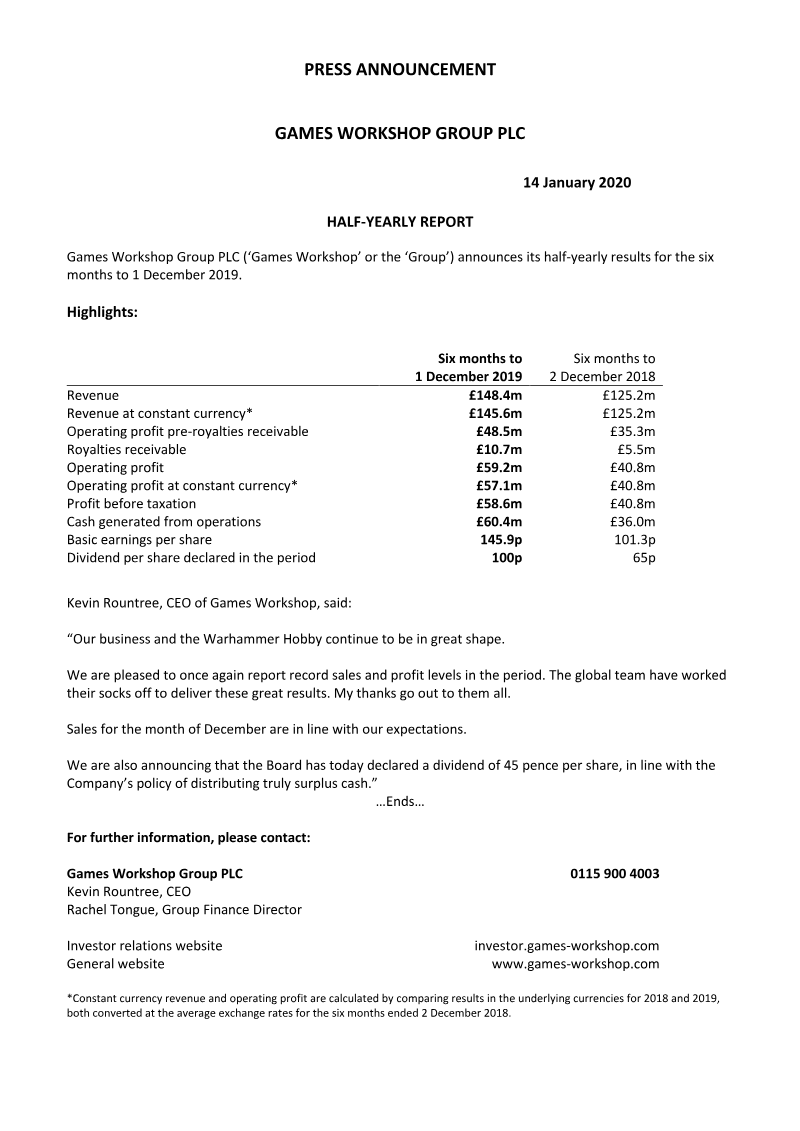
FINANCIAL HIGHLIGHTS 2018 2017 £000 £000 Revenue 219,868 158,114 Revenue at constant currency* 222,594 158,114 Operating profit - pre-royalties receivable 64,702 30,832 Royalties receivable 9,893 7,491 Operating profit 74,595 38,323 Profit before taxation 74,546 38,403 Cash generated from operations 82,332 49,370 Earnings per share 185.0p 95.1p Dividends per share declared in the year 126p 74p CONTENTS Chairman’s statement 2 Strategic report 3 Directors’ report 13 Corporate governance report 18 Remuneration report 22 Directors’ responsibilities statement 32 Company directors and advisers 33 Independent auditors’ report 34 Consolidated income statement 39 Statements of comprehensive income 39 Balance sheets 40 Consolidated and Company statements of changes in total equity 41 Consolidated and Company cash flow statements 42 Notes to the financial statements 43 Five year summary 63 Financial calendar 63 Notice of annual general meeting 64 *Constant currency revenue is calculated by comparing results in the underlying currencies for 2018 and 2017, both converted at the 2017 average exchange rates as set out on page 11. 1 Games Workshop Group PLC
CHAIRMAN’S STATEMENT This is my first statement as non-executive chairman of Games Workshop Group PLC: I was appointed on the retirement of Tom Kirby at our shareholders’ meeting in September 2017. Not an easy act to follow: Tom has been the embodiment of the Company since its management buy-out in 1991. Tom’s preambles to the Games Workshop annual report in the past bear witness to his love of Games Workshop, his extensive business experience and his wideranging perspective: I would not presume to try and imitate these statements. On behalf of everyone involved in any way in Games Workshop, thank you, Tom, for your contribution over so many years. Our financial year ended 3 June 2018 was a great year for Games Workshop, building on the strong performance achieved in 2016/17. Your board believes that the Company has achieved a new order of magnitude, driven by the strategy devised and implemented by our CEO, Kevin Rountree. As Kev describes in his report later in this annual report, the growth achieved over the last two financial years and our outlook have encouraged us to put in place for the first time plans to increase our production facilities in Nottingham to enable us to service better the demand for our products worldwide. Kev will describe other initiatives we have underway in his report.
er the last two financial years and our outlook have encouraged us to put in place for the first time plans to increase our production facilities in Nottingham to enable us to service better the demand for our products worldwide. Kev will describe other initiatives we have underway in his report. The core of our strategy remains unchanged: to design, manufacture and sell wonderful models and games for our existing hobbyists/customers, and to recruit and retain new customers excited by our Warhammer worlds. The appetite for our products - in many countries around the world - is strong and has been growing well recently. We believe that our efforts on ever better customer service, supported by appropriate digital marketing, have been received positively. Mindful in particular of our recent - and notable - growth, your board is taking care to remain alert to the business risks we face every day. Achieving, and maintaining, unprecedented (for us) levels of growth present many new issues which we must address. Not least is the need to invest continually in product design, development and manufacturing capacity, as noted above. Your board remains focused on running Games Workshop as well as we can for the long term: our share price must look after itself. On this front I should mention that I’m aware of a few comments regarding the Company’s nomination for certain investment awards over the past year and our not attending the related events. We’re not trying to be disrespectful here, it’s simply that we’re more focused on the future and opportunities for further improvement rather than on our past performance.
regarding the Company’s nomination for certain investment awards over the past year and our not attending the related events. We’re not trying to be disrespectful here, it’s simply that we’re more focused on the future and opportunities for further improvement rather than on our past performance. Our AGM this year will be different from those in recent years: it will focus purely on normal AGM business. The opportunity for investors to meet and engage with all board members will, of course, continue. On the subject of the long term, part of my responsibilities as chairman include leading a review of the composition of the Company's board and to set in motion a process to appoint new non-executive directors of the Company (some of us, myself included, have been around for quite a time). Our aim is to add skills and experience which should be of help in maintaining and building upon our new position as a business with sales of £200m+. We set in motion this process in October 2017. Finding the right people - people with the relevant skills who ‘fit’ with Games Workshop - takes time but I am pleased to inform you that John Brewis was appointed to the board in June this year; John’s background is described later in this annual report. In 2019, Chris Myatt, our senior independent director, will step down. We will start the search for his successor later this year. I have three enjoyable responsibilities to discharge before concluding this statement:
in June this year; John’s background is described later in this annual report. In 2019, Chris Myatt, our senior independent director, will step down. We will start the search for his successor later this year. I have three enjoyable responsibilities to discharge before concluding this statement: - firstly, to thank our executive directors and the Games Workshop team as a whole for achieving such success this year (and last year) – and to encourage them to keep it up! The performance of the team in responding so well to our rapid growth, overcoming challenges in our performance in recent years, has been fantastic. - secondly, to thank our loyal customers: we will do our best to continue to produce wonderful models and games for you. - thirdly, to encourage our shareholders to attend our AGM/shareholders’ meeting on 19 September 2018: we look forward to seeing you there. With thanks, and best wishes. Nick Donaldson Non-executive chairman 30 July 2018 2 Games Workshop Group PLC
STRATEGIC REPORT Strategy and objectives Games Workshop is committed to making the Warhammer Hobby and our business ever better. Our ambitions remain clear: to make the best fantasy miniatures in the world, to engage and inspire our customers, and to sell our products globally at a profit. We intend to do this forever. Our decisions are focused on long-term success, not short-term gains. Let me go through our strategy part by part: The first element - we make high quality miniatures. We understand that what we make is not for everyone, so to recruit and re-recruit customers we are absolutely focused on making our models the best in the world. In order to continue to do that forever and to deliver a decent return to our owners, we sell them for the price that we believe the investment we have made in quality is worth. The second element is that we make fantasy miniatures based in our endless, imaginary worlds. This gives us control over the imagery and styles we use and ownership of the intellectual property (IP). Aside from our core business, we are constantly looking to grow our royalty income from opportunities to use our IP in other markets. The third element is that we are customer focused. We talk to our customers. We aim to communicate in an open, fun way. Whoever and wherever our customers are, and in whichever way they want to engage with Warhammer, we will do our utmost to support them.
Games Workshop achieved record-breaking financial performance during the 2016/17 fiscal year, characterized by a 34% increase in revenue to £158.1 million and a doubling of operating profit to £38.3 million. This growth was balanced across all primary channels—trade, retail, and mail order—and supported by a robust gross margin of 72.4%. North America emerged as the largest geographic market, contributing £57.0 million to the total revenue. The company’s vertically integrated model, centered on its Nottingham manufacturing hub, produced 30 million miniatures and launched over 400 new products, while royalty income from licensed video games like Total War: Warhammer provided high-margin supplementary growth. Strategic priorities focused on long-term stability and cash generation, resulting in a 72% return on capital and a 76% increase in dividends per share. Despite this success, the period involved significant administrative and leadership transitions. Long-standing Chairman Tom Kirby announced his retirement, and the board addressed a technical breach of the Companies Act 2006 regarding an "unlawful dividend" payment of £1.9 million. This was rectified through shareholder resolutions to release directors from liability and treat the payment as a loan offset by future dividends. Operational investments included a major ERP system upgrade and a continued commitment to the UK Living Wage and universal profit-sharing, which saw a £4.9 million discretionary payment to the workforce. Environmental and governance disclosures highlight a reduction in carbon emissions and an 85% waste recycling rate. While the company maintains a conservative "survivalist" fiscal strategy, its strong liquidity position—ending the year with £17.9 million in cash and no debt—underpins its viability as a going concern through the 2020 horizon.
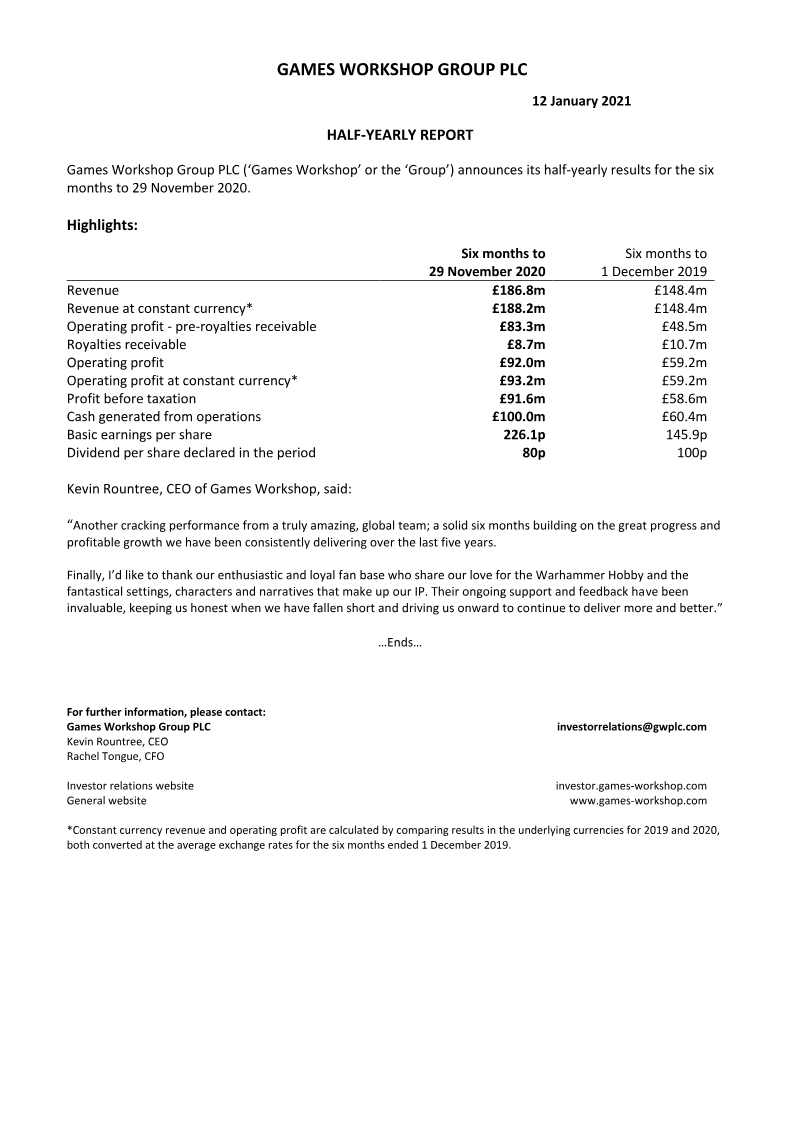
Games Workshop achieved record-breaking financial results for the 2019/20 fiscal year, demonstrating significant resilience despite the operational disruptions caused by the COVID-19 pandemic. Annual revenue rose 5.1% to £269.7 million, while profit before tax reached £89.4 million. This performance marks the fourth consecutive year of record growth, driven primarily by a robust trade segment—which now accounts for 52% of total revenue—and a substantial increase in royalty income from licensing agreements in the video game and media sectors. The company’s strategic focus remained on the global expansion of its Warhammer intellectual property and the modernization of its industrial infrastructure. Significant capital investments totaling £18 million were directed toward production and logistics expansions in Nottingham and North America, alongside the implementation of a new ERP system. While physical retail sales declined by 11% due to pandemic-related store closures, digital engagement and online sales saw marked growth. The company also successfully navigated the transition to IFRS 16 accounting standards, which brought £32.1 million in lease liabilities onto the balance sheet. Geographically, North America remains the company's largest market, contributing £104.8 million to total revenue. Despite the economic uncertainties of the pandemic and Brexit, the Group maintained a strong liquidity position, ending the period with £52.9 million in cash and no utilized borrowing facilities. This financial stability allowed the board to maintain its commitment to shareholders through dividends of 145 pence per share and to support its workforce by providing full pay during shutdowns and distributing profit-share bonuses to all staff. The report concludes with a focus on long-term sustainability, ethical sourcing, and continued IP exploitation to ensure future viability.
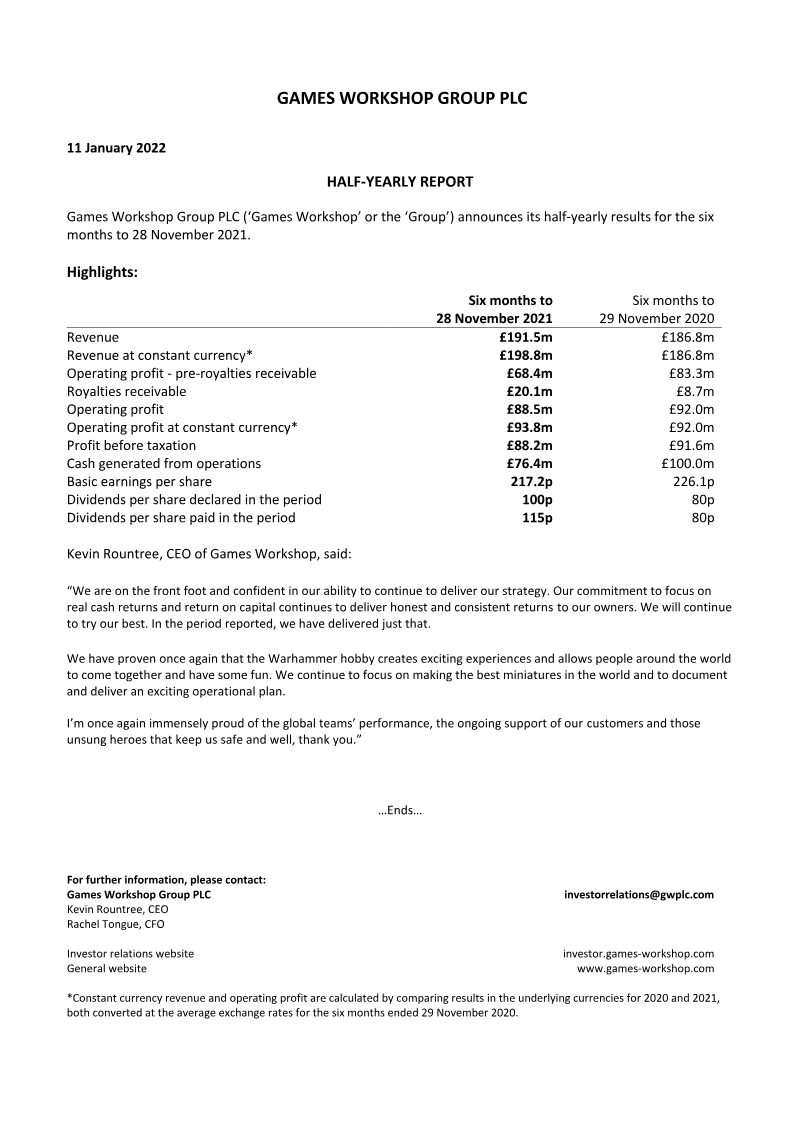
Games Workshop achieved record-breaking financial performance for the 2021 fiscal year, with revenue rising 31% to £353.2 million and profit before tax exceeding £150 million for the first time. This growth was primarily driven by the successful launch of the latest edition of *Warhammer 40,000* and a 70% surge in online sales, which effectively offset the impact of global retail lockdowns. The company maintained a debt-free balance sheet and a strong cash position of £85.2 million, allowing for a significant increase in dividends to 235 pence per share and the distribution of £13.2 million in profit-share and discretionary bonuses to its global workforce. The company’s vertically integrated business model remains centered in Nottingham, UK, where it designs and manufactures its core intellectual property. While the UK remains the production hub, the business is increasingly international, with 77% of sales generated globally across 73 countries. North America stands as the largest geographic market, contributing £145.5 million in revenue. To support this global expansion, the group is investing heavily in physical infrastructure, including new warehousing in the UK and US, increased plastic production capacity, and the development of the Warhammer+ subscription service and digital licensing portfolio. Strategic priorities for the 2021/22 period focus on IP exploitation through media and digital content, alongside a commitment to environmental, social, and governance (ESG) goals. The company reported a 21% reduction in Scope 1 and 2 emissions and formalized an ESG steering group to oversee long-term sustainability. Despite operational challenges related to COVID-19, Brexit, and supply chain disruptions, the group’s high return on capital employed (184%) and robust liquidity position underscore a stable outlook for continued international growth and brand development.
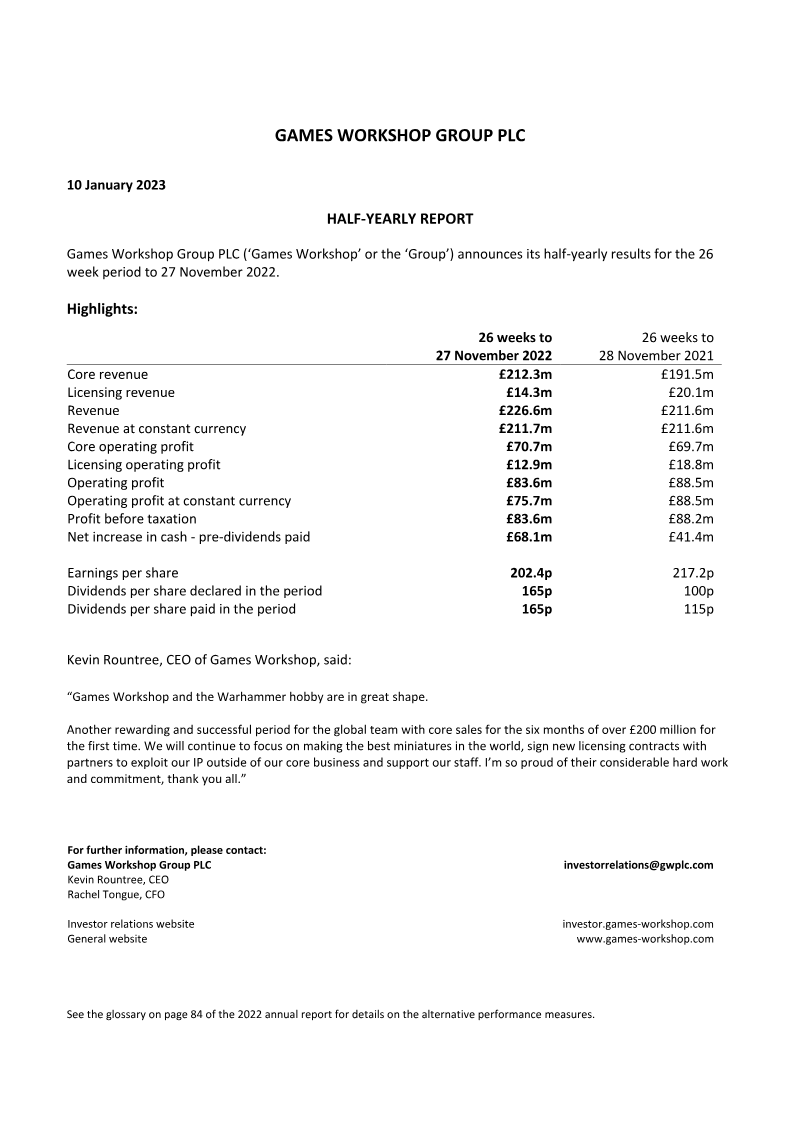
Games Workshop achieved record financial performance for the fiscal year ending May 29, 2022, reporting total revenue of £414.8 million and a profit before tax of £156.5 million. This growth was characterized by a 10% increase in core revenue and a near-doubling of licensing revenue to £28.0 million, bolstered by major agreements with partners such as Nexon. Despite macroeconomic pressures including Brexit-related supply chain costs and the conflict in Ukraine, the group maintained a debt-free balance sheet and continued its policy of returning surplus cash to shareholders, declaring £77.1 million in dividends. The group’s vertically integrated business model remains centered in Nottingham, UK, supporting a global retail network of 6,200 accounts across 72 countries. Strategic investments focused on "future-proofing" operations, including £16.7 million in design, £5.7 million in tooling, and significant upgrades to North American warehouse capacity and UK manufacturing facilities. While core gross margins faced a 5.6% decline due to rising freight and inventory costs, the licensing division’s high profitability helped offset these operational headwinds. Sustainability and governance were key areas of focus, with the establishment of a Social Responsibility and Sustainability strategy and a commitment to science-based carbon reduction targets. Although total greenhouse gas emissions rose by 5% due to business expansion, revenue-based emissions intensity decreased by 6%. Governance transitions included a leadership succession plan and the appointment of a new Audit and Risk Committee Chair. The board confirmed the group’s long-term viability through 2025, supported by robust cash reserves and a simplified executive remuneration structure that aligns leadership interests with long-term stability rather than short-term targets.