Global
Documents
Q1 2021: Store Intelligence Data Digest
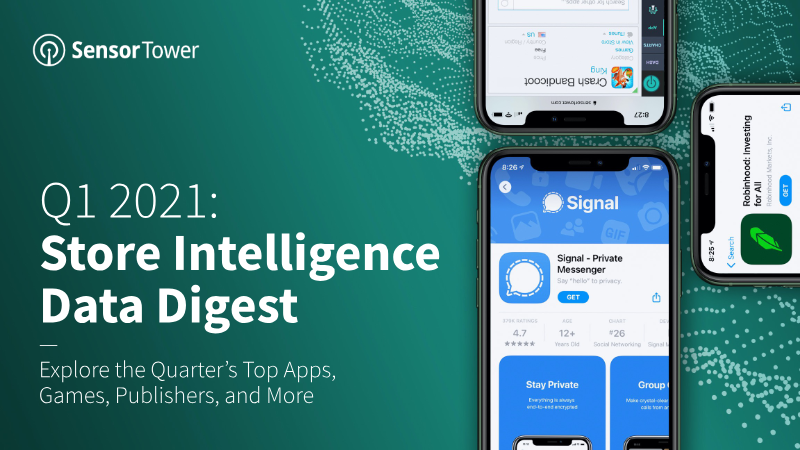
Global mobile app downloads reached 36.6 billion in the first quarter of 2021, representing an 8.7% year-over-year increase. This growth was primarily fueled by a 15.3% surge on Google Play, which reached 28.2 billion installs, effectively counteracting an 8.6% decline on the App Store. While emerging markets like India and the Philippines saw growth exceeding 30%, established markets such as the United States and Russia experienced slight contractions as the initial download spikes seen during the 2020 pandemic began to stabilize.
The quarter was defined by a significant shift in consumer behavior toward privacy-focused communication and financial management. Telegram and Signal saw massive adoption, with Telegram becoming the top messaging app worldwide and Signal’s installs jumping from 2 million to over 60 million. Simultaneously, interest in cryptocurrency and retail investing drove a 34% increase in Finance category downloads across the U.S. and Europe, propelled by platforms such as Robinhood, Coinbase, and Binance. TikTok maintained its position as the top global app, while Google and Facebook continued their rivalry as the leading publishers by volume.
In the gaming sector, hypercasual titles remained the dominant force, accounting for 80% of the top 20 games in the United States. Join Clash 3D emerged as the most downloaded game globally, bolstered by heavy adoption in Asia. Despite a late-quarter release, Crash Bandicoot: On the Run achieved a standout performance with 23 million installs in its first week. Although App Store game downloads fell 22.4% year-over-year due to a high 2020 baseline in China, the overall market remained competitive, with hypercasual publishers like Voodoo and Zynga maintaining high rankings through aggressive acquisition and rapid release cycles.
- Global mobile app downloads rose 8.7% year-over-year to 36.6 billion in Q1 2021, driven by a 15.3% surge on Google Play that offset an 8.6% decline on the App Store.
- Hypercasual games dominated the U.S. market, accounting for 80% of the top 20 titles, with Join Clash 3D ranking as the most downloaded game globally.
- Finance category downloads in the U.S. and Europe grew by 34%, fueled by retail investing and cryptocurrency platforms like Robinhood, Coinbase, and Binance.
- Privacy-focused communication apps saw massive adoption, with Telegram becoming the top global messaging app and Signal installs increasing from 2 million to over 60 million.
- Emerging markets like India and the Philippines experienced growth exceeding 30%, while established markets like the U.S. and Russia saw slight contractions as pandemic-era download spikes stabilized.
Store Intelligence Data Digest: Q4 2020
The global mobile app ecosystem experienced unprecedented expansion in 2020, culminating in a fourth quarter that saw 35.2 billion downloads and a year-end total of 143 billion. This 23.8% year-over-year increase was primarily catalyzed by the COVID-19 pandemic, which fundamentally altered consumer behavior across the App Store and Google Play. While Google Play drove the majority of volume growth with a 28% increase, the United States notably overtook China as the leading App Store market. India remained the global leader in total volume, contributing over 7 billion downloads in the final quarter alone.
The pandemic created a sharp divergence between industry segments, fueling record-breaking demand for Business and Gaming apps while severely depressing Travel and Navigation. Business category downloads surged by 134% as video conferencing tools like Zoom and Google Meet became essential, reaching 681 million and 331 million annual downloads respectively. Conversely, airline and rideshare apps saw declines of up to 46% in the United States. In the gaming sector, social-oriented titles thrived; Among Us emerged as a cultural phenomenon with 166 million quarterly downloads, while mobile gaming revenue surpassed $21 billion in the final quarter of the year.
Market leadership shifted significantly during this period as Google surpassed Facebook to become the top global publisher for the first time. TikTok maintained its status as the most downloaded non-gaming app globally for both the quarter and the year. Despite the overall surge in digital engagement, certain sub-sectors like hypercasual gaming faced headwinds in mature markets like the U.S. due to changes in commuting patterns. However, the successful late-year launches of titles such as Call of Duty: Mobile in China and the global rise of Genshin Impact signaled continued strength and diversification within the mobile gaming landscape heading into 2021.
- The global mobile app ecosystem reached 143 billion total downloads in 2020, a 23.8% year-over-year increase driven largely by pandemic-related shifts in consumer behavior.
- Business app downloads surged by 134% in 2020, highlighted by Zoom and Google Meet reaching 681 million and 331 million annual downloads respectively.
- Mobile gaming revenue exceeded $21 billion in Q4 2020, with social-oriented titles like Among Us driving engagement via 166 million quarterly downloads.
- Google surpassed Facebook to become the top global publisher for the first time, while TikTok maintained its position as the most downloaded non-gaming app globally for the year.
- India led the world in total download volume with over 7 billion downloads in Q4 2020, while the United States overtook China as the leading market for the App Store.
Social Casino Gaming Apps Report 2021
The global social casino market reached $6.2 billion in gross revenue in 2020, demonstrating robust financial health despite a highly saturated competitive landscape. Data collected from 239 apps and 39 million events between August 2020 and August 2021 indicates that while the sector is expanding, it has become increasingly difficult for new entrants to break into the top rankings. Marketing costs reflect this friction, with the average cost-per-install reaching $7.21. Significant disparities exist between platforms, as iOS installations cost more than double those on Android, largely due to shifting privacy regulations and tracking limitations.
Profitability in this sector relies on high long-term engagement and sophisticated monetization mechanics. The genre maintains a Day 30 return on ad spend of 25.18%, supported by a player base that is predominantly older, with nearly half of users aged 45 or above. These players are primarily motivated by the thrill of gameplay and the desire for treasure collection. To capitalize on these motivations, top-performing apps have increasingly adopted features such as album collectibles and special side-modes. Most notably, the battle pass mechanic saw a dramatic rise in market penetration, growing from 5% to 36% within a single year, while piggy banks and guild systems remain essential for driving social interaction and consistent spending.
Sustaining growth in the current climate requires a strategic shift toward high-excitement ad creatives and seamless integration with in-app experiences. Because no new titles reached the top 200 during the study period, established players must utilize machine learning and feature-level data to optimize for long-term value. Success is no longer defined solely by user acquisition but by the ability to integrate complex meta-features that satisfy the core audience's psychological drivers within an increasingly crowded and expensive digital marketplace.
- The social casino market is highly consolidated, with no new titles breaking into the top 200 rankings between August 2020 and August 2021.
- Market entry is increasingly expensive, with average cost-per-install reaching $7.21 and iOS acquisition costs more than double those of Android due to privacy tracking limitations.
- Battle pass mechanics experienced rapid adoption, with market penetration growing from 5% to 36% in a single year.
- The sector generated $6.2 billion in gross revenue in 2020, maintaining a Day 30 return on ad spend of 25.18%.
- The core player demographic is mature, with nearly 50% of users aged 45 or older, driving a focus on treasure collection and album collectible features.
Gaming Deals Activity Report Q1-Q3’2021
The global video game industry experienced unprecedented growth in deal activity during the first three quarters of 2021, reaching a total closed deal value of $57.7 billion across 667 transactions. This represents a 2.5x increase in cumulative value and a 46% increase in the number of deals compared to the same period in 2020. The market was primarily driven by the gaming segment, which accounted for 75% of total value, followed by platform and technology, esports, and other related sectors.
Mergers and acquisitions served as the primary engine for this expansion, contributing $27.9 billion or 48% of the total closed deal value. Notable transactions included Microsoft’s $7.5 billion acquisition of ZeniMax Media and ByteDance’s $4 billion acquisition of Moonton. Public offerings contributed $21.2 billion, highlighted by the $3.75 billion IPO of Krafton. However, the report identifies a cooling trend in public markets during the third quarter, characterized by a decline in the number of deals and share price volatility for industry leaders. Private investments reached a record $8.6 billion, with late-stage venture capital accounting for 78% of that value, led by significant rounds for companies like Sorare and Discord.
A major finding is the explosive rise of blockchain gaming, which saw a 34x year-over-year growth in deal value, totaling $1.56 billion. Investors showed a strong preference for infrastructure and platform layers that enable blockchain integration, rather than individual game titles. Geographically, the report highlights the continued dominance of strategic investors like Tencent, which closed 69 deals during the period, focusing heavily on the mobile segment and the Chinese market.
The analysis is based on data from InvestGame and S&P Capital IQ, tracking closed transactions across mobile, PC, console, and VR/AR segments while excluding pure gambling and betting. The methodology utilizes a weighted average ranking system to identify the most active venture capital and strategic investors globally.
- The video game industry saw $57.7 billion in closed deal value across 667 transactions in Q1–Q3 2021, representing a 2.5x increase in value and 46% increase in deal volume compared to 2020.
- Mergers and acquisitions were the primary growth driver, contributing $27.9 billion (48% of total value), headlined by Microsoft’s $7.5 billion acquisition of ZeniMax Media and ByteDance’s $4 billion purchase of Moonton.
- Public offerings generated $21.2 billion, led by Krafton’s $3.75 billion IPO, though the market experienced a cooling trend and increased share price volatility during the third quarter.
- Blockchain gaming experienced explosive growth with a 34x year-over-year increase in deal value to $1.56 billion, with investors prioritizing infrastructure and platform layers over individual game titles.
- Private investments reached a record $8.6 billion, with late-stage venture capital accounting for 78% of that total, driven by major funding rounds for companies like Sorare and Discord.
Gaming Spotlight 2021 Review
Mobile gaming has solidified its position as the primary driver of global digital games consumption, with spending projected to extend its lead to 3.1 times that of home consoles in 2021. This growth is characterized by a merging of the mobile and console experiences, as mobile devices increasingly offer console-quality graphics and cross-platform social features. Data indicates that global consumers downloaded over 1 billion games per week in Q1 2021—a 30% increase over pre-pandemic levels—while weekly spending rose 40% to $1.7 billion.
The industry is increasingly defined by cross-platform connectivity and real-time online features. Top-grossing titles like Roblox and Genshin Impact demonstrate the success of multi-platform rollouts that prioritize cross-play and cross-save functionality. This trend is supported by a surge in console companion apps and game livestreaming platforms. For instance, Steam saw a 60% increase in peak daily concurrent users between October 2019 and March 2021, while engagement and monetization on apps like Twitch and Discord reached new heights as social gaming habits became more ingrained during the pandemic.
Market research into gamer sentiment reveals a nuanced landscape for ad monetization. While overall sentiment toward in-game ads improved in the United States between 2019 and 2020, formats offering a direct value exchange performed best. Rewarded video ads and playable ads received the highest positive sentiment, whereas standard video ads remained the most divisive due to their perceived intrusiveness. Findings suggest that ad oversaturation correlates with negative sentiment and potential churn, particularly in high-saturation genres like word and trivia games.
This analysis covers global market trends from 2014 through early 2021, with specific deep dives into U.S. gamer surveys from Q3 2019 and Q3 2020. The data is synthesized from App Annie’s mobile market estimates and IDC’s primary research, which includes surveys of over 3,000 gamers and analysis of digital and physical spending across mobile, PC, and console segments.
- Mobile gaming is the dominant market force, with 2021 spending projected to be 3.1 times higher than that of home consoles.
- Global game downloads reached over 1 billion per week in Q1 2021, a 30% increase over pre-pandemic levels, while weekly spending grew 40% to $1.7 billion.
- Cross-platform functionality is a critical success factor, as evidenced by the performance of titles like Roblox and Genshin Impact that prioritize cross-play and cross-save features.
- PC gaming engagement saw significant growth, with Steam recording a 60% increase in peak daily concurrent users between October 2019 and March 2021.
- In-game advertising performance is highly dependent on format, with rewarded video and playable ads receiving the highest positive sentiment compared to intrusive standard video ads.

Go Global Mobile Game: New Insights
During the first half of 2021, China-headquartered publishers ascended to the global leadership position in the mobile gaming market, capturing 23% of overseas consumer spend. This 47% year-over-year growth resulted in $8 billion in revenue, driven by a strategic expansion into both established markets like Germany and emerging regions such as Chile and Egypt. The industry landscape is currently defined by a shift toward hybridization, where developers integrate casual mechanics into core genres to broaden audience appeal and sustain engagement.
The 4X March-Battle subgenre remains a dominant global force, leading consumer spend across major economies including the United States and the United Kingdom. While mature titles in the 4X and M3-Meta categories continue to drive massive revenue growth, emerging opportunities are surfacing in high-growth subgenres like Luck Battle and Merge Saga. These "Score Leaders" demonstrate significant increases in consumer spending despite declining download rates, suggesting a market pivot toward deeper monetization of existing user bases rather than raw acquisition.
The market is also experiencing a surge in specialized categories, most notably the Idol Training subgenre, which saw triple-digit growth in both spending and downloads during the first half of the year. In contrast, Puzzle RPGs faced declines in performance, likely due to shifting privacy policies impacting user acquisition strategies. To navigate these fluctuations, publishers are increasingly leveraging "Nijigen" or anime-style aesthetics and gacha monetization models. By combining these thematic elements with cross-subgenre mechanics and social features, developers are successfully maintaining competitive advantages in an increasingly crowded global marketplace.
- China-headquartered publishers captured 23% of overseas mobile gaming consumer spend in H1 2021, achieving $8 billion in revenue and 47% year-over-year growth.
- Developers are increasingly adopting a hybridization strategy, integrating casual mechanics into core genres to broaden audience appeal and improve user engagement.
- The 4X March-Battle subgenre remains the leading driver of consumer spend in major markets like the United States and the United Kingdom.
- High-growth subgenres such as Luck Battle and Merge Saga are seeing increased consumer spending despite declining download rates, signaling a shift toward deeper monetization of existing users.
- The Idol Training subgenre experienced triple-digit growth in both spending and downloads during the first half of 2021.
Games Marketing Insights for 2021
This analysis examines the shifting landscape of the global gaming industry following the COVID-19 pandemic, focusing on player motivations, monetization, and community engagement. The primary thesis asserts that the pandemic catalyzed a permanent expansion of the gaming audience, introducing a "new gamer" cohort that differs significantly from existing players in demographics and behavior. While existing players increased their time spent gaming, they became less likely to spend money, whereas new players emerged as a high-value segment with a greater propensity for in-game purchases.
The findings are based on a July 2020 survey of 13,246 mobile gamers across nine markets, including the United States, United Kingdom, Germany, and South Korea. Data indicates that the mobile gaming audience grew by 28 million in the US and 8.6 million in the UK. In Western markets, these new players are significantly younger than existing ones and gravitate toward "core" genres like shooters and strategy rather than casual puzzles. Conversely, South Korea proved an anomaly, where new gamers are older and prefer casual titles. Across all regions, new gamers play more hours per week than veterans and are more open to social features, such as multiplayer modes and in-game chatting.
The industry saw a massive shift toward digital discovery and community. Live-streaming platforms experienced record growth, with Facebook Gaming surpassing one billion hours watched in Q3 2020. Furthermore, 70% of consumers reported increased mobile device usage, making mobile-first discovery essential. A critical finding for marketers is the rising importance of brand familiarity; less than a quarter of players in the US, UK, and Germany tried games they had never heard of, suggesting that title recognition and IP strength are now as vital for mobile games as they are for the console market.
To navigate these shifts, the analysis recommends a mixed monetization model that balances ad-supported content with in-app purchases to capture diverse spending habits. It concludes that developers must embrace "always-on" marketing and community management, as players are increasingly seeking engagement through social media groups and streaming partnerships outside of the game client itself.
- The pandemic triggered a significant expansion of the gaming audience, adding 28 million mobile players in the US and 8.6 million in the UK by July 2020.
- New gamers represent a high-value segment with a greater propensity for in-game purchases compared to veteran players, who increased their playtime but decreased their spending.
- Brand familiarity is critical for acquisition, as fewer than 25% of players in the US, UK, and Germany are willing to try games they have not heard of previously.
- New gamers in Western markets are younger and prefer core genres like shooters and strategy, while new gamers in South Korea are older and favor casual titles.
- Live-streaming platforms saw record growth during the pandemic, with Facebook Gaming exceeding one billion hours watched in Q3 2020.
The 2021 Global Mobile Gamers Whitepaper
Mobile gaming has emerged as the primary driver of the global games market, generating $93.2 billion in 2021 and accounting for over half of total industry revenue. This segment is projected to reach $116.1 billion by 2024, fueled by expansion in emerging markets and the integration of social metaverse experiences. Within this landscape, short-video platforms have become essential hubs for player engagement, with nearly half of mobile gamers across thirteen key global markets utilizing these platforms to discover and share content.
Users on these platforms represent a high-value demographic that outperforms the average gamer in nearly every engagement metric. These players install 50% more games, spend 36% more time playing weekly, and engage with a significantly broader variety of genres. Their behavior is characterized by a high propensity for spending, particularly on progression-based purchases and in-game add-ons. This audience acts as a community of evangelists, twice as likely as non-users to discover new titles through social video content and subscription services, making them a critical target for strategy and MOBA developers.
Geographic analysis reveals distinct regional preferences in art styles and mechanics. While realistic aesthetics maintain global dominance, Asian markets show a unique affinity for anime and "cute" art styles, alongside a higher tolerance for randomized reward systems like gacha. Conversely, Western markets in the United States and United Kingdom lean toward puzzle and casual titles with cartoonish aesthetics. Despite these regional differences, fantasy remains the most popular setting worldwide. Across all territories, the consistent introduction of new content and technical stability are the most effective levers for re-engaging lapsed players and maintaining long-term retention.
- Mobile gaming generated $93.2 billion in 2021, accounting for over half of total industry revenue, with projections to reach $116.1 billion by 2024.
- Users who engage with short-video platforms represent a high-value demographic that installs 50% more games and spends 36% more time playing weekly than the average gamer.
- Short-video platform users are twice as likely as non-users to discover new titles through social content and subscription services, making them a primary target for strategy and MOBA developers.
- Regional art style preferences vary significantly, with Asian markets favoring anime and 'cute' aesthetics alongside gacha mechanics, while U.S. and U.K. markets prefer puzzle and casual titles with cartoonish aesthetics.
- Fantasy remains the most popular global game setting, while consistent content updates and technical stability are the primary drivers for re-engaging lapsed players and ensuring long-term retention.
Dapp Industry Report: January 2021
The report presents a snapshot of the decentralized‑application (dapp) landscape in January 2021, emphasizing Ethereum’s continued dominance while highlighting the rapid emergence of competing blockchains and the explosive growth of the NFT sector. Across the month, Ethereum generated more than $112 billion in transaction volume—86 % of total blockchain activity—and supported roughly 72 000 daily active wallets (30 % of the market). Its DeFi ecosystem accounted for 99 % of this activity, with Uniswap and 1inch leading in unique wallet usage, while total value locked (TVL) on Ethereum surpassed $30 billion, driven by token price surges and a rise in aTVL to $14 billion.
NFT activity on Ethereum expanded tenfold, from $3 million in December to $33 million in January, propelled by CryptoPunks and the newly launched Hashmasks, which quickly became the top collectible dapp. Meanwhile, the Flow blockchain’s NBA Top Shot achieved over $40 million in sales, overtaking Ethereum‑based NFTs to become the leading NFT platform. Binance Smart Chain (BSC) recorded its strongest month, exceeding $15 billion in transaction volume and generating the highest number of unique active wallets on its network, largely through Venus and PancakeSwap. Wax’s gaming dapp Alien Worlds also posted rapid growth, reaching 8 000 daily active wallets.
Scalability constraints on Ethereum continued to inflate gas fees, prompting migration to layer‑2 solutions such as Matic and to alternative layer‑1 chains. The report’s data derive from DappRadar analytics, covering transaction volumes, wallet activity, and TVL across major protocols (Ethereum, BSC, Wax, Flow, EOS, Tron, and emerging networks like Polkadot and Solana) for the calendar month of January 2021. Overall, the findings indicate a blockchain ecosystem transitioning from DeFi‑centric growth to a new wave dominated by high‑value NFT dapps and diversified cross‑chain activity.
- Ethereum maintained market dominance in January 2021 with $112 billion in transaction volume, representing 86% of total blockchain activity and over $30 billion in total value locked.
- The NFT sector experienced explosive growth, with Ethereum-based NFT volume increasing tenfold to $33 million, while Flow’s NBA Top Shot surpassed all Ethereum platforms to lead the market with over $40 million in sales.
- Binance Smart Chain recorded its strongest performance to date, processing over $15 billion in transaction volume and achieving the highest number of unique active wallets, driven primarily by Venus and PancakeSwap.
- Ethereum's DeFi ecosystem remained the primary driver of its activity, accounting for 99% of its network usage with Uniswap and 1inch as the leading platforms.
- High gas fees caused by Ethereum's scalability constraints accelerated a migration toward alternative layer-1 blockchains and layer-2 solutions like Matic.
Global Video Game Investment Activity Report Q1 2021
The first quarter of 2021 marked a historic surge in global video game industry investments, signaling a potential record-breaking year. Total deal value for closed transactions reached $25 billion across 249 deals, representing a twofold increase compared to the first half of 2020. When including announced but unclosed transactions, the total deal value for the quarter climbed to $39 billion. This growth was observed across all primary investment frontiers, including private placements, public offerings, and mergers and acquisitions (M&A).
M&A activity served as the primary engine for this expansion, accounting for $14.3 billion in closed deal value, a nearly sixfold increase year-over-year. This segment was dominated by high-profile "mega-deals," most notably Microsoft’s $7.5 billion acquisition of ZeniMax Media and ByteDance’s $4 billion acquisition of Moonton. Public offerings also saw record activity, generating $8.3 billion in value—a 29-fold increase over the previous year—driven by a tripling of initial public offerings and the rising popularity of Special Purpose Acquisition Companies (SPACs). Private investments reached a segment record of $2.6 billion, with late-stage rounds for companies like Roblox and Dapper Labs accounting for 73% of that total.
Strategic and venture capital activity remained highly concentrated among top-tier players. Tencent maintained its leadership in deal volume, closing 35 transactions with a focus on PC and console developers. Meanwhile, the top five strategic investors—Tencent, Microsoft, Embracer Group, Electronic Arts, and ByteDance—contributed over half of the total announced deal value. Early-stage venture capital also grew significantly, with a 120% increase in capital raised by game developers. Geographically and by segment, mobile and multiplatform studios remained the most attractive targets for investors, while PC and console segments drove the majority of M&A value. This analysis is based on tracked closed transactions in the global video game industry, excluding gambling and betting, utilizing data from public media, business partners, and S&P Capital IQ.
- Global video game investment reached $25 billion in closed deal value during Q1 2021, a twofold increase over the first half of 2020, with total announced deal value hitting $39 billion.
- M&A activity was the primary growth driver, totaling $14.3 billion in closed deals—a nearly sixfold year-over-year increase—led by Microsoft’s $7.5 billion ZeniMax acquisition and ByteDance’s $4 billion Moonton acquisition.
- Public offerings generated $8.3 billion in value, representing a 29-fold increase over the previous year, fueled by a tripling of IPOs and the rise of SPACs.
- Tencent, Microsoft, Embracer Group, Electronic Arts, and ByteDance dominated the landscape, collectively contributing over 50% of the total announced deal value.
- Private investments hit a record $2.6 billion, with 73% of that capital directed toward late-stage rounds for companies such as Roblox and Dapper Labs.
The State of Mobile Gaming 2021
The global mobile gaming industry experienced unprecedented expansion through early 2021, catalyzed by a pandemic-induced surge that drove quarterly revenue to a record $22.2 billion. This growth represents a significant 33% year-over-year increase, with the United States emerging as the premier revenue market, contributing 28% of global consumer spending. While mature markets in North America and Europe reached new financial heights, developing regions—most notably India—served as the primary engines for user acquisition, pushing global downloads to new peaks. Asia remains the largest collective region, surpassing $12 billion in quarterly revenue, anchored by Japan’s robust $5 billion contribution.
Market dynamics shifted toward social and multiplayer experiences, with titles such as Roblox and Genshin Impact dominating both engagement and monetization. RPG and Strategy remain the highest-grossing genres, generating $21.9 billion and $15.1 billion respectively in 2020, though Simulation and Shooter categories exhibited the fastest year-over-year growth. Simultaneously, the Hypercasual genre achieved staggering scale, reaching 3.4 billion downloads in a single quarter. This high-volume segment has become a cornerstone of the mobile advertising ecosystem, where publishers like Zynga and Playrix maintain a dominant share of voice across major digital networks.
Monetization has consolidated almost entirely around the freemium model, which now accounts for 99% of App Store revenue through a combination of in-app purchases, subscriptions, and advertising. Looking forward, the industry is projected to reach $117 billion in annual revenue by 2023, maintaining a compound annual growth rate of 13.5%. While the initial pandemic-driven spike in downloads has stabilized, the sustained increase in consumer spending and the rapid growth of markets in Southeast Asia and Europe indicate a permanent upward shift in the global gaming trajectory.
- The mobile gaming industry reached a record $22.2 billion in quarterly revenue in early 2021, marking a 33% year-over-year increase.
- The industry is projected to reach $117 billion in annual revenue by 2023, maintaining a compound annual growth rate of 13.5%.
- The freemium model now dominates the market, accounting for 99% of App Store revenue through in-app purchases, subscriptions, and advertising.
- RPG and Strategy remain the highest-grossing genres at $21.9 billion and $15.1 billion respectively, while Hypercasual games reached 3.4 billion downloads in a single quarter.
- The United States is the premier revenue market, contributing 28% of global consumer spending, while Asia remains the largest collective region with over $12 billion in quarterly revenue.
An Analysis of the Card Battler Sub‑Genre 2021
The card battler mobile sub-genre experienced significant growth and market shifts during the first half of 2021. While representing five percent of player spending within the broader strategy genre, card battlers reached a new revenue baseline exceeding $55 million per month. This growth was punctuated by a 17 percent quarterly revenue increase in early 2021, driven largely by established "forever franchises" and the successful mobile launch of legacy intellectual properties.
The geographic landscape of the sub-genre is diversifying. Although Asian markets like Japan and China historically dominated the space, the United States emerged as a critical growth region, accounting for 27 percent of player spending in the first half of 2021. The U.S. market also demonstrated the highest growth in revenue per download among strategy sub-genres, rising 53 percent. This trend suggests the market is maturing and becoming increasingly lucrative for developers targeting Western audiences.
Market leadership remains concentrated among titles leveraging powerful intellectual properties. Yu-Gi-Oh! Duel Links and Hearthstone continue to lead in lifetime earnings, while Magic: The Gathering Arena rapidly ascended to the top ten following its March 2021 release. The success of these titles, alongside niche performers like WWE SuperCard and the high download volume of Mighty Party, indicates a healthy appetite for both established tabletop conversions and new gameplay concepts.
The analysis utilizes data from Sensor Tower’s Game Intelligence and Store Intelligence platforms, covering global App Store and Google Play performance. Findings highlight that while the sub-genre is smaller than 4X strategy or MOBA categories, its increasing average revenue per user and the success of aggressive user acquisition strategies by new contenders point to significant ongoing opportunities for expansion.
- The card battler sub-genre reached a new revenue baseline exceeding $55 million per month in the first half of 2021, driven by a 17 percent quarterly revenue increase.
- The United States has become a critical market, accounting for 27 percent of global player spending and experiencing a 53 percent increase in revenue per download during the first half of 2021.
- Market leadership is dominated by established intellectual properties, with Yu-Gi-Oh! Duel Links and Hearthstone leading in lifetime earnings and Magic: The Gathering Arena entering the top ten shortly after its March 2021 launch.
- While card battlers represent five percent of total strategy genre spending, the sub-genre shows significant expansion potential due to rising average revenue per user and effective user acquisition strategies.
- The sub-genre demonstrates a healthy appetite for diverse gameplay, ranging from tabletop-to-mobile conversions like Magic: The Gathering Arena to high-volume download titles like Mighty Party and niche performers like WWE SuperCard.