Web3 & Blockchain·Updated Mar 17, 2026 by DappRadar
Report · January 1, 2021
Published by DappRadar
The report presents a snapshot of the decentralized‑application (dapp) landscape in January 2021, emphasizing Ethereum’s continued dominance while highlighting the rapid emergence of competing blockchains and the explosive growth of the NFT sector. Across the month, Ethereum generated more than $112 billion in transaction volume—86 % of total blockchain activity—and supported roughly 72 000 daily active wallets (30 % of the market). Its DeFi ecosystem accounted for 99 % of this activity, with Uniswap and 1inch leading in unique wallet usage, while total value locked (TVL) on Ethereum surpassed $30 billion, driven by token price surges and a rise in aTVL to $14 billion. NFT activity on Ethereum expanded tenfold, from $3 million in December to $33 million in January, propelled by CryptoPunks and the newly launched Hashmasks, which quickly became the top collectible dapp. Meanwhile, the Flow blockchain’s NBA Top Shot achieved over $40 million in sales, overtaking Ethereum‑based NFTs to become the leading NFT platform. Binance Smart Chain (BSC) recorded its strongest month, exceeding $15 billion in transaction volume and generating the highest number of unique active wallets on its network, largely through Venus and PancakeSwap. Wax’s gaming dapp Alien Worlds also posted rapid growth, reaching 8 000 daily active wallets. Scalability constraints on Ethereum continued to inflate gas fees, prompting migration to layer‑2 solutions such as Matic and to alternative layer‑1 chains. The report’s data derive from DappRadar analytics, covering transaction volumes, wallet activity, and TVL across major protocols (Ethereum, BSC, Wax, Flow, EOS, Tron, and emerging networks like Polkadot and Solana) for the calendar month of January 2021. Overall, the findings indicate a blockchain ecosystem transitioning from DeFi‑centric growth to a new wave dominated by high‑value NFT dapps and diversified cross‑chain activity.
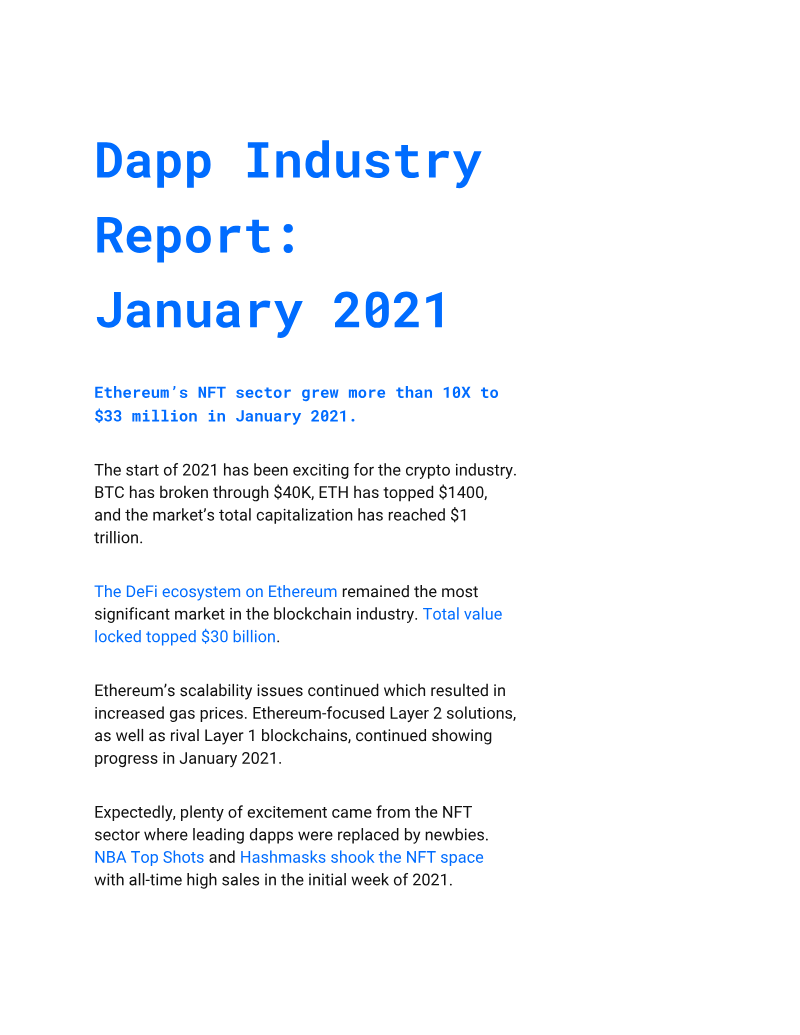
Dapp Industry Report: January 2021 Ethereum’s NFT sector grew more than 10X to $33 million in January 2021. The start of 2021 has been exciting for the crypto industry. BTC has broken through 40K, ETH has topped 1400, and the market’s total capitalization has reached $1 trillion. The DeFi ecosystem on Ethereum remained the most significant market in the blockchain industry. Total value locked topped $30 billion. Ethereum’s scalability issues continued which resulted in increased gas prices. Ethereum-focused Layer 2 solutions, as well as rival Layer 1 blockchains, continued showing progress in January 2021. Expectedly, plenty of excitement came from the NFT sector where leading dapps were replaced by newbies. NBA Top Shots and Hashmasks shook the NFT space with all-time high sales in the initial week of 2021.
Table of contents ● Key takeaways ● Ethereum’s scalability issues continue ● Ethereum still leads the tribe ● DeFi hits all-time high TVL ● More excitement for NFTs ● NBA Top Shot leads NFT category ● The new NFT project by Pranksy ● Hashmasks is the leading NFTs platform on Ethereum ● January in-summary Key takeaways ● The Ethereum blockchain generated 86% of total transaction volumes in January or more than $112 billion. ● In terms of daily active wallets, the blockchain accounts for 30% or 72,000 unique active wallets daily.
● The DeFi ecosystem generated 99% of Ethereum activity. ● Ethereum’s NFT sector grew by more than 10 times from 3 million in December to 33 million in January. The biggest contributors were CrytpoPunks and Hashmasks. ● The Flow blockchain’s most active dapp NBA Top Shots reached all-time highs and took the leadership position in the NFT space with more than $40 million in sales volumes. ● BSC had the best month so far. The blockchain surpassed $15 billion in transaction volumes. The biggest contributors were Venus and PancakeSwap. ● Wax had the best month in terms of daily active wallets surpassing 21,000. The fastest-growing dapp Alien Worlds contributed the most. Ethereum scalability issues continue Ethereum gas prices tend to grow In waves. At the beginning of 2020, there was the Tether USDT stablecoin wave which was followed by the DeFi ecosystem or yield farming wave in the middle of
summer. In 2021, the increased gas prices are mainly triggered by DeFi and NFT activity. Although the arrival of Ethereum 2.0 looks promising, developers are moving to different blockchains or layer 2 solutions. BSC distributed several new DeFi dapps now showing growth. Matic showed its potential to grab games activity. While Flow demonstrated the potential of the NFT sector with the best growing NFT dapp – NBA Top Shot. Ethereum Gas Price Value (Wei, BnValue (Wei, Bn T30 @DappRadar 500.00 100.00 M 50.00 10.00 1/1/2020 4/1/2020 7/1/2020 10/1/2020 1/1/2021 Source:DappRadar Ethereum still leads the tribe Historically, the main contenders to Ethereum’s dominance were EOS and Tron and although these protocols generated substantial activity in 2021, other projects such as Binance Smart Chain (BSC) and Wax have quickly risen to prominence.
In terms of unique active wallets, Ethereum, BSC, and Wax grew daily unique active wallets month-on-month by 29%, 10%, and 9% respectively in January. The biggest category for the Ethereum blockchain was still the DeFi ecosystem. Uniswap and 1inch Exchange were the two biggest contributors with unique active wallets of 44,000 and 3,400 respectively. BSC also showed improved results. PancakeSwap on average generated 11,000 unique active wallets while Venus was around 1,000. Unique Active Wallets by Protocol, K Ethereum EOS TRON BSC WAX 6 w Source:DappRadar
WAX was leading in terms of games activity with a dapp called Alien Worlds. Growth from 1,700 to almost 8,000 unique active wallets meant it was the fastest-growing dapp on WAX in January 2021. Ethereum EOS TRON BSC WAX 0.5 0.2 0.05 0.02 0.01 0 Miyh 0 07/01/2020 01/01/2020 03/01/2020 05/01/2020 09/01/2020 11/01/2020 01/01/2021 Source:DappRadar Other Ethereum contenders such as Polkadot, Cosmos, NEAR Protocol, Solana, Avalanche, and others are trying to challenge too. Reef Finance debuted as the first Polkadot project. Additionally, Polkadot’s price rallied by 85% in January 2021 and surpassed XRP in market capitalization.
The analysis evaluates the health and dynamics of the blockchain ecosystem during October 2022, revealing a sector in transition marked by divergent growth patterns across applications, platforms, and asset classes. Overall user engagement rose, with unique active wallets for decentralized applications increasing 6.8 percent to just over two million, driven primarily by explosive adoption on Arbitrum, Optimism and a dramatic surge on NEAR following its partnership with Google Cloud. By contrast, the gaming segment and Ethereum’s core wallet base contracted, falling 2 percent and 4.5 percent respectively, underscoring a shift of activity toward emerging layer‑2 solutions. DeFi continued its rebound, with total value locked climbing 5.3 percent to $83 billion, though Ethereum retained a dominant 62 percent share of that capital. New entrants also made notable strides; the Aptos token achieved a $1 billion market capitalization within two weeks, entering the top‑50 cryptocurrencies, while Dogecoin posted the strongest price appreciation of the month at 50 percent. NFT markets displayed mixed signals: trading volume and sales declined 30 percent month‑on‑month, yet the number of unique NFT traders grew 18 percent to 1.11 million, and Polygon’s NFT volume surged 770 percent, largely propelled by Reddit‑hosted collections. Security vulnerabilities remained a critical concern, with cross‑chain bridges accounting for 82 percent of the month’s $3.57 million in exploit losses, including high‑profile attacks on Mango Markets, TempleDAO, the QANX bridge and Rabby Swap. The combined effect of rapid user migration, uneven asset performance, and persistent bridge exploits highlights both the growth potential and the systemic risk factors shaping the blockchain industry at the close of 2022.
The July 2022 DappRadar Blockchain Industry Report analyzes the state of the decentralized application ecosystem during a significant market downturn. The findings indicate that while the broader crypto industry remains trapped in a bear market influenced by the collapse of Terra and macroeconomic pressures like U.S. inflation, specific sectors—most notably blockchain gaming—demonstrate remarkable resilience. The report covers global trends across decentralized finance (DeFi), non-fungible tokens (NFTs), and gaming, utilizing data on Unique Active Wallets (UAW) and Total Value Locked (TVL) to measure health and engagement. Data shows that dapp activity reached a yearly low in July with 1.68 million daily UAW, a 4% decrease from June. DeFi was the hardest-hit segment, with UAW dropping below 500,000 for the first time since early 2021. Despite this, DeFi TVL saw a 22% recovery during the month, rising to $82.3 billion, led by growth on Ethereum, BNB Chain, and Tron. The report also highlights the continued "crypto contagion" following the Celsius Network bankruptcy filing, which has increased calls for international regulatory frameworks like the EU’s MiCA. The NFT market experienced a contraction, with monthly trading volume failing to reach $1 billion for the first time in over a year. Market dynamics are shifting as OpenSea’s dominance fell from 84% in May to 58.6% in July, facing increased competition from new entrants like the GameStop and Nickelodeon marketplaces. Conversely, the gaming sector emerged as a primary industry driver, accounting for nearly 60% of all dapp usage. With nearly 1 million daily UAW, blockchain games grew 8% month-over-month, suggesting that immersive mechanics and venture capital interest are insulating the segment from the prevailing "crypto winter."
The blockchain gaming industry underwent a significant market correction in late 2022, signaling a transition from speculative "Play-to-Earn" (P2E) models toward more sustainable, gameplay-focused ecosystems. While unique active wallets stabilized at approximately one million, NFT transaction volumes fell 30% to $500 million, and major project market capitalizations plummeted by over 90%. Despite a 19% year-over-year decline in total deal value to $875 million in the third quarter, the sector saw a 2.6x increase in the number of funding deals. This shift indicates a move away from infrastructure-heavy "picks and shovels" investments toward seed-stage funding for game studios and user-friendly wallet solutions. The collapse of unsustainable economic designs has catalyzed a pivot toward "Free-to-Own" (F2O) and "Play-and-Own" (P&O) models. These frameworks prioritize fun-first gameplay and lower entry barriers by offering free initial digital assets, moving away from the yield-focused mechanics that previously dominated the space. This evolution is supported by a significant talent migration from traditional AAA and mobile gaming companies, which is professionalizing development and introducing more sophisticated tokenomics. Furthermore, the industry is expanding its reach through casual genres and the integration of established intellectual properties from major Asian studios like Square Enix and SEGA. Mass adoption efforts are increasingly focused on distribution and technical scalability. Notable milestones include the launch of blockchain titles on mainstream platforms like the Epic Games Store and the clarification of NFT guidelines within the Apple App Store. However, the industry faces ongoing challenges, including a crisis in the gaming guild model and intensifying regulatory scrutiny. As the SEC investigates major entities regarding the classification of digital assets as securities, developers are balancing innovation in on-chain mechanics and AI-driven content with the need for compliance in an increasingly complex global legal landscape.
The blockchain gaming industry experienced a transformative period of expansion in 2021, driven primarily by the emergence of play-to-earn mechanics and the implementation of true digital asset ownership. Industry professionals identify these features as the most significant catalysts for growth, with a vast majority anticipating that traditional gaming entities will integrate blockchain technology within the next two years. This momentum is further evidenced by approximately $4 billion in capital inflows from venture firms and decentralized autonomous organizations, signaling strong institutional confidence in the sector’s long-term viability. Despite this rapid financial and technological acceleration, the industry faces substantial structural headwinds. Regulatory uncertainty remains the most pressing concern for over half of the organizations operating in the space, followed closely by a general lack of public understanding regarding core blockchain concepts. Additionally, the sector must navigate technical challenges related to user-friendliness and a shortage of specialized engineering talent. While environmental sustainability has been a point of external criticism, the industry is actively transitioning toward carbon-neutral protocols and Proof of Stake networks to mitigate its ecological footprint. The ecosystem is characterized by a diverse and collaborative landscape that spans game studios, major traditional publishers like Ubisoft, and specialized firms in decentralized finance, legal, and infrastructure. While financial incentives have been the primary driver of initial adoption, long-term sustainability is widely believed to depend on the development of high-quality gameplay that can compete with traditional titles. This cross-sector synergy suggests that the future of the industry relies on balancing innovative monetization models with the fundamental entertainment value required for mainstream appeal.