Global
Documents
Gaming Industry Report: Q1 2023
The gaming industry experienced a resilient start to 2023, with a projected global market size of $201 billion, representing a 9% year-over-year increase. Public markets showed strength, with gaming-focused exchange-traded funds (ETFs) recording gains between 10% and 23% year-to-date. While private market venture funding saw a total of $761 million across 109 deals in the first quarter, activity remains concentrated in early-stage investments, as late-stage funding has slowed significantly compared to the peak levels of 2021.
Geographically, Asia led global venture funding in the first quarter, followed by North America and Europe. Emerging markets such as Africa and South America saw sporadic but notable deal activity, highlighting a broader global interest in gaming infrastructure and content. Major industry players currently hold approximately $48 billion in cash and equivalents, suggesting a stable environment for potential future mergers and acquisitions despite ongoing regulatory scrutiny regarding large-scale consolidation.
Key industry trends in early 2023 include the integration of artificial intelligence for asset generation and conversational tools, alongside a strategic shift by major tech firms toward cloud-based gaming infrastructure. Competitive dynamics are evolving as Epic Games introduces self-publishing tools to challenge Steam’s market dominance and integrates user-generated content into its Fortnite ecosystem. Furthermore, platforms like Roblox are successfully expanding their reach by aging up their user demographic. These developments, supported by a robust schedule of global industry conferences, indicate a focus on platform scalability, content diversification, and the optimization of developer tools to sustain long-term growth.
- The global gaming market is projected to reach $201 billion in 2023, reflecting a 9% year-over-year growth rate.
- Major industry players possess $48 billion in cash reserves, signaling a stable environment for future M&A activity despite regulatory headwinds.
- Venture capital funding totaled $761 million across 109 deals in Q1 2023, with investment heavily concentrated in early-stage ventures rather than late-stage rounds.
- Gaming-focused ETFs demonstrated strong performance in early 2023, recording year-to-date gains ranging from 10% to 23%.
- Asia currently leads global venture funding, followed by North America and Europe, with emerging activity appearing in African and South American markets.

The 50-Plus Gamer of Today and Tomorrow
The population of gamers aged 50 and older has expanded to 52.4 million individuals, with average weekly engagement rising over 40% since 2019 to reach 12 hours per week. While mobile remains the dominant platform due to the popularity of puzzle, card, and word games, there is a notable increase in console and PC usage among high-engagement segments. This demographic is segmented into five distinct cohorts, where the most passionate 26% of players—classified as Enthusiasts and Immersives—account for nearly half of all total spending. Although current biannual spending averages $49 per person, the market is poised for significant growth as the 40-49 age bracket, which boasts a 62% participation rate, transitions into this older demographic.
Primary motivations for play center on mental acuity and passing time, with 70% of these gamers viewing play as an essential component of healthy aging and cognitive stimulation. Despite this high level of engagement, a significant gap exists between consumer behavior and industry representation. Approximately 70% of older gamers feel the industry treats them as an afterthought, citing a lack of age-inclusive design and a dearth of marketing that reflects their demographic. Furthermore, these players express strong dissatisfaction with aggressive monetization strategies, such as progress-gating ads and microtransactions, which serve as primary barriers to enjoyment.
The industry currently faces a critical disconnect where older adults struggle to find titles specifically designed for their needs. While gaming peaks for this group during evening hours, their preferences remain concentrated in logic and tile genres, though higher-engagement segments increasingly seek narrative-driven and social experiences. To capture the full potential of this expanding market, developers must address sensitivities regarding cost and representation while leveraging the deep-seated belief among older players that gaming is a vital tool for maintaining mental health and social connection.
- The 50-plus gaming population has reached 52.4 million individuals, with average weekly engagement increasing by over 40% since 2019 to 12 hours per week.
- A high-engagement segment comprising 26% of the demographic—classified as Enthusiasts and Immersives—accounts for nearly 50% of total spending.
- 70% of gamers aged 50 and older believe gaming is essential for cognitive stimulation and healthy aging, yet 70% feel the industry treats them as an afterthought in design and marketing.
- Current biannual spending averages $49 per person, but the market is positioned for growth as the 62% participation rate of the 40-49 age bracket transitions into this demographic.
- Aggressive monetization strategies, specifically progress-gating ads and microtransactions, are identified as the primary barriers to enjoyment and retention for this age group.
Esports Live-Streaming Trends Report: Q1 2023
The esports live-streaming market demonstrated significant resilience in the first quarter of 2023, with viewership growing 15% year-over-year to reach 651 million hours watched. This growth occurred despite a general decline in broader live-streaming viewership during the same period. The data, aggregated from major platforms including Twitch, YouTube, Facebook Gaming, and AfreecaTV, indicates that the top 30 tournaments alone account for 68% of total esports viewership, highlighting a heavy concentration of audience interest in premier events.
Twitch maintains its market leadership with a 62% share of esports hours watched, followed by YouTube at 30%. While Twitch dominates smaller events with an 81% market share, YouTube has successfully increased its presence in the large-scale event segment, capturing 34% of viewership for tournaments with an average minute audience exceeding 80,000. Multiplayer Online Battle Arena (MOBA) and First-Person Shooter (FPS) remain the most popular genres, though Action-Adventure saw the highest growth due to specialized events like Minecraft Extremo.
A critical trend identified is the rise of co-streaming, where independent creators broadcast official tournament footage to their own audiences. In the case of the Call of Duty League, co-streaming helped triple the league's hours watched compared to the previous year, with nearly 60% of the peak audience watching via creator channels rather than official streams. Top creators like Tarik and Ibai have become central to this ecosystem, often generating higher chat engagement rates than official broadcasts. Mobile esports also showed strength, particularly Mobile Legends: Bang Bang, which saw a 273% increase in esports viewership despite a general downturn in the mobile gaming sector.
- Esports live-streaming viewership grew 15% year-over-year in Q1 2023 to 651 million hours, bucking the broader industry trend of declining live-streaming viewership.
- Audience interest is highly concentrated, with the top 30 tournaments accounting for 68% of total esports hours watched.
- Twitch holds 62% of the total esports market share, while YouTube maintains 30% and has successfully captured 34% of viewership for large-scale events with an average minute audience over 80,000.
- Co-streaming has become a primary growth driver, exemplified by the Call of Duty League tripling its hours watched as 60% of its peak audience tuned in via creator channels rather than official streams.
- Mobile esports demonstrated significant momentum, with Mobile Legends: Bang Bang recording a 273% increase in viewership despite a general downturn in the mobile gaming sector.
Video Game Streaming Trends Report: Q1 2023
The live-streaming market experienced a cooling period in the first quarter of 2023, with combined viewership across major platforms decreasing by 16% compared to the previous year. Despite this decline, the industry remains significantly larger than pre-pandemic levels, with total hours watched still 46% higher than in Q1 2020 and double the volume of Q1 2019. This analysis, based on data from Twitch, YouTube Live Gaming, Facebook Live, and emerging platforms like AfreecaTV, highlights a shifting competitive landscape where Twitch and YouTube have increased their market share to 74% and 15% respectively, while Facebook Live’s influence plummeted by nearly 69%.
A primary trend identified is the growing synergy between streaming and other media formats. The release of The Last of Us television series on HBO triggered a 107% increase in viewership for the franchise's games and generated over one million related chat messages on Twitch within two weeks. Similarly, non-gaming content continues to expand, with sports—specifically football—accounting for four of the top five non-gaming broadcasts. In the gaming sector, League of Legends reclaimed the top spot by hours watched, while Hogwarts Legacy set a record for single-player games with 1.28 million peak viewers during its early access period.
The creator landscape saw significant shifts as KaiCenat became the top streamer, surpassing xQc following a record-breaking 30-day "subathon" that generated 53.4 million hours watched. The report also notes the rising dominance of VTubers, particularly in the female creator category, where they occupy half of the top ten spots. Geographically, the influence of Spanish and Portuguese-speaking creators remains strong, representing the majority of the top ten global streamers. While the market is stabilizing after years of rapid growth, these findings suggest that high-production crossovers and diverse content categories are becoming the primary drivers of audience engagement.
- Total live-streaming viewership declined 16% year-over-year in Q1 2023, though total hours watched remain 46% higher than Q1 2020 levels.
- Twitch and YouTube Live Gaming consolidated their market dominance to a combined 89% share, while Facebook Live viewership plummeted by 69%.
- Cross-media synergy is a primary growth driver, evidenced by the HBO 'The Last of Us' series triggering a 107% increase in viewership for the franchise's games.
- Hogwarts Legacy set a record for single-player games with 1.28 million peak concurrent viewers during its early access period.
- Creator KaiCenat became the top streamer in Q1 2023, generating 53.4 million hours watched during a 30-day 'subathon'.
Global Gaming Report Q1 2023
The global gaming industry entered 2023 showing signs of a robust public market recovery, evidenced by a 12% rise in the Drake Star Gaming Index and a notable expansion in valuation multiples. While the volume of mergers and acquisitions experienced a temporary dip to 43 deals, private financing remained resilient. Over 200 deals raised approximately $1.3 billion during the first quarter, driven primarily by early-stage investments. A strategic shift in investor interest became apparent as capital moved away from blockchain-centric projects toward gaming tools and artificial intelligence platforms.
Investment activity was characterized by significant capital injections from major players, most notably Savvy Gaming Group’s $265 million investment in VSPO and Believer’s $55 million raise for open-world development. Venture capital firms such as BITKRAFT and Andreessen Horowitz maintained high deal volumes across PC, console, and platform segments. Despite the broader slowdown in consolidation, Embracer Group remained highly active, completing 18 deals totaling over $1.1 billion. Public market valuations revealed distinct regional and sectoral trends, with Japan and Korea-based developers commanding higher median EV/EBITDA multiples of 9.2x compared to the 5.7x seen in Western PC and console firms.
The financial landscape remains complex and volatile, marked by modest median revenue growth of 1% for hardware and platforms and negative average profit margins across several segments. Regional disparities are particularly sharp in the Chinese market, where Shenzhen-listed firms maintain significantly higher valuation multiples than their counterparts. In the hardware sector, NVIDIA continues to dominate with a market capitalization exceeding $680 billion, despite facing substantial declines in EBITDA. Looking forward, the industry is positioned for a significant M&A rebound in the latter half of the year, supported by massive capital earmarks from sovereign wealth funds and high-profile acquisitions in the mobile and social gaming space.
- The Drake Star Gaming Index rose 12% in Q1 2023, signaling a robust public market recovery despite a temporary dip in M&A volume to 43 deals.
- Private financing remained resilient with over 200 deals raising $1.3 billion, driven primarily by early-stage investments and a strategic pivot away from blockchain toward AI and gaming tools.
- Embracer Group remained the most active consolidator, completing 18 deals totaling over $1.1 billion during the quarter.
- Valuation disparities are significant, with Japan and Korea-based developers commanding median EV/EBITDA multiples of 9.2x, compared to 5.7x for Western PC and console firms.
- Major capital injections included Savvy Gaming Group’s $265 million investment in VSPO and Believer’s $55 million raise for open-world development.

The Mobile Economy and Digital Ad Space in 2022 and Beyond: An Analysis of the Global Trends Shaping the Mobile and Digital Advertising Industry
This analysis examines the global mobile economy and digital advertising landscape throughout 2022 and into early 2023, utilizing proprietary market intelligence data from the App Store and Google Play. While global app installs have slowed following the initial pandemic surge, they remain significantly above 2019 levels. Mobile games continue to be the primary driver of downloads globally, exceeding 50 billion installs in 2022, though the utilities category has recently emerged as a significant growth leader, particularly in emerging markets like India.
A major shift occurred in 2022 as global consumer spending on mobile games declined for the first time, falling to $79 billion. This downturn was particularly pronounced on Android devices, which saw a 7 percent revenue drop driven by high inflation and the lifting of COVID-19 restrictions. Japan experienced the most significant contraction, with game revenue falling by $3.2 billion. Conversely, the entertainment category has become a primary engine for revenue growth, with spending on apps like TikTok, HBO Max, and Disney+ reaching record highs. In the United States, entertainment spending doubled compared to 2019 levels, while in Japan, a manga reader app became the top-grossing title for the first time, displacing traditional gaming leaders.
The digital advertising sector reached $28 billion across North America and major European markets in the fourth quarter of 2022. While established platforms like Facebook maintain the largest market share, TikTok has emerged as the fastest-growing ad channel, recording a 60 percent quarterly increase in U.S. ad spend. Facing headwinds from Apple’s privacy changes and reduced marketing budgets, many developers are pivoting toward subscription models and diversified monetization strategies. Looking forward, the reopening of China and the high smartphone penetration growth in Africa are identified as critical factors for the next phase of global mobile adoption.
- Global consumer spending on mobile games declined for the first time in 2022, falling to $79 billion, with Android devices experiencing a 7 percent revenue drop.
- Entertainment apps have overtaken gaming as a primary revenue engine, with U.S. spending on entertainment doubling since 2019 and apps like TikTok, HBO Max, and Disney+ reaching record highs.
- Digital advertising reached $28 billion in North America and major European markets in Q4 2022, with TikTok emerging as the fastest-growing channel via a 60 percent quarterly increase in U.S. ad spend.
- Mobile games remain the primary driver of global downloads with over 50 billion installs in 2022, though the utilities category is now a significant growth leader in emerging markets like India.
- Japan experienced the most significant mobile gaming contraction in 2022, losing $3.2 billion in revenue and seeing a manga reader app displace traditional gaming titles as the top-grossing app.
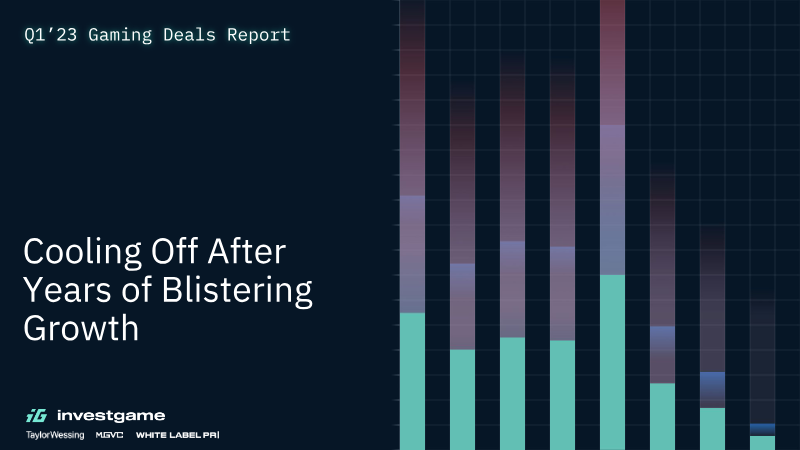
Q1'23 Gaming Deals Report
Analysis of the global video game industry’s financial activity in the first quarter of 2023 reveals a period of market correction and stabilization following previous record highs. While total deal value across private investments, mergers and acquisitions (M&A), and public offerings saw significant year-over-year declines, the volume of private deals suggests a return to regular levels of activity. The data indicates a bifurcated market where early-stage venture capital remains robust while late-stage and public market activities struggle under the pressure of high interest rates and bearish sentiment.
Private investment reached $3.3 billion across 141 deals, representing a 71% decrease in value compared to the same period in 2022. However, early-stage investments showed resilience, acting as a primary driver for future industry growth. In contrast, late-stage deals were scarce, with a single $265 million investment in VSPO accounting for 65% of the total late-stage value. The M&A sector hit a multi-year low with only 43 closed deals totaling $11.4 billion—a 94% drop in value from the previous year—though pending major acquisitions like Scopely and Rovio suggest a potential rebound in subsequent quarters.
Public offerings remained stalled, totaling $0.7 billion across nine deals, as macroeconomic conditions continued to deter companies from entering public markets. The most active venture capital firms during this period included Andreessen Horowitz, Makers Fund, and BITKRAFT Ventures, with a heavy focus on early-stage rounds.
The findings are based on data from InvestGame, which tracks closed transactions in the video game sector excluding gambling and non-gaming blockchain entities. Methodology involves a weighted ranking system for investors that prioritizes lead deal volume and value. Data sources include public media, S&P Capital IQ, and internal market insights.
- M&A activity hit a multi-year low in Q1 2023 with only 43 closed deals totaling $11.4 billion, representing a 94% year-over-year decline in value.
- Private investment value plummeted 71% year-over-year to $3.3 billion across 141 deals, reflecting a broader market correction and stabilization.
- The market is bifurcated, as early-stage venture capital remains robust while late-stage and public market activities are constrained by high interest rates and bearish sentiment.
- Late-stage investment was exceptionally scarce, with a single $265 million deal for VSPO accounting for 65% of the total value in that category.
- Public offerings remained stalled with only $0.7 billion raised across nine deals, as macroeconomic conditions continue to deter market entry.

The Mobile Economy and Digital Ad Space in 2022 and Beyond: An Analysis of Global Trends
The analysis evaluates how the mobile ecosystem and digital advertising evolved through 2022 and projects future dynamics, using Sensor Tower’s App Store and Google Play data, quarterly download and revenue estimates, and ad‑spend figures from North America and major European markets. It frames the mobile economy as still expanding beyond pre‑COVID levels while noting a slowdown in install growth, with India, the United States, Brazil and Indonesia leading global downloads and emerging markets such as Africa poised for rapid gains as smartphone penetration rises.
Mobile games retained dominance, accounting for over 50 billion downloads and generating roughly $79 billion in revenue, yet 2022 marked the first year of year‑over‑year revenue decline, driven by reduced spending in the United States, Japan and other major economies. Utilities—particularly VPN apps in India—became the fastest‑growing category, while Turkey showed the sharpest adoption increase but faced inflation‑driven limits on consumer spend. Venture‑capital funding contracted, raising concerns about the emergence of new app disruptors, and Android revenue fell 30 percent year‑over‑year, contrasted with a modest 1 percent iOS growth.
Spending patterns shifted as entertainment apps eclipsed social networking in the United States, with TikTok, HBO Max and Disney+ leading a surge that doubled 2019 levels and made entertainment revenue twice that of the next‑largest non‑game category. In Japan, a manga‑reader app topped overall gross revenue for the first time, highlighting diversification beyond games.
- Mobile gaming revenue experienced its first year-over-year decline in 2022, generating $79 billion from over 50 billion downloads as consumer spending dropped in major markets like the United States and Japan.
- Android revenue fell by 30 percent year-over-year in 2022, while iOS revenue saw a modest 1 percent growth.
- Entertainment apps have overtaken social networking in the United States, with revenue from platforms like TikTok, HBO Max, and Disney+ doubling 2019 levels to become the largest non-game category.
- India, the United States, Brazil, and Indonesia lead global app downloads, with emerging markets in Africa expected to see rapid growth due to increasing smartphone penetration.
- Utilities, specifically VPN apps in India, emerged as the fastest-growing app category, while Turkey recorded the sharpest adoption increase despite inflation-related constraints on consumer spending.
State of Blockchain Gaming Q1 2023 Report
Investment in Blockchain Games (Q4 2022 → Q1 2023)
| Quarter | Investment (USD) | Investment (Bn USD) | % Quarter‑over‑Quarter Change | |---------|------------------|----------------------|--------------------------------| | Q4 2022 | ≈ $654.5 million | ≈ 0.655 Bn | – | | Q1 2023 | $739 million | 0.739 Bn | +12.95 % |
How the numbers were derived
The report states that Q1 2023 saw a 12.95 % increase over the previous quarter and that the Q1 2023 total was $739 M. To back‑calculate the Q4 2022 figure:
\[ \text{Q4 2022 Investment} = \frac{\text{Q1 2023 Investment}}{1 + 0.1295} = \frac{739\text{ M}}{1.1295} \approx 654.5\text{ M} \]
Converting to billions (1 Bn = 1,000 M):
\[ 654.5\text{ M} \approx 0.655\text{ Bn} \qquad 739\text{ M} = 0.739\text{ Bn} \]
Key take‑away
Q1 2023 investment in blockchain gaming and metaverse projects reached $739 M (0.739 Bn), marking a robust 12.95 % quarter‑over‑quarter growth from the ≈ $654.5 M (0.655 Bn) invested in Q4 2022. This upward trajectory underscores the accelerating capital interest in the blockchain gaming sector.
- Blockchain gaming and metaverse projects secured $739 million in investment during Q1 2023.
- Investment in the sector grew by 12.95% quarter-over-quarter compared to the $654.5 million recorded in Q4 2022.
- The $739 million total for Q1 2023 represents a sustained upward trajectory in capital interest for blockchain-based gaming.
- Quarterly investment figures rose from approximately $0.655 billion in Q4 2022 to $0.739 billion in Q1 2023.

Aktualizacja Strategii Nowe Otwarcie: Polska
People Can Fly’s strategic update, issued on 31 January 2023, outlines a transformation from a single‑title studio into a multi‑project, globally distributed developer and emerging self‑publisher. The core thesis is that leveraging the group’s expertise in AAA shooters, Unreal Engine technology, and a newly expanded talent pool will enable simultaneous delivery of several high‑quality games while shifting revenue generation toward Game‑as‑a‑Service and diversified monetisation models.
Over the past two years the group has completed the Outriders launch and its Worldslayer expansion, restructured its production pipeline from one‑game‑at‑a‑time to parallel development, and opened new studios in Kraków and Montréal. Acquisitions of Phosphor Games (Chicago), Game On Creative (motion‑capture and cinematics), and Incuvo S.A. (VR) have broadened capabilities into compact‑AAA, virtual‑reality and live‑service titles. The workforce now exceeds 600 “Aviators,” including roughly 400 developers, with two‑thirds based in Europe and one‑third in North America. Internal processes rely on agile, matrix‑based feature teams, a proprietary PCF Framework for Unreal Engine, and Centers of Excellence that foster cross‑project knowledge sharing.
Future plans target six new releases by 2027, aiming for at least 3 billion PLN in combined revenue from 2023‑2027. The pipeline includes the AAA work‑for‑hire title Gemini (partnered with Square Enix, slated for 2026), the self‑funded AAA projects Dagger, Bifrost and Victoria (all projected for 2025‑26), the compact‑AAA concept Red, and the self‑published VR titles Thunder (2023) and Green Hell VR (202
- People Can Fly aims to generate at least 3 billion PLN in combined revenue between 2023 and 2027 through a portfolio of six new releases.
- The studio is transitioning from a single-title developer to a multi-project, self-publishing entity capable of simultaneous AAA production.
- The development pipeline includes the AAA work-for-hire title Gemini (2026), three self-funded AAA projects (Dagger, Bifrost, and Victoria) slated for 2025-2026, and various compact-AAA and VR titles.
- The company has scaled to over 600 employees, with approximately 400 developers distributed across North American and European studios.
- Strategic acquisitions of Phosphor Games, Game On Creative, and Incuvo S.A. have expanded the studio's capabilities into motion capture, cinematics, and virtual reality.
Global Gaming Report 2022
The global gaming market achieved a record $127 billion in total deal value across 1,320 transactions in 2022, a surge primarily fueled by a threefold increase in merger and acquisition volume. This consolidation was headlined by transformative deals such as Microsoft’s $68.9 billion pending acquisition of Activision Blizzard and Take-Two’s $12.7 billion purchase of Zynga. While the PC, console, and platform tools segments attracted the highest volume of interest, major technology firms including Meta, Google, and Netflix simultaneously expanded their internal capabilities through strategic acquisitions in virtual reality, artificial intelligence, and independent studio development.
Despite the record-breaking M&A activity, the broader financial landscape reflected significant volatility. Public gaming stocks experienced sharp declines, with many market capitalizations falling by more than 30%. Private financing deal counts rose by 29%, yet the total capital raised decreased to $11.1 billion as late-stage investments cooled. Blockchain gaming emerged as a particularly resilient sub-sector, securing $4 billion in funding across nearly 400 companies, supported by over $13 billion raised by specialized venture capital funds. Established industry leaders like Sony and Nintendo maintained robust EBITDA margins of 19.5% and 35.0% respectively, demonstrating operational stability amidst macroeconomic shifts.
The industry is transitioning into a period of heavy consolidation and potential "taking private" transactions as companies capitalize on lower public valuations. Future growth and investment are expected to concentrate on augmented and virtual reality, AI-driven development tools, and mobile audience expansion. Furthermore, the emergence of the Savvy Gaming Group, backed by a $35 billion investment fund, signals a shift toward new geographic centers of influence. As the market matures, the first significant wave of consolidation within the blockchain gaming sector is anticipated, marking a move toward more sustainable, high-quality project development.
- The global gaming market reached a record $127 billion in deal value across 1,320 transactions in 2022, driven by a threefold increase in M&A volume headlined by Microsoft’s $68.9 billion pending acquisition of Activision Blizzard and Take-Two’s $12.7 billion purchase of Zynga.
- Public gaming stocks faced significant volatility with many market capitalizations dropping over 30%, while private financing deal counts rose 29% despite a decline in total capital raised to $11.1 billion due to cooling late-stage investment.
- Blockchain gaming proved resilient, securing $4 billion in funding across nearly 400 companies, bolstered by over $13 billion in specialized venture capital fund commitments.
- Established industry leaders maintained operational stability, with Nintendo and Sony reporting robust EBITDA margins of 35.0% and 19.5% respectively.
- The industry is shifting toward consolidation and potential 'taking private' transactions to exploit lower public valuations, with future investment targeting AI-driven tools, AR/VR, and mobile expansion.
Mobile Games: State of the Market & Playtime Q3 2023
Mobile games: state of the market & playtime Joint report of Apptica & Gamelight The purpose of this study is to analyse the state of gaming category in Q3 2023. All data presented in this report has been collected from Apptica and Gamelight platforms. "Games" category is defined by a store's tag. The basis of this analysis is made up of data from the Apptica's Store, Ad and Market Intelligence sections and Gamelight's playtime and app usage data.
- iOS remains the dominant platform for mobile gaming revenue, accounting for 56.01% of the total global share compared to 43.99% for Android.
- The United States and Japan are the leading revenue generators among major markets, contributing $2.92 billion and $2.03 billion respectively, with the six analyzed countries accounting for 59% of global gaming revenue.
- South Korea experienced the highest growth in game installs at 32% compared to Q3 2022, while the United States and France saw declines of 5% and 0.7%, respectively.
- Card games are the most engaging genre globally with an average playtime of 41.68 minutes, consistently ranking as the top genre for user engagement across analyzed regions.
- Average daily playtime is higher on iOS (38.69 minutes) than on Android (32.17 minutes) across the studied markets.