Global
Documents
Toxicity and the Bottom Line: The Impact of Hate and Harassment on Player Retention and In-Game Purchases
Toxicity and harassment in online gaming environments significantly impact player retention and monetization, creating a direct financial incentive for studios to prioritize trust and safety. Research based on a representative survey of 2,408 active gamers across various age groups, genders, and ethnicities indicates that three out of four players consider safety from hate and harassment a high priority. Despite this, approximately 10% of players report feeling actively unsafe, with this figure rising to 23% among bisexual players and 18% among Asian players, highlighting the disproportionate impact on marginalized communities.
The data establishes a clear link between toxic behavior and lost revenue. Approximately 19% of players report spending less money in gaming communities to avoid harassment, while 21% have reduced their overall playtime. Engagement is further eroded by defensive player behaviors: 31% of participants have abandoned matches already in progress, 27% have left lobbies before a match began, and 44% have disabled voice chat entirely to mitigate exposure to abuse. These actions not only decrease individual player lifetime value but also degrade the experience for the broader player base.
Demographic analysis reveals that younger players, particularly those aged 18 to 24, are the most sensitive to these issues. This cohort is the most likely to feel unsafe and the most prone to disengaging or reducing spending in response to toxicity. Because these players represent a core demographic with long-term growth potential, their tendency to "vote with their wallets" suggests that safer gaming environments are fundamentally more profitable. The findings conclude that traditional moderation is currently insufficient, necessitating more robust community guidelines and integrated safety tools to protect both players and the industry's bottom line.
- Toxicity directly suppresses revenue, as 19% of players spend less money and 21% reduce their overall playtime to avoid harassment.
- Safety is a critical player priority, with 75% of the 2,408 surveyed gamers identifying protection from hate and harassment as a high priority.
- Harassment causes significant engagement loss, with 44% of players disabling voice chat, 31% abandoning active matches, and 27% leaving lobbies to avoid abuse.
- Marginalized groups face disproportionate risks, with 23% of bisexual players and 18% of Asian players reporting that they feel actively unsafe in gaming environments.
- The 18-to-24 age demographic is the most sensitive to toxicity, showing the highest propensity to disengage or reduce spending, which threatens long-term industry growth.
Games Market Trends 2024
This analysis examines the 2024 global games market, forecasting a period of recovery and strategic restructuring following the post-pandemic market correction. The primary thesis suggests that while the industry is returning to growth, it faces a "lean year" characterized by cautious investment, workforce reductions, and a pivot away from the oversaturated live-service model toward premium, finite gaming experiences.
Key findings indicate that the market began recovering in 2023 and is projected to maintain a positive Compound Annual Growth Rate (CAGR) of +1.3% through 2026. Despite this growth, the report highlights a significant shift in business strategies. Developers are increasingly favoring established Intellectual Property (IP) and sequels to mitigate risk. Furthermore, the "gold rush" for live-service titles is cooling as 19 games currently command 60% of total playtime, leading companies to return to premium releases. Other major trends include the slowing growth of multi-game subscriptions, the expansion of mobile developers into the PC space to combat rising user acquisition costs, and the anticipated launch of next-generation Nintendo hardware.
The scope of this research is global, covering mobile, PC, and console segments with revenue and engagement forecasting extending from 2021 through 2026. The methodology combines internal data analysis from the Newzoo platform with a qualitative survey of gaming executives and experts from organizations such as Ubisoft, Savvy Games Group, and Iron Galaxy Studios.
Technological and platform shifts also define the 2024 outlook. Generative AI is expected to improve production efficiencies and NPC depth, though it is not predicted to impact game production at scale within the current year. Additionally, the report anticipates increased platform fluidity, specifically noting Microsoft’s intent to launch an Xbox mobile store on Android to challenge existing app store duopolies.
- The global games market is entering a recovery phase with a projected Compound Annual Growth Rate (CAGR) of +1.3% through 2026.
- The live-service market is consolidating, with just 19 titles currently capturing 60% of total player engagement, prompting a strategic shift back toward premium, finite gaming experiences.
- Developers are increasingly mitigating financial risk by prioritizing established Intellectual Property and sequels over new, unproven concepts.
- Mobile developers are expanding into the PC market to offset rising user acquisition costs, while Microsoft is preparing to challenge mobile app store duopolies with a dedicated Xbox store for Android.
- Growth in multi-game subscription services is slowing, signaling a plateau in the adoption of these platforms.
State of the Game Industry 2024
The global game industry entered 2024 in a state of profound volatility, defined by a painful market correction following post-pandemic overexpansion. This period of instability is marked by widespread layoffs affecting one-third of the workforce and a surge in studio closures linked to rapid corporate conglomeration. While North America remains the primary hub for development and PC continues to be the dominant platform, the workforce is increasingly preoccupied with job security and the ethical implications of emerging technologies. Generative AI has seen rapid adoption, with nearly half of developers utilizing these tools, yet 84% express deep concern regarding copyright infringement and the potential for further job displacement.
Labor dynamics are shifting as developers react to economic pressures and perceived corporate mismanagement. Support for unionization has climbed to 57%, with particularly high enthusiasm among younger professionals aged 18 to 24 who are grappling with inflation and precarious employment. This desire for collective bargaining coincides with a growing rejection of mandatory return-to-office policies and a decline in confidence regarding corporate diversity and sustainability initiatives. Furthermore, the technical landscape is fracturing; significant dissatisfaction with Unity’s recent policy changes has led one-third of developers to consider switching engines, often favoring open-source alternatives like Godot.
Business models remain centered on digital premium downloads, favored by 51% of the industry, even as marketing strategies face disruption due to overwhelming negative sentiment toward major social media platforms like Twitter/X. Despite the internal turmoil, there is a measurable increase in the implementation of accessibility features, which now appear in nearly half of all projects. However, the industry’s demographic makeup remains largely stagnant, continuing to be predominantly White and male. Ultimately, the current landscape reflects a workforce caught between the necessity of financial stability through consolidation and a growing demand for systemic reform to address ethical, technical, and labor-related grievances.
- The industry is undergoing a severe market correction characterized by widespread layoffs affecting one-third of the global workforce and a surge in studio closures.
- Support for unionization has reached 57%, driven largely by younger professionals (ages 18–24) facing economic instability and dissatisfaction with corporate management.
- While 49% of developers have adopted generative AI, 84% of the workforce reports significant concerns regarding copyright infringement and potential job displacement.
- Technical infrastructure is shifting, with one-third of developers considering engine migrations—often toward open-source options like Godot—following recent policy changes at Unity.
- Digital premium downloads remain the primary business model for 51% of the industry, even as marketing strategies struggle with declining sentiment toward major social media platforms.
2024 State of Game Technology Report
The global game technology landscape has reached a critical inflection point in 2024, characterized by the widespread expansion of game engines into non-gaming sectors such as automotive, healthcare, and media. Approximately 50% of developers now utilize these engines for cross-industry applications, with Unreal Engine maintaining a dominant 63% market share, particularly within media and entertainment. Despite this growth, the industry contends with significant structural challenges, including acute funding shortages, personnel deficits, and the technical complexities of managing massive data sets across distributed teams. To mitigate these hurdles, organizations are prioritizing toolset consolidation and robust version control systems, with Perforce Helix Core and Git-based platforms serving as the primary infrastructure for modern development pipelines.
The technical ecosystem remains highly fragmented but is increasingly defined by a shift toward automation and cloud integration. Microsoft Visual Studio and Jenkins continue to lead in the AAA space, though modern alternatives like JetBrains Rider and GitHub Actions are gaining substantial traction. Cloud-based development has become a standard practice for nearly half of the industry, with Amazon Web Services emerging as the preferred provider. Furthermore, generative AI has seen rapid institutional integration, with 65% of organizations adopting the technology to streamline workflows. This technological evolution coincides with a shift in labor dynamics; following widespread industry layoffs, employers now prioritize cross-functional adaptability over narrow specialization, while the workforce increasingly values direct access to leadership and mental health support.
Geographically and industrially broad, these findings reflect a transition toward more agile, cloud-native development environments that must balance aggressive timelines against resource constraints. The move toward indie development and the diversification of game engine utility suggest that the boundaries between traditional gaming and broader digital creation are permanently blurring. Success in this environment depends on the ability to manage increasingly large file sizes and complex collaboration requirements through integrated CI/CD and version control strategies.
- Game engines are expanding beyond gaming, with 50% of developers now applying them to sectors like automotive, healthcare, and media, while Unreal Engine holds a 63% market share.
- Generative AI has reached 65% institutional adoption as organizations integrate the technology to streamline development workflows.
- Cloud-based development is now standard for nearly 50% of the industry, with Amazon Web Services serving as the primary infrastructure provider.
- To combat technical complexities and data management challenges, firms are prioritizing toolset consolidation and robust version control systems like Perforce Helix Core and Git-based platforms.
- Industry labor dynamics have shifted toward cross-functional adaptability following recent layoffs, with employers prioritizing versatile skill sets over narrow specialization.

Inside Gaming: It's Personal! 2024
The 2024 Inside Gaming analysis reveals that video games have evolved into a primary medium for identity formation and self-expression, surpassing traditional motivations like competition or time-killing. Based on a global survey of 5,000 entertainment and gaming consumers alongside proprietary first-party data, the findings indicate that 46% of players now prioritize creation and imagination as their primary reason for gaming, marking a 10% year-over-year increase. This shift is driving significant engagement, as players who view gaming as a platform for authenticity are 30% more likely to increase their playtime compared to previous years.
The data highlights a profound psychological disconnect between players' digital and physical lives, with 80% of respondents stating their gaming personality differs from their real-life persona. Furthermore, 64% of gamers find it easier to be themselves with a controller in hand than in person. This desire for authenticity is reflected in gameplay preferences, where 76% of players utilize character personalization and 48% focus on unique gamertags to express themselves. Games that facilitate this expression through in-game customization, vast open worlds, and constant updates see 60% higher engagement than industry norms, a trend exemplified by titles such as Roblox, Fortnite, and The Sims.
There is a significant commercial opportunity for brands to bridge the gap between virtual and physical identities. Nearly half of all players express a desire for their real-life presence to mirror their gaming presence, particularly regarding physical appearance and skill sets. This sentiment is especially strong among marginalized and younger demographics, including women, non-binary individuals, and multicultural players. Consequently, 72% of consumers report they would view brands more favorably if those companies helped them translate their gaming-inspired self-expression into the real world through products, skills, or lifestyle alignments.
- 46% of gamers now prioritize creation and imagination as their primary motivation for playing, representing a 10% year-over-year increase.
- Games that facilitate self-expression through customization, open worlds, and constant updates—such as Roblox, Fortnite, and The Sims—achieve 60% higher engagement than industry norms.
- 72% of consumers report they would view brands more favorably if those companies helped them translate their gaming-inspired self-expression into real-world products, skills, or lifestyle alignments.
- 64% of gamers find it easier to be themselves while gaming than in person, and 80% report that their gaming personality differs from their real-life persona.
- Players who view gaming as a platform for authenticity are 30% more likely to increase their total playtime compared to previous years.
Midcore Gaming Apps Report 2023
The midcore mobile gaming market is undergoing a significant expansion as players increasingly migrate from hyper-casual titles toward games offering greater depth and complexity. Currently accounting for 35% of total US iOS gaming revenue, the midcore segment is defined by its high player retention and diverse monetization strategies. While these games face higher user acquisition costs than casual titles—averaging a $2 cost-per-install (CPI)—they leverage sophisticated LiveOps and multi-layered Battle Pass systems to drive long-term profitability. Strategy and RPG genres lead the market, while emerging trends like extraction shooters and season-based gameplay loops further solidify the segment's dominance.
Data from 2022 to 2023 highlights stark contrasts in performance across platforms and regions. Android remains the more cost-effective platform for developers, offering a $0.73 CPI compared to $3.86 on iOS, while also delivering nearly double the Day-7 return on ad spend (ROAS) at 6.1%. Geographically, North America represents the most expensive market with a $5.45 CPI, yet it maintains a strong 4.5% ROAS. Conversely, the EMEA region provides the best overall value, balancing a low $0.80 CPI with a competitive 4.4% ROAS. Genre-specific analysis shows that Shooters require the highest acquisition investment at $7.47 but yield the highest early returns, whereas RPGs offer the lowest entry cost at $0.60.
To maximize revenue and bypass traditional platform fees, midcore developers are increasingly adopting external web stores and aggressive LiveOps schedules, often running an average of 15 simultaneous active events. This shift toward complex, service-based ecosystems is supported by specialized growth acceleration platforms that provide the infrastructure for large-scale app marketing and monetization. By utilizing programmatic exchanges and targeted advertising solutions, developers can navigate the high-cost landscape of midcore gaming to secure a dedicated and high-value audience.
- Midcore games now account for 35% of total US iOS gaming revenue, driven by a player migration from hyper-casual titles toward deeper, more complex gameplay.
- Android is significantly more cost-effective for developers than iOS, with a $0.73 CPI compared to $3.86 and nearly double the Day-7 ROAS at 6.1%.
- The EMEA region offers the best market value, balancing a low $0.80 CPI with a competitive 4.4% ROAS, while North America remains the most expensive market at a $5.45 CPI.
- Genre-specific acquisition costs vary widely, with Shooters requiring the highest investment at $7.47 per install, while RPGs offer the lowest entry cost at $0.60.
- To drive long-term profitability and bypass platform fees, developers are increasingly utilizing external web stores and aggressive LiveOps strategies, often maintaining 15 simultaneous active events.
Top 500 Titles on Twitch 2023
The gaming industry experienced record-breaking engagement in 2023, with the top 500 titles on Twitch generating nearly 15 billion hours of watch time. This viewership was characterized by extreme concentration at the top of the rankings, as a mere 11 titles accounted for half of the total watch time. Grand Theft Auto V led the industry with 1.3 billion hours watched, while Fortnite demonstrated the highest level of creator engagement, boasting 2.8 million unique channels—more than double its nearest competitor.
The streaming landscape across 2023 showcased a diverse mix of modern AAA releases, indie sensations, and enduring legacy titles. While competitive staples like VALORANT and League of Legends dominated the upper echelons, the rankings revealed significant staying power for older franchises. Titles such as Super Mario 64, Age of Empires II, and various entries from The Legend of Zelda series maintained millions of hours of watch time, often outperforming newer releases. This trend highlights a bifurcated market where viewers gravitate toward both high-stakes competitive play and nostalgic speedrunning or retro content.
The data, which excludes non-gaming categories like "Just Chatting" and tabletop games to focus strictly on video game performance, indicates that even titles at the bottom of the top 500 maintain substantial audiences. Games ranked between 400 and 500, such as Tekken 8 and PICO PARK, still commanded approximately 1.8 million to 2.2 million hours watched each. This comprehensive analysis across PC, console, and mobile platforms underscores a resilient ecosystem where niche indie horror, classic RPGs, and modern shooters coexist, maintaining high viewer retention despite broader economic volatility within the development sector.
- The top 500 Twitch titles generated nearly 15 billion hours of watch time in 2023, with 50% of that total concentrated in just 11 games.
- Grand Theft Auto V was the most-watched title of 2023, accumulating 1.3 billion hours of viewership.
- Fortnite led the industry in creator engagement with 2.8 million unique channels, more than double the count of its nearest competitor.
- The streaming market is bifurcated between high-stakes competitive staples like League of Legends and VALORANT and legacy titles like Super Mario 64 and Age of Empires II that maintain millions of hours of watch time.
- Even titles ranked between 400 and 500, such as Tekken 8 and PICO PARK, sustained significant engagement, each generating between 1.8 million and 2.2 million hours watched.
Gaming Industry Report: Global & MENAP Outlook Q4 2023
The analysis presents a forward‑looking assessment of the global gaming market with a particular focus on the MENAP region, outlining the strategic opportunities that are reshaping the industry in 2024 and beyond. Central to the outlook is the rapid convergence of emerging technologies—virtual reality, artificial intelligence, mobile platforms, quantum computing, GPU‑as‑a‑Service, and cloud gaming—which together are accelerating content creation, distribution, and consumption across diverse consumer bases.
Investment activity is framed around a thesis that prioritises three core pillars: high‑value content and intellectual property, software efficiency solutions that lower development costs, and user‑generated‑content ecosystems that drive engagement and monetisation. Funding targets range from pre‑seed to Series A rounds, with typical ticket sizes of $1 million to $8 million, reflecting confidence in early‑stage ventures that can capitalize on the identified technology trends. The outreach strategy includes participation in high‑profile events such as the World Gaming Conference in Abu Dhabi (15‑16 February) and LEAP 2024 in Riyadh (4‑7 March), complemented by a dedicated “Gaming Investor” newsletter, a GameON podcast, and sponsorship opportunities for research partners.
Overall, the findings underscore a vibrant growth trajectory for gaming in both established and emerging markets, driven by technological innovation and a robust pipeline of investable startups. Stakeholders are encouraged to engage through subscription services, collaborative research, and direct investment to capture value in this rapidly evolving sector.
- Investment activity in the gaming sector is currently targeting early-stage ventures from pre-seed to Series A, with typical ticket sizes ranging from $1 million to $8 million.
- Strategic investment is focused on three core pillars: high-value intellectual property, software solutions that reduce development costs, and ecosystems centered on user-generated content.
- The industry is experiencing a rapid convergence of emerging technologies, including AI, VR, cloud gaming, quantum computing, and GPU-as-a-Service, to accelerate content creation and distribution.
- The MENAP region is a primary focus for growth, with key industry engagement scheduled for the World Gaming Conference in Abu Dhabi on February 15–16 and LEAP 2024 in Riyadh on March 4–7.
- Market growth is being driven by a combination of technological innovation and a robust pipeline of investable startups across both established and emerging global markets.
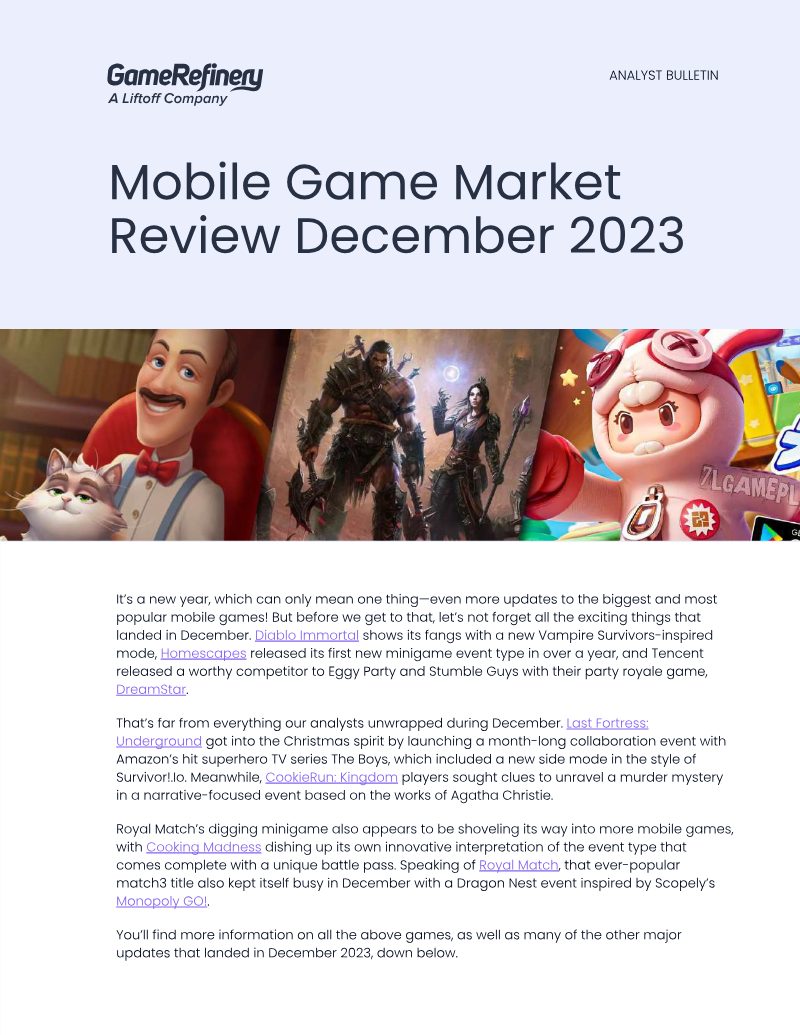
Mobile Game Market Review December 2023
The mobile gaming market in December 2023 was characterized by aggressive experimentation with cross-genre mechanics and high-profile intellectual property collaborations. Analysts observed a significant trend of "genre-blending," where successful mechanics from market leaders were integrated into established titles. Notable examples include Royal Match adopting the cooperative partner event structure popularized by Monopoly GO!, and Diablo Immortal and Last Fortress: Underground introducing roguelite survival modes inspired by Vampire Survivors and Survivor.io.
In the casual segment, developers focused on deepening engagement through complex minigames. Homescapes introduced tycoon-style restoration events to its match-3 core, while Cooking Madness innovated by linking a digging minigame directly to battle pass progression. The midcore sector saw diverse narrative and social strategies, such as CookieRun: Kingdom’s Agatha Christie-inspired murder mystery and the launch of Tencent’s party royale title DreamStar in China. DreamStar quickly became a top-grossing competitor to Eggy Party by emphasizing social hubs and user-generated content.
Major updates to legacy titles yielded substantial financial results, particularly for Clash of Clans. The introduction of Town Hall 16, building-merging mechanics, and a new hero equipment system drove a 350% daily revenue spike in the United States. Geographically, the review highlights strong performance in the Chinese market for both domestic releases like DreamStar and localized versions of Western hits. Overall, the period demonstrated that mobile developers are increasingly looking beyond their own sub-genres to borrow proven engagement and monetization loops from the broader gaming ecosystem.
- Clash of Clans experienced a 350% daily revenue spike in the U.S. following the December 2023 release of Town Hall 16, new building-merging mechanics, and a hero equipment system.
- Mobile developers are increasingly adopting cross-genre mechanics, such as Royal Match integrating cooperative partner events and midcore titles like Diablo Immortal adding roguelite survival modes.
- Tencent’s new party royale title, DreamStar, emerged as a top-grossing competitor to Eggy Party in China by focusing on social hubs and user-generated content.
- Casual games are deepening engagement through complex minigames, exemplified by Homescapes adding tycoon-style restoration events and Cooking Madness linking digging minigames to battle pass progression.
- The mobile market in December 2023 was defined by a shift toward borrowing proven engagement and monetization loops from across the broader gaming ecosystem rather than remaining within traditional sub-genre silos.
Analyst Bulletin: Mobile Game Market Review November 2023
The mobile gaming market in November 2023 was characterized by the proliferation of specific event mechanics and the rise of the 3D match subgenre. Analysis of market leaders reveals that Royal Match has become a primary trendsetter for casual titles. Its "Social Win Streak" and "Digging Minigame" mechanics were widely adopted by competitors such as Monopoly GO!, Matchington Mansion, and BTS Island. Simultaneously, the success of Triple Match 3D spurred a wave of new entries in the 3D match category, including Match Factory and spin-offs from established franchises like Candy Crush.
A significant shift occurred in the midcore segment, where developers increasingly experimented with pay-gated event content. Titles such as Free Fire, State of Survival, and Last Fortress: Underground implemented exclusive rewards and gameplay modes accessible only through direct purchases or premium currency top-ups. This trend suggests a strategic move toward more aggressive monetization of live events, moving away from purely engagement-based models to those requiring financial entry points for participation.
Geographically, the US market saw major activity with the global launch of Warcraft Rumble, which achieved the top download spot and maintained a top-50 grossing position. In China, Soul Knight Prequel demonstrated the continued strength of the roguelite genre, reaching the top of the download charts. Other notable developments included the expansion of user-generated content via the Stumble Workshop in Stumble Guys and the rapid emergence of mobile clones inspired by the viral Nintendo Switch title, Suika Game. These findings indicate a highly reactive market where developers quickly iterate on successful mechanics and viral trends across both casual and midcore segments.
- Royal Match has emerged as the primary industry trendsetter, with competitors like Monopoly GO!, Matchington Mansion, and BTS Island adopting its 'Social Win Streak' and 'Digging Minigame' mechanics.
- Midcore titles including Free Fire, State of Survival, and Last Fortress: Underground are shifting toward aggressive monetization by pay-gating exclusive event content and gameplay modes.
- The 3D match subgenre is expanding rapidly following the success of Triple Match 3D, leading to new entries like Match Factory and 3D spin-offs of established franchises such as Candy Crush.
- Warcraft Rumble's global launch in November 2023 secured the top download spot in the US market while maintaining a top-50 grossing position.
- The roguelite genre remains highly competitive in China, evidenced by Soul Knight Prequel reaching the top of the download charts.

How IP and Brand Collaborations Level Up Games
IP and brand collaborations serve as a critical strategic lever for boosting player engagement and revenue in the modern games market. Analyzing 477 collaborations across 104 unique PC and console games between January 2021 and June 2023, the data reveals that these events drive an average daily active user (DAU) increase of 11% during the first week of launch. Engagement typically peaks between the fourth and fifth days of an event before gradually returning to baseline levels.
The impact of these partnerships varies significantly by monetization model. Premium games experience a more substantial engagement boost of 19% on average, largely because they often utilize downloadable content (DLC) that adds substantial new gameplay or story elements. In contrast, free-to-play titles see a more modest 8% DAU increase, as they frequently rely on cosmetic skins which, while cost-effective, offer less mechanical depth to drive player return.
The most frequent collaborations occur between two game IPs, followed by partnerships with anime, manga, and comic franchises. Battle Royale and Sandbox genres lead the market in collaboration frequency, exemplified by platforms like Fortnite and Roblox. Case studies of Dead by Daylight and Top Gun: Maverick expansions in Ace Combat 7 and Microsoft Flight Simulator demonstrate that success is heavily dependent on brand fit and timing. Aligning in-game events with broader transmedia marketing activities, such as theatrical film releases, can result in DAU increases as high as 120%.
Methodologically, the analysis utilizes Newzoo’s Game Performance Monitor, covering 37 global markets. The study excludes browser games and Nintendo Switch data, focusing on Steam, PlayStation, and Xbox platforms. To isolate the specific impact of collaborations, the research excludes events that coincide with initial game launches or shifts to free-to-play models.
- Aligning in-game collaborations with external transmedia marketing, such as theatrical film releases, can drive DAU increases of up to 120%.
- IP collaborations generate an average 11% increase in daily active users (DAU) during the first week of launch, with engagement typically peaking between the fourth and fifth days.
- Premium games see a 19% average DAU boost from collaborations, significantly outperforming free-to-play titles, which see an 8% increase due to a heavier reliance on cosmetic-only content.
- Battle Royale and Sandbox titles, such as Fortnite and Roblox, lead the industry in the frequency of brand partnerships.
- Game-to-game IP partnerships are the most common form of collaboration, followed by integrations with anime, manga, and comic franchises.

Launching PC & Console Titles in the Ever-Changing Games Market
The PC and console gaming market is characterized by intense competition and the dominance of established franchises, with total revenues projected to reach $95.2$ billion in 2023. Analysis of 37 major markets reveals a significant barrier to entry for new titles; in 2022, 18 of the top 20 games by monthly active users (MAU) were released in previous years. This trend continued into 2023, where Hogwarts Legacy was the only new release to break into the top 20 MAU rankings during the first five months of the year. Furthermore, while the total number of games released on Steam continues to rise, the number of titles reaching a milestone of 50,000 lifetime players is declining, highlighting a market increasingly consolidated around long-standing live-service titles and known intellectual properties.
Demographic data from a global survey of over 60,000 respondents across 36 markets indicates that gaming engagement is highest among younger generations, with 89% of Gen Z and 82% of Millennials identified as game enthusiasts. These cohorts spend approximately 20% of their leisure time playing video games, a figure that rivals time spent on social networks. Spending patterns also skew toward younger players, with over 70% of Gen Z and Millennials making in-game or game-related purchases. Notably, these audiences engage with gaming far beyond active play, frequently participating in community sites, viewing gaming video content, and following creators.
To succeed in this "attention economy," the findings suggest that developers must move beyond traditional product launches to embrace cultural relevance and community building. Successful strategies include leveraging transmedia IP, such as television adaptations and film crossovers, and utilizing creator marketing to reach audiences on platforms like TikTok, which generated over 3 trillion gaming content views in 2022. The intersection of gaming with non-endemic brands in fashion, music, and consumer goods further illustrates the industry's evolution into a mainstream cultural pillar that competes directly with traditional media for consumer time and loyalty.
- The PC and console market is highly consolidated, as 18 of the top 20 games by monthly active users (MAU) in 2022 were legacy titles, with Hogwarts Legacy being the only new release to reach that tier in early 2023.
- Market saturation is increasing, evidenced by a rising number of Steam releases coupled with a declining number of titles achieving a 50,000 lifetime player milestone.
- Gaming is a primary leisure activity for younger demographics, with 89% of Gen Z and 82% of Millennials identifying as enthusiasts and dedicating approximately 20% of their free time to gaming.
- Monetization potential remains strong among younger cohorts, as over 70% of Gen Z and Millennials report making in-game or game-related purchases.
- Success in the current $95.2 billion market requires moving beyond traditional launches to leverage transmedia IP and creator-led marketing, such as the 3 trillion gaming content views generated on TikTok in 2022.