Market (Mobile)·Updated Mar 17, 2026 by Mariusz Gasiewski (Google)
Report · January 16, 2025
Published by Mariusz Gasiewski (Google), Google
The analysis tracks mobile‑gaming dynamics from 2022 through 2024, arguing that the sector’s financial expansion now exceeds its ability to attract new users. Revenue on Google Play rose roughly 10 % year‑on‑year in 2023‑24 while download volumes stagnated or slipped slightly, and iOS revenue grew about 12 % against an 8 % rise in downloads. Despite this divergence, the concentration of earnings among the top ten publishers has held steady, indicating that market power remains entrenched even as overall spend accelerates. Consumer‑device preferences reveal a near‑universal reliance on smartphones, with 97 % of Brazilian gamers using mobile phones in 2024 and personal PCs ranking as the only other significant platform; console usage is negligible. Across the United States and Brazil, the primary incentives for trying a new title are free‑to‑play pricing, recognizable brands or characters, and easy access through subscription services. Gender nuances appear modest: men place greater value on non‑pay‑to‑win structures and strong single‑player experiences, whereas women are drawn to customizable avatars and peer recommendations. Behavioral data show a pronounced tendency toward deep engagement with a single game. Approximately half of respondents in Brazil, Germany, Japan and the United States report completing one title before moving to the next, suggesting that the market favors sustained, title‑centric play rather than rapid turnover. The findings collectively underscore a maturing mobile‑gaming ecosystem where revenue growth is driven by monetisation depth and brand loyalty rather than sheer user acquisition.

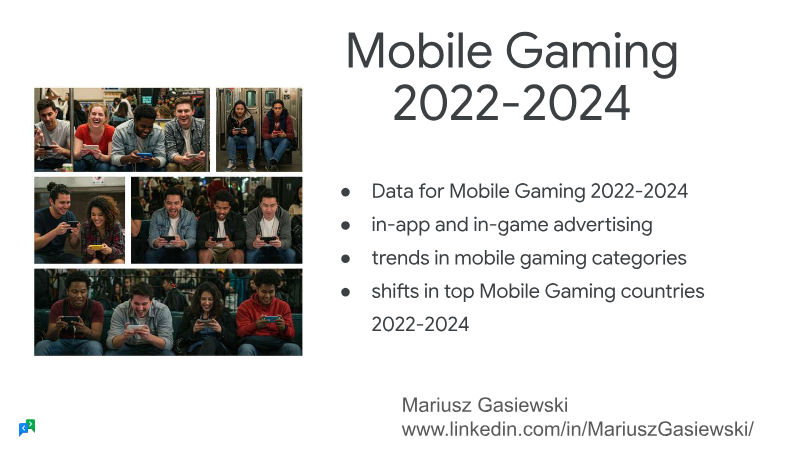
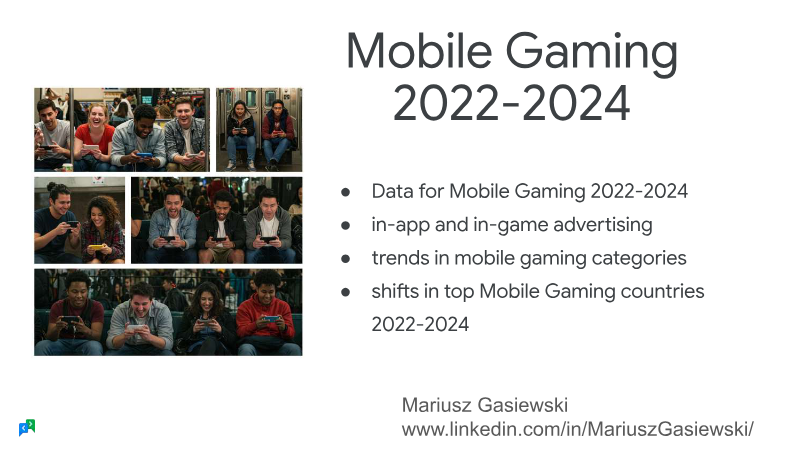
~~Mobile Gaming~~ 2022-2024 ● Data for Mobile Gaming 2022-2024 ● in-app and in-game advertising 34 ● trends in mobile gaming categories ● shifts in top Mobile Gaming countries 2022-2024 Mariusz Gasiewski
Executive summary ● Majority of gamers play games on smartphones. Most of new gamers will be playing on Mobile ● There is no danger that gaming will go away. Even very young still users play games ● Users have the preference for free-to-play games, family recommendations, games with good ratings ● Most of new smartphone users will be in Emerging Markets ● In-game advertising is important part of mobile gaming revenue in many countries. It grows faster than in-app purchases. ● Revenue is growing faster than downloads in Mobile Gaming (both in Android and iOS) ● 2024 was very good year for iOS. Mobile gaming was growing faster on iOS than on Android ● In Gaming categories that have strong importance and high growth rates are:
Gaming is huge. Majority of users play on smartphones. Share of internet user who use smartphones to play games?
Gaming is huge Share of internet user who are playing games on other devices (ie. laptop, tablet, console), although not smartphone USA 15%
> **[Chart page]** This page contains visual data — view in PDF for the best experience. Most of new users will come from Mobile New users (in mln users) TotalPMobileConsole 250.0 212.8 200.0 166.9 166.1 190.7 173.9 150.0 148.5 150.5 151.0 101.0 128.124.1 148.2 119.7 111.3 106.5 100.0 81.4 74.2 95.9 96.9 90.3 86.4 39.2 50.8 32.732.8 34.0 50.0 28.5 27.2 30.6 23.024.0 29.5 13.9 22.523.6 21.622.7 20.122.2 1.3 0.0 2018 2019 2020 2021 2022 2023 2024 2025 2026 2027
> **[Chart page]** This page contains visual data — view in PDF for the best experience. Mobile operating system market share based on share of traffic 10S Androld 100% 2.89 3.7% 34% 4.3% 48% 8.0% 8.4% 10.8% 9.1% 12.0% 12.8% 13.3% 13.6% 15.9% 17.9% 19.8% 20.2% 20.6% 20.6% 20.4% 22.4% 23.7% 22.9% 23.6% 75% 50% 97.2% 96.2% 96.1% 95.5% 94.8% 91.9% 91.5% 89.1% 88.3% 87.8% 87.1% 86.2% 86.1% 83.8% 80.8% 80.0% 79.5% 79.3% 79.3% 79.2% 77.2% 76.2% 76.12 76.0% 25% 0% p Algri BrazelMeNICONigria th sauniesTh Fare pland Span S Bat Ehope Paisdaon Argoingd Egypal Inbors Grce India peru Chand China Sukoel Other systems iOs Android 100% 75% 25.8% 26.9% 27.7% 27.6% 28.6% 29.1% 28.9% 30.4% 30.5% 31.2% 31.2% 32.4% 35.5% 37.0% 38.7% 48.6% 46.4% 47.7% 54.8% 54.6% 57.5% 57.9% 57.8% 57.7% 64.7% 50% 25% 73.9% 72.9% 72.0% 71.8% 70.6% 70.5% 70.4% 69.2% 58.6% 68.4% 68.0% 67.2% 63.9% 62.2% 60.7% 50.7% 50.6% 47.7% 45.0% 44.6% 42.1% 41.9% 41.8% 40.0% 34.8% 0% Chite Cyous Swden Thaliend Japan Cehas CandaTawan MalyaTurkey Uraine Coloa Venan Romnd Russia Htaly Sinppore theelandsizelend Kong Australia Demank Gemany States
The global mobile gaming market entered a period of mature recovery in 2024, characterized by a strategic pivot toward live services and high-value player retention. While total downloads declined by 6.6%, global in-app purchase revenue grew by 4% to reach $82 billion. This growth was primarily driven by North America and the Middle East, offsetting spending declines in Asia. The industry has transitioned into a "live operations" era, where 84% of all revenue is generated by games utilizing continuous updates and seasonal events. This shift is further evidenced by a 50% decrease in new game releases since 2020, as publishers prioritize high-quality core titles over volume. Genre performance highlights a market dominated by Strategy and RPG titles, which collectively generated over $34 billion in 2024. Action games emerged as the fastest-growing category with a 46% revenue increase, fueled by breakout hits like Last War: Survival. Despite the dominance of established franchises, a record 11 games surpassed $1 billion in annual consumer spend, including MONOPOLY GO!, which secured the top global position. The market is also seeing a demographic shift, particularly in the United States, where the 18-24 age group now represents 18% of the player base, up from 13% in 2022. Marketing strategies have evolved to combat rising user acquisition costs, with a significant move toward high-intent creative content and short-form video platforms. TikTok experienced a 67% year-over-year growth in social ad share, while mid-core developers nearly doubled their impression share on social networks. To maintain profitability, publishers are increasingly leveraging external web stores, celebrity partnerships, and localized cultural influencers, such as virtual YouTubers in the Japanese market. These trends underscore a broader industry movement toward sophisticated monetization models and IP-driven growth in an increasingly concentrated competitive landscape.
The global mobile gaming market underwent a significant correction in 2023, characterized by a 10% decline in worldwide downloads and a 2% drop in total revenue. This downturn was primarily fueled by escalating user acquisition costs and a post-pandemic stabilization of consumer habits. While the broader market contracted, a distinct shift toward casualization occurred, evidenced by an 8% increase in Casual game revenue and a 30% surge in the Hybridcasual segment. Conversely, Mid-core titles faced a 9% revenue decline, signaling a transition in player preferences toward more accessible experiences. Geographic performance diverged sharply as publishers pivoted toward emerging markets to mitigate rising costs in established territories. While the Asian market saw a 6% revenue contraction, the Middle East, Europe, and Latin America experienced revenue growth of 8%, 7%, and 4% respectively, despite falling download numbers. This regional resilience was often driven by high-profile intellectual properties, such as the success of Monopoly GO! in Europe and the expansion of Netflix’s gaming portfolio, which saw a 194% increase in downloads through the integration of major franchises like Grand Theft Auto. Strategic adaptations in 2023 focused on maximizing player lifetime value through Live Ops events and transmedia collaborations. Mobile gaming now commands 67% of global digital advertising spend, with marketing strategies increasingly segmented by platform; YouTube and TikTok serve as primary hubs for core gamers, while Facebook and Pinterest remain vital for reaching casual female audiences. To combat the challenges of the current landscape, the industry has embraced low-cost user-generated content and external subscription models, leveraging recognizable IP to bridge the gap between gaming and broader entertainment media.
The analysis tracks the state of the global mobile‑gaming market through 2024 and projects its trajectory toward 2025, emphasizing how emerging AI‑driven personalization will shape growth. It establishes that the sector is recovering from the volatility of 2023, with worldwide app installs climbing 4 % year‑over‑year in 2024, even as average session length contracted. Core user engagement metrics, however, show modest decline: day‑1 retention fell from 28 % to 27 % and median revenue per active user dropped from $0.31 to $0.28, indicating pressure on traditional monetization models. In contrast, advertising efficiency improved, reflected in higher installs per mille (IPM) and stronger ad‑performance indicators across major markets. The report’s geographic scope is global, encompassing all major mobile‑gaming regions, and its temporal frame spans the 2023‑2025 period. It integrates data from app stores, ad networks, and cross‑platform measurement tools to deliver a comprehensive view of user acquisition, retention, and revenue trends. The central thesis posits that the next wave of growth will be powered by AI‑enabled, culturally tailored experiences that adapt difficulty, blend monetization formats, and deploy live events to boost lifetime value. Developers and marketers who adopt a metrics‑focused, AI‑augmented approach—identifying pivotal in‑game moments and steering users toward optimal pathways—are projected to achieve the most scalable expansion. Cross‑platform analytics suites are highlighted as essential for delivering the visibility required to implement these strategies effectively.
Global mobile gaming revenue experienced its first historical year-over-year decline in the first quarter of 2022, falling 6% to $21.2 billion. This contraction follows a period of unprecedented pandemic-driven growth and is largely attributed to market stabilization and rising inflation, which contributed to a 22% spending drop on Google Play. While established markets such as the United States and Japan saw double-digit revenue decreases, global game adoption remained resilient at approximately 14 billion quarterly downloads, a figure significantly higher than pre-pandemic benchmarks. Geographic performance diverged sharply between mature and emerging regions. The U.S. market saw consumer spending fall 10% to $5.8 billion, and the broader Asian market declined 7% to $11.2 billion. Conversely, emerging markets in Southeast Asia and the APAC region showed significant growth. India solidified its position as the global leader in volume, accounting for 15% of worldwide installs and a 73% increase in consumer spending. In Europe, Turkey emerged as a primary growth hub, recording a 36% revenue increase and becoming the region's fastest-growing market for both downloads and development. Genre and monetization trends indicate a shift toward sophisticated engagement mechanics. While RPG and Shooter revenues fell by 13% and 14% respectively, RPG remains the highest-grossing genre globally, and Hypercasual titles continue to dominate downloads with a 32.5% market share. Real-Time Strategy emerged as the fastest-growing sub-genre by revenue. To combat declining spending, developers are increasingly adopting Season Passes, now utilized by half of the world’s top-grossing titles to revitalize legacy games. Furthermore, strong correlations have emerged between specific aesthetics and monetization strategies, particularly the synergy between Anime art styles and Gacha mechanics, as well as the integration of ad-removal subscriptions within casual titles.