Game Studies reports and market data
Documents
Musicking with Digital Games
This paper, by Costantino Oliva of the University of Malta, applies Christopher Small's concept of "musicking" to digital games, arguing that musicology of games should center on the forms of musical participation players engage in rather than on the pre-composed soundtrack.
- Oliva argues that game musicology should center on how players musically participate (performing, rehearsing, traversing, and so on) rather than on the pre-composed soundtrack, drawing on Christopher Small's concept of 'musicking'.
- The paper proposes 'ergodic musicking,' a form of musical participation in which the non-trivial effort of traversing a game involves degrees of musical engagement, and argues this form is unique to digital games rather than a blend of existing musicking practices.
- Rhythm games such as Guitar Hero and Rock Band are analyzed as remediations of real-world musical activity via Miller's concept of schizophonic performance, while Thumper and Tetris Effect are presented as games exploring musicalities not tied to prior musicking forms.
The Uses of Ludobiography: Life Writing and Game Studies
Rob Gallagher's paper argues that videogames and auto/biography, though seemingly incompatible, can be productively brought together through what he terms "ludobiography," a written life narrative centred on digital play.
- Rob Gallagher's paper introduces "ludobiography," a written life narrative centred on digital play, and argues it can enrich both game studies and life writing studies.
- The paper identifies three main virtues of ludobiographies: they serve as historical resources preserving first-hand contexts of early arcade machines and consoles, they challenge reductive "typical player" categories, and they inform posthumanist inquiry into the timescales of technocapitalism.
- As historical sources, first-hand accounts expose gaps in canonical gaming histories, such as the marginalisation of the 3DO platform.
Transcultural Learning and Live-Action Role-Play in Japan
This extended abstract, presented at DiGRA 2019, explores whether live-action role-play (larp) can foster transcultural learning and empathy toward absent or stereotyped "others" in Japan.
- The paper argues that live-action role-play (larp) can serve as a mediated experiential alternative to direct contact with marginalized groups, which is often impractical, for fostering empathy and understanding of difference as non-threatening.
- The main case study is a larp on the perceptions and life-worlds of people diagnosed with Autism Spectrum Disorder, designed to test whether larp can produce sustainable learning effects in Japanese school and civic education, a context where the form is still nascent.
- Design principles for empathy-inducing play include transparency about goals in pre-workshop briefings, tasks encouraging empathic play, and portrayals of diverse ASD experiences informed by qualitative interviews and ongoing feedback.
Bad Vibrations: The Auditory Experience of Digital Dark Tourism
This paper examines how audio design shapes the dark tourist experience in digital environments, focusing on The Town of Light (LKA 2016), a video game set in the derelict Ospedale Psichiatrico di Volterra in Italy, where conditions were especially harsh under the fascist regime of the late 1930s and early 1940s.
- The paper argues that the role of music and sound in constructing digital dark tourism experiences has been comparatively neglected, despite scholarly attention to digital dark tourism in general.
- Using archaeoacoustics, the study treats the soundscape of The Town of Light (LKA 2016), set in the derelict Ospedale Psichiatrico di Volterra in Italy, as an object of archaeological analysis, mapping sounds to specific locations and comparing them with similarly themed games.
- The game reconstructs the asylum's dark heritage through voice performance, sound effects, and horror-derived atmospheric tropes such as creaking doors and indistinct noises.
ROM Hacks, Randomizers, and Retro Games: Challenging Copyright and Remixing Zelda
This conference paper, presented at the 2019 Digital Games Research Association (DiGRA) conference, examines how videogame hacking communities share and distribute projects built on copyrighted commercial games despite legal risk.
- The paper uses the A Link to the Past Randomizer, a ROM hack of the 1991 Super NES game The Legend of Zelda: A Link to the Past, as its central case study; the hack turns the linear adventure into a randomized, competitive game played through communities on Twitch and Discord.
- The author frames ROM hacking communities as creative labour operating at the margins of media production and law, placing the work within the history of hacker ethics and the tightening of intellectual property enforcement after the rise of the Internet and the Digital Millennium Copyright Act.
- Nintendo's lawsuits against ROM distribution sites such as LoveROMs.com and LoveRETRO.co are argued to produce a chilling effect on hobbyist hackers who lack the resources to resist corporate pressure.
Canons of Games Research: An Analysis of the Most Cited Publications
This study by Karhulahti and Koskimaa maps the most-cited publications in play and games research, aiming to test and extend Paul Martin's earlier work on the most-cited authors in the field.
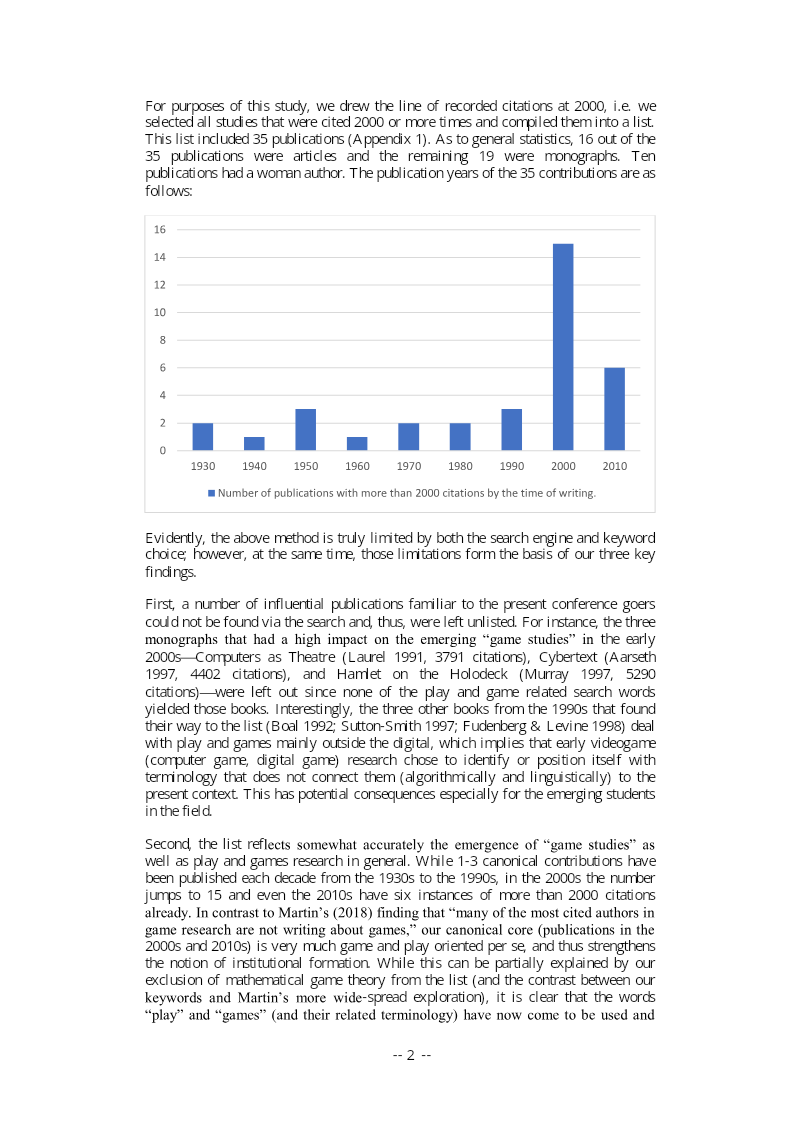
- The study maps the most-cited publications in play and games research, screening Google Scholar, CiteSeer, and Microsoft Academic for works with at least 2,000 citations and arriving at 35 publications (16 articles and 19 monographs), only ten of which had a woman author.
- The canon reflects the institutional emergence of game studies: only one to three canonical works appeared per decade from the 1930s through the 1990s, versus fifteen in the 2000s and six already in the 2010s.
- Recent canonical works are predominantly oriented toward games and play themselves rather than using them metaphorically, marking a shift in the field's focus.
Dwelling in Digital Game Worlds
This paper argues that existing game studies scholarship has characterized the player's spatial existence in digital game worlds as essentially hermetic, meaning path-oriented, transitive, and defined by movement and progression.
- The paper argues that game studies has largely framed players' spatial existence as 'hermetic' (path-oriented, defined by movement and progression), and contends that a 'hestial' (centralizing, homelike) mode of being-in-the-gameworld is also present and deserves recognition.
- The argument draws on Edward Casey's distinction between hestial and hermetic dwelling, along with Heidegger's and Norberg-Schulz's phenomenologies of dwelling, to broaden theoretical understanding of spatial player existence beyond games as spaces to be traversed.
- The paper critically surveys influential theorists, including Aarseth, Gazzard, Calleja, Wolf, and Günzel, whom it interprets as privileging forward movement, while acknowledging exceptions such as Flynn's 'digital hearth,' McGregor's architectural nodal space, and Liboriussen's work on building in Second Life.
Radical Game Fictionalism
This philosophical paper, presented at DiGRA 2019 and written by Grant Tavinor of Lincoln University, examines how games relate to fiction and proposes a position it calls "radical game fictionalism."
- Grant Tavinor (Lincoln University) presents 'radical game fictionalism' at DiGRA 2019, arguing that the connection between games and fiction is more fundamental than previously recognized.
- The paper distinguishes 'gameworld fictionalism' (worlds like Tamriel in The Elder Scrolls are fictional, and tabletop and card games can count as 'ludofictions') from the more ambitious 'radical game fictionalism'.
- Radical game fictionalism borrows from philosophical fictionalism used in mathematics and morality, proposing that talk about games should be understood as fiction rather than literally.
Dawn of Machinic Cyclicality: Life as We Don’t Know
Alexandre Paquet's essay uses the video game Horizon: Zero Dawn as a theoretical text to challenge linear, apocalyptic conceptions of time and human dominance over nature.
- The essay uses Horizon: Zero Dawn as a theoretical text to challenge linear, apocalyptic views of time and human dominance over nature, drawing on Anthropocene, Capitalocene, and Donna Haraway's Chthulucene discourses.
- Its central argument is that the game's 'post-post-apocalyptic' setting reframes the end of humanity as a recurring process of cyclical renewal, not finality, through the Zero Dawn project in which the AI GAIA reseeds life after a robot-driven ecological collapse.
- The analysis supports this reading with Anna Tsing's concept of resurgence within capitalist ruins and Fernand Braudel's longue durée, presenting time in the game as malleable and shaped by agency.
The Politics of Game Canonization: Tales from the Frontlines of Creating a National History of Games
Glas and van Vught's paper examines how the Netherlands Institute for Sound and Vision assembled a national games canon, arguing that canonization is a politically charged process rather than a neutral act of documentation.
- Canonization of national game history is a politically charged act rather than a neutral documentation exercise, and the authors frame the Dutch case through the 'politics of acquisition', where preservation goals and socioculturally driven historiographical aims become entangled.
- The Netherlands Institute for Sound and Vision justified including games in its national collection through its 2016–2020 strategic plan, citing new media's importance for a representative record of Dutch multimedia production, and drew on populist, maturation, and instrumental arguments.
- The initial selection began with a 600-title longlist divided into five-year periods, and the resulting canon blended commercially successful titles with obscure 1980s niche games, shaped by pragmatic archival needs.
Dancing with the Hands: Frictions with Videogames, Dance and Gender
Timothy Snowdon's "Dancing with the Hands" interrogates the claim, advanced by Graeme Kirkpatrick, that all videogame play constitutes a form of dance, and it probes whether dance can serve as a meaningful challenge to the masculine coding long associated with videogame culture.
- Timothy Snowdon argues that the claim that all videogame play is a form of dance conflates distinct concepts: dance, choreography, and dancing must be separated, and a player's agency differs substantively from a trained dancer's.
- Explicit dance titles such as Just Dance and Dance Central engage with dance thematically, but player performance remains interpretive, and players can resist or subvert prescribed movement.
- Videogames are choreographic in that they embed movement scripts that players engage with more malleably than fixed choreography, often without any explicit dancerly intent.
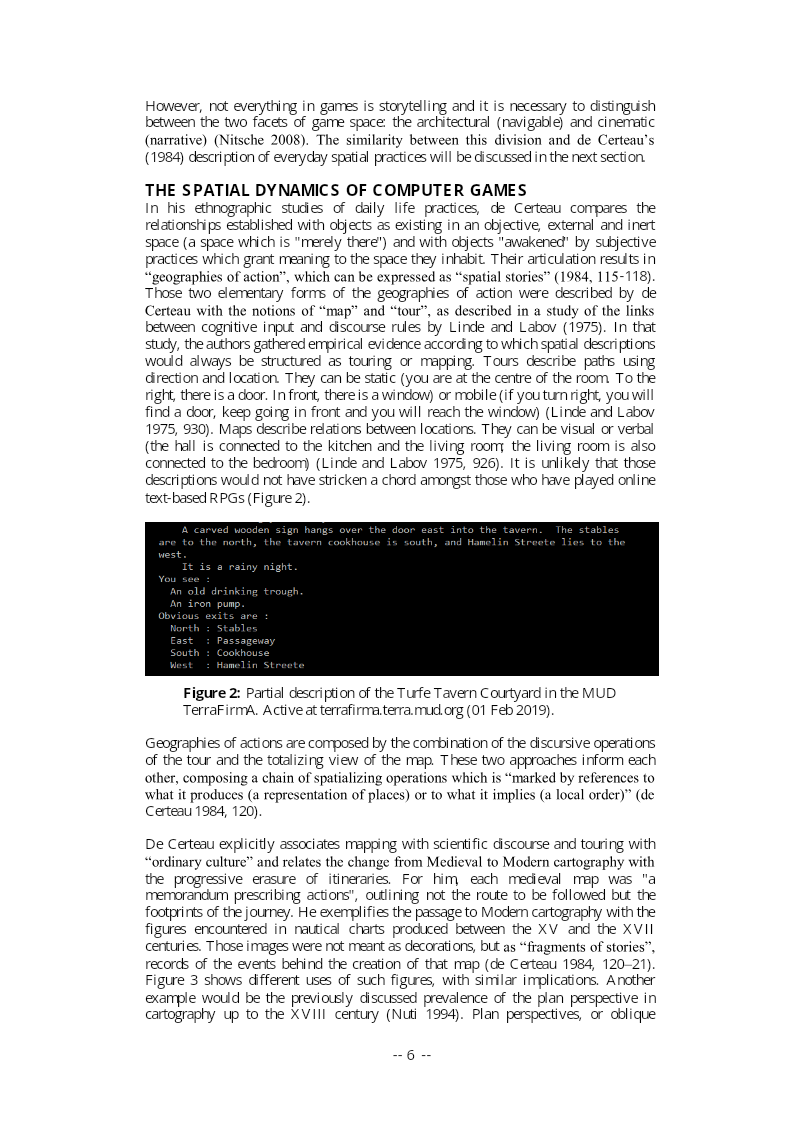
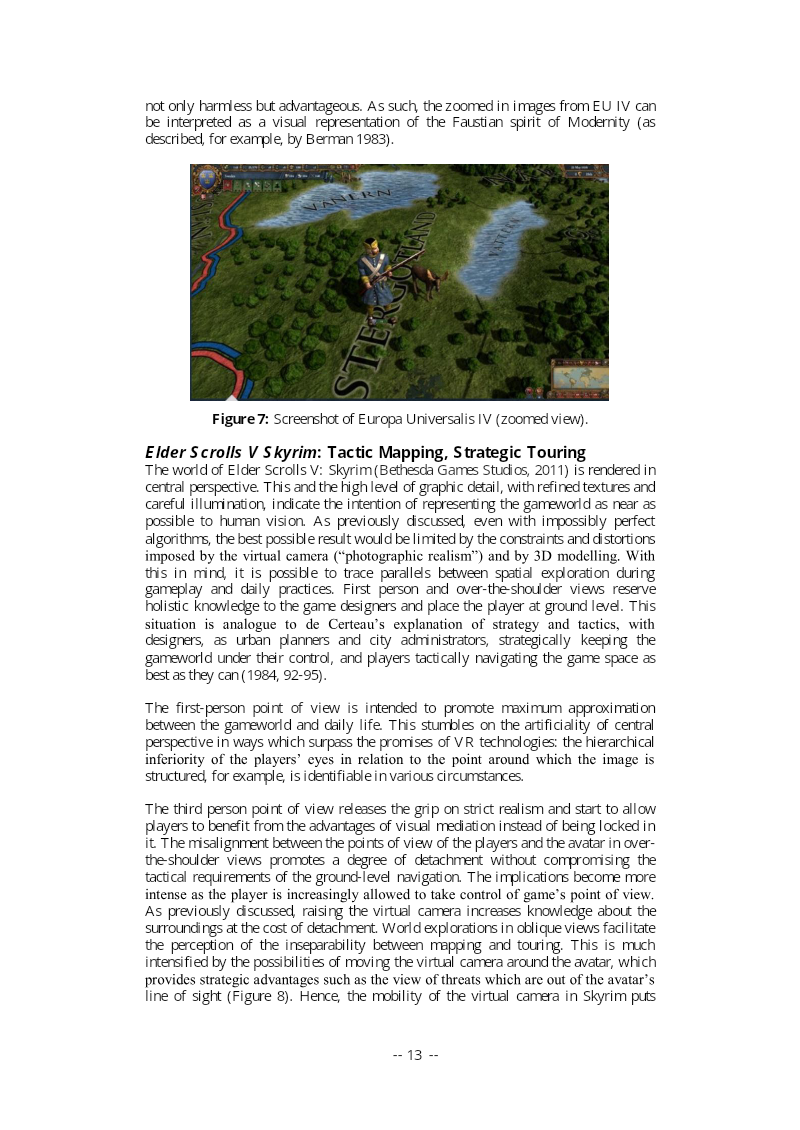
Beyond God's Eye: On the Reliability of Gameworld Images
"Beyond God's Eye" argues that the maps and perspective views found in video games are never neutral reproductions of space.
- Game maps and perspective views are not neutral reproductions of space; they carry Modernist assumptions of homogeneous, infinite Cartesian space and an anthropocentric, externally positioned viewer.
- The paper's central conclusion is that gameworld images make propositions about the spaces they represent rather than simply depicting them.
- Whether games challenge spatial stratification depends on how maps and perspective projections are combined, how synchronous they are, and how much control the player has over the point of view.