Creative Ads reports and market data
Documents
Mobile Dev Memo Podcast, Season 7, Episode 1: GenAI in CTV advertising (with Jonathan Moffie)
Generative AI is fundamentally reshaping the Connected TV (CTV) advertising landscape by dismantling the high financial barriers that historically restricted the medium to large-scale brand advertisers.
- Generative AI is lowering financial barriers to entry for Connected TV (CTV) advertising, allowing smaller, performance-focused businesses to compete alongside large-scale brand advertisers.
- By automating creative asset production and adapting social media content for television, AI is unlocking previously dormant CTV inventory for local and performance-driven marketers.
- The integration of generative AI with ad servers and mobile measurement partners enables real-time optimization of creative variants based on downstream KPIs like app installs and direct purchases.

Why short drama is beating games at Engagement & UA (Holywater's Bogdan Nesvit Explains)
The entertainment landscape is undergoing a fundamental shift as short-form drama platforms emerge as primary competitors to traditional mobile gaming for user attention and acquisition budgets.
- Short-form drama platforms are directly competing with mobile games for user attention and acquisition budgets by utilizing web-based, direct-to-consumer funnels that bypass traditional app store constraints.
- These platforms operate on high-volume production cycles, releasing hundreds of series annually to maintain continuous user acquisition funnels and optimize payback periods.
- Artificial intelligence is the core production engine, enabling the rapid generation of thousands of creative variations that function simultaneously as high-performing advertising assets and narrative content.

2026 Global Mobile Apps Marketing Trends
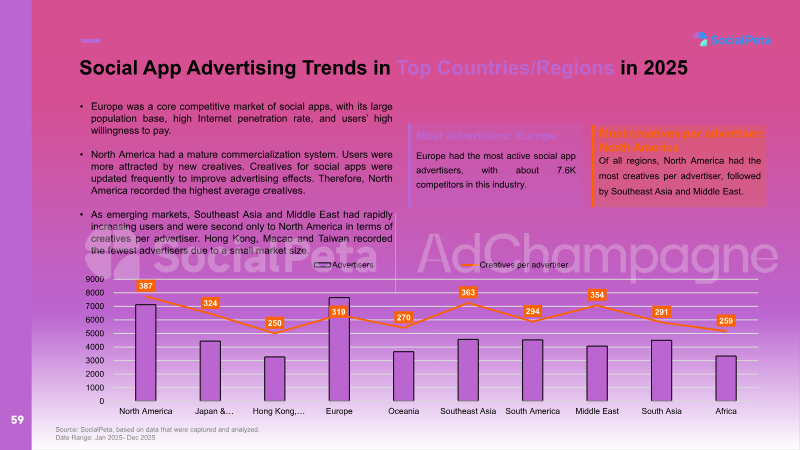
The 2026 mobile marketing landscape is defined by a fundamental transition from media-centric targeting to creative-driven acquisition, necessitated by tightening privacy constraints and the saturation of traditional advertising channels.
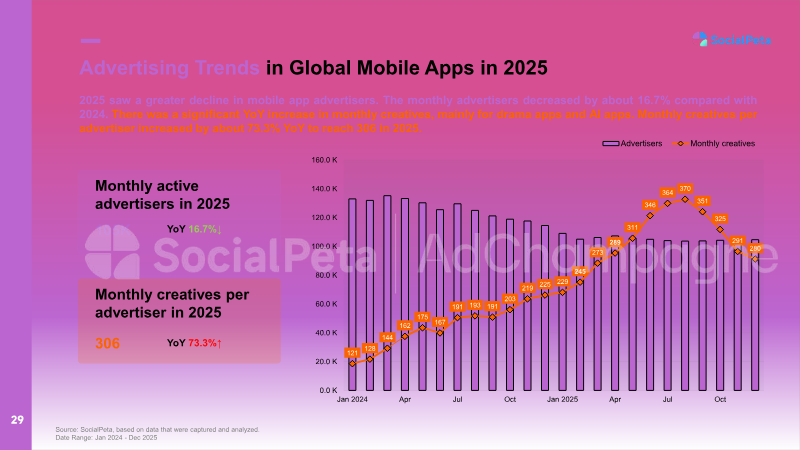
- The mobile marketing landscape has shifted from media-centric targeting to creative-driven acquisition, evidenced by a 73.3% surge in creative output per advertiser alongside a 16.7% decline in the total number of active advertisers.
- Playable ads are currently the top-performing format, consistently delivering the highest conversion metrics, scroll-stop rates, and attention duration.
- The AI application sector underwent a significant contraction in 2025, with the number of active advertisers dropping by 48%.
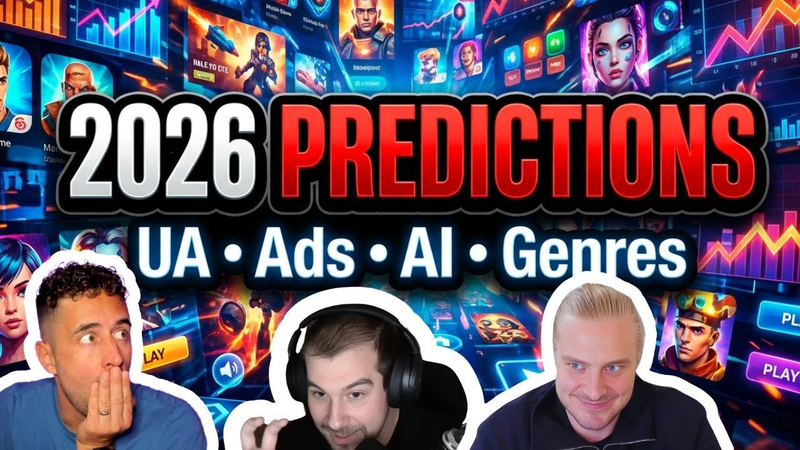
🚀 Our 2026 Mobile Gaming Predictions. No fluff!
The mobile gaming industry is entering a period defined by aggressive efficiency and the strategic replication of successful market trends.
- By 2026, top ad-supported mobile titles are projected to generate $3 million in daily revenue through aggressive monetization strategies.
- Developers are increasingly utilizing web-to-app flows and browser-based playables to qualify users and optimize cost-per-install metrics before driving traffic to app stores.
- Market growth is being driven by the systematic use of genre-skinning and the repurposing of competitor assets to minimize production costs while maximizing user acquisition.
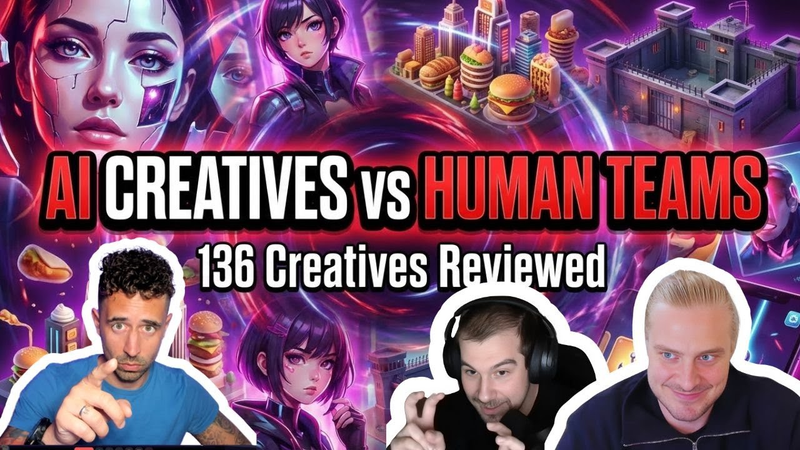
🤖 AI Creative trends November 2025: How to spot AI creative?
The mobile gaming industry is undergoing a fundamental transformation in user acquisition, driven by the rapid adoption of generative artificial intelligence for creative production.
- Generative AI has reached a level of visual fidelity by late 2025 that makes machine-generated content nearly indistinguishable from authentic user-generated content.
- Market viability in mobile gaming now depends on the ability to scale creative assets through prompt engineering and consistent character modeling rather than traditional production standards.
- Developers are prioritizing high-volume iteration and rapid testing, accepting technical flaws like inconsistent physics, lighting artifacts, and anatomical errors as trade-offs for speed and cost-efficiency.

The Art of Scaling games: The Creative arms race
Modern mobile user acquisition is defined by a shift toward creative velocity, where the ability to produce and test massive volumes of advertising assets outweighs reliance on individual artistic talent.
- Top-grossing mobile titles earning over $2 million monthly now produce hundreds of new advertising creatives every month to combat creative fatigue and rising costs per mille.
- Modern user acquisition success is driven by high-volume industrial production pipelines rather than individual artistic talent, as platforms like Meta prioritize new uploads to determine traffic distribution.
- Studios should allocate 10 to 15 percent of their total marketing budget specifically toward creative testing to identify the high-performing assets that drive the majority of impressions.
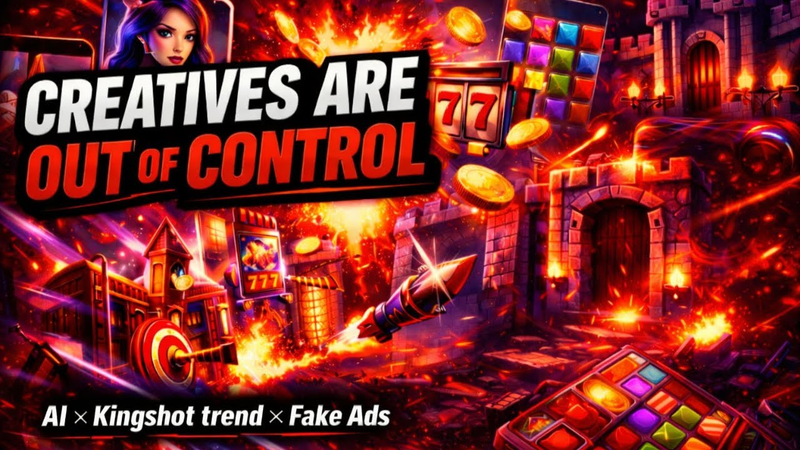
Creative trends November 2025: Players don’t care. Platforms don’t care. Only performance matters.
The mobile gaming industry has transitioned into a performance-first ecosystem where traditional priorities such as gameplay authenticity, creative originality, and ethical branding have been largely abandoned.
- The mobile gaming industry has shifted to a performance-first model where high-frequency ad output and data-driven trend exploitation take precedence over gameplay authenticity or thematic consistency.
- Developers are increasingly utilizing misleading or 'fake' creatives, such as puzzle-based playables that do not represent the actual in-game experience, to drive user acquisition.
- Titles such as King Shot and Whiteout Survival demonstrate the success of cultural mimicry and viral hooks, prioritizing market share capture over alignment between promotional content and the product.
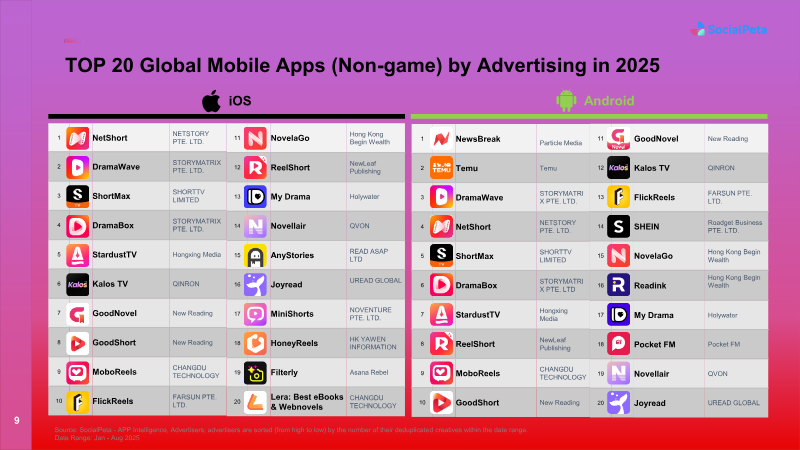
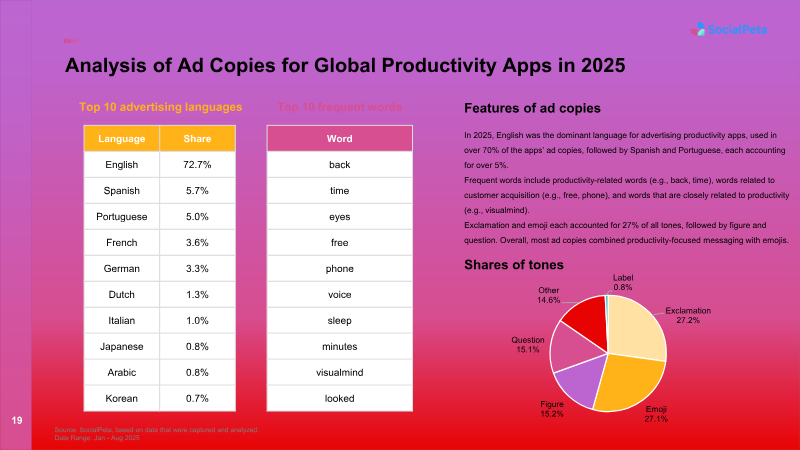
2025 Report on Marketing Trends of Productivity Apps
The report analyzes global marketing activity for productivity apps during the first half of 2025, drawing on a dataset of over 1.6 billion ad creatives from more than 80 channels across 80+ countries.
- The productivity app sector saw a 6% year-over-year decline in active advertisers to 8.9k per month, though new entrants surged to over 30% of the market share following Q2 2025.
- Meta, Google, and TikTok remain the primary channels for cross-platform campaigns, with Google leading in conversion rates and TikTok offering cost-efficient Gen Z engagement at a $3.2 CPM.
- Video and playable ads consistently outperform static creatives, with TikTok favoring 15–60 second native videos and Meta utilizing a combination of carousel and video formats.

H1 2025 AIGC Mobile App Marketing Analysis
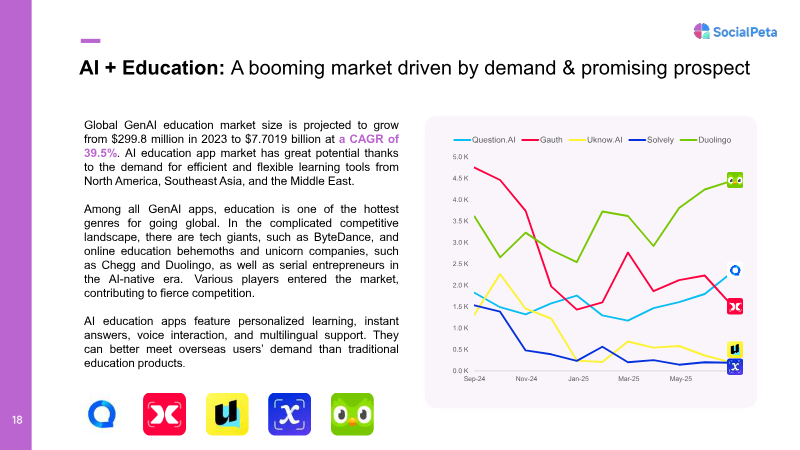
The analysis demonstrates that while the global pool of active AI-advertisers has contracted by 35–45% in H1 2025, the remaining players are compensating with a markedly higher creative output—an 84% increase to an average of 416 monthly creatives per advertiser.
- The number of active AI-advertisers in the mobile market contracted by 35–45% in H1 2025, while the remaining players increased their creative output by 84% to an average of 416 monthly creatives per advertiser.
- Meitu’s revenue grew 12.3% to RMB 1.8 billion in H1 2025, driven primarily by a 45.2% surge in AI-powered imaging and design subscriptions, which reached RMB 1.35 billion.
- Video advertising currently dominates the AI mobile landscape, accounting for 84% of all ads, with over half of inventory utilizing 15–30 second formats.
How to Create Ad Creatives With Open‑Source AI
Mobile game marketing is undergoing a fundamental transformation as the industry pivots toward AI-driven user acquisition.
- By 2026, an estimated 50% of user acquisition (UA) creatives in the mobile gaming industry will be generated using AI.
- Open-source AI models, such as those found on Civitai or utilized via ComfyUI, offer significantly more control over image and video output than 'black box' Western tools like MidJourney or ChatGPT.
- Mastering image generation is the foundational requirement for high-quality creative production, as video generation workflows rely on these initial frames for consistency and style.

Marketing Trends of Finance Apps in 2025
The 2025 landscape for finance applications is defined by a strategic shift toward integrated ecosystem models and the aggressive adoption of artificial intelligence.
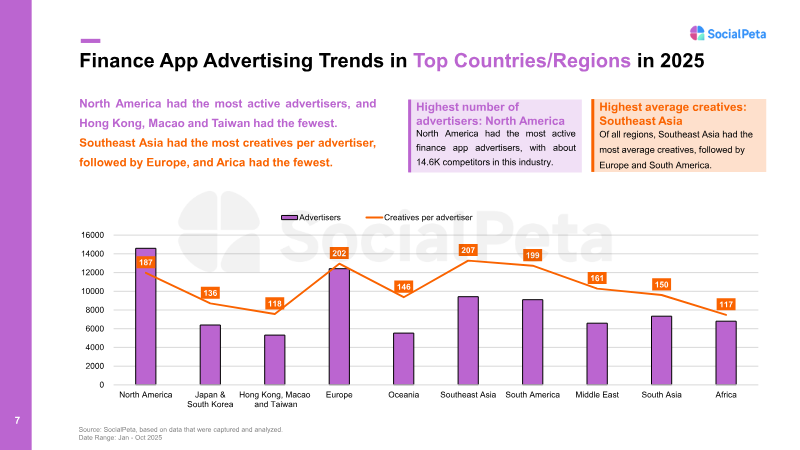
- While the number of monthly active finance app advertisers declined by 3.81% to approximately 13,000 in 2025, marketing intensity surged, with a 23.83% increase in monthly creatives per advertiser.
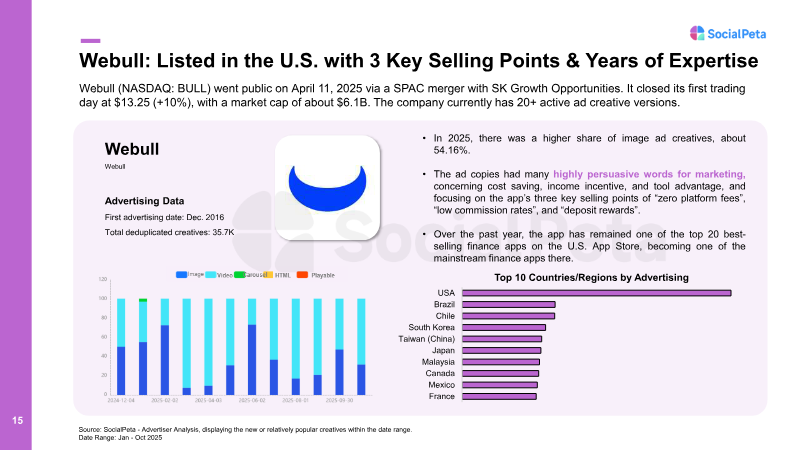
- Finance apps are shifting toward 'super app' ecosystem models that embed financial services into daily activities like e-commerce and ride-hailing to improve user stickiness and data feedback loops.
- AI has transitioned from a supplementary tool to a core business driver, enabling intelligent risk control that has demonstrably reduced default rates.
☠️ Marketability tests are DEAD! Do this instead by Matej Lancaric
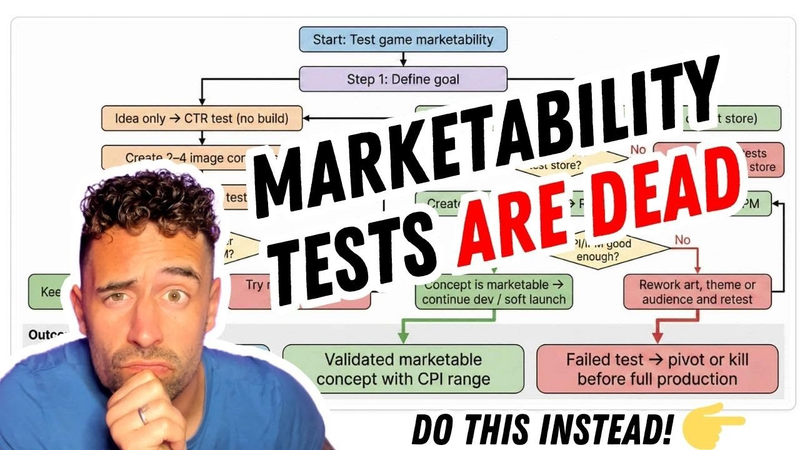
Marketability testing as traditionally practiced is ineffective because it relies on misleading metrics like click-through rates (CTR) rather than actual user acquisition behavior.
- Traditional marketability testing based on click-through rates is ineffective; studios must shift to rigorous cost-per-install (CPI) testing to achieve meaningful market validation.
- Estimated CPIs derived from early-stage testing are typically 1.5 to 2 times lower than the actual CPIs encountered during a full soft launch, a discrepancy that must be factored into financial viability projections.
- To simulate a real user funnel without a functional APK, developers should use landing pages that track 'play now' button clicks as conversion events to optimize Meta ad campaigns.