Showing 30 of 654 results · 0.88s
Jan 2023
Hybridcasual Games Playbook (2023)
Sensor Tower, Homa
much as 35% in specific case studies. The industry scope covers global mobile gaming, with a focus on subgenres including arcade idle, tower defense, and simulation. Methodologically
Report32 pages
Annual Report of the German Games Industry 2024
game – Verband der deutschen Games-Branche e. V.
euros in 2023, marking a 6 percent increase driven largely by hardware sales, mobile gaming, and in-game purchases. Despite this financial expansion and a 52 percent growth
Report41 pages
Jan 2025
Roblox as a Strategic Growth Platform: What Developers Need to Know
Newzoo
creators in a single quarter. While the platform shares structural similarities with mobile gaming—such as an 80% mobile user base and monetization driven by cosmetics and gacha
Report7 pages
Jan 2023
2023 Serbian Gaming Industry Report
SGA
developers like Yboga, Art Bully and Flat Hill Games. Key findings reveal that mobile gaming dominates the revenue landscape, with Android accounting for 60 % of market share
Report73 pages
Jan 2023
From Hyper to Hybrid: Hypercasual Gaming Trends 2023
Tenjin
mobile gaming landscape is undergoing a significant structural shift as developers transition from hyper-casual models toward hybrid-casual strategies. This evolution is driven by a marked decline
Report27 pages
Sep 2021
India Market Update: September 2021
Newzoo
base, and total number of paying users over the next four years. The mobile gaming sector remains a primary driver of market activity, though it faces operational hurdles
Report3 pages
Jan 2020
Level Up: A Guide to Succeed in Asia’s Gaming Market
Newzoo
expanded to 500 million players by 2019 and contributes nearly 40% of total mobile gaming revenue. This shift necessitates more inclusive storylines and diverse development teams to capture
Report62 pages
Jan 2023
2023 Liftoff Company Midcore Gaming Apps Report
Liftoff
midcore mobile gaming market in 2023 is defined by a strategic pivot toward deeper gameplay mechanics and diversified monetization streams, now commanding 35% of total iOS gaming revenue
Report32 pages
Jul 2021
State of Card Battler Mobile Games Report 2021
Sensor Tower
mobile card-battler sub-genre represents a high-growth segment within the broader mid-core strategy market, characterized by strong monetization and increasing global diversification. While mid-core
Report26 pages
Jan 2024
Casual Gaming Apps Report 2024
GameRefinery
mobile gaming landscape is currently defined by a strategic shift toward casual and hybrid-casual experiences, which serve as the primary engine for industry growth and user acquisition
Report40 pages
Jan 2021
Gaming Spotlight 2021: The Year in Review
data.ai
Mobile gaming has solidified its position as the primary driver of digital games consumption, with global spending projected to extend its lead to 2.9 times that of PC/Mac
Report26 pages
Financial Highlights: 1st Quarter of the Fiscal Year Ending March 2012
Koei Tecmo
business line. The report covers Japan‑based operations across five core segments—Game Software, Online & Mobile, Media & Rights, Pachislot & Pachinko, and Amusement Facilities—over the first quarter
Report1 pages
Essential Facts about Video Games in Italy: 2025
IIDEA – Italian Interactive Digital Entertainment Association
full‑game downloads (98 percent of console sales). Subscription services are pivotal: console ecosystem subscriptions contribute 59 percent of total gaming‑subscription revenue (€153 m), with mobile
Report49 pages
Jan 2024
Midcore Gaming Apps Report 2023
GameRefinery, Liftoff
midcore mobile gaming market is undergoing a significant expansion as players increasingly migrate from hyper-casual titles toward games offering greater depth and complexity. Currently accounting
Report32 pages
Financial Highlights: 1st Half of Fiscal Year Ending March 2012
Koei Tecmo
same period a year earlier. The recovery was largely due to Game Software (+34.8 %) and Online & Mobile (+66.4 %). However, Media & Rights, Pachislot & Pachinko, Amusement Facilities, and Other segments
Report1 pages
Jan 2021
The State of Card Battler Mobile Games
Sensor Tower
The report examines the mobile card‑battler sub‑genre, focusing on global market dynamics and
Report26 pages
Jun 2021
RPG Genre Snapshot Report June 2021
GameRefinery
Role-playing games (RPGs) represent a cornerstone of the mobile gaming market, accounting for approximately 14% of total revenue on the US iOS platform
Report19 pages
Mar 2024
Marketing Insights into Global Casual & Puzzle Games for Q1 2024
SocialPeta
global mobile gaming landscape in the first quarter of 2024 is characterized by a significant expansion in the advertiser base, which grew nearly 29% year-over-year
Report33 pages
Jun 2021
RPG Genre Snapshot
GameRefinery
Role-playing games represent a significant pillar of the mobile gaming market, currently holding a 14% revenue share on the US iOS platform. While established titles like Raid
Report19 pages
Dec 2025
Cross-Platform Gaming: Bridging Mobile and PC/Console 2025
Sensor Tower
global gaming landscape in 2025 is defined by a strategic synergy between the accessibility of mobile platforms and the immersive depth of PC and console ecosystems. Mobile serves
Report34 pages
Jan 2026
China WeChat Mini Games Industry Report 2026
Meridian Play, Jinke
games actively running advertisements in 2025, a figure that substantially outpaces traditional mobile game growth. Market data indicates that the Mini Games sector generated RMB 53.535 billion (approximately
Report24 pages
State of Mobile 2025: Why Community Wins on Mobile
Reddit, Adjust, Sensor Tower
from 5 billion in 2019), non‑game spend (in‑app purchase revenue outside gaming climbed $14 billion, a 25% YoY jump), mobile gaming (IAP revenue grew
Report29 pages
Management Policy & Strategy: Fiscal Year Ended March 2013
Koei Tecmo
million‑user social game base. Segment analysis shows Game software as the largest contributor, with Online & Mobile and Media & Rights businesses identified for future rebuilding. Geographically, Japan remains
Report27 pages
Jan 2021
State of Mobile 2021
data.ai
mobile engagement, surpassing live television viewership in the United States. Venture capital followed this momentum, with investments in mobile technology rising 27% to $73 billion. Mobile gaming remained
Report55 pages
Jan 2020
2020 Year in Review: Digital Games and Interactive Media
SuperData
play titles, which accounted for 78% of total digital revenue, largely fueled by mobile gaming in Asian markets. However, the premium games segment saw the most rapid growth
Report22 pages
Jan 2022
The Hyper-Casual Benchmark Report: Q3 2022
Tenjin
hyper-casual mobile gaming sector experienced a notable escalation in acquisition costs during the latter half of 2022, characterized by rising median cost-per-install (CPI) rates across
Report17 pages
Jan 2026
Gaming Deep Dive: Ad Monetization 2026
Sensor Tower
Mobile gaming has structurally reorganized to treat advertising as a foundational revenue model, generating $12 billion annually across 19 global markets. As of 2026, ad-supported titles account
Report39 pages
Jun 2022
Innovative Monetization Features Snapshot Report
GameRefinery
Modern mobile game monetization is increasingly defined by the integration of sophisticated Battle Pass systems and gacha mechanics, which serve as the primary drivers for the industry
Report35 pages
Jan 2023
Global Games Market Report: August 2023
Newzoo
growth signals a stabilization following the post-pandemic market correction of 2022. While mobile gaming remains the largest revenue segment, console gaming serves as the primary catalyst
Report52 pages
The Gaming App Insights Report: 2026 Edition
Adjust
mobile gaming industry is undergoing a fundamental strategic transition, moving away from a reliance on high-volume user acquisition toward a model centered on long-term retention
Report35 pages

Hybridcasual Games Playbook (2023)
Jan 202332 pages4k words
Summary
Hybridcasual gaming represents a strategic evolution in the mobile industry, bridging the gap between the accessibility of hypercasual titles and the sophisticated progression systems of casual games. The primary thesis of this analysis is that by blending simple, intuitive mechanics with deeper metagame layers—such as narrative progression, resource management, and social features—developers can significantly increase user retention, session length, and lifetime value (LTV). This shift addresses the declining interest in traditional hypercasual games, which saw a 15% decrease in downloads between 2021 and 2022, while hybridcasual titles experienced continued growth, reaching 5 billion downloads in 2022.
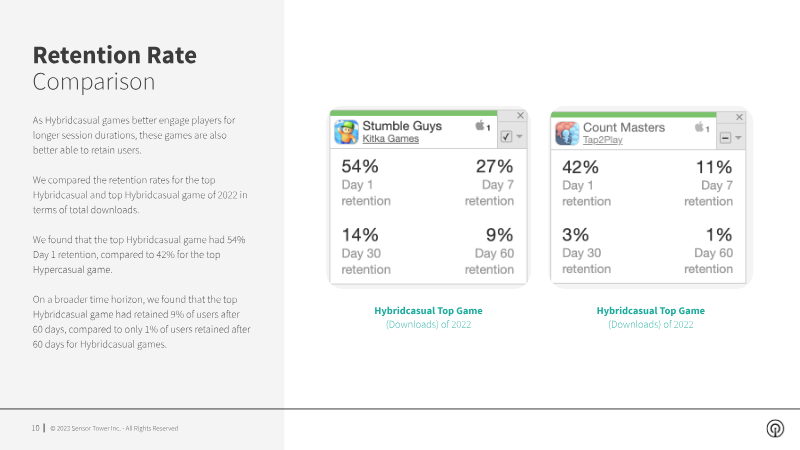
Key performance data highlights the superiority of the hybridcasual model in maintaining player interest. Top-tier hybridcasual games demonstrate average session lengths of 372 seconds, exceeding hypercasual benchmarks by 160 seconds. Furthermore, retention rates are substantially higher, with hybridcasual titles achieving 54% Day 1 retention and 9% Day 60 retention, compared to significantly lower figures for hypercasual counterparts. Revenue models have also matured; while advertisements remain a core component, they are increasingly optional and rewarded, allowing in-app purchases (IAPs) to account for a growing share of total revenue. Successful implementation of IAP strategies, such as secondary currencies and exclusive content packs, has been shown to increase IAP revenue by as much as 35% in specific case studies.
The industry scope covers global mobile gaming, with a focus on subgenres including arcade idle, tower defense, and simulation. Methodologically, the findings rely on comparative performance metrics from 2022, internal product strategy analysis, and specific case studies of titles like Zombie Defense and Aquarium Land. The analysis concludes that long-term success in this segment requires a rigorous, data-driven approach to post-launch optimization, including A/B testing of game economies, audience segmentation, and the continuous integration of new content to sustain player engagement.
Pages



Insights
- Hybridcasual games reached 5 billion downloads in 2022, contrasting with a 15% decline in traditional hypercasual downloads between 2021 and 2022.
- Hybridcasual titles achieve a 54% Day 1 retention rate and a 9% Day 60 retention rate, significantly outperforming traditional hypercasual benchmarks.
- Average session lengths for top-tier hybridcasual games reach 372 seconds, which is 160 seconds longer than hypercasual industry benchmarks.
- Integrating in-app purchase strategies like secondary currencies and exclusive content packs can increase IAP revenue by up to 35%.
- The hybridcasual model shifts revenue dependency away from mandatory advertisements toward optional, rewarded ad formats and increased in-app purchases.
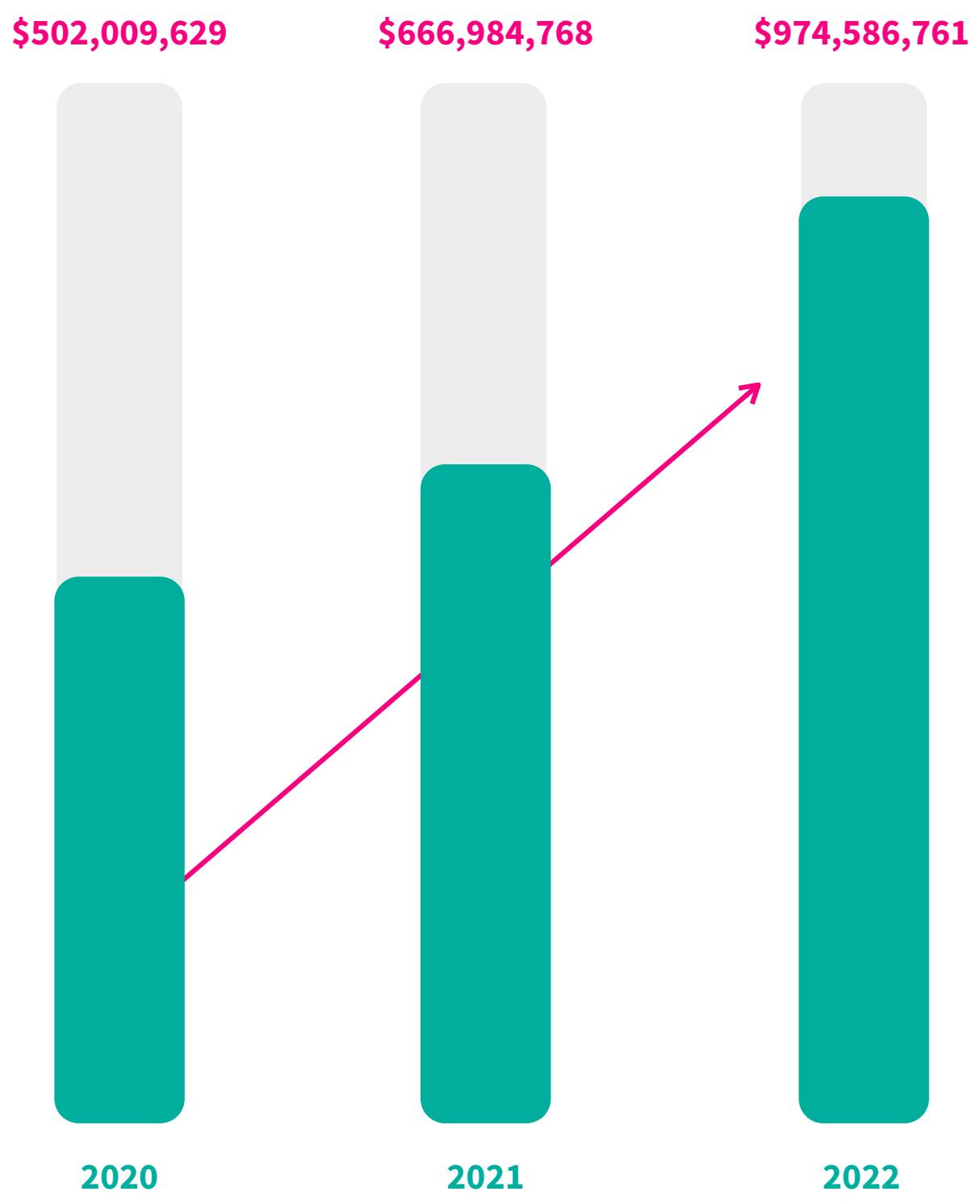
This chart illustrates the year-over-year growth in revenue for a specific sector of the game industry from 2020 to 2022. It shows a clear upward trend, with figures rising from approximately $502 million in 2020 to over $974 million by 2022.