Showing 30 of 156 results · 0.25s
Feb 2026
Southeast Asia Gaming Consumer Economy
Telekom Malaysia, Twimbit
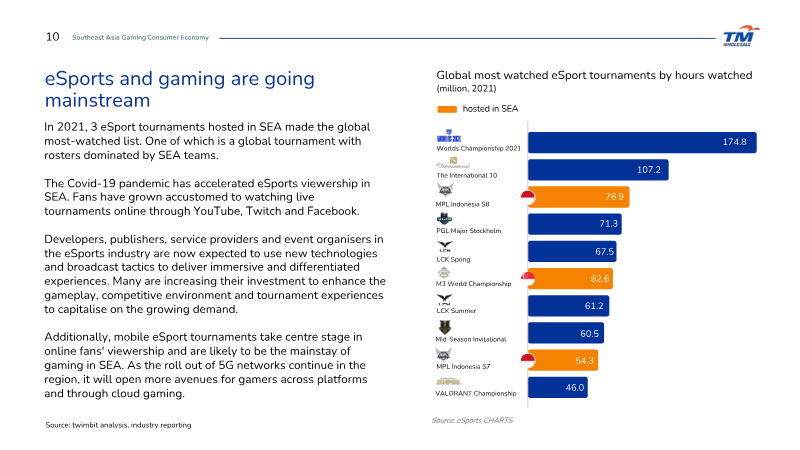
highly spend‑active. eSports viewership is nascent but growing, with SEA tournaments ranking among the world’s most‑watched events; mobile eSports is expected to lead future growth
Report19 pages
Asia Pacific Market Report 2025: Creating Opportunities for Video Games in Asia
GamesBeat, Xsolla
Monster Hunter generating $215 billion in worldwide influence and $178.8 million in IP revenue, while mobile titles like Fate/Grand Order expand overseas earnings. The country’s mature domestic
Report36 pages
Jul 2026
Weekly Gaming Reports Recap: July 6 - July 10, 2026
GameDev Reports
remain a primary hurdle for developers looking to capitalize on browser-based gaming. Esports continues to serve as a critical pillar of industry growth, particularly among
Article1 pages
Nov 2020
Turtle Beach Form 10-Q: Q3 2020
Turtle Beach
Recon 70 and Stealth 600/700 contributing to a 65 % year‑over‑year revenue lift and an improved gross margin of 41 %. Market dynamics are dominated by console
Financial1 pages
Jun 2026
Top Streamers of IEM Cologne Major 2026
Esports Charts
continued to grow, cementing its status as a key event on the 2026 esports calendar. Community casters and streamers were central to the tournament’s success. Ivan “StRoGo
Article1 pages
Sep 2021
VR Game Discovery, Reddit, Trailers & More
GameDiscoverCo
billion when accounting for hardware, development tools, and complementary sectors like esports. In the mobile space, some premium developers are finding success by transitioning older titles to free
Article
Jan 2022
Games, Esports, Live Streaming, Cloud and the Metaverse: 2022
Newzoo
posits that the sector is shifting toward an interconnected, cross-platform ecosystem where revenue diversification and creator-driven engagement models are essential for growth. While consumer skepticism persists
Report30 pages
Mar 2026
Valorant vs. CS: Explaining the Massive 2026 Esports Team Sponsorship Gap
Esports Charts
competitive landscape of professional esports in 2026 reveals a stark divergence in commercialization strategies between Valorant and Counter-Strike. While Counter-Strike teams frequently adopt a high-saturation
Article1 pages
Jan 2024
The Future of UA: 5 of the Best Creator Programs and UA Lessons We Can Learn From Them
Brutally Honest
pivoted toward a "Creator Economy 2.0" model for Fortnite, committing 40% of net revenue to a pool distributed based on player engagement and retention metrics. Roblox similarly supports
Article
Jan 2019
New Party Who Dis?: Gaming as a Broader Vernacular to Reach Voters
SuperJoost
NetEase, and the competitive gaming sector, noted by Walmart’s entry into esports through in-store arenas. Market trends also indicate a transition toward subscription-based models
Article
Consolidated Financial Results: Fiscal Year Ended March 31, 2026
Capcom
surged 49.7 % to ¥10,033 million, supported by long‑term hall operations, global esports events, and media initiatives such as Street Fighter 6 tournaments. Other Businesses sales climbed
Financial24 pages
Jan 2020
Is Twitch Losing the Live Streaming Wars?
SuperJoost
pocketed rivals like Google and Microsoft. Data points indicate that Twitch’s 2019 revenue of approximately $300 million fell significantly short of the $500 million to $600 million
Article
Jan 2021
Newzoo Trends to Watch 2021
Newzoo
This analysis outlines the primary trends shaping the global games, esports, and mobile markets for 2021. The central thesis posits that while the COVID-19 pandemic accelerated engagement
Report23 pages
Feb 2020
Sweeney's Utopia: The Puritan Perspective of Epic Games CEO
SuperJoost
industry, the reality remains a struggle for platform dominance and recurring revenue. The scope of the analysis covers major global players including Apple, Sony, Electronic Arts, and Activision
Article
Feb 2019
What's Next for Sony's PlayStation: New Revenue Models, Content, and Cloud Gaming
SuperJoost
traditional hardware-centric model and the industry-wide shift toward recurring service revenues, cross-platform play, and digital ecosystems. While Sony’s corporate leadership emphasizes expanding services
Article
Jan 2022
Newzoo Trends to Watch 2022: Games, Esports, Live Streaming, Cloud and the Metaverse
Newzoo
The analysis projects that 2022 will be defined by a cautious expansion of emerging monetisation
Report30 pages
Jan 2022
Global White Paper on Mobile Advertising & Marketing Game
Tencent
driven by cross‑platform titles such as Genshin Impact and the rise of esports and metaverse expectations. Geographically, China’s HK/Macau/TW region maintained RPG dominance but broadened
Report106 pages
Esports Business in H1 2026: Four Structural Shifts Reshaping the Industry
Esports Charts
competitive formats through the formalization of national-team play. Events such as the Esports Nations Cup have demonstrated substantial commercial viability, prompting publishers to integrate these international, country
Article1 pages
Jan 2020
Europe and Esports: High Engagement and Even Higher Potential
PayPal
study demonstrates that European esports audiences are expanding rapidly, with a projected 92 million viewers by the end of 2020 and a year‑over‑year growth
Report14 pages
Apr 2026
India’s Gaming Market in 2025
BITKRAFT Ventures, Redseer
which will rise from 43 % of revenue in 2025 to 66 % by 2030, while advertising declines from 57 % to 33 %. Average revenue per paying user (ARPPU) has increased
Article1 pages
Middle East & Africa Gaming Review 2025
Lucidity Insights
Legacy hardware sales remain a key revenue driver, with story‑rich single‑player titles and console sales generating multi‑billion dollar revenues. However, the rise of subscription models
Report52 pages
Feb 2019
Games Are the Antidote to Covid-19
SuperJoost
Game Studios withdraw titles from NVIDIA’s GeForce Now, signaling ongoing disputes over revenue sharing in emerging distribution models. Geographically, the analysis notes significant engagement in the Middle
Article
Jan 2020
Asia Spotlight Report: The Impact of COVID-19 on China’s Video Game Market in Q1 2020
Niko Partners
also forced a rapid evolution in industry operations, particularly within the esports and development sectors. Esports tournaments successfully migrated to online formats, supported by municipal government initiatives
Report21 pages
Jan 2025
Global State of Game Publishing & Marketing 2025 Industry Report
Epic Games
digital-first model, with digital sales accounting for 95% of total revenue. Marketing strategies now prioritize influencer partnerships and transmedia collaborations over traditional retail channels
Report46 pages
Jun 2020
Play Like a Girl: Key Ways to Engage Asia's Growing Female Gaming Audience
Niko Partners
week—their spending power is substantial. Female gamers contributed 35% of mobile gaming revenue in 2019, a figure projected to reach 39% in 2020. Contrary to casual stereotypes
Presentation1 pages
Sep 2026
Southeast Asia’s Gaming Market: 2026
Niko Partners
contribution to total revenue remains modest with spending expected to reach $1.5 billion by 2030. Conversely, Thailand stands out as the region’s primary revenue driver, with player
Article1 pages
Jan 2020
For the Win: Breaking Down the Preferences of Asia's Mobile Gamers
Niko Partners
anime and manga aesthetics, with RPGs accounting for nearly half of its mobile revenue. South Korea leverages its robust 5G infrastructure and "PC bang" culture to sustain
Report22 pages
Jul 2026
FY26/3 Earnings Summary and Mid- to Long-Term Growth Strategies: Japan
Capcom Co.
flywheel business model that utilizes established intellectual property across consumer games, eSports, and media to broaden the global fan base. By leveraging data-driven marketing across 244 countries
Financial42 pages
Apr 2026
Esports Industry Q1 2026: Strategies, Deals & Transformations
Esports Charts
esports industry entered the first quarter of 2026 by transitioning from a speculative, venture-capital-reliant model toward a phase of pragmatic consolidation and commercial maturity. This shift
Article2 pages
Aug 2026
Electronic Arts Delists From Nasdaq as PIF-Led Consortium Closes $55B Buyout
The Esports Advocate
secured and unsecured notes earlier in 2026. While the publisher reported GAAP net revenue of approximately $7.5 billion for fiscal year 2026, the transition marks a significant shift
Article1 pages
Southeast Asia Gaming Consumer Economy
Feb 202619 pages3k words
Summary
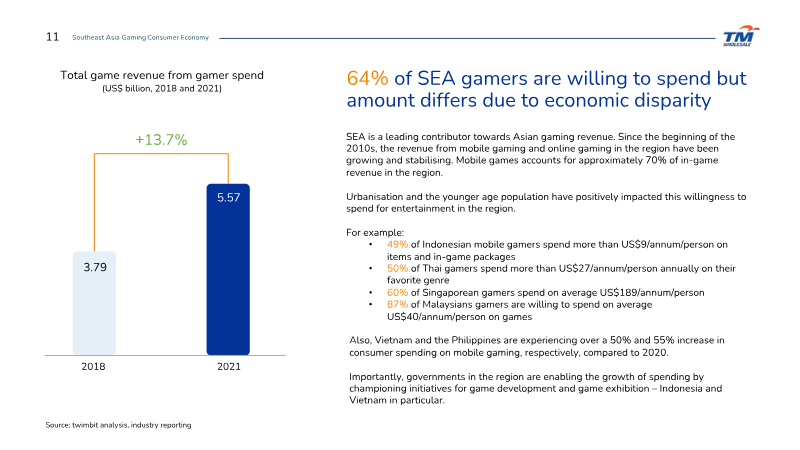
The Southeast Asia Gaming Consumer Economy report, produced jointly by Telekom Malaysia and twimbit in Q2 2022, examines the region’s rapidly expanding gaming market. Six key economies—Indonesia, Malaysia, the Philippines, Singapore, Thailand and Vietnam—account for 85 % of SEA’s gamer population, which is projected to reach 367.8 million by 2025, representing more than half of the region’s total population. Mobile gaming dominates, with 70 % of in‑game revenue and a 13.7 % CAGR in consumer spend from 2018 to 2021, totaling US$5.57 billion. Urbanisation and a youthful demographic drive high willingness to spend, with 64 % of gamers willing to pay; average annual spend varies from US$9 in Indonesia to US$189 in Singapore.
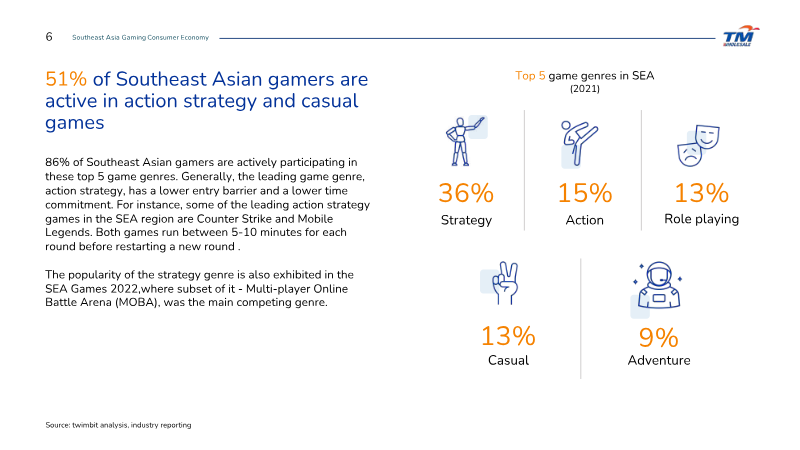
Genre preferences skew toward action, strategy and casual titles; 86 % of players engage in the top five genres. Gender parity is notable, especially on mobile where female gamers constitute 47 % of the market and are highly spend‑active. eSports viewership is nascent but growing, with SEA tournaments ranking among the world’s most‑watched events; mobile eSports is expected to lead future growth as 5G and cloud gaming mature. Monetisation remains dominated by free‑to‑play with in‑app purchases (86 % of revenue), supplemented by hybrid and subscription models.
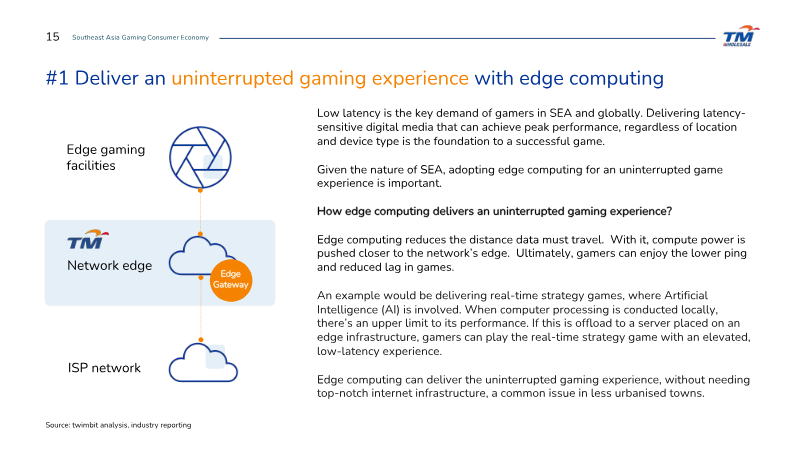
Methodologically, the study synthesises industry interviews, published data, annual reports, and platform analytics. The report recommends that developers adopt edge computing for low‑latency play, deliver cross‑device flexibility, and build scalable cloud architectures to meet the region’s dynamic demand.
Pages
Insights
- The Southeast Asian gaming population is projected to reach 367.8 million by 2025, with Indonesia, Malaysia, the Philippines, Singapore, Thailand, and Vietnam accounting for 85% of the total regional gamer base.
- Mobile gaming is the dominant market force, generating 70% of in-game revenue and achieving a 13.7% CAGR in consumer spending between 2018 and 2021, reaching a total of US$5.57 billion.
- Monetization is heavily reliant on free-to-play models with in-app purchases, which account for 86% of total revenue, though hybrid and subscription models are increasingly utilized.
- 64% of gamers in the region are willing to pay for content, though average annual spending varies significantly by market, ranging from US$9 in Indonesia to US$189 in Singapore.
- Gender parity is high in the mobile sector, where female gamers represent 47% of the market and demonstrate high levels of spending activity.
Global most watched eSport tournaments by hours watched (million, 2021)