
Report7 pages
Audio Ad Engagement in Mobile Games
This analysis examines the efficacy of in-game audio advertising as a non-intrusive alternative to traditional video and banner formats within the mobile gaming industry. The primary thesis posits that audio ads maintain player engagement and retention by allowing gameplay to continue uninterrupted, thereby fostering a more positive brand association compared to conventional, disruptive advertising models.
Research findings are derived from a combination of market surveys and behavioral testing. A YouGov survey of 2,200 respondents highlights that 86% of UK adults dislike video ads, while 28% identify audio ads as their preferred monetization model. Behavioral testing conducted by Go Live Test confirms that 100% of participants continued playing during audio ad delivery and achieved 100% brand recall when ads were paired with a companion banner. Furthermore, the data indicates a significant engagement advantage, with audio ads achieving a click-through rate (CTR) of approximately one click per 1.4 listens, vastly outperforming the 0.08% average CTR typical of static banners.
The effectiveness of this format is further validated by a Warner Music Group case study targeting 18-to-30-year-olds in the United States. The campaign achieved a 1.78% CTR—representing a 1,000% increase over traditional banner standards—and an ad completion rate exceeding 75%, significantly higher than the 4% to 8% industry standard for skippable video ads. Additionally, the campaign recorded a 1.8% bounce rate on the destination page, suggesting high intent among users who engaged with the audio format.
These findings suggest that audio advertising offers a viable solution for developers and brands seeking to monetize a global audience of 2.8 billion mobile gamers without compromising the user experience. By integrating seamlessly into the background of gameplay, audio ads mitigate the frustration associated with screen-blocking video ads, ultimately driving higher engagement and more favorable brand outcomes.
- Audio ads achieve a click-through rate (CTR) of approximately one click per 1.4 listens, vastly outperforming the 0.08% average CTR of static banners.
- A Warner Music Group campaign targeting 18-to-30-year-olds achieved a 1.78% CTR, representing a 1,000% increase over traditional banner standards.
- Behavioral testing shows 100% of participants continued gameplay during audio ad delivery, with 100% brand recall when ads were paired with a companion banner.
- The Warner Music Group campaign recorded an ad completion rate exceeding 75%, significantly higher than the 4% to 8% industry standard for skippable video ads.
- A YouGov survey of 2,200 UK adults found that 86% of respondents dislike video ads, while 28% prefer audio ads as a monetization model.
+4
AudioMobJan 2021
Whitepaper63 pages
White Paper on Global Mobile Games 2021
The 2021 mobile gaming landscape was defined by a transition toward creative-led advertising strategies necessitated by rising acquisition costs and shifting privacy regulations. As iOS privacy changes prompted a strategic pivot toward Android platforms, the industry experienced a 200% surge in ad creatives and a 34% year-over-year increase in CPMs on major platforms like Meta. With the United States emerging as the most expensive market at an average CPM of $28.18, advertisers increasingly prioritized data-driven optimization and regional targeting to maintain return on investment amidst a broader 5% slowdown in total advertiser market growth.
While casual and puzzle games maintained the highest volume of individual advertisers globally, RPGs consistently dominated in total creative output across key regions, including Southeast Asia, Hong Kong, Macao, and Taiwan. To combat market saturation, developers shifted toward high-engagement formats, specifically vertical video ads exceeding 30 seconds and playable end cards. These creative strategies, often incorporating celebrity endorsements and real-people trailers, became essential tools for driving conversions in a competitive environment where traditional tracking methods faced significant headwinds.
Looking toward future growth, the industry is increasingly focused on globalization and the refinement of hybrid monetization models. Developers are diversifying revenue streams by integrating NFTs and combining traditional in-app purchases with ad-based structures. Furthermore, the adoption of privacy-compliant user acquisition, such as early SKAN testing and AI-driven optimization, has become a prerequisite for success. As companies expand into emerging markets like the Middle East and the CIS, the combination of M&A activity, social feature integration, and sophisticated monetization frameworks will remain central to navigating the complexities of the post-privacy mobile ecosystem.
- Rising acquisition costs and iOS privacy regulations triggered a 200% surge in ad creatives and a 34% year-over-year increase in CPMs on platforms like Meta.
- The United States became the most expensive market for mobile advertising, reaching an average CPM of $28.18.
- Total advertiser market growth slowed by 5% in 2021, forcing developers to prioritize data-driven optimization and regional targeting to protect ROI.
- While casual and puzzle games lead in advertiser volume, RPGs dominate total creative output in key regions including Southeast Asia, Hong Kong, Macao, and Taiwan.
- Developers are countering market saturation by adopting high-engagement formats, such as vertical video ads longer than 30 seconds and playable end cards featuring celebrity endorsements.
+4
SocialPetaJan 2021
Presentation44 pages
1Q FY2021 Presentation Material: October to December 2020
CyberAgent achieved record-high consolidated sales of 131 billion yen during the first quarter of fiscal year 2021, representing a 13.3% year-over-year increase. This growth was primarily propelled by the Media and Advertising segments, offsetting a temporary downturn in the Game business. While the Game segment saw revenue decline 15% to 29.9 billion yen and operating profit drop 77.8% due to seasonal factors and elevated marketing expenditures, the company maintained a strong financial foundation with 252 billion yen in total assets. This performance establishes a solid trajectory toward meeting full-year targets despite the mixed results across different business units.
The Media segment emerged as a significant growth engine, with ABEMA driving a 67% surge in revenue to 20.4 billion yen. This expansion was supported by a premium subscriber base exceeding 921,000 users and an elevenfold increase in transaction volume for the WINTICKET platform. To capitalize on this momentum, the company restructured ABEMA into distinct Free and Premium business units. Simultaneously, the Game business prepared for a recovery through the high-profile launches of titles such as Uma Musume Pretty Derby and NieR Re[in]carnation, signaling a strategic focus on high-quality content to stabilize future earnings.
Corporate strategy remains centered on governance and technological adaptation within the Japanese market. The organizational structure utilizes a clear distinction between supervision and execution, supported by a board of eight directors that includes significant outside representation. By emphasizing environmental data disclosure and the integration of artificial intelligence within advertising and media functionality, the company aims to align with modern ESG standards. These initiatives, framed within the context of the New Normal, reflect a commitment to long-term sustainability and operational agility in a rapidly evolving digital landscape.
- CyberAgent achieved record-high consolidated sales of 131 billion yen in 1Q FY2021, a 13.3% year-over-year increase driven by strong performance in the Media and Advertising segments.
- The Media segment grew revenue by 67% to 20.4 billion yen, bolstered by ABEMA’s premium subscriber base exceeding 921,000 users and an elevenfold increase in WINTICKET transaction volume.
- The Game business experienced a 15% revenue decline to 29.9 billion yen and a 77.8% drop in operating profit, attributed to seasonal factors and increased marketing spend.
- To drive future earnings recovery, the company is focusing on high-quality content launches, specifically Uma Musume Pretty Derby and NieR Re[in]carnation.
- Management restructured ABEMA into separate Free and Premium business units to better capitalize on current growth momentum.
+1
CyberAgentJan 2021

Report93 pages
2021 H1 Global Mobile App Marketing Whitepaper
The global mobile marketing landscape experienced a massive surge in activity during the first half of 2021, characterized by a 108% year-on-year increase in advertising creatives totaling over 19 million. This growth was primarily driven by hard-core gaming titles and a significant expansion in the non-game sector, where creatives rose 38% to 47.6 million. Despite this volume increase, Apple’s IDFA policy changes caused a 13% decline in the share of iOS creatives, shifting more focus toward Android platforms. Geographically, the United States remained the largest advertising market, while Oceania emerged as the fastest-growing region for non-game advertisers.
Chinese companies solidified their global dominance during this period, accounting for 70% of top-charting mobile game media buying and over 25% of the total global market share. These developers maintained a particularly strong presence on major social platforms, representing 100% of the top ten advertisers on Facebook’s News Feed. However, this increased competition contributed to a sharp rise in acquisition costs, with Facebook’s average CPC and CPM both climbing 128% year-over-year. RPG and Puzzle genres led in total creative volume, while Strategy games exhibited the highest media buying intensity per advertiser.
Marketing strategies have evolved toward high-engagement, "snackable" short-form video content and influencer-led campaigns to combat rising costs and privacy-related tracking challenges. In the gaming sector, creative tactics shifted toward live-action footage and gameplay extensions, while non-game apps—particularly in the education and shopping sectors—capitalized on pandemic-related lifestyle shifts. As the industry navigates the post-IDFA era, the integration of high-quality in-game ads and diverse creative formats has become essential for maintaining user retention and driving monetization across both domestic Chinese and international markets.
- Chinese developers dominated the global market in 2021 H1, accounting for 70% of top-charting mobile game media buying and 100% of the top ten advertisers on Facebook’s News Feed.
- Advertising costs surged significantly, with Facebook’s average CPC and CPM increasing by 128% year-over-year due to heightened competition.
- Apple’s IDFA policy changes triggered a 13% decline in the share of iOS advertising creatives, forcing a strategic shift in focus toward Android platforms.
- Total advertising creatives for hard-core gaming and non-game sectors saw massive growth, with non-game creatives rising 38% to 47.6 million and total creatives increasing 108% year-on-year to over 19 million.
- Strategy games exhibited the highest media buying intensity per advertiser, while RPG and Puzzle genres led the industry in total creative volume.
+1
SocialPetaJan 2021
Report30 pages
Mobile Ad Creative Report: August 2021
Mobile gaming creative trends in August 2021 centered on humanizing digital experiences and leveraging high-profile cultural partnerships. Analysis of top-performing ads across platforms like YouTube, Instagram, Snapchat, and Facebook reveals a heavy reliance on real-world celebrities, particularly musicians. Notable examples include Garena Free Fire featuring DJs Dimitri Vegas & Like Mike as playable characters and Call of Duty Mobile partnering with artist Ozuna. These collaborations often utilize cinematic storytelling and high-fidelity animations to bridge the gap between gaming and mainstream entertainment.
The industry continues to utilize specific psychological triggers and visual formats to drive engagement. Fail-state elements, where ads demonstrate a player losing a level to pique viewer interest, remain prevalent in titles like Royal Match and Evony. Additionally, hyper-casual games are increasingly adopting popular music soundtracks and expressive callouts to appeal to younger demographics on Snapchat. Other emerging visual trends include split-screen layouts, the use of Bitmojis, and "search bar" call-to-actions that visually demonstrate how to find the app in stores.
Geographically, the findings cover global releases with specific performance data from major ad networks including ironSource, Applovin, and Vungle. The scope encompasses diverse genres, from mid-core shooters and RPGs to hyper-casual and puzzle games. Methodology involves ranking creatives based on their performance and visibility across social media and ad networks during the August 2021 period. Conclusions suggest that successful creatives are moving away from pure gameplay footage in favor of narrative-driven content, anniversary themes, and interactive elements like Buzzfeed-style quizzes or "Christmas in July" promotions.
- Mobile gaming ads in August 2021 shifted toward high-fidelity, narrative-driven content featuring real-world celebrity partnerships, such as Garena Free Fire’s collaboration with Dimitri Vegas & Like Mike and Call of Duty Mobile’s integration of Ozuna.
- Top-performing creatives are increasingly moving away from pure gameplay footage in favor of cinematic storytelling, anniversary-themed promotions, and interactive elements like Buzzfeed-style quizzes.
- Psychological triggers remain a core engagement strategy, with 'fail-state' ads—demonstrating a player losing a level—continuing to drive performance for titles like Royal Match and Evony.
- Hyper-casual games are targeting younger demographics on platforms like Snapchat by integrating popular music soundtracks and expressive visual callouts.
- Emerging visual design trends for mobile ads include the use of split-screen layouts, Bitmojis, and 'search bar' call-to-actions that provide users with direct visual instructions on how to locate apps in stores.
+1
Sensor TowerJan 2021
Report30 pages
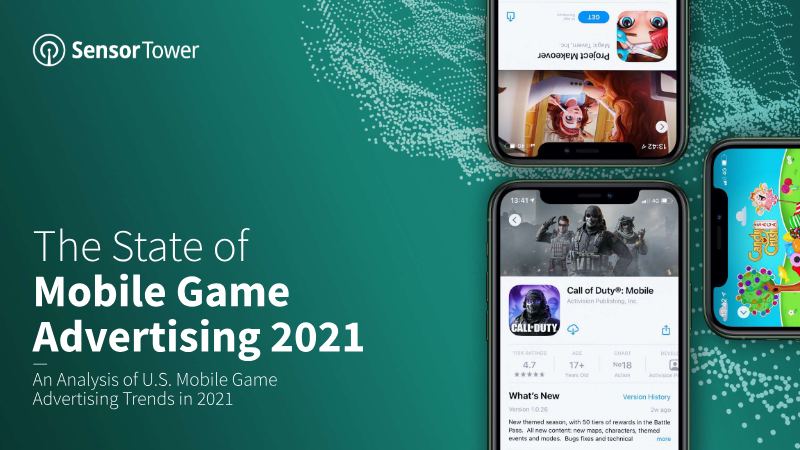
The State of Mobile Game Advertising: An Analysis of U.S. Mobile Game Advertising Trends in 2021
Mobile game advertising in the United States remained resilient through the first half of 2021, showing no immediate negative impact from privacy changes such as the deprecation of IDFA. Analysis of the advertising landscape reveals a strategic divide between ad networks. Specialized platforms like AppLovin, Chartboost, and Vungle maintain a high concentration of gaming content, often exceeding 90 percent share of voice. In contrast, diversified platforms like Facebook, TikTok, and YouTube maintain a more balanced split between gaming and non-gaming advertisements, serving as critical channels for reaching broader audiences.
Market trends indicate that ad network selection is increasingly driven by genre and demographic alignment. Puzzle and Hypercasual games dominate gaming-focused networks, while mid-core genres like Strategy and Shooter find higher engagement on social platforms like YouTube and Instagram. Notably, Adcolony emerged as a primary hub for Casino games, catering to an older, female-leaning demographic. Across most platforms, video remains the dominant creative format, though playable ads have gained significant traction, particularly on AppLovin where they account for over 40 percent of gaming share of voice.
Creative strategies are evolving to include "fake playables," relaxing music for casual titles, and real-world testimonial-style conversations. Even mid-core titles with complex mechanics, such as Call of Duty: Mobile, have begun adopting simplified playable "mini-games" to lower the barrier for user acquisition. This data, compiled by Sensor Tower using its Ad Intelligence platform, covers U.S. trends across iOS and Android from 2018 through the second quarter of 2021, suggesting that success in the current market requires a sophisticated mix of genre-specific network targeting and experimental creative formats.
- Mobile game advertising in the U.S. remained resilient through H1 2021, showing no immediate negative impact from the deprecation of IDFA.
- Playable ads have become a dominant creative format, accounting for over 40 percent of the gaming share of voice on AppLovin.
- Specialized ad networks like AppLovin, Chartboost, and Vungle maintain a gaming-focused inventory exceeding 90 percent share of voice, while platforms like Facebook, TikTok, and YouTube provide broader audience reach.
- Ad network selection is increasingly genre-specific, with Puzzle and Hypercasual games favoring gaming-focused networks, while Strategy and Shooter titles find higher engagement on social platforms like YouTube and Instagram.
- Adcolony has established itself as a primary hub for Casino games, effectively targeting an older, female-leaning demographic.
+1
Sensor TowerJan 2021

Report15 pages
The African Mobile Apps Landscape (2021)
The African mobile app market experienced a period of rapid acceleration between Q1 2020 and Q1 2021, driven by a young, mobile-first population and the unique conditions of the COVID-19 pandemic. Analysis of 6,000 apps and 2 billion installs across South Africa, Nigeria, and Kenya reveals that overall app installs grew by 41% during this period. Nigeria led this growth with a 43% increase, while South Africa saw the most immediate surge in downloads following strict lockdown measures.
The gaming sector proved particularly resilient, with installs jumping 50% in Q2 2020 as consumers sought home entertainment. This trend extended to monetization, as in-app advertising revenue surged by 167% between Q2 2020 and Q1 2021. Furthermore, in-app purchasing revenue peaked in Q3 2020, accounting for one-third of the year's total revenue. While Android remains the dominant platform with a 54% increase in non-organic installs, iOS also showed growth despite a 21% rise in cost-per-install.
Several structural trends define the current landscape, including the rise of fintech apps addressing the needs of unbanked populations and the emergence of super apps that consolidate multiple services to overcome device storage limitations. Despite this progress, challenges remain regarding connectivity, as mobile internet adoption in Sub-Saharan Africa stands at 26%, well below the global average. To succeed, marketers are encouraged to move toward a multi-moment maturity model by integrating durable measurement foundations, focusing on high-value user acquisition, and utilizing remarketing strategies to drive long-term engagement.
- Between Q1 2020 and Q1 2021, mobile app installs across Nigeria, South Africa, and Kenya grew by 41%, with Nigeria leading the growth at 43%.
- The gaming sector saw a 50% jump in installs during Q2 2020, while in-app advertising revenue for gaming surged by 167% between Q2 2020 and Q1 2021.
- In-app purchasing revenue for gaming peaked in Q3 2020, contributing one-third of the total annual revenue.
- Android remains the dominant platform with a 54% increase in non-organic installs, while iOS growth persists despite a 21% rise in cost-per-install.
- Market growth is driven by fintech apps serving unbanked populations and the adoption of super apps designed to mitigate device storage limitations.
+2
AppsFlyerJan 2021

Presentation54 pages
FY2020 Presentation Material
CyberAgent achieved record-high financial performance in fiscal year 2020, reporting consolidated sales of 478.5 billion yen and an operating profit of 33.8 billion yen. These results represent year-over-year increases of 5.5% and 9.9% respectively, surpassing initial forecasts despite the operational challenges posed by the global pandemic. Growth was primarily catalyzed by the Game business, which generated 155.8 billion yen in sales. This segment benefited from the sustained performance of legacy titles and the successful launch of Project SEKAI, which acquired over two million users within its first three weeks.
The Media business, centered on the ABEMA streaming platform, remains a critical pillar for long-term expansion. ABEMA experienced a 22.6% increase in annual sales to 57 billion yen, supported by a cumulative download base exceeding 59 million. While the segment continues to operate at a loss of 18.5 billion yen due to aggressive up-front investments, these losses are narrowing as new monetization streams mature. Specifically, the rapid adoption of Pay-Per-View services and a seventeen-fold increase in transaction volume for the WINTICKET cycling betting service have diversified the platform's revenue model beyond traditional advertising.
Looking toward fiscal year 2021, the strategic focus shifts toward scaling consolidated sales to 500 billion yen while maintaining a robust financial position. To manage this growth, a new governance structure has been implemented to separate management oversight from execution. Although increased selling, general, and administrative expenses led to a quarterly dip in operating profit during the final months of 2020, the overall trajectory remains positive. The combination of a highly profitable gaming portfolio and the accelerating monetization of digital media assets positions the organization for sustained domestic leadership in the Japanese internet services market.
- CyberAgent achieved record FY2020 performance with 478.5 billion yen in sales and 33.8 billion yen in operating profit, marking year-over-year growth of 5.5% and 9.9% respectively.
- The Game business served as the primary growth engine, generating 155.8 billion yen in sales driven by legacy titles and the successful launch of Project SEKAI, which reached two million users in three weeks.
- The Media segment, anchored by ABEMA, grew annual sales by 22.6% to 57 billion yen, supported by a cumulative base of over 59 million downloads.
- Despite an 18.5 billion yen operating loss in the Media segment due to aggressive investment, monetization is diversifying through Pay-Per-View services and a seventeen-fold increase in transaction volume for the WINTICKET cycling betting service.
- CyberAgent has set a consolidated sales target of 500 billion yen for FY2021 and implemented a new governance structure to separate management oversight from operational execution.
+1
CyberAgentOct 2020

Report82 pages
Annual Report 2020
Games Workshop achieved record-breaking financial results for the 2019/20 fiscal year, demonstrating significant resilience despite the operational disruptions caused by the COVID-19 pandemic. Annual revenue rose 5.1% to £269.7 million, while profit before tax reached £89.4 million. This performance marks the fourth consecutive year of record growth, driven primarily by a robust trade segment—which now accounts for 52% of total revenue—and a substantial increase in royalty income from licensing agreements in the video game and media sectors.
The company’s strategic focus remained on the global expansion of its Warhammer intellectual property and the modernization of its industrial infrastructure. Significant capital investments totaling £18 million were directed toward production and logistics expansions in Nottingham and North America, alongside the implementation of a new ERP system. While physical retail sales declined by 11% due to pandemic-related store closures, digital engagement and online sales saw marked growth. The company also successfully navigated the transition to IFRS 16 accounting standards, which brought £32.1 million in lease liabilities onto the balance sheet.
Geographically, North America remains the company's largest market, contributing £104.8 million to total revenue. Despite the economic uncertainties of the pandemic and Brexit, the Group maintained a strong liquidity position, ending the period with £52.9 million in cash and no utilized borrowing facilities. This financial stability allowed the board to maintain its commitment to shareholders through dividends of 145 pence per share and to support its workforce by providing full pay during shutdowns and distributing profit-share bonuses to all staff. The report concludes with a focus on long-term sustainability, ethical sourcing, and continued IP exploitation to ensure future viability.
- Games Workshop achieved record-breaking financial results for the 2019/20 fiscal year, with revenue rising 5.1% to £269.7 million and profit before tax reaching £89.4 million.
- The trade segment now accounts for 52% of total revenue, supported by a significant increase in royalty income from video game and media licensing.
- North America remains the company's largest market, contributing £104.8 million to total revenue despite pandemic-related operational disruptions.
- The company invested £18 million in capital projects, including production and logistics expansions in Nottingham and North America and the implementation of a new ERP system.
- Physical retail sales declined by 11% due to pandemic-related closures, though this was offset by growth in digital engagement and online sales.
+1
Games Workshop GroupAug 2020
Report14 pages
Rapport Annuel 2019 Entertainment
The 2019 annual report of the Canadian Entertainment Software Association (ALD) outlines the organization’s role as the principal advocate for Canada’s video‑game sector, emphasizing a strategic focus on member‑first principles, regulatory advocacy, and public perception. Central to its thesis is the conviction that a coordinated, policy‑friendly environment and heightened visibility of the industry’s economic contribution will sustain long‑term growth.
Key findings highlight a robust domestic market, with more than 23 million Canadians identified as regular gamers through a 2018 NPD Group survey that captured demographic, console usage and purchasing patterns. The “Jeux vidéo sur la Colline” event drew a record 250 participants, including 25 federal legislators, and featured leading publishers such as Ubisoft, Nintendo, EA and Xbox, underscoring the sector’s political engagement. ALD’s lobbying efforts included testimonies before multiple parliamentary committees and direct dialogue with Minister Navdeep Bains, reinforcing support for tax‑credit frameworks and innovation policies. Internationally, the association participated in the Global Video Game Associations Summit in Santa Monica, addressing issues like loot‑box regulation and the WHO’s inclusion of gaming disorder in ICD‑11.
Operational highlights for 2019 include the appointment of a new director of policy and a director of communications, a targeted media campaign that secured coverage in four major Canadian newspapers, and the launch of bilingual parental‑control tutorials in partnership with console manufacturers. Membership remained stable while two prominent publishers, Codename Entertainment and Kabam, joined the association, reflecting continued expansion of the member base. Overall, the report demonstrates ALD’s comprehensive advocacy, research, and outreach activities aimed at strengthening Canada’s video‑game ecosystem during the fiscal year.
- The Canadian video-game market remains robust, with a 2018 NPD Group survey identifying over 23 million regular gamers in Canada.
- The Entertainment Software Association (ALD) successfully engaged 25 federal legislators and major industry players including Ubisoft, Nintendo, EA, and Xbox during the 'Jeux vidéo sur la Colline' event.
- Lobbying efforts focused on securing tax-credit frameworks and innovation policies through direct dialogue with Minister Navdeep Bains and testimonies before parliamentary committees.
- The association expanded its membership base in 2019 by adding publishers Codename Entertainment and Kabam.
- ALD addressed international regulatory challenges, specifically loot-box legislation and the WHO’s classification of gaming disorder in the ICD-11, at the Global Video Game Associations Summit.
ESAC – Entertainment Software Association of CanadaJan 2019
Report62 pages
MTG Corporate Responsibility Report 2015
In 2015 the media group placed corporate responsibility at the core of its strategy, integrating ethical governance, sustainability and gender‑parity objectives across a global operation that spans 165 countries and includes broadcast, content localisation and e‑sports segments. The company achieved a 96 % compliance rate among 514 new hires—drawn from 38 nationalities—who signed a unified code of conduct, whistle‑blower and anti‑bribery policies aligned with the UN Global Compact and OECD guidelines, while stakeholder engagement was overseen by a dedicated board committee.
Environmental performance showed mixed results: total carbon emissions rose 13 % since 2010, driven largely by travel that accounted for 61 % of emissions, and overall energy use increased 3 %. Nevertheless, the firm earned a 95 C rating on the Dow Jones Sustainability Index for the third consecutive time, a CDP disclosure score of 95 C, and operates a “green” office equipped with more than 200 solar panels. Targets for 2016 include a 23 % reduction in employee energy use (baseline 2010), expansion of renewable energy, and comprehensive data‑privacy training in response to upcoming EU legislation.
Social impact was highlighted by a 91 % accessibility rate for
- MTG achieved a 96% compliance rate among 514 new hires across 38 nationalities regarding its unified code of conduct, anti-bribery, and whistle-blower policies.
- Total carbon emissions increased by 13% since 2010, with business travel accounting for 61% of the company's total emissions footprint.
- The company maintained a 95C rating on the Dow Jones Sustainability Index and a 95C CDP disclosure score for the third consecutive year.
- Energy use rose by 3% overall, prompting a 2016 target to reduce employee energy consumption by 23% relative to 2010 levels.
- Governance and stakeholder engagement were formalized through a dedicated board committee overseeing operations across 165 countries.
+2
Modern Times GroupJan 2015

Report42 pages
Padres y Videojuegos Hoy: España 2014
The research investigates contemporary Spanish parental attitudes toward video gaming, focusing on usage patterns, perceived competence, and consumer behavior during the 2014 holiday season. It reveals that a substantial majority—84 %—of parents actively play video games and consider themselves technologically equal to or more knowledgeable than their children. This confidence translates into a notable educational dimension, with 40 % of parents employing games as learning tools for their offspring.
Family interaction emerges as a key driver, as more than half of the surveyed parents have maintained or increased their gaming time after becoming parents, citing shared play as a primary motivator. Economic analysis shows a modest decline in overall holiday spending on games compared with the previous year; however, parents who identify as gamers intend to allocate higher expenditures than non‑gamer parents. Video games rank as the most coveted Christmas gift for half of the children surveyed, with a particular preference for physical console titles.
Overall, the findings underscore a robust integration of gaming within Spanish households, highlighting parental confidence, educational utilization, and sustained consumer demand despite slight seasonal spending fluctuations. The study’s scope encompasses Spanish families during the December 2014 period, offering insight into parental influence on market dynamics across both digital and physical gaming segments.
- In 2014, 84% of Spanish parents actively played video games and reported feeling equally or more technologically competent than their children.
- 40% of Spanish parents utilized video games as formal educational tools for their children.
- More than 50% of surveyed parents maintained or increased their personal gaming time after becoming parents, primarily driven by the desire for shared family play.
- Video games were the most requested Christmas gift for 50% of children in Spain during the 2014 holiday season, with a strong preference for physical console titles.
- While overall holiday spending on games saw a slight decline in 2014, parents who identified as gamers planned to spend more on gaming products than non-gamer parents.
+1
AEVIDec 2014
Report43 pages
MTG Corporate Responsibility Report 2014
Modern Times Group positioned 2014 as a year of deepening corporate responsibility, linking its expanding digital portfolio to heightened standards in data‑privacy, child protection, freedom of expression and sanctions compliance. The narrative underscores a strategic shift toward embedding ethical, anti‑corruption and sustainability practices across a globally dispersed media operation.
Financially, the company recorded net sales of SEK 16.7 billion, up from SEK 13.3 billion in 2012, while operating income contracted, reflecting investment in new digital initiatives. Governance was reinforced through a dedicated corporate‑responsibility advisory group, multiple board committees and local representatives, ensuring that compliance mechanisms permeated all levels of the organization. A UN‑Global Compact‑aligned system saw 787 employees endorse an anti‑bribery policy, the launch of a sanctions‑risk register and an Interpol‑backed anti‑piracy project, alongside comprehensive updates to data‑protection protocols.
The workforce grew to 4,186 full‑time equivalents, achieving an 84 % appraisal completion rate and a zero‑fatality safety record, with work‑related accidents falling from ten to six. Diversity expanded to 44 nationalities and the gender‑pay gap narrowed to women earning 75
- Modern Times Group recorded net sales of SEK 16.7 billion in 2014, an increase from SEK 13.3 billion in 2012, though operating income declined due to investments in digital initiatives.
- The company expanded its workforce to 4,186 full-time equivalents, representing 44 nationalities, while narrowing the gender pay gap to women earning 75% of men's salaries.
- Governance and compliance were strengthened through a new corporate-responsibility advisory group, a sanctions-risk register, and an anti-bribery policy endorsed by 787 employees.
- Operational safety improved in 2014, with work-related accidents decreasing from ten to six and maintaining a zero-fatality record.
- The company launched an Interpol-backed anti-piracy project and updated data-protection protocols to align with its expanding digital portfolio.
+1
Modern Times GroupJan 2014
Report8 pages
Dossier de Prensa: España 2014
AEVI was created in 2014 to replace aDeSe and to serve as the unified voice of Spain’s video‑game ecosystem, encompassing publishers, developers, distributors and related agents. Its core mission is to promote domestic industry growth, attract investment, defend intellectual‑property rights and foster a sustainable, responsible market that highlights the sector’s cultural and innovative value.
The association now gathers companies that control more than 90 % of the national distribution market, including major global publishers such as Activision‑Blizzard, Nintendo, Sony, Electronic Arts, Ubisoft and Microsoft Iberia, as well as the first development member, Novarama. Industry data indicate that Spain ranks among the top five European and top ten global gaming markets, with 19 million players across all platforms. In 2013 total consumer spending reached €762 million—software €401 million, hardware €275 million and accessories €86 million—despite a 7 % decline in physical sales that nevertheless halved the previous years’ downturn. Adult participation stands at 24 % while 62 % of minors play regularly.
Regulatory focus centers on the PEGI self‑rating system, introduced in 2003, and on pending legislative reforms to the Penal Code and Intellectual‑Property Law aimed at curbing piracy, which cost the sector €284 million in 2013 and, if eliminated, could generate roughly 26 600 new jobs. AEVI also promotes major events, notably the second edition of Madrid Games Week in October 2014, positioning the capital as a key venue on the international exhibition circuit and providing a forum for industry debate.
- AEVI was established in 2014 as the unified industry body representing companies controlling over 90% of Spain’s video game distribution market, including major publishers like Sony, Nintendo, Microsoft, and Ubisoft.
- Spain is a top-five European and top-ten global gaming market with 19 million players, generating €762 million in total consumer spending during 2013.
- The 2013 market revenue comprised €401 million in software, €275 million in hardware, and €86 million in accessories, with physical sales declines slowing to 7%.
- Piracy remains a critical economic challenge, costing the sector €284 million in 2013 with estimates suggesting that its elimination could create approximately 26,600 new jobs.
- Industry regulatory efforts are currently focused on the PEGI self-rating system and pending legislative reforms to the Penal Code and Intellectual Property Law.
+1
AEVIJan 2014

Report52 pages
MTG Corporate Responsibility Report 2011
The 2011 Modern Responsibility Report demonstrates how Modern Times Group (MTG) has integrated a comprehensive sustainability framework across its operations in 39 countries, targeting employee welfare, anti‑corruption, climate action and community engagement. By the end of 2011 the company achieved a 5 % reduction in carbon footprint per employee—equating to a 16 % total cut in emissions—and a 6 % per‑employee decline in CO₂ versus the 2009 baseline, while overall office energy use fell by the same 16 % margin. These environmental gains were accompanied by a record‑low incidence of work‑related accidents (zero) and consistently low absenteeism around one percent.
MTG’s expansion strategy in 2011 combined geographic and product growth, acquiring stakes in TV Prima, Darial TV and Balkan Media Group, launching Viasat HD, History HD and Nature HD in 22 Central‑ and Eastern‑European markets, and entering four African nations (Ghana, Uganda, Tanzania, Kenya). The broadcasting arm, including Strix, continued to produce and co‑produce TV formats sold in more than 80 territories, while its gambling subsidiary Bet24 remained a marginal revenue source subject to strict responsible‑gaming controls.
Stakeholder dialogue was institutionalised through a GRI‑aligned materiality analysis, enabling MTG to meet 14 of 15 short‑term sustainability targets for the year. Employee turnover averaged 18 % among 3,031 staff (mean age 34) and training participation rose, though the rollout of anti‑bribery e‑learning was deferred for policy refinement. The whistle‑blower system recorded only two operational reports, underscoring a relatively clean compliance environment.
Community contributions
- MTG achieved a 16% total reduction in carbon emissions and office energy use by the end of 2011, resulting in a 6% decline in CO2 per employee compared to the 2009 baseline.
- The company expanded its geographic footprint in 2011 by entering four African nations—Ghana, Uganda, Tanzania, and Kenya—and acquiring stakes in TV Prima, Darial TV, and Balkan Media Group.
- MTG maintained a strong safety record with zero work-related accidents and an absenteeism rate of approximately 1% among its 3,031 employees.
- The broadcasting division, including Strix, successfully produced and co-produced TV formats for distribution across more than 80 territories.
- MTG met 14 of its 15 short-term sustainability targets for 2011, supported by a GRI-aligned materiality analysis and a whistle-blower system that recorded only two operational reports.
+2
Modern Times GroupJan 2011
Report24 pages
MTG Corporate Responsibility Report 2010
The 2010 Modern Responsibility report presents Modern Times Group’s first GRI‑aligned disclosure, expanding the reporting perimeter to encompass all subsidiaries and leased assets that employ staff. It establishes a comprehensive materiality analysis, stakeholder survey, and a crisis‑support team, framing corporate responsibility as a strategic pillar that underpins responsible broadcasting across MTG’s television, radio and digital platforms. The document’s thesis is that transparent governance, measurable sustainability targets, and inclusive social initiatives can drive long‑term value for both the business and its broader stakeholder community.
Governance is overseen by a seven‑member board—six independent non‑executives, five men and two women—supported by audit, remuneration and Modern Responsibility committees. The report sets concrete performance goals, including training 50 % of relevant staff on compliance by the end of 2010 and achieving full coverage by 2012, reducing per‑employee CO₂ emissions by 5 % versus the 2009 baseline by February 2012, and extending a supplier self‑check system to half of MTG’s partners. Parallel gender‑equity objectives launch a women‑in‑leadership network in Sweden and benchmark gender‑pay gaps in Scandinavia by June 2011 and globally by February 2012.
Operational outcomes for 2010 demonstrate strong social and environmental stewardship. MTG achieved 100 % subtitling/closed‑captioning for Swedish output, delivered 110 hours of compliance training, recorded only 21 internal complaints and incurred no fines. Philanthropic activity leveraged media assets to donate roughly 111 million SEK of airtime and raise over €58 million for health, disaster relief and child‑health campaigns across more than 20 countries. The United for Peace football tournament engaged 130 youths from 12 nations, with 88 % reporting new friendships and a near‑universal endorsement of sport as a conflict‑resolution tool, while the Playing for Change initiative secured a Social Capitalist award and raised 160 k SEK.
Environmental performance shows a 7 % rise in total greenhouse‑gas emissions to 15,032 t CO₂e, driven mainly by facility energy (5,496 t) and business travel (8,727 t), raising per‑employee emissions to 5.6 t CO₂e. In response, MTG plans greener travel options, country‑specific green‑action lists, 80 % employee training in “green thinking,” and supplier CO₂ assessments to meet the 5 % per‑employee reduction target. The report thus captures a global, multi‑segment (broadcasting, digital, philanthropy, sports) snapshot of MTG’s 2010 responsibility performance and its forward‑looking commitments through
- MTG launched its first GRI-aligned corporate responsibility report in 2010, establishing a formal materiality analysis and crisis-support framework across all subsidiaries.
- Philanthropic efforts leveraged media assets to donate 111 million SEK in airtime and raise over €58 million for global health and disaster relief campaigns.
- Total greenhouse gas emissions rose 7% to 15,032 tonnes of CO2e in 2010, with business travel and facility energy as the primary drivers, leading to a new target of a 5% per-employee reduction by February 2012.
- Governance objectives include achieving 100% staff compliance training by 2012 and benchmarking gender-pay gaps globally by February 2012.
- Operational performance in 2010 included 100% subtitling for Swedish output, 110 hours of compliance training, and zero regulatory fines.
+1
Modern Times GroupJan 2010
Report42 pages
MTG Corporate Responsibility Report 2009
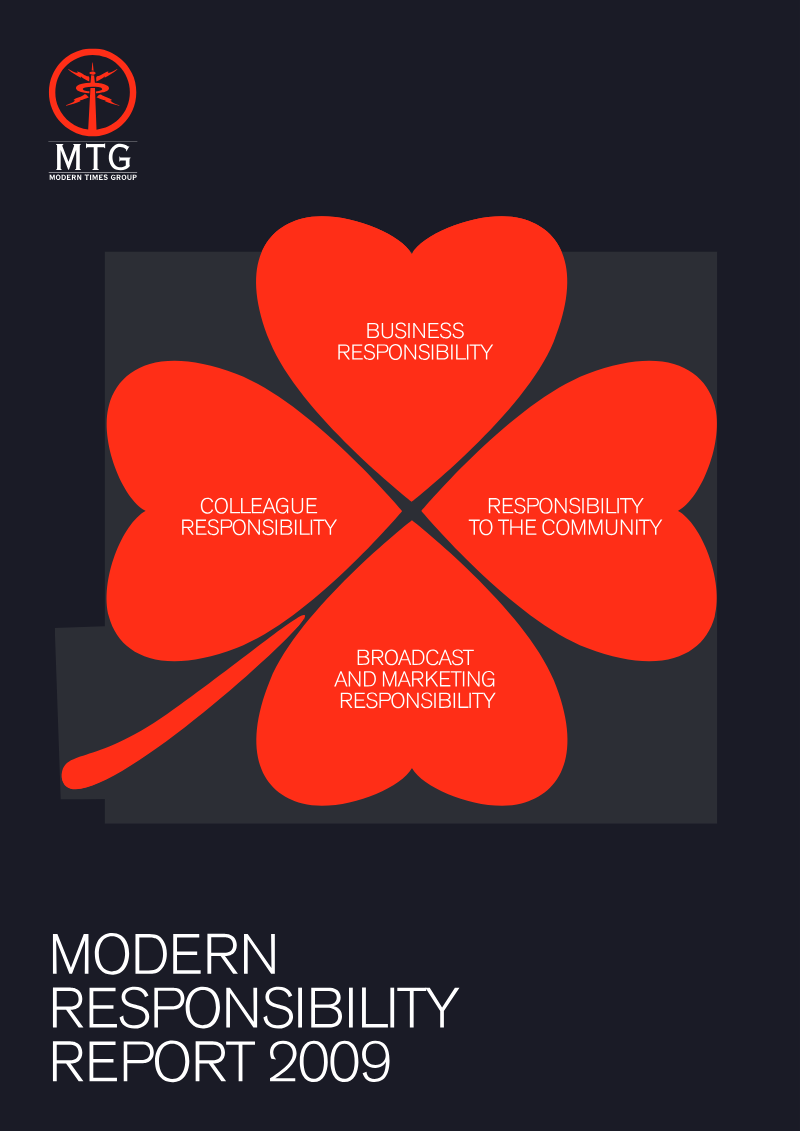
The 2009 Modern Responsibility Report presents Modern Times Group’s (MTG) effort to embed corporate responsibility across its broadcasting and media operations while navigating the aftermath of the 2008‑09 financial crisis. The report’s thesis is that a structured, multi‑pillar responsibility programme can coexist with commercial growth, even as the group expands its channel portfolio and geographic reach.
In 2009 MTG recorded net sales of SEK 14.2 billion and launched three new channels—TV3 Puls, Prima COOL and Viasat Hockey—while completing a major restructuring of its Bulgarian assets. Despite revenue growth, operating income fell to a loss of SEK 1.4 billion and basic earnings per share turned negative at ‑30.86 SEK. The responsibility framework, introduced in 2004, is now governed by the CEO, board directors, a central committee and local “Green Ambassadors,” with KPIs, internal audits and external consultancy guiding progress. Targets for 2010 include broader KPI coverage, reduced carbon emissions and enhanced stakeholder communication across business, broadcast‑marketing, colleague and community dimensions.
Employee engagement proved strong: 86 % of the 2,906 staff across 38 national markets completed the annual survey, 88 % expressed enthusiasm for their work and 90 % embraced the company’s three lead words. Gender balance approached parity overall (52 % male, 48 % female) though managerial levels remained skewed (63 % male, 37 % female). Internal recruitment accounted for 40 % of hires.
The carbon footprint for 2009 amounted to roughly 13 000 t CO₂e across 19 countries, split evenly between facilities and office‑supply material use, with an intensity of 4.2 t CO₂e per employee (0.9 t per MSEK turnover). ISO 14001 certification for the Swedish radio division and energy‑efficient headquarters illustrate concrete mitigation steps. Partnerships with WWF and Sweden’s BLICC, together with expanded carbon‑footprint audits, underscore MTG’s commitment to environmental stewardship within the
- MTG reported 2009 net sales of SEK 14.2 billion, though operating income resulted in a loss of SEK 1.4 billion and earnings per share fell to -30.86 SEK.
- The company expanded its portfolio during the 2008-09 financial crisis by launching TV3 Puls, Prima COOL, and Viasat Hockey, alongside a major restructuring of Bulgarian assets.
- Employee engagement remained high, with 86% of the 2,906-person workforce participating in the annual survey and 88% reporting enthusiasm for their work.
- Gender parity across the total workforce was nearly achieved at 52% male and 48% female, though management roles remained male-dominated at 63%.
- The company's 2009 carbon footprint totaled approximately 13,000 t CO2e, representing an intensity of 4.2 t CO2e per employee or 0.9 t per MSEK of turnover.
+3
Modern Times GroupJan 2009
Report13 pages
MTG Corporate Responsibility Report 2008
Modern Times Group’s Modern Responsibility programme, launched in 2004, is presented as a strategic framework for leveraging entertainment to create social and environmental value across the company’s global operations. The initiative is positioned as core to MTG’s mission to “maximise the power of entertainment,” with responsibility articulated through five measurable pillars: community, environment, colleagues, broadcasting standards, and marketing.
In 2008 the group reached 125 million viewers in 30 countries, operating 70 brands across television, radio, online retail and production. Financial performance showed net sales rising to SEK 13.2 billion and operating income to SEK 2.6 billion, while basic earnings per share more than doubled to SEK 43.25. Employee data indicate an average workforce of 2 810, with 35 % female representation, a 22 % turnover rate and 461 training days delivered to 46 % of staff. Community engagement generated 78 million SEK of donated airtime and raised 56 million SEK for charities, while environmental actions reduced office energy use by 28 % relative to national standards and produced a total carbon footprint of 4 223 tonnes CO₂ (3.0 t per employee), calculated under the Greenhouse Gas Protocol with external verification.
Stakeholder governance is overseen by senior management, a dedicated coordinator and a Modern Responsibility Committee, supported by local ambassadors in each market. Reporting draws on internal data, carbon accounting from Tricorona Climate Partner, and regular stakeholder feedback through surveys and focus groups. The 2008 snapshot underscores MTG’s expanding footprint, its commitment to ethical broadcasting, and its ambition to deepen responsibility reporting in subsequent years.
- In 2008, MTG achieved strong financial growth with net sales of SEK 13.2 billion, an operating income of SEK 2.6 billion, and basic earnings per share of SEK 43.25.
- MTG’s community engagement efforts in 2008 resulted in SEK 78 million worth of donated airtime and SEK 56 million raised for charitable causes.
- The company maintained a workforce of 2,810 employees across 30 countries, with 35% female representation and a 22% staff turnover rate.
- MTG reduced office energy consumption by 28% relative to national standards and recorded a total carbon footprint of 4,223 tonnes of CO2, averaging 3.0 tonnes per employee.
- The Modern Responsibility programme is governed by a dedicated committee and senior management, utilizing external verification from Tricorona Climate Partner to track carbon accounting.
+1
Modern Times GroupJan 2008