Report64 pages
Power of Play: Informe Global de Videojuegos 2025
The research surveyed more than 24,000 active gamers from 21 nations on six continents, representing a broad cross‑section of the global gaming population (average age 41, 48 % female). Its central thesis is that video games function as a powerful catalyst for cognitive, social, educational, and mental‑health benefits, extending far beyond entertainment. Across all regions, a majority of players report gaming primarily for fun (56 %), stress relief (55 %) and mental stimulation (46 %). Mobile devices dominate usage (55 % of respondents), followed by PCs/laptops and consoles, while 73 % say gaming reduces feelings of isolation and 81 % view it as mentally stimulating.
Perceived skill development is strong: 77 % associate gaming with enhanced creativity, 74 % with problem‑solving, and substantial portions note improvements in teamwork, resilience and social interaction. The survey highlights a professional impact, with 43 % globally—reaching 76 % in Nigeria and 70 % in India—believing gaming positively shaped their education or career. Mental‑health outcomes are equally pronounced; 70‑90 % report reduced stress, increased happiness and a healthier outlet for daily challenges, with the highest well‑being scores in India, Nigeria and Mexico. Online multiplayer is identified as the primary social connector, cited by up to 96 % of respondents.
Complementary academic research corroborates these findings, showing that digital games boost learning engagement, reading skills and decision‑making, while immersive technologies such as AR/VR enhance performance in high‑stress professional settings, including medical surgery and aerospace training. Collectively, the evidence positions video games as a validated tool for skill development, education, and mental‑health recovery across diverse global markets.
- Gaming is primarily used for stress relief (55%) and mental stimulation (46%), with 73% of the 24,000 surveyed players reporting that it reduces feelings of isolation.
- Skill development is a major outcome, as 77% of players associate gaming with enhanced creativity and 74% with improved problem-solving abilities.
- Mobile devices are the leading platform for 55% of global gamers, followed by PCs/laptops and consoles.
- 43% of global respondents believe gaming has positively influenced their education or career, with that figure rising to 76% in Nigeria and 70% in India.
- Online multiplayer serves as the primary social connector for up to 96% of respondents.
+1
AEVIJan 2025

Report15 pages
El Seguro en el Ámbito de los Videojuegos
This industry guide, developed by the Spanish Video Game Association (AEVI) in collaboration with legal experts from Pérez-Llorca, serves as a strategic framework for managing risk within the video game development and publishing sectors. The primary thesis emphasizes that insurance is an essential mechanism for ensuring the financial viability of projects, acting as an indirect prevention tool against the inherent complexities of game production, such as tight delivery schedules, technical bugs, and intellectual property disputes.
The analysis identifies several critical risk categories specific to the gaming industry, including breach of delivery deadlines, transmission of computer viruses, and unauthorized data intrusions. Key findings highlight that Professional Civil Liability (RCP) and Errors and Omissions (E&O) insurance are the most vital protections for developers, covering involuntary contractual breaches and negligence. Furthermore, the guide underscores the rising importance of cybersecurity insurance to mitigate operational costs and reputational damage resulting from hacking, ransomware, and data leaks, which can trigger significant sanctions from regulatory bodies like the Spanish Data Protection Agency.
The scope of the guidance focuses on the Spanish market, referencing local legal standards and regulatory bodies, while covering the entire industry lifecycle from independent developers and freelancers to large publishers. It details specific coverage areas such as intellectual property infringement—protecting against claims regarding music, characters, and concept art—and liability for defamation or the unauthorized use of public images. Methodologically, the guide provides a practical checklist for insurance procurement, advising firms to utilize insurance brokerages for periodic contract reviews and to ensure all operational risks are disclosed to maintain policy validity.
- Professional Civil Liability (RCP) and Errors and Omissions (E&O) insurance are the primary mechanisms for protecting developers against involuntary contractual breaches and professional negligence.
- Cybersecurity insurance is essential for mitigating the operational costs and reputational damage associated with ransomware, data leaks, and hacking incidents.
- Insurance policies must specifically cover intellectual property infringement, including claims related to unauthorized use of music, character designs, and concept art.
- The Spanish Video Game Association (AEVI) and Pérez-Llorca identify breach of delivery deadlines, computer virus transmission, and unauthorized data intrusions as the most critical operational risks for game studios.
- Regulatory compliance, particularly regarding data protection standards enforced by the Spanish Data Protection Agency, is a major driver for adopting comprehensive insurance coverage.
+1
AEVIJan 2025
Report14 pages
Employment Issues in Video Game Development: Spain
The guideaims to help video‑game publishers, developers and related staff in Spain navigate employment legislation while fostering safe, productive workplaces. It stresses that compliance with the Workers’ Statute, the 2022 labour reform and the Remote‑Working Law is essential to avoid costly legal sanctions and to protect staff from the health‑risk phenomenon known as “crunch.”
Key findings highlight the danger of false self‑employment, where workers appear independent but are actually subject to employer control. Spanish courts identify dependency, subordination and fixed remuneration as hallmarks; violations can trigger Social‑Security fines of €3,750‑€12,000 per worker, plus surcharges up to 150 % of unpaid contributions. The guide confirms that indefinite contracts are the default; fixed‑term contracts are permissible only for production‑related needs or to replace absent employees, with a maximum six‑month duration for the former and 90 days per calendar year for the latter. Misusing temporary contracts converts the relationship to permanent status and incurs fines of €751‑€7,500 per affected employee.
Remote work must be voluntarily agreed, cover at least 30 % of a worker’s time, and include employer‑funded equipment costing roughly €25‑€35 per month; non‑compliance also attracts fines of €751‑€7,500. Occupational‑risk prevention is mandated under Law 31/1995, with penalties ranging from €45 to €983,736 depending on severity, and requires systematic risk analyses to curb physical and psychosocial harms linked to crunch periods. Additionally, firms must maintain objective daily time‑recording systems, respect the irregular distribution of hours (up to a 10 % pool, notified five days in advance), and implement digital‑disconnection protocols, equality plans for organisations with over 50 employees, and whistle‑blowing channels.
Overall, the guide provides a practical checklist for Spanish video‑game companies: verify contract types, assess self‑employment arrangements, formalise remote‑work agreements, enforce occupational‑risk measures, and ensure accurate time‑keeping and compliance with broader digital‑and‑equality obligations, thereby reducing legal exposure and promoting healthier work environments.
- Misclassifying employees as independent contractors can result in Social Security fines of €3,750–€12,000 per worker, plus potential surcharges of up to 150% of unpaid contributions.
- Indefinite contracts are the legal default in Spain, with fixed-term contracts strictly limited to production needs (six-month maximum) or employee replacement (90 days per year); misuse of these terms triggers fines of €751–€7,500 per employee.
- Occupational risk prevention, specifically regarding 'crunch' and psychosocial health, is mandated under Law 31/1995, with non-compliance penalties ranging from €45 up to €983,736 for severe violations.
- Remote work agreements must be voluntary, cover at least 30% of working hours, and include employer-funded equipment costs of approximately €25–€35 per month to avoid fines of €751–€7,500.
- Companies are legally required to implement objective daily time-recording systems and adhere to digital-disconnection protocols, while organizations with over 50 employees must also maintain formal equality plans and whistle-blowing channels.
+1
AEVIJan 2025
Report12 pages
Financing Video Games: Spain
The guide aims to equip Spanish video‑game developers and publishers with a practical framework for securing external financing beyond traditional bank credit. It argues that investment agreements (IAs) represent a flexible, hybrid model that can bridge the gap between shareholders’ equity and debt, allowing investors to fund projects while retaining political and economic rights comparable to shareholders without immediate capital‑increase obligations.
Key content outlines the typical structure of an IA: investors provide lump‑sum or milestone‑linked capital, receive a defined share of commercial revenues, and obtain voting, dividend and information rights. Comparative analysis shows that, unlike standard debt, IAs do not impose fixed repayment schedules, instead tying returns to project profitability and offering conversion mechanisms that can transform credit into equity if revenues fall short. The guide enumerates standard clauses—profitability timeframes, capitalisation rights, representations and warranties, confidentiality, “bad‑leaver” provisions, and pre‑emptive rights—to protect both parties and manage risk. An illustrative example notes that a €100 investment with a 20 % return target is achieved once the project generates €120 in revenue.
The scope is national, targeting the Spanish video‑game sector and addressing developers of any size who seek alternative funding. Authored by legal counsel from Pérez‑Llorca and the Asociación Española de Videojuegos, the document draws on industry practice rather than empirical surveys, presenting a checklist and glossary to support contract drafting and due‑diligence processes. Its conclusion stresses that, as acquisitions and external investments rise, IA investors will increasingly influence project governance despite not holding formal share capital.
- Investment agreements (IAs) serve as a hybrid financing model for Spanish developers, bridging the gap between equity and debt by granting investors shareholder-like rights without requiring immediate capital increases.
- Unlike traditional bank loans, IAs replace fixed repayment schedules with returns tied directly to project profitability, often including conversion mechanisms that turn credit into equity if revenue targets are missed.
- IAs typically structure capital as lump-sum or milestone-linked payments, with returns defined by a percentage of commercial revenues, such as a €100 investment targeting a €120 return.
- Standard contractual protections in these agreements include profitability timeframes, capitalisation rights, confidentiality clauses, pre-emptive rights, and 'bad-leaver' provisions to mitigate risk for both parties.
- Investors utilizing IAs gain significant influence over project governance, including voting, dividend, and information rights, despite not holding formal share capital.
+1
AEVIJan 2025

Report13 pages
Guide to Consumer Rights, Advertising and Data Protection: Spain
The guide is intended to equip Spanish video‑game publishers, developers and marketers with a practical understanding of the legal framework governing consumer rights, advertising and data protection. It draws on the General Law for the Defence of Consumers and Users, the General Advertising Law, the Unfair Competition Law, the General Data Protection Regulation and the Spanish Organic Law on Data Protection, applying them to digital products released in Spain throughout 2025.
Key consumer‑protection provisions require clear pre‑purchase information, a 14‑day withdrawal right for most digital purchases, and safeguards against unfair terms such as unilateral contract changes. Exceptions apply to virtual currencies, physical copies that have been opened and age‑rated titles once gameplay begins. Developers must maintain and communicate updates, while digital assets—including NFTs—must be presented with transparent licensing terms and explicit notices when the right of withdrawal is lost. Advertising must avoid misleading claims, covert sponsorship, political content outside election periods, and any material that exploits minors, encourages violence, discrimination or unhealthy behaviours; influencer promotions must be marked with visible disclosures such as #Sponsored or #Ad.
Data‑protection obligations centre on distinguishing controller and processor roles, informing users through layered privacy notices, and securing personal data—including special categories—via documented processing activities and contractual safeguards. For users under 14, parental consent must be verified through age checks or electronic signatures. The guide concludes with a checklist summarising rights to information, withdrawal, fair advertising, loot‑box age verification, ongoing game maintenance and GDPR‑compliant data handling.
- Digital purchases in Spain generally require a 14-day right of withdrawal, though this is waived for age-rated titles once gameplay begins and for opened physical copies or virtual currencies.
- Data processing for users under 14 requires verified parental consent, which must be obtained through age-verification mechanisms or electronic signatures.
- Influencer marketing must include clear, visible disclosures such as #Sponsored or #Ad to avoid violating regulations against covert sponsorship.
- Advertising content is strictly prohibited from exploiting minors, promoting violence or discrimination, or featuring political messaging outside of designated election periods.
- Digital assets and NFTs must be sold with transparent licensing terms and explicit notifications informing users exactly when their right of withdrawal is forfeited.
+1
AEVIJan 2025

Report15 pages
Insurance in the Video Game Sector: Spain
The guide explains that insurance is a critical safeguard for video‑game development in Spain, where tight schedules, complex technical workflows and the involvement of multiple parties create a range of legal and financial exposures. Its central thesis is that appropriate coverage not only mitigates the impact of unforeseen events but also functions as an indirect prevention tool, protecting both small studios and independent creators from liabilities that could jeopardise a project’s completion and commercial success.
Key risks identified include failure to meet delivery deadlines, software bugs, transmission of computer viruses, cyber‑attacks, data‑protection breaches, intellectual‑property infringements, defamation, and malicious acts by employees. Each risk is linked to potential legal consequences such as contractual liability, third‑party compensation claims, regulatory penalties from the Spanish Data Protection Agency, and reputational damage. The guide matches these exposures to specific insurance solutions: Professional Liability Insurance (PLI) and Errors & Omissions (E&O) for contractual and professional errors; Cybersecurity Insurance for hacking, ransomware and data‑loss incidents; Multi‑Risk and General Civil Liability policies for broader operational hazards; and specialised coverage for intellectual‑property disputes, defamation and employee misconduct.
The scope is national, focusing on the Spanish video‑game sector and addressing developers of all sizes, from freelancers to larger studios. While the guide does not present original empirical research, it draws on prevailing market offerings and legal frameworks to construct a practical risk‑assessment matrix. Recommendations emphasize engaging insurance brokers to conduct tailored assessments, compare policy terms, and periodically review coverage, with clear procedural steps for application, policy issuance, amendment periods and premium payment.
Overall, the guide provides a comprehensive checklist for selecting and maintaining insurance that aligns with the specific vulnerabilities of video‑game projects, underscoring the importance of proactive risk management in a highly competitive and technically demanding industry.
- Spanish video game developers face critical financial and legal exposures from project delays, software bugs, cyber-attacks, and intellectual property infringements.
- Professional Liability Insurance (PLI) and Errors & Omissions (E&O) policies are essential to mitigate risks related to contractual failures and professional errors.
- Cybersecurity insurance is required to address specific threats including ransomware, data-protection breaches, and the transmission of computer viruses.
- General Civil Liability and Multi-Risk policies provide necessary coverage for broader operational hazards and physical or malicious acts by employees.
- Developers should engage insurance brokers to conduct tailored risk assessments and perform periodic reviews of policy terms to ensure coverage aligns with evolving project vulnerabilities.
+1
AEVIJan 2025
Report17 pages
Taxation in the Video Game Sector: Spain
The guide explains the tax framework that applies to video‑game companies operating in Spain, outlining both mandatory obligations and the range of incentives available to reduce fiscal burdens. It establishes that resident legal entities must pay corporate income tax at 25 % of profit, value‑added tax generally at 21 %, and the Economic Activities Tax, which is exempt for the first two years or for turnover below €1 million. Non‑resident individuals and firms are subject to the non‑resident income tax, with rates of 25 % when a permanent establishment exists and 19‑24 % otherwise, and must file the appropriate IRNR forms within prescribed periods. Personal income tax for self‑employed developers ranges from 19 % to 47 % depending on income level, and withholding obligations apply to employee and contractor payments.
Key fiscal incentives include a research and development and technological innovation deduction that allows a 12 % credit on qualifying expenses, capped at 25‑50 % of the tax liability, and a patent‑box regime that reduces the taxable base on income from patents, utility models, designs, and advanced software. The Start‑ups Law offers a reduced corporate tax rate of 15 % for four periods and defers advance instalments, while small entities with turnover under €10 million benefit from accelerated depreciation, finance‑lease deductions, and an equalisation reserve that can lower the tax base by up to 10 %. Companies located in the Canary Islands can access the REF and ZEC regimes, featuring a 4 % corporate tax rate and exemptions on property‑transfer and IGIC taxes when specific investment and employment criteria are met.
The guide also lists practical tools to support compliance, such as the tax‑agency’s query database, an annual calendar of filing deadlines, virtual assistance services, and a telephone help line. It emphasizes the need for proper registration, reporting of activity start‑up and cessation, and electronic filing using certified certificates, ensuring that video‑game developers can meet statutory requirements while exploiting available tax efficiencies.
- Resident video game companies in Spain are subject to a 25% corporate income tax rate, while qualifying start-ups can access a reduced 15% rate for four tax periods.
- The Canary Islands offer a highly competitive 4% corporate tax rate and exemptions on property-transfer and IGIC taxes for companies meeting specific investment and employment criteria.
- R&D and technological innovation expenses qualify for a 12% tax credit, capped at 25–50% of total tax liability, alongside a patent-box regime that reduces the taxable base for advanced software.
- Small entities with an annual turnover under €10 million are eligible for fiscal benefits including accelerated depreciation, finance-lease deductions, and an equalisation reserve that lowers the tax base by up to 10%.
- Non-resident firms without a permanent establishment face income tax rates between 19% and 24%, while resident entities must generally apply a 21% value-added tax.
+2
AEVIJan 2025
Report15 pages
AEVI Guides- Videogames and intellectual and industrial property
The guide aims to equip video‑game developers and publishers with practical knowledge for building a robust intellectual‑property (IP) portfolio that safeguards creative assets and minimizes infringement risk. It clarifies the legal distinction between copyright‑related rights, which protect artistic and literary expressions, and industrial‑property rights such as patents, trademarks, industrial designs and trade secrets, emphasizing that trademarks and designs are the most relevant instruments for the sector.
Key points outline how each component of a game—script, dialogue, soundtrack, character graphics, user‑interface, source code, middleware and databases—can be protected. Copyright arises automatically upon creation and lasts 70 years after the author’s death (or 70 years from disclosure for collective works); registration at the General Registry of Intellectual Property can serve as evidence of ownership. Trademarks require filing with the Spanish Patent and Trademark Office or the EUIPO, granting ten‑year protection renewable indefinitely, while industrial designs protect the visual appearance of GUIs for five‑year terms, renewable up to 25 years. Trade‑secret protection relies on confidentiality agreements and technical safeguards for non‑public information such as storylines or novel mechanics.
The guide stresses that, under Spanish law, employees retain initial rights to their creations, so studios must secure written assignments—preferably exclusive, worldwide and lasting until the work enters the public domain—to ensure exploitable rights. Collective works, common in game development, confer ownership to the coordinating developer or publisher. For third‑party content, the document outlines limited exceptions—public‑domain use, statutory limits, and narrowly defined descriptive uses of trademarks—while noting that the EU does not recognise a broad “fair‑use” doctrine.
Overall, the document provides a comprehensive, jurisdiction‑specific framework for protecting video‑game assets across Spain and the European Union, guiding stakeholders through registration procedures, contractual safeguards and permissible uses of external material to secure commercial value and legal certainty.
- Under Spanish law, studios must secure written, exclusive, and worldwide copyright assignments from employees to ensure full exploitation rights, as initial authorship remains with the creator.
- Copyright protection for game components like source code, scripts, and soundtracks arises automatically upon creation and lasts for 70 years after the author's death or 70 years from disclosure for collective works.
- Trademarks, which require filing with the Spanish Patent and Trademark Office or the EUIPO, provide renewable ten-year protection terms and are critical for securing brand identity.
- Industrial design rights protect the visual appearance of user interfaces for an initial five-year term, which can be renewed for up to 25 years.
- Trade secrets, such as novel game mechanics or unreleased storylines, must be protected through formal confidentiality agreements and technical security measures rather than public registration.
AEVIJan 2025

Report15 pages
Aspectos Laborales en el Desarrollo de Videojuegos
The guide aims to equip professionals in the Spanish video‑game sector with a practical framework for complying with national labour legislation while fostering safe, flexible and sustainable work environments. It stresses that employment relationships must be governed primarily by the Estatuto de los Trabajadores and the 2022 labour reform, positioning indefinite contracts as the default model and limiting temporary contracts to production‑related needs or substitution of specific workers.
Key legal risks are highlighted, notably the use of “falso autónomo” arrangements. Indicators such as dependence, lack of entrepreneurial risk, fixed remuneration and provision of equipment can reclassify a contractor as an employee, exposing firms to Social Security back‑payments of up to €50 000, fines ranging from €3 750 to €12 000 per case and additional penalties of 100‑150 % of the owed contributions. Incorrectly formalised temporary contracts trigger automatic conversion to permanent status and fines between €751 and €7 500 per affected worker.
The document outlines the regulatory regime for teleworking, requiring a voluntary agreement, employer‑borne provision costs of roughly €25‑35 per month, and detailed specifications on schedules and monitoring tools. Non‑compliance is penalised as a grave infringement with fines identical to those for improper temporary contracts. Prevention of occupational risks, especially the “crunch” phenomenon, is mandated under the 1995 Prevention of Risks Law; violations can attract fines from €45 up to €983 736, and employers may face civil liability for work‑related injuries or illnesses.
Additional obligations include mandatory daily working‑time records introduced in 2019, the use of irregular‑hour distribution up to 10 % of total hours with five‑day notice and strict rest‑period safeguards, and the implementation of digital‑disconnection protocols, equality plans for firms with more than fifty employees, whistle‑blowing channels and digital‑device usage policies. The guide, authored by legal experts and industry consultants, synthesises statutory provisions and recent reforms to provide a comprehensive compliance checklist for developers, publishers and marketing teams operating within Spain’s
- Misclassifying contractors as 'falso autónomo' carries severe financial risk, including Social Security back-payments of up to €50,000, fines of €3,750 to €12,000 per case, and additional penalties of 100–150% of owed contributions.
- Indefinite contracts are the mandatory default under the 2022 labour reform, with improperly formalised temporary contracts triggering automatic conversion to permanent status and fines ranging from €751 to €7,500 per worker.
- Violations of occupational risk prevention laws, particularly regarding 'crunch' culture, can result in fines reaching up to €983,736 and potential civil liability for work-related health issues.
- Teleworking requires a formal voluntary agreement and employer-covered costs of approximately €25–35 per month, with non-compliance classified as a grave infringement subject to fines of €751 to €7,500.
- Employers must maintain mandatory daily working-time records and adhere to strict rest-period safeguards, while also implementing digital-disconnection protocols and whistle-blowing channels.
+1
AEVIJan 2025

Report15 pages
Guías AEVI: Propiedad intelectual e industrial
The guide aims to equip video‑game developers and publishers with a practical framework for safeguarding the creative and technical assets that constitute a game’s intellectual and industrial property. It clarifies the dual nature of IP under Spanish law—copyright and related rights on the one hand, and industrial property (patents, trademarks, designs, trade secrets) on the other—explaining which categories protect specific game elements such as scripts, music, graphics, code, user‑interface designs, character names and logos.
Key conclusions stress that copyright arises automatically upon creation, lasting 70 years after the author’s death (or 70 years from disclosure for collective works), while related rights endure 50 years. Trademark protection requires registration and lasts ten years per filing, renewable indefinitely; design protection covers the external appearance of a GUI for five‑year periods, renewable up to 25 years. Trade‑secret measures rely on confidentiality agreements and technical safeguards rather than formal registration. The guide also outlines the legal regimes governing ownership of works created by employees, freelancers or collaborators, noting that Spanish law lacks a “work‑for‑hire” concept and therefore mandates explicit written assignments of exploitation rights, typically detailed in employment or service contracts.
Practical recommendations include a step‑by‑step checklist for identifying each asset, determining the appropriate protection mechanism, confirming that all contributors have assigned their rights, and implementing NDAs to preserve secrecy during development. The guide further outlines limited exceptions for using third‑party material—public‑domain works, specific statutory limits, and narrowly defined descriptive uses of trademarks—while warning that doctrines such as “fair use” are not recognized in the EU. Overall, the document provides a comprehensive, Spain‑focused roadmap for building a robust IP portfolio that enhances a game’s market value and minimizes infringement risk.
- Spanish law does not recognize the 'work-for-hire' doctrine, meaning developers must secure explicit written assignments of exploitation rights in all employment and service contracts to ensure legal ownership of creative assets.
- Copyright protection for video game elements arises automatically upon creation and lasts for 70 years after the author's death, or 70 years from disclosure in the case of collective works.
- Trademark protection requires formal registration and provides 10-year terms that are renewable indefinitely, while industrial design protection for GUIs lasts for five-year periods, renewable up to a maximum of 25 years.
- Trade secrets are protected through internal confidentiality agreements and technical safeguards rather than formal registration, making NDAs essential during the development phase.
- The EU legal framework does not recognize the 'fair use' doctrine, limiting the use of third-party materials to public domain works, specific statutory exceptions, and narrow descriptive trademark uses.
AEVIJan 2025

Report17 pages
La Fiscalidad en el Sector de los Videojuegos: España
The guide aims to clarify the tax framework that applies to video‑game developers, publishers and related service providers operating in Spain, outlining both mandatory obligations and available fiscal incentives. It serves as a practical reference for resident legal entities, self‑employed professionals and non‑resident firms that generate income in the Spanish market, helping them meet compliance deadlines while exploiting deductions that can significantly lower the effective tax burden.
Key obligations are mapped to the principal Spanish taxes: corporate income tax (IS) at a standard 25 % rate, personal income tax (IRPF) ranging from 19 % to 47 % for individuals, value‑added tax (IVA) generally set at 21 %, the economic activities tax (IAE) with fixed tariffs and exemptions for the first two years or turnover below €1 million, and withholding obligations on salaries and payments to non‑resident contractors. Filing deadlines are detailed for each model form (e.g., Model 200/210 for IS, Model 303/390 for IVA, Model 111/190 for IRPF withholdings) and the guide notes the possibility of fiscal consolidation for groups of related companies.
The most valuable incentives for the sector include a 12 % deduction on qualifying research, development and innovation (R&D +i) expenses, which can rise to 45 % for projects carried out in the Canary Islands, and a patent‑box regime that reduces taxable income from intangible assets such as patents and advanced software. The 2022 Spanish Video‑Game Development White Paper underpins the emphasis on genuine technological advancement. Start‑up companies meeting ENISA criteria benefit from a reduced corporate rate of 15 % for four years, exemption from advance payments, and deferred tax liabilities. Small and medium‑sized entities with turnover under €10 million can also apply accelerated depreciation, enhanced lease deductibility and loss‑carry‑forward mechanisms.
Operational guidance covers the procedural steps required to register for a tax identification number, declare activity commencement or cessation, and submit electronic filings via the Agencia Tributaria’s portal using a digital certificate. Complementary tools include a searchable tax‑question database, an annually updated taxpayer calendar, virtual assistance services for the main tax types, and a dedicated helpline. Together, these resources aim to streamline compliance, reduce administrative risk and enable video‑game firms to maximize the fiscal advantages embedded in Spanish law.
- Video game companies in Spain can access a 12% tax deduction for qualifying R&D+i expenses, which increases to 45% for projects developed in the Canary Islands.
- Start-ups meeting ENISA criteria qualify for a reduced 15% corporate tax rate for four years, along with exemptions from advance payments and deferred tax liabilities.
- The standard corporate income tax (IS) rate in Spain is 25%, while personal income tax (IRPF) for self-employed professionals ranges from 19% to 47%.
- A patent-box regime is available to reduce taxable income derived from intangible assets, including patents and advanced software.
- Small and medium-sized enterprises with an annual turnover under €10 million are eligible for accelerated depreciation, enhanced lease deductibility, and loss-carry-forward mechanisms.
+2
AEVIJan 2025

Report43 pages
Videojuegos en el Aula: ¿Qué se está haciendo en España? Manual para docentes 2025
Video games have become a central cultural and educational tool in Spain, where more than 22 million people—over half of them women—play an average of 8.2 hours each week. This widespread engagement is leveraged to motivate learning, prompting the development of a coordinated ecosystem that supplies teachers with curated resources, professional training, and ready‑to‑use platforms such as Dok Student, Cokitos, Mundo Primaria, Eutopía and Escapeweb. Publicly funded titles like ABC Dinos, BookyPets and Quijote: Quest for Glory employ RPG, tower‑defense and card mechanics to reinforce early literacy, while historically grounded games such as Dîrok, Plus Ultra Legado and El Enigma de Toledo integrate rigorous research into curricula, supporting both STEM competencies and language development.
A parallel surge in health‑oriented games addresses the mental‑health concerns of Spanish adolescents, with 41 % reporting problems and one‑third never having discussed them. These applications aim to provide preventive support and therapeutic engagement within school settings. Meanwhile, esports and gamified learning are gaining institutional traction; a national competition rewards winning schools with €20 000 in technology, and industry partnerships like GGTech’s site visits illustrate viable career pathways. Complementary initiatives, such as Cruz Roja’s 150‑hour Unity programming course for unemployed youth and the Andalusian “Desafía & Aprende” program, further embed game design skills into broader employment strategies.
Overall, the Spanish educational landscape demonstrates a rapid, multi‑sectoral integration of video games that spans literacy, history, health, and vocational training, reflecting a strategic response to the medium’s pervasive cultural presence and its potential to enhance learning outcomes across the country.
- Spain’s gaming ecosystem is supported by over 22 million players, with women accounting for more than half of the user base and an average weekly playtime of 8.2 hours.
- Educational integration is facilitated by a standardized infrastructure of platforms including Dok Student, Cokitos, Mundo Primaria, Eutopía, and Escapeweb.
- Publicly funded titles like ABC Dinos, BookyPets, and Quijote: Quest for Glory utilize RPG and tower-defense mechanics to improve early literacy, while games like Dîrok and El Enigma de Toledo support STEM and history curricula.
- To address the 41% of Spanish adolescents reporting mental health concerns, schools are increasingly adopting therapeutic and preventive video game applications.
- Institutional support for esports and gamification includes a national competition offering €20,000 in technology prizes and industry-led career exposure through partners like GGTech.
+3
AEVIJan 2025
Report6 pages
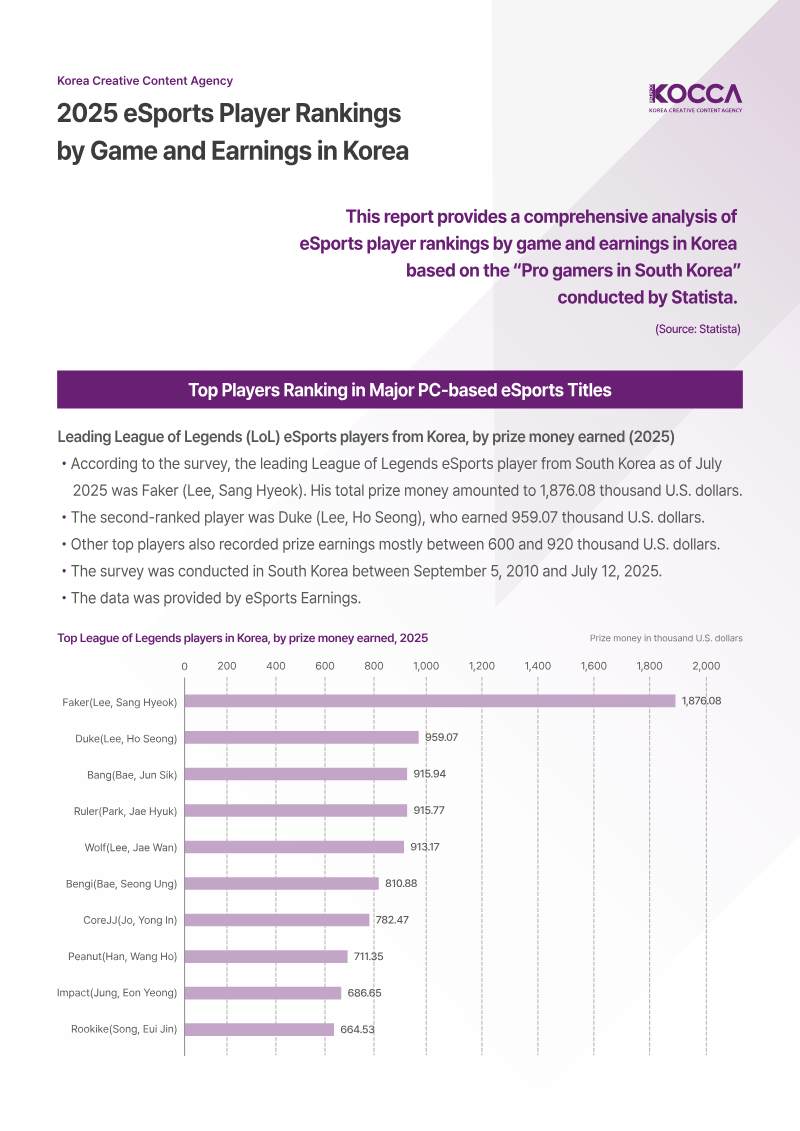
2025 eSports Player Rankings: By Game and Earnings in Korea
South Korea’s professional gaming landscape is characterized by a title-centered evaluation system where prize earnings are highly concentrated among elite players. Analysis of the country’s top eSports competitors across five major PC-based titles—League of Legends, StarCraft II, Valorant, Overwatch 2, and PlayerUnknown’s Battlegrounds (PUBG)—reveals significant disparities in cumulative wealth based on the longevity and global scale of each game’s competitive scene.
League of Legends remains a dominant sector, with Lee Sang-hyeok (Faker) leading all players with approximately $1.88 million in prize money as of July 2025. This exceeds the top earners in other disciplines, such as Cho Sung-choo (Maru) in StarCraft II, who earned $1.39 million, and Park Jung-young (Loki) in PUBG, who secured $1.25 million. In contrast, newer or more recently transitioned titles like Overwatch 2 and Valorant show lower cumulative earnings, with top players Choi Tae-min (MER1T) and Kim Jong-min (Lakia) earning $375,450 and $164,980 respectively.
The data, sourced from eSports Earnings and compiled by the Korea Creative Content Agency, utilizes a longitudinal methodology tracking performance from as early as 2010 through mid-2025. While the rankings for League of Legends, StarCraft II, and Valorant reflect 2025 figures, the data for Overwatch 2 and PUBG is current through late 2024. This segmentation highlights a fragmented domestic performance structure where success is measured by game-specific milestones rather than a unified national ranking. The findings underscore a mature market where established titles continue to provide the highest financial returns for top-tier professional talent.
- League of Legends remains the most lucrative eSports title in South Korea, with top earner Lee Sang-hyeok (Faker) accumulating $1.88 million in prize money as of July 2025.
- Established titles offer significantly higher financial returns than newer games, as evidenced by StarCraft II leader Cho Sung-choo earning $1.39 million and PUBG leader Park Jung-young earning $1.25 million.
- Newer competitive titles show a substantial earnings gap compared to legacy games, with top Overwatch 2 player Choi Tae-min earning $375,450 and Valorant leader Kim Jong-min earning $164,980.
- The South Korean professional gaming market lacks a unified national ranking system, relying instead on a fragmented structure where success is measured by game-specific milestones.
- Data compiled by the Korea Creative Content Agency indicates that cumulative wealth in the sector is heavily concentrated among elite players at the top of their respective disciplines.
+1
KOCCA – Korea Creative Content AgencyJan 2025
Report25 pages
Global Business Strategies for K-Fashion: A Focus on K-Content
The analysis demonstrates that the future competitiveness of Korean fashion hinges on integrating cultural content with advanced technology and participatory fan ecosystems. Influencer campaigns have evolved from reliance on celebrity notoriety to collaborations built on shared values and fan‑aligned storytelling, positioning fan‑generated media as an active co‑marketing partner rather than a peripheral buzz generator. This shift amplifies brand authenticity and deepens consumer loyalty across global markets.
Artificial intelligence is identified as the primary catalyst reshaping product development, marketing, and sustainability. On‑demand production models, exemplified by Desigual’s AI‑driven forecasting, have markedly reduced inventory waste, while hyper‑personalized styling tools and virtual‑try‑on platforms are delivering measurable financial gains. Gentle Monster’s AI‑based recommendation engine lifted revenue by 25 %, and H&M’s deployment of digital twins curtailed refund rates, underscoring the profitability of AI integration. The emergence of agentic commerce, projected to mature by 2026, promises further automation of the purchase journey and deeper data‑driven consumer insights.
Geographically, the findings span a global perspective, encompassing major fashion hubs in North America, Europe, and Asia, and cover the period from the early 2020s through the anticipated developments of 2026. The scope encompasses the apparel, accessories, and eyewear segments, with particular emphasis on digital fashion, AI‑enabled supply chains, and the symbiotic relationship between K‑content and international consumer culture. Collectively, these insights outline a strategic roadmap for Korean fashion brands seeking to leverage cultural capital and technological innovation to secure sustainable growth worldwide.
- AI integration is a primary driver of profitability, evidenced by Gentle Monster’s 25% revenue increase through recommendation engines and H&M’s reduction in refund rates via digital twins.
- Korean fashion brands are shifting influencer strategies from celebrity-based notoriety to value-aligned storytelling, treating fan-generated media as a core co-marketing partner to boost authenticity.
- On-demand production models, such as those utilized by Desigual, are effectively leveraging AI-driven forecasting to minimize inventory waste and improve supply chain sustainability.
- Agentic commerce is projected to mature by 2026, a development expected to further automate the consumer purchase journey and provide deeper data-driven insights.
- Future competitiveness for Korean fashion relies on the strategic integration of cultural content, advanced technology, and participatory fan ecosystems across global markets.
KOCCA – Korea Creative Content AgencyJan 2025

Report6 pages
Securing Competitiveness in Human-Creativity-Driven BGM Production in the Age of AI-Generated Music: South Korea
The interview with Hong Eun‑Ji, CEO of T2Sound, examines how background‑music (BGM) producers in South Korea can preserve competitive advantage as AI‑generated music becomes increasingly affordable and rapid. The central thesis is that human creativity—particularly the ability to convey authentic emotion and intent—remains the decisive factor that AI cannot replicate, and that leveraging AI as a collaborative tool rather than a threat can enhance, not replace, the artistic value of BGM.
Key insights emphasize that quality and emotional resonance, achieved through meticulous mixing and mastering, are the core values guiding T2Sound’s work. The company prioritises collaboration with external creators, believing that collective expertise yields richer nuance than isolated in‑house production. Market trends reveal a shift among overseas buyers toward tracks with distinctive sonic signatures rather than generic pleasantness, and Korean BGM’s success abroad is linked to its unique emotional line and texture. In short‑form media, the interview highlights the necessity of an immediate, memorable hook within the first few seconds to secure brand recognition and audience immersion.
Looking ahead to 2026, the conversation predicts a consolidation around financially proven genres such as hip‑hop and trot in Korea, reflecting an industry increasingly driven by economic sustainability. The interview’s qualitative methodology—direct dialogue with a leading BGM provider—offers a focused perspective on the evolving interplay between AI tools, human artistry, and global market demands within the South Korean audio‑content sector.
- Human creativity remains the primary competitive advantage for BGM producers, as the ability to convey authentic emotion and intent cannot be replicated by AI.
- T2Sound maintains market competitiveness by prioritizing meticulous mixing and mastering to ensure high-quality emotional resonance, rather than competing solely on speed or cost.
- Global demand is shifting away from generic background music toward tracks with distinctive sonic signatures, with Korean BGM gaining traction due to its unique emotional texture.
- Short-form media content requires an immediate, memorable hook within the first few seconds to successfully secure brand recognition and audience immersion.
- T2Sound leverages a collaborative model with external creators to achieve richer artistic nuance than what is typically produced through isolated in-house workflows.
+1
KOCCA – Korea Creative Content AgencyJan 2025
Report15 pages
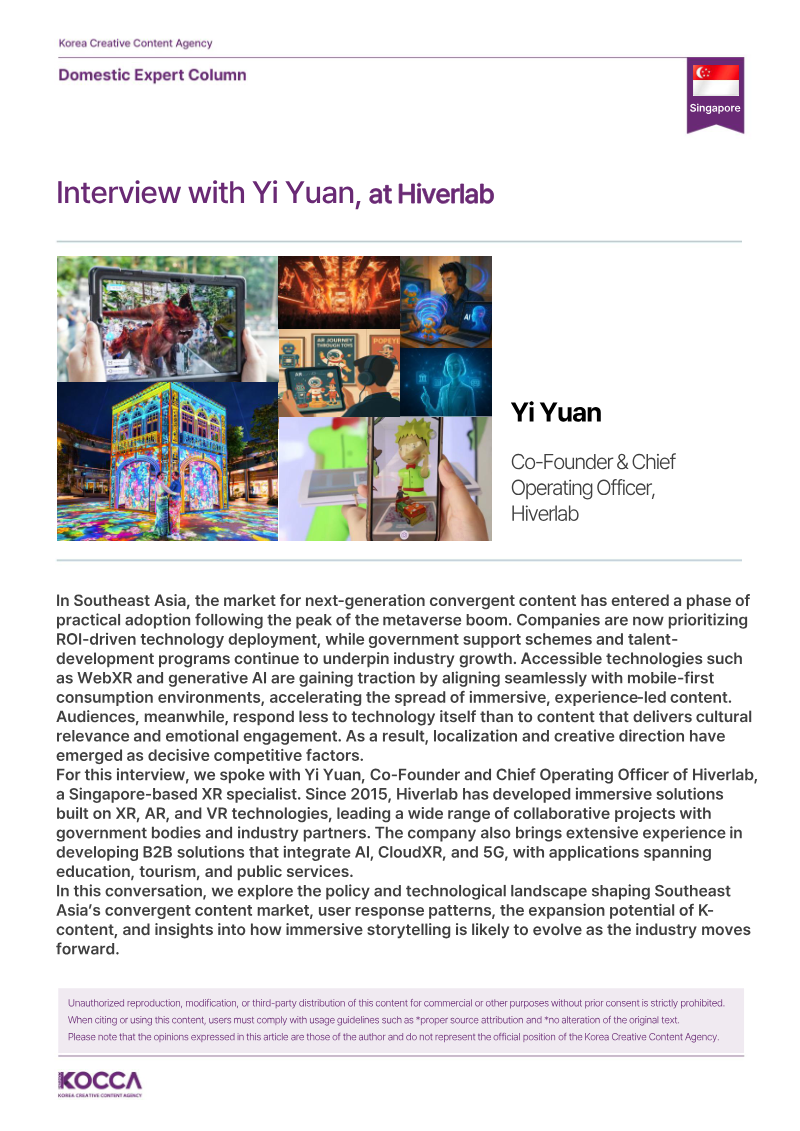
Interview with Yi Yuan, at Hiverlab: Southeast Asia
The interview underscores a shift in Southeast Asia’s convergent‑content market from speculative metaverse enthusiasm to a pragmatic, ROI‑driven landscape where augmented reality has become the primary vehicle for marketing and tourism initiatives. Growth is anchored in measurable outcomes such as cost‑reduction ratios and increased foot‑traffic, supported by government funding and a mobile‑first infrastructure that leverages WebXR and expanding 5G networks. Large‑scale AR deployments at heritage and tourist sites illustrate the sector’s scalability, emphasizing the necessity of culturally resonant storytelling, clear narrative structures, and quantitative metrics like dwell time and interaction density to assess engagement.
Effective experiences consistently incorporate gamified micro‑games and selfie‑style interactions that encourage user participation and social sharing. These design elements amplify interaction density and foster virality, reinforcing the importance of narrative quality over pure technological novelty. The chief operating officer highlights that AI‑generated, personalized storytelling—through digital humans and generative‑AI scripts—remains the chief catalyst for sustained user interest, with success measured by dwell time, interaction density and social‑virality indicators.
A principal commercial obstacle is the high bandwidth demand of simultaneous, large‑scale XR experiences. The rollout of 5G and cloud‑native architectures such as CloudXR has already mitigated latency and loading challenges, as demonstrated by the AR broadcast of Singapore’s Chingay festival in 2020. Continued expansion across the region will depend on further high‑bandwidth network deployment, sustained government infrastructure investment, and deeper integration of AI technologies to produce adaptive, immersive content.
- Southeast Asia’s convergent-content market has shifted from speculative metaverse projects to a pragmatic, ROI-driven focus on augmented reality for marketing and tourism.
- Success in the region is measured by quantitative metrics including dwell time, interaction density, and social-virality indicators rather than technological novelty.
- Large-scale AR deployments are currently anchored by government funding and mobile-first infrastructure, utilizing WebXR and 5G networks to ensure scalability.
- AI-generated personalized storytelling, including digital humans and generative-AI scripts, is identified as the primary catalyst for sustaining long-term user interest.
- High-bandwidth demands for simultaneous XR experiences are being addressed through cloud-native architectures like CloudXR, as evidenced by the 2020 AR broadcast of Singapore’s Chingay festival.
+1
KOCCA – Korea Creative Content AgencyJan 2025

Report30 pages
Growth of the Korean Emoticon Market: A New Distribution and Expansion Method for the K-Character Industry
The Korean emoticon market has evolved from a peripheral messaging feature into a multi‑billion‑won character‑IP industry, now valued at roughly KRW 1.5 trillion (≈US$1.2 trillion). This transformation is anchored by KakaoTalk, whose emoticon platform expanded from an initial KRW 100 billion base in the early 2010s to a dominant revenue stream that underpins a broader ecosystem of licensed characters and digital content. Over the past fourteen years, more than 850 000 distinct emoticons have been released, generating in excess of 300 billion individual sends, illustrating both high user engagement and the low‑sensitivity nature of the market’s cash flow.
The core of this growth lies in the development of unique intellectual‑property (IP) assets such as KakaoFriends and LINE Friends. These brands have transcended simple sticker usage to become central brand assets that are licensed across a spectrum of media, including merchandise, mobile games, animation, and information‑communication‑technology services. By converting emoticons into high‑value IP, companies have created diversified revenue channels that extend well beyond the messaging platform itself.
Export potential is accelerating, driven by corporate collaborations and strategic international expansion. Partnerships with established IP owners enable Korean firms to tap into global distribution networks, while the modular nature of emoticon‑based branding facilitates rapid adaptation to foreign markets. The overall trajectory suggests that the emoticon sector will continue to serve as a catalyst for the broader K‑character industry, reinforcing Korea’s position as a leading exporter of digital cultural content.
- The Korean emoticon market has grown into a KRW 1.5 trillion (≈US$1.2 trillion) industry, anchored by the KakaoTalk platform.
- Over the last 14 years, the market has seen the release of more than 850,000 distinct emoticons, resulting in over 300 billion individual sends.
- Emoticons have evolved from simple messaging features into high-value intellectual property (IP) assets, such as KakaoFriends and LINE Friends, that drive revenue across merchandise, mobile games, and animation.
- The industry has expanded significantly from its initial KRW 100 billion base in the early 2010s to become a primary revenue stream for digital content ecosystems.
- The sector’s growth is characterized by low-sensitivity cash flow and high user engagement, providing a stable foundation for broader K-character industry development.
+1
KOCCA – Korea Creative Content AgencyJan 2025

Report13 pages
Interview with Kim Yoo, License Manager at Bandai Namco Korea
The Japanese character market has evolved from a niche subculture into a mainstream value chain driven by a diverse demographic of high-spending fans. While male consumers maintain a strong presence in the traditional collectible figure segment, women in their 20s and 30s have emerged as a dominant force, shifting market demand toward lifestyle goods, customizable plush toys, and shareable social media content. This transformation is fueled by the global reach of streaming platforms, the normalization of fandom culture through K-pop, and an increasing consumer preference for immersive offline experiences such as pop-up stores and collaboration cafés.
Strategic success in this landscape requires a dual-track approach that balances mass-market accessibility with premium, limited-edition offerings. Current growth is heavily concentrated in cross-category collaborations where character intellectual properties intersect with fashion, digital goods, and the music industry. Navigating this market necessitates a deep understanding of multi-tiered licensing structures and a commitment to protecting the narrative integrity, or worldview, of each IP. Establishing long-term credibility through disciplined execution remains a prerequisite for international partners seeking to enter this competitive ecosystem.
Looking toward 2026, the industry is moving toward a hybrid model that prioritizes experiential content and convergence-driven trends. To remain competitive, businesses must develop the agility to identify these shifts early and execute initiatives swiftly. The integration of character IPs into broader cultural sectors like exhibitions and music suggests that the future of the market lies in creating holistic brand experiences rather than simple product manufacturing. This evolution underscores the necessity for strategic flexibility and rapid response to the changing tastes of a globalized fandom.
- The Japanese character market has shifted from a niche segment to a mainstream industry driven by high-spending female consumers in their 20s and 30s.
- Market demand is moving away from traditional collectible figures toward lifestyle goods, customizable plush toys, and content optimized for social media sharing.
- Strategic success requires a dual-track model that balances mass-market accessibility with premium, limited-edition product offerings.
- Growth is increasingly concentrated in cross-category collaborations that integrate character intellectual property with fashion, digital goods, and the music industry.
- The industry is transitioning toward a hybrid model by 2026 that prioritizes experiential, holistic brand experiences like pop-up stores and collaboration cafés over simple product manufacturing.
KOCCA – Korea Creative Content AgencyJan 2025
Report13 pages
Interview with Frank Kang, Associate Partner at Antler: Malaysia
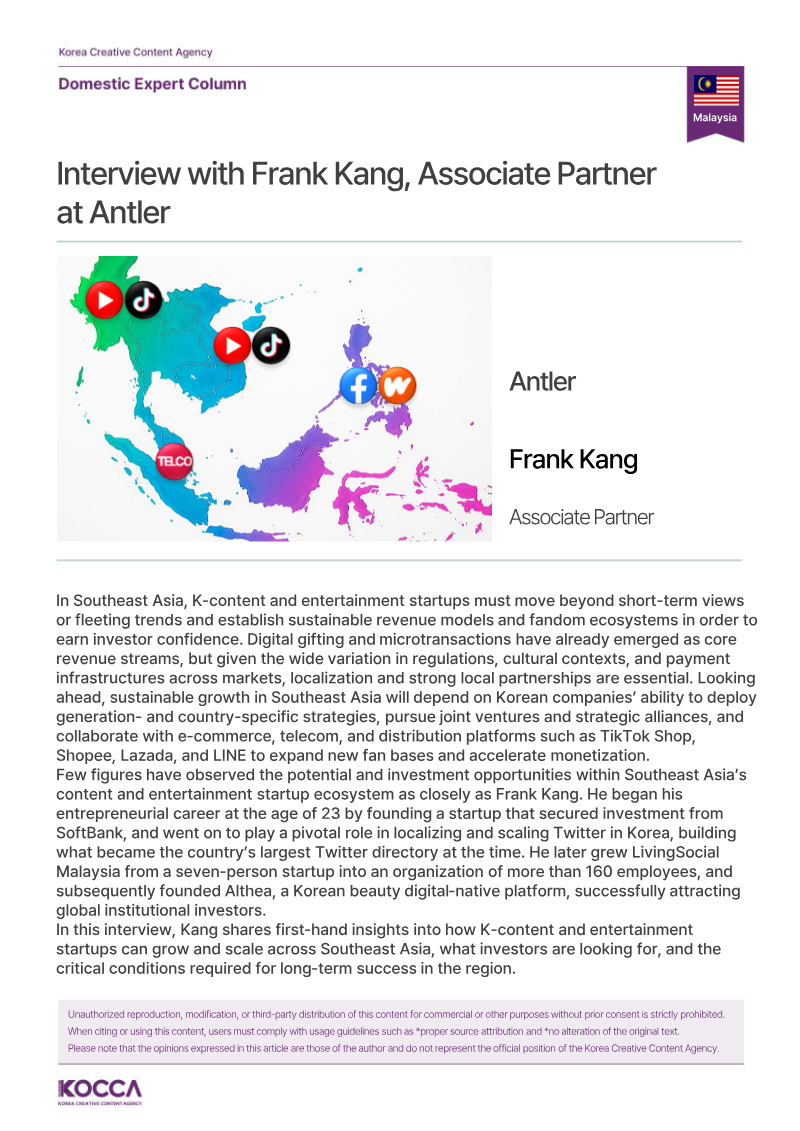
Korean content and entertainment startups are being urged to treat Southeast Asia as a primary growth engine rather than a peripheral market. Success hinges on deep localisation that goes beyond subtitles, requiring partnerships with local “co‑pilots” that can navigate fragmented linguistic, regulatory and payment landscapes in cities such as Jakarta, Manila and Bangkok. By embedding region‑specific monetisation schemes—micro‑transactions, live‑commerce, and hybrid free‑plus‑premium models—companies can align with the mobile‑wallet‑driven habits of Southeast Asian fans and convert grassroots enthusiasm into sustainable revenue streams.
The region’s fandom operates as a decentralized, grassroots network where fans act as unpaid marketers, driving earnings through digital stickers, low‑priced concert tickets and other micro‑purchases that often outpace traditional subscription revenues seen in Korea or Japan. Promising niches include short‑form video, webtoons and IP‑centric ecosystems, mobile‑first games, and live‑commerce platforms, all of which benefit from early community testing and strong local alliances. Trust capital built by global Korean acts such as BTS and BLACKPINK demonstrates the willingness of Southeast Asian audiences to pay for authentic, culturally resonant experiences.
Investors now demand proven revenue traction and genuine localisation before committing capital, and scalable startups are expected to adopt modular, locally adapted business models. Exits are likely to occur through mergers and acquisitions rather than public listings, underscoring the strategic importance of establishing a resilient foothold in Southeast Asia as a launchpad for broader global expansion.
- Korean entertainment and content startups must treat Southeast Asia as a primary growth engine rather than a peripheral market to achieve sustainable expansion.
- Success requires deep localisation through local 'co-pilots' to navigate fragmented linguistic, regulatory, and payment landscapes in key hubs like Jakarta, Manila, and Bangkok.
- Revenue models should shift toward mobile-wallet-driven micro-transactions, live-commerce, and hybrid free-plus-premium structures to align with local consumption habits.
- Startups should leverage decentralized, grassroots fan networks that drive revenue through digital stickers and low-priced micro-purchases, which often outperform traditional subscription models.
- High-growth niches include short-form video, webtoons, IP-centric ecosystems, and mobile-first games that utilize early community testing and local alliances.
+1
KOCCA – Korea Creative Content AgencyJan 2025
Report13 pages
Interview with Sarah Chung, Senior Manager at Disney Company
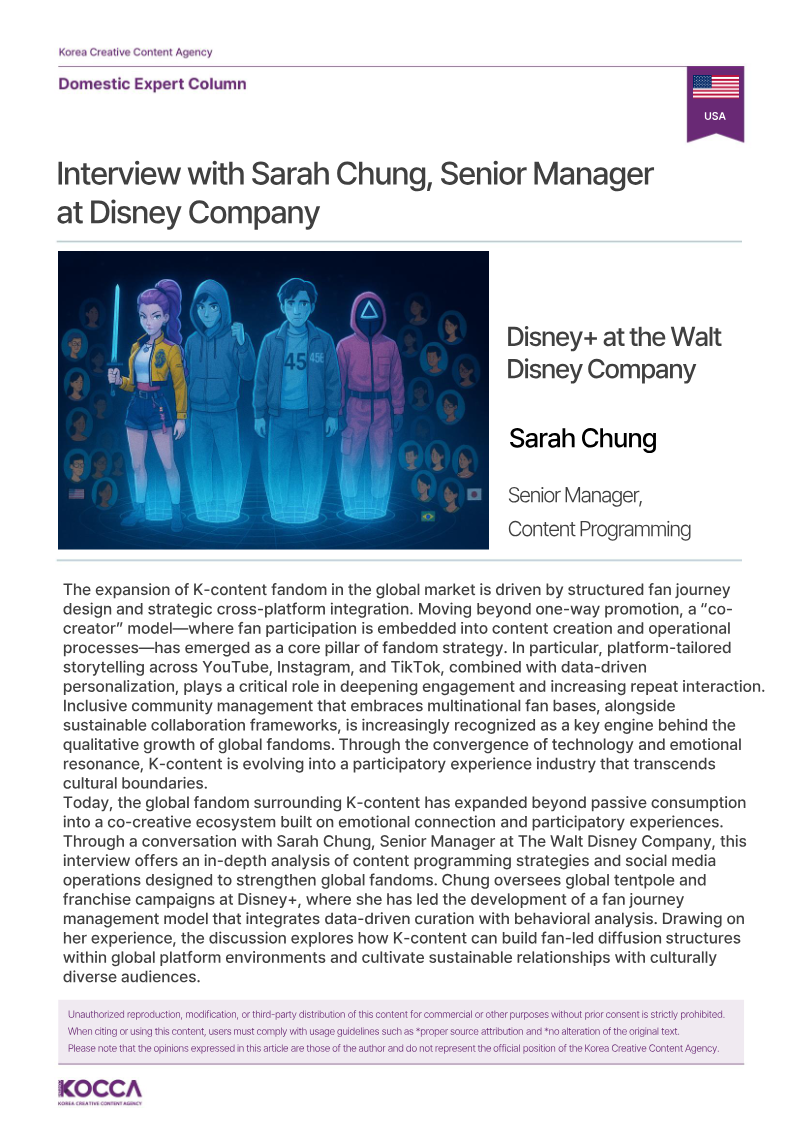
The interview underscores that the worldwide surge of Korean content is rooted in a “cocreator” fandom model, where streaming services offering seamless subtitle and dubbing options enable audiences to engage directly with material and co‑produce cultural moments. This participatory dynamic is amplified by nostalgia‑driven “comfort viewing” and the rapid diffusion of fan‑made short‑form clips on TikTok, which together reshape attention spans and create a feedback loop that fuels further consumption.
A key finding is that Korean productions are breaking out of traditional genre boundaries, as illustrated by titles such as The Glory, D.P., Sweet Home and Gyeongseong Creature. These series now contend not only with other OTT platforms but also with short‑form ecosystems like TikTok and YouTube, as well as user‑generated content. To secure global reach, Korean studios must prioritize distribution channels that combine extensive international footprints with aggressive off‑platform promotion, while exploiting AI‑driven recommendation engines to surface relevant titles amid an oversupply of options.
Looking ahead to 2026, success will depend on a balanced strategy that merges technological adaptability, clear conceptual storytelling, and format experimentation. Integrating nostalgia‑centric comfort viewing with cross‑platform interactive campaigns will allow Korean creators to navigate a fragmented global content landscape and maintain competitive relevance across both long‑form and short‑form media environments.
- The global success of Korean content is driven by a 'cocreator' fandom model, where streaming platforms leverage seamless localization tools to allow audiences to actively participate in cultural moments.
- Korean productions must now compete for attention against both traditional OTT platforms and short-form ecosystems like TikTok and YouTube, necessitating a shift in how content is marketed and consumed.
- To maintain global reach, studios must adopt a dual strategy of utilizing platforms with extensive international footprints while executing aggressive off-platform promotional campaigns.
- Success in a saturated market requires the integration of AI-driven recommendation engines to ensure content visibility amid an oversupply of available media options.
- Future competitive relevance through 2026 depends on blending nostalgia-driven 'comfort viewing' with cross-platform interactive campaigns that bridge long-form and short-form media.
KOCCA – Korea Creative Content AgencyJan 2025