
Report10 pages
Interview with Lee, Su-Hyun: South Korea
The interview with Professor Lee Su‑Hyun of Seoul National University articulates digital transformation (DX) as a comprehensive restructuring of the Korean fashion value chain, extending beyond e‑commerce to encompass AI‑driven design, smart‑factory automation, and data‑centric marketing. By leveraging generative AI for 3‑D virtual prototyping, automated sewing, digital twins, and metaverse‑enabled retail experiences, the industry can cut sample costs, shorten lead times, and enhance personalized consumer interactions while supporting carbon‑neutral objectives such as on‑demand production and circular‑economy tracking.
Professor Lee emphasizes that smart apparel remains in early commercial stages, with functional niches in sports, healthcare, and disaster safety already demonstrating pilot deployments. Critical technical barriers include washability and durability of conductive fibers, sensor performance after repeated laundering, and the need for flexible, miniaturized battery solutions. Rapid advances in printed textile batteries and energy‑harvesting technologies are narrowing these gaps, yet mass‑production capacity and system integration lag behind leading markets in the United States and Germany.
Strategic recommendations focus on three business models: subscription‑based health and fitness services, interoperable platform modules detachable across garments, and specialized ceremonial wear where visible technology adds value. Successful scaling will require coordinated industry‑academia curricula, a robust talent pipeline, national standardization participation (e.g., IEC TC124), shared testing facilities, and proactive IP support to translate Korea’s strong patent portfolio into globally competitive products.
Looking ahead to 2026, AI and sustainability are projected to dominate the fashion sector. AI will become an essential capability across design, inventory, and personalization, while sustainability will drive digital traceability, carbon‑neutral manufacturing, and circular‑economy initiatives, together reshaping competitiveness criteria for the Korean fashion industry.
- South Korea’s fashion industry is undergoing a comprehensive digital transformation (DX) that integrates generative AI for 3-D virtual prototyping, smart-factory automation, and data-centric marketing to reduce sample costs and lead times.
- The adoption of on-demand production and digital traceability is being prioritized to meet carbon-neutral objectives and support circular-economy initiatives within the fashion value chain.
- Smart apparel development is currently limited to functional niches in sports, healthcare, and disaster safety, with technical progress hindered by the durability of conductive fibers and the need for miniaturized, flexible battery solutions.
- To achieve global competitiveness by 2026, the industry must overcome current lags in mass-production capacity and system integration compared to the United States and Germany.
- Strategic business models for smart apparel include subscription-based health services, modular, detachable technology components, and high-value ceremonial wear.
KOCCA – Korea Creative Content AgencyJan 2025

Report8 pages
Strategies for Creating Global Hit Formats: Exporting and Localizing K-Broadcast Formats
The interview with Jin‑Woo Hwang, CEO and executive producer of Something Special, outlines a strategic framework for turning Korean broadcast formats into globally successful products. Central to the thesis is that formats must be conceived with a “global‑oriented concept” and then deliberately exported and localized, rather than relying on passive inbound interest. Hwang identifies six core attributes—simplicity, flexibility, scalability, authenticity, compelling storytelling, and play‑along participation—that distinguish formats capable of crossing cultural boundaries, and he emphasizes the “Korean Twist,” a hybrid, genre‑blending approach that reflects Korea’s dynamic audience preferences.
The discussion situates these ideas within a practical scope that spans Asia, Europe, and North America. Something Special’s recent LEAP project with Taiwan’s Creative Content Agency, alongside new co‑development deals with major French and Spanish media firms, illustrates active outbound collaboration. Past successes such as “Grandpas Over Flowers” and “I Can See Your Voice” are cited as case studies where market insight, differentiation articulation, and extensive pitching were essential. Hwang stresses that legal risk management—registering formats with FRAPA’s Format Registration System, maintaining detailed e‑trail documentation, and constructing a “format bible” for localization—are critical to protecting intellectual property and enhancing commercial value.
Technology is addressed as both an opportunity and a challenge; AI and VR can enrich format expression, yet integrating these tools abroad requires careful cost‑benefit analysis and protection of core technologies. Hwang warns that entering the U.S. market without experience in intermediate territories often demands significant sacrifice, underscoring the need for a stepwise, experience‑based expansion strategy. Ultimately, the interview calls for Korean producers to choose active global expansion, invest in long‑term partnerships, and view format export as a dual process of contract negotiation and sustained localization, positioning Something Special as a hub for Korea’s future format IP ecosystem.
- Successful global format export requires a proactive strategy of deliberate localization rather than relying on passive inbound interest.
- Core attributes for cross-cultural success include simplicity, flexibility, scalability, authenticity, compelling storytelling, and play-along participation, often enhanced by a 'Korean Twist' of genre-blending.
- Protecting intellectual property is essential and should be managed through the FRAPA Format Registration System, detailed e-trail documentation, and the creation of a comprehensive 'format bible'.
- A stepwise expansion strategy is recommended, as entering the U.S. market without prior experience in intermediate territories often requires significant commercial sacrifice.
- Active international collaboration is demonstrated by Something Special’s LEAP project with Taiwan’s Creative Content Agency and new co-development partnerships with French and Spanish media firms.
+1
KOCCA – Korea Creative Content AgencyJan 2025
Report7 pages
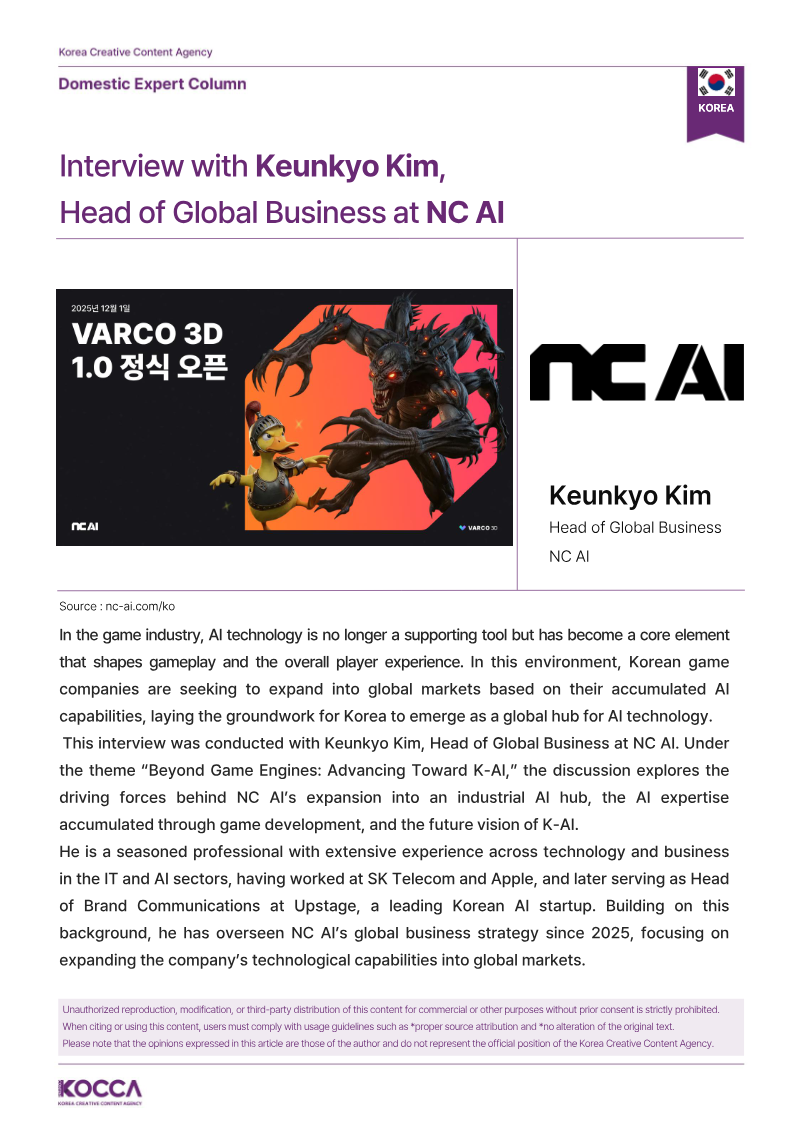
Interview with Keunkyo Kim, Head of Global Business at NC AI
The interview articulates NC AI’s transformation from a game‑focused research lab into a national industrial‑AI hub, positioning Korea as a global center for “K‑AI.” It outlines the company’s ambition to leverage fourteen years of game‑AI expertise to drive cross‑industry innovation, emphasizing that AI has moved from a supporting role to a core driver of gameplay, content creation, and broader economic competitiveness.
NC AI, a subsidiary of NCSoft, has built a proprietary large‑language model called VARCO and the VARCO 3D engine, which can generate near‑realistic, physics‑based 3D environments from text or images. The firm was selected as one of five leaders in Korea’s Independent Foundation Model project and became the first Korean entity to deploy its LLM on AWS. An open‑source release of VARCO Vision 2.0 attracted over 10 000 downloads within ten days, reflecting a strategic push for global adoption and a vibrant developer ecosystem.
The company’s real‑time processing and reinforcement‑learning capabilities, honed in massive MMORPG settings, are now applied to digital twins for manufacturing, robotics, smart‑city, and defense sectors. NC AI pursues a dual‑track model—developing a 200‑billion‑parameter LLM while simultaneously creating lightweight, edge‑optimized multimodal diffusion models—to balance scale with field efficiency. Its proprietary safety filter, Safeguard, has been integrated into NCSoft’s NCER chatbot, underscoring a commitment to AI trustworthiness and standards collaboration.
Looking ahead, NC AI leads a consortium of 54 organizations to produce industry‑specific AI that validates in real‑world environments, aiming for Korean AI sovereignty and global leadership. By enabling user‑generated content through VARCO 3D, Voice, and animation tools, the firm promotes a “everyone can be a creator” ethos, encouraging young talent to contribute to a vertically integrated AI ecosystem that links industry, government, and academia and positions Korea as a powerhouse in the international AI landscape.
- NC AI is leveraging 14 years of MMORPG-based reinforcement learning and real-time processing expertise to expand from gaming into industrial sectors, including manufacturing, robotics, smart cities, and defense.
- The company is developing a dual-track AI strategy that balances a 200-billion-parameter large language model with lightweight, edge-optimized multimodal diffusion models for field efficiency.
- NC AI’s proprietary VARCO 3D engine enables the generation of physics-based 3D environments from text or images, while the open-source VARCO Vision 2.0 achieved over 10,000 downloads within ten days of release.
- As a leader in Korea’s Independent Foundation Model project, NC AI is the first Korean entity to deploy its proprietary LLM on AWS and currently heads a 54-organization consortium to drive industry-specific AI adoption.
- The firm is prioritizing AI safety and trustworthiness through its proprietary 'Safeguard' filter, which is already integrated into the NCER chatbot.
+1
KOCCA – Korea Creative Content AgencyJan 2025

Report60 pages
PowerUP: Spelbranschen – en svensk basnäring
Sweden’s video‑game sector is positioned as a culturally driven, “born‑global” industry that, despite generating more than SEK 3.5 billion in revenue and employing over 15 000 staff abroad, remains fragmented and under‑supported at the national level. The analysis maps the ecosystem of roughly 1 000 firms—87 % micro‑enterprises, 42 % with no employees, and only 1 % large companies—highlighting that 97 % of studios rely on regional clusters such as Skövde, Malmö and the northern hub, which suffer from chronic under‑financing and a lack of long‑term planning. The sector’s growth is constrained by low legitimacy, inadequate national financing mechanisms, and regulatory barriers that impede talent recruitment, especially for start‑ups and regional firms.
Key findings show a mismatch between the sector’s cultural impact—average player age 32, documented benefits for creativity, problem‑solving, STEM interest and mental health—and the absence of coordinated public‑private structures to translate these gains into economic value. Comparative data reveal Sweden’s early‑stage funding to be far below peer EU nations, while the talent pipeline is strained, with a projected need for 25 000 developers over the next decade and 40 % of the current workforce being foreign‑born. The report recommends establishing a comprehensive national game strategy, a dedicated investment fund modeled on Industrifonden, long‑term financing for regional clusters, and a Swedish games institute to de‑risk commercial projects and retain IP ownership.
To secure sustainable growth, the analysis calls for reform of innovation metrics, inclusion of game‑specific occupations in labour policy, expanded vocational and research education, and the separation of cultural and commercial funding streams. By implementing these measures, Sweden could elevate its position from the EU’s fourth‑largest producer to a leading contender alongside France and Germany by 2025.
- Sweden's video-game sector requires a national strategy and a dedicated investment fund to support an ecosystem of 1,000 firms, 87% of which are micro-enterprises.
- The industry faces a critical talent shortage with a projected need for 25,000 new developers over the next decade, while 40% of the current workforce is already foreign-born.
- Despite generating over SEK 3.5 billion in revenue and employing 15,000 staff abroad, the sector is hindered by inadequate national financing and regulatory barriers that impede start-up growth.
- 97% of studios are concentrated in regional clusters like Skövde, Malmö, and northern hubs, which currently suffer from chronic under-financing and a lack of long-term planning.
- The sector remains highly fragmented, with 42% of firms having no employees and only 1% classified as large companies.
DataspelsbranschenJan 2025

Report48 pages
Uppdaterad Statistik för de Kulturella och Kreativa Branscherna: Sverige
Sweden’s cultural and creative economy is quantified through an extensive 2023 update that records more than 140 000 firms employing roughly 250 000 people and generating over SEK 650 billion in turnover. Limited companies account for the bulk of activity (SEK 607 billion from 48 000 entities), while sole traders and other legal forms contribute SEK 16 billion and SEK 30 billion respectively. Revenue per employee averages SEK 2.6 million and intangible assets are valued at SEK 20 billion, underscoring the sector’s high productivity and knowledge intensity.
The core thesis asserts that existing SNI‑code classifications markedly under‑represent large and fast‑growing components such as digital platforms, video‑games, furniture design, and numerous craft activities, leading to distorted employment, value‑added and regional statistics. By revising the SNI list, eliminating irrelevant codes, and cross‑checking company accounts, a more accurate database—derived from roughly 73 000 active limited companies and refined to about 40 000 distinct firms—has been assembled. The transition to the 2025 SNI framework introduces five‑digit codes that improve granularity for design, illustration and literary arts, though short‑term classification gaps persist.
Turnover concentration is evident in a few dominant markets: music (SEK 11.4 billion, 12 % nominal growth), cultural events (SEK 42.3 billion), design (SEK 78.5 billion) and video‑games (SEK 34.6 billion). Data collection relied on commercial databases because Bolagsverket’s APIs cannot filter by SNI, highlighting a systemic data‑access limitation. The report recommends appointing a lead agency—suggested as Tillväxtverket—to oversee an annual analytical publication and maintain a comprehensive KKB database that integrates cultural VAT, service exports, firm size, region and activity type, ensuring reliable, comparable statistics across Sweden’s cultural and creative sectors.
- Sweden’s cultural and creative economy comprises over 140,000 firms and 250,000 employees, generating a total annual turnover exceeding SEK 650 billion.
- Limited companies drive the vast majority of sector revenue, contributing SEK 607 billion of the total turnover compared to SEK 46 billion from other legal entities.
- The sector demonstrates high productivity and knowledge intensity, with an average revenue per employee of SEK 2.6 million and intangible assets valued at SEK 20 billion.
- Key industry segments include design (SEK 78.5 billion), cultural events (SEK 42.3 billion), video games (SEK 34.6 billion), and music (SEK 11.4 billion, reflecting 12% nominal growth).
- Current SNI-code classifications significantly under-represent high-growth areas like digital platforms and video games, necessitating a transition to a more granular 2025 five-digit SNI framework.
Kreativ SektorJan 2025
Report32 pages
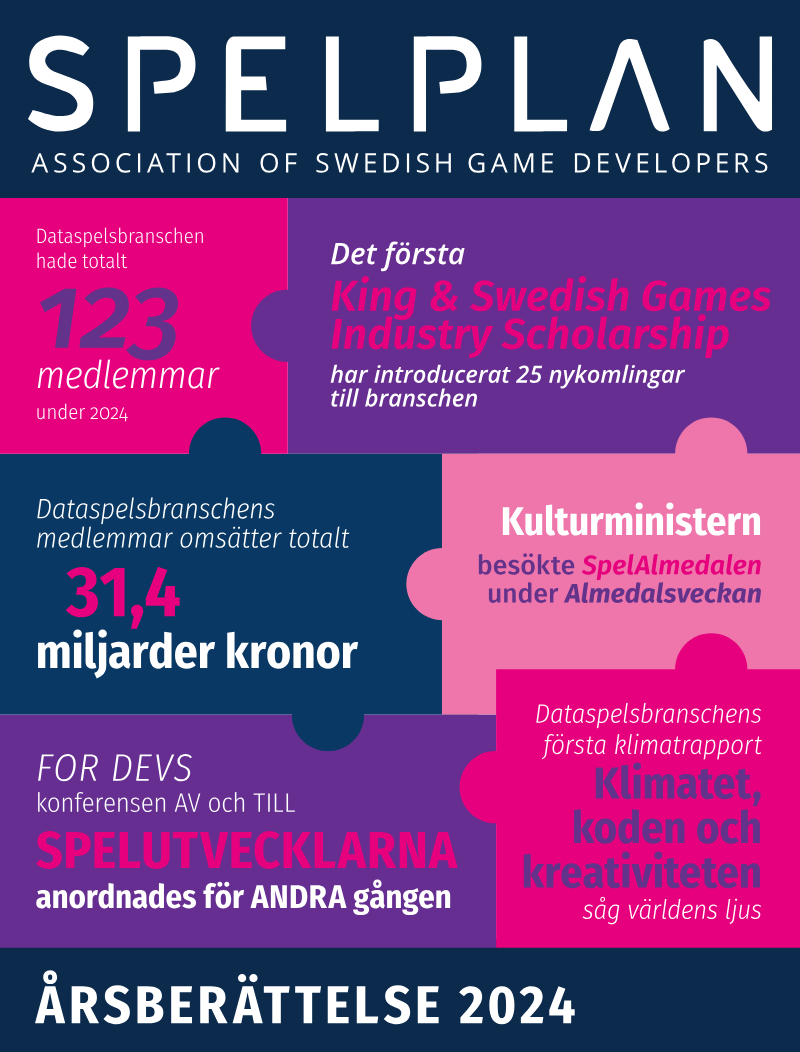
Association of Swedish Game Developers: 2024 Report
The 2024 overview of Sweden’s games industry presents a comprehensive assessment of the sector’s performance, challenges, and forward‑looking dynamics within the Swedish market. It argues that, despite a noticeable wave of studio closures, the industry remains resilient and is entering a phase of regeneration driven by regional clusters, targeted investment schemes, and internationally successful titles.
Analysis of the year shows that development activity is increasingly concentrated in hubs such as Skövde, where new studios have emerged and produced world‑hit games like Satisfactory, a title that secured both D.I.C.E. and Golden Joystick awards. This creative output underscores Sweden’s capacity to generate globally competitive products even as legacy firms exit the market. Growth is attributed largely to coordinated programmes—including Redeye Gaming Day, Invest in Games, and the EU‑funded CDG‑Booster mentoring cohort—that channel capital, mentorship, and market access to emerging developers.
The findings highlight a sector that, while contending with consolidation pressures, is expanding its export footprint and sustaining employment through the formation of new companies and the scaling of award‑winning projects. Investment in talent development and cluster formation emerges as a decisive factor in maintaining Sweden’s reputation as a leading European game‑development hub.
Overall, the 2024 snapshot confirms that Sweden’s games industry, spanning development, publishing, and ancillary services, continues to generate significant economic value and cultural impact, positioning itself for sustained growth in the coming years.
- Sweden’s games industry is undergoing a structural shift characterized by legacy studio closures offset by the emergence of new, high-performing development hubs.
- Regional clusters like Skövde have become primary drivers of industry output, exemplified by the commercial and critical success of the title Satisfactory.
- Industry resilience is supported by targeted support initiatives, including Redeye Gaming Day, Invest in Games, and the EU-funded CDG-Booster mentoring program.
- The sector is maintaining its international export footprint and employment levels by successfully scaling new companies and award-winning projects.
- Strategic investment in talent development and cluster-based infrastructure is identified as the core factor sustaining Sweden’s position as a leading European game-development hub.
+1
Spelplan-ASGDJan 2025

Report68 pages
Spelutvecklarindex: Sweden 2025
The analysis maps Sweden’s game‑development landscape, arguing that the sector’s rapid expansion has positioned the country as a leading European hub while simultaneously exposing new regulatory and societal challenges. Over the past twenty years the industry has multiplied from 71 firms with SEK 0.5 billion in revenue to more than 1 100 companies generating roughly SEK 37 billion—an increase of about 7 500 %—and employing 9 130 staff domestically, complemented by an additional 11 000 workers abroad. This growth underscores the sector’s escalating economic weight and its contribution to national employment.
Geographically, the ecosystem spans all Swedish counties, comprising over 300 development studios. The highest concentrations are found in Stockholm and its surrounding regions, notably Uppsala, Värmland and Örebro, where studio density exceeds twelve entries per county. Domestically, Swedish‑produced titles commanded the majority share of the Steam market in 2024, reflecting strong consumer preference for locally created content and reinforcing the sector’s market relevance.
Artificial intelligence has become a dual‑purpose tool within the industry: it is employed to generate novel game assets and to identify players exhibiting signs of radicalisation or harassment. The analysis stresses that radicalisation often migrates from in‑game interactions to external, unmoderated forums, distinguishing it from broader online hate. Consequently, it calls for coordinated, cross‑border interventions that involve regulators, academic researchers and game companies to mitigate these risks while preserving the sector’s innovative momentum.
- Sweden’s game industry has grown to over 1,100 companies generating SEK 37 billion in annual revenue, a 7,500% increase from the SEK 0.5 billion recorded twenty years ago.
- The sector currently employs 9,130 staff domestically and an additional 11,000 workers abroad.
- Swedish-produced titles held the majority market share on Steam in 2024, demonstrating strong consumer demand for local content.
- The industry ecosystem is comprised of over 300 development studios distributed across all Swedish counties, with the highest density concentrated in Stockholm, Uppsala, Värmland, and Örebro.
- Artificial intelligence is being utilized as a dual-purpose tool for both generating game assets and monitoring player behavior for signs of radicalization and harassment.
+1
DataspelsbranschenJan 2025

Report71 pages
State of AI Apps Report 2025
The analysis quantifies the rapid expansion of generative‑AI applications in the first half of 2025, documenting 1.6 billion downloads and $1.2 billion in in‑app‑purchase revenue. This represents a 67 percent increase in downloads and a 200 percent jump in revenue compared with the second half of 2024, indicating a pronounced acceleration in user adoption and monetisation. Engagement metrics rose in tandem, underscoring the sector’s heightened activity during this period.
User demographics reveal a pronounced male and youth bias: roughly 60 percent of users are male and nearly 70 percent are under 35. While flagship services such as ChatGPT and Google Gemini attract comparatively balanced audiences and exhibit strong cross‑app overlap, niche offerings—including Grok and DeepSeek—tend to cluster with privacy‑focused, crypto‑trading, and gaming user personas. This segmentation highlights divergent appeal across the generative‑AI landscape.
Advertising investment intensified, with OpenAI’s major campaign propelling it into the top‑ten spenders in key markets such as the United States, India and South Korea. AI‑driven ad creatives increasingly employ light‑hearted, animal‑centric visuals while emphasizing concrete everyday utilities, exemplified by Google Gemini’s car‑warning guidance and Microsoft Copilot’s quiz‑making and recipe‑generation tools. Spend estimates, tracked across U.S. platforms including Reddit, LinkedIn, TikTok and YouTube, illustrate the breadth of digital‑advertising channels leveraged.
Overall, the findings portray a sector experiencing explosive growth, a skewed yet evolving user base, and a surge in AI‑powered marketing activity across major global markets during H1 2025.
- Generative AI applications experienced explosive growth in H1 2025, reaching 1.6 billion downloads and $1.2 billion in in-app purchase revenue.
- Revenue growth significantly outpaced adoption, with a 200 percent increase in in-app purchase revenue and a 67 percent rise in downloads compared to H2 2024.
- The user base is heavily skewed toward younger males, with approximately 60 percent of users being male and nearly 70 percent under the age of 35.
- While flagship services like ChatGPT and Google Gemini maintain broad appeal, niche AI apps such as Grok and DeepSeek are increasingly associated with privacy-focused, crypto-trading, and gaming demographics.
- OpenAI has become a top-ten advertising spender in major markets including the United States, India, and South Korea.
+2
Sensor TowerJan 2025

Report40 pages
Gaming App Insights Report: 2025 Edition
The analysis tracks the state of the global mobile‑gaming market through 2024 and projects its trajectory toward 2025, emphasizing how emerging AI‑driven personalization will shape growth. It establishes that the sector is recovering from the volatility of 2023, with worldwide app installs climbing 4 % year‑over‑year in 2024, even as average session length contracted. Core user engagement metrics, however, show modest decline: day‑1 retention fell from 28 % to 27 % and median revenue per active user dropped from $0.31 to $0.28, indicating pressure on traditional monetization models. In contrast, advertising efficiency improved, reflected in higher installs per mille (IPM) and stronger ad‑performance indicators across major markets.
The report’s geographic scope is global, encompassing all major mobile‑gaming regions, and its temporal frame spans the 2023‑2025 period. It integrates data from app stores, ad networks, and cross‑platform measurement tools to deliver a comprehensive view of user acquisition, retention, and revenue trends. The central thesis posits that the next wave of growth will be powered by AI‑enabled, culturally tailored experiences that adapt difficulty, blend monetization formats, and deploy live events to boost lifetime value. Developers and marketers who adopt a metrics‑focused, AI‑augmented approach—identifying pivotal in‑game moments and steering users toward optimal pathways—are projected to achieve the most scalable expansion. Cross‑platform analytics suites are highlighted as essential for delivering the visibility required to implement these strategies effectively.
- Global mobile-gaming app installs grew by 4% year-over-year in 2024, signaling a recovery from 2023 market volatility.
- Monetization is under pressure as median revenue per active user declined from $0.31 to $0.28.
- User retention metrics weakened in 2024, with day-1 retention falling to 27% from the previous year's 28%.
- Advertising efficiency has improved, evidenced by higher installs per mille (IPM) and stronger performance indicators across major global markets.
- Average session lengths contracted in 2024, contributing to a modest overall decline in core user engagement metrics.
+2
AdjustJan 2025

Report37 pages
Japan Market Report 2025
The Japanese games market represents a unique and highly lucrative landscape, accounting for 9.1% of global games revenue despite containing only 2.2% of the global player base. Average revenue per user is significantly higher in Japan than in Western markets, with Japanese players spending approximately $223 compared to $145 in the United Kingdom. While the market is characterized by a strong preference for domestic franchises and Nintendo’s 70% dominance of console hardware, a substantial $2.5 to $3.0 billion opportunity exists for international stakeholders when excluding mobile and Nintendo platforms.
Demographic and behavioral data indicates that Japan’s PC and console player base is generally older than its Western counterparts. Player motivations also diverge sharply from global trends; Japanese gamers prioritize narrative depth, character design, and solo play, whereas Western players favor open worlds, high-end graphics, and competitive multiplayer. Genre preferences further illustrate this divide, with Japanese console players gravitating toward single-player RPGs and fantasy themes, while PC players increasingly embrace shooters and lower-priced co-op experiences.
The market has seen rapid PC revenue growth over the last seven years, though this trajectory is expected to stabilize through 2027. Conversely, the console segment has faced recent declines attributed to the Nintendo Switch lifecycle and a weaker slate of premium releases. International publishers face specific macroeconomic challenges, notably the weakening Japanese Yen against the U.S. Dollar. Despite these headwinds, titles such as Apex Legends and Genshin Impact have maintained massive free-to-play success, signaling continued potential for well-positioned global titles. This analysis utilizes data from the Newzoo Global Gamer Study, incorporating surveys from over 73,000 gamers across 37 markets to provide a comprehensive view of the 2025 landscape.
- Japan generates 9.1% of global games revenue from only 2.2% of the global player base, with an average revenue per user of $223 compared to $145 in the UK.
- International stakeholders have a $2.5 to $3.0 billion market opportunity when excluding mobile and Nintendo platforms, which currently command 70% of console hardware dominance.
- Japanese gamers prioritize narrative depth, character design, and solo play, contrasting with Western preferences for open worlds, high-end graphics, and competitive multiplayer.
- While PC revenue has experienced rapid growth over the last seven years, this trajectory is projected to stabilize through 2027.
- The console segment is currently facing declines due to the Nintendo Switch lifecycle and a weaker slate of premium releases.
+1
UKIE – UK Interactive EntertainmentJan 2025

Report13 pages
Shooter Games on Live Streaming Mini-Report
This analysis explores the landscape of shooter games on live streaming platforms from 2019 through 2025, tracking viewership trends, subgenre shifts, and the impact of esports. While shooters remain a cornerstone of the industry—consistently accounting for at least 20% of all gaming viewership—the genre has seen a 6% decline in market share since 2022. By 2024, shooters represented approximately one-in-five gaming hours watched, totaling 6.1 billion hours.
The data reveals a significant transition in subgenre dominance. Tactical shooters overtook battle royale games in 2023 to become the most-watched subgenre. This shift is largely driven by the sustained popularity of Valorant and Counter-Strike, which together claim 90% of tactical shooter viewership. Conversely, the battle royale subgenre has seen its viewership halve since its 2020 peak, despite the continued popularity of Fortnite. Other segments, such as extraction and arena shooters, have maintained stable but smaller market shares, with Escape From Tarkov accounting for nearly two-thirds of all extraction shooter hours.
Esports serves as a primary engine for the genre's visibility. By late 2025, nearly half of all Counter-Strike viewership was generated by esports events. Valorant maintains a balanced global presence, holding significant viewership shares across North America, Europe, Asia, and the Southern Hemisphere. In contrast, Counter-Strike remains heavily reliant on the European market, while PUBG Mobile dominates the mobile-centric Asian market.
The analysis also highlights the influence of individual creators and variety streamers. In 2024, Gaules emerged as the leading shooter streamer with 79.2 million hours watched. While Twitch remains the dominant platform for top creators, accounting for 73% of the top ten's viewership, the data shows high viewer overlap between franchises. For example, over 40% of Valorant viewers also engage with other tactical shooters, suggesting strong community fluidity across the genre. Methodology for these findings includes data aggregation from all major streaming platforms, excluding TikTok Live, with specific sentiment analysis conducted on Twitch chat data.
- Shooter games remain a pillar of live streaming, accounting for 6.1 billion hours watched in 2024, though their total market share has declined by 6% since 2022.
- Tactical shooters became the most-watched subgenre in 2023, with Valorant and Counter-Strike capturing 90% of that segment's viewership.
- Battle royale viewership has halved since its 2020 peak, despite the sustained popularity of Fortnite.
- Esports is a critical driver of engagement, accounting for nearly 50% of all Counter-Strike viewership by late 2025.
- Viewer demographics are geographically segmented, with Counter-Strike concentrated in Europe, PUBG Mobile dominating the Asian market, and Valorant maintaining a balanced global presence.
+2
Stream HatchetJan 2025

Report31 pages
Influencer Marketing for Brands
The gaming creator landscape has evolved into a primary cultural driver, with Gen Z and Alpha audiences now prioritizing streamers and digital personalities over traditional celebrities or professional athletes. This shift necessitates a move away from disruptive advertising toward seamless integration within creator ecosystems. Current consumer sentiment indicates that 75% of audiences demand innovative marketing approaches, while 57% actively seek brand experiences that can be converted into social media content. High-engagement activations across major titles like Minecraft and League of Legends, which boast interaction rates between 13.4% and 31.8%, demonstrate that brand relevance is best achieved through long-term ambassador programs and interactive live events rather than one-off placements.
Strategic focus has transitioned from manual outreach to automated creator programs and data-driven management tools. Brands such as HyperX and HP OMEN utilize dedicated landing pages to vet high-intent applicants, streamlining the scaling of influencer networks. Growth is increasingly concentrated in immersive environments, including Roblox—which recently doubled its monthly viewership to reach 400 million users—as well as augmented reality activations and niche communities within Discord and Grand Theft Auto V role-play servers. These platforms allow brands to leverage user-generated content and earned media to foster authentic connections with digital-native demographics.
Global expansion and technological shifts further define the current marketing environment. While Twitch and YouTube Gaming remain dominant, emerging platforms like Kick and Korean services such as SOOP and Chzzk offer new avenues for engagement. Marketers must also navigate technical challenges, including the rise of AI-driven influencer discovery, the mitigation of viewbotting, and the optimization of the "Q5" holiday period to maximize return on investment. Ultimately, success in the 2025 landscape depends on a brand's ability to integrate into the creator’s narrative while utilizing sophisticated tracking metrics to measure performance across diverse digital territories.
- Gen Z and Alpha audiences prioritize digital creators over traditional celebrities, requiring brands to shift from disruptive advertising to seamless integration within creator ecosystems.
- Long-term ambassador programs and interactive live events in titles like Minecraft and League of Legends yield high interaction rates ranging from 13.4% to 31.8%.
- Roblox has doubled its monthly viewership to 400 million users, highlighting the growing importance of immersive environments for fostering authentic connections with digital-native demographics.
- Consumer data shows that 75% of audiences demand innovative marketing approaches, while 57% specifically seek brand experiences that can be converted into social media content.
- Brands like HyperX and HP OMEN are scaling influencer networks by replacing manual outreach with automated, data-driven management tools and dedicated vetting landing pages.
Stream HatchetJan 2025
Report46 pages
Yearly Live Streaming Trends Report 2024
The live streaming industry experienced a period of stabilization and strategic maturation throughout 2024, characterized by a modest 3% year-over-year increase in total hours watched across major platforms. This growth brought the global annual viewership to approximately 35 billion hours, signaling a shift from the volatile surges of previous years toward a more sustainable, long-term trajectory. While Twitch maintained its position as the market leader in terms of total hours watched, its market share faced increasing pressure from YouTube Gaming and Kick, the latter of which saw a 45% increase in viewership as it successfully attracted high-profile creators through non-exclusive contracts and aggressive revenue-sharing models.
Geographically, the Asia-Pacific region remains the primary engine for mobile streaming growth, while North American and European markets show a deepening preference for high-production "eventized" content. Non-gaming content, specifically the Just Chatting category, continues to dominate the landscape, accounting for nearly 15% of all platform activity. However, the competitive gaming sector saw a resurgence driven by the massive success of tactical shooters and the expansion of co-streaming rights for major esports tournaments. These community-driven broadcasts often outperformed official channels, representing a fundamental shift in how audiences consume professional competitive play.
The integration of artificial intelligence and enhanced monetization tools defined the technological landscape of the year. Creators increasingly utilized AI-driven moderation and clip-generation tools to maximize reach across short-form video platforms like TikTok and Instagram Reels, which now serve as the primary discovery funnel for live broadcasts. Brands have responded by shifting budgets toward long-term creator partnerships rather than one-off sponsorships, seeking to capitalize on the high engagement rates of mid-tier streamers who boast more dedicated, niche communities. As the industry moves into 2025, the convergence of live commerce and interactive broadcasting is expected to become the next major frontier for platform revenue.
- The live streaming industry reached 35 billion hours watched in 2024, reflecting a stable 3% year-over-year growth rate as the market shifts toward long-term sustainability.
- Kick grew its viewership by 45% in 2024 by leveraging aggressive revenue-sharing models and non-exclusive contracts to challenge Twitch’s market leadership.
- The 'Just Chatting' category remains the dominant content type, accounting for nearly 15% of all platform activity across the industry.
- Co-streaming rights for major esports tournaments have fundamentally changed consumption habits, with community-driven broadcasts frequently outperforming official tournament channels.
- Short-form video platforms like TikTok and Instagram Reels have become the primary discovery funnels for live streaming, driven by the adoption of AI-powered clip-generation tools.
+2
Stream HatchetJan 2025

Report26 pages
Global Sports Tech Market Report H1 2025
In the first half of 2025 the global sports‑technology sector recorded approximately $52 billion in announced or closed transactions, underscoring a rapid acceleration of both merger‑and‑acquisition activity and capital raising. Roughly $32 billion stemmed from 233 M&A deals, while a record‑high $6.6 billion was secured through 239 private‑placement rounds, more than 80 % of which involved early‑stage companies. The capital influx was driven by a mix of strategic consolidations—most notably TSG Consumer’s $1.5 billion acquisition of EOS Fitness and RTL’s $613 million purchase of Sky Deutschland—alongside a wave of targeted investments such as Valeas’s $110 million majority stake in Ticketmanager, Genstar’s acquisition of Playmetrics for integration with Stack Sports, and IMG’s takeover of SportsRecruits. Deal multiples varied across subsectors, reflecting divergent growth trajectories within wearables, fan‑engagement platforms, and performance‑analytics solutions.
Geographically, the activity spanned North America, Europe and emerging markets, with transaction processing centralized through Drake Star Securities LLC in the United States and its UK affiliate, Drake Star UK Limited, both operating under FINRA regulation and SIPC membership. This infrastructure ensures compliance and investor protection for institutional participants. The concentration of early‑stage financing and the prevalence of large‑scale consolidations together signal a market transitioning from fragmented innovation toward integrated platforms capable of delivering end‑to‑end sports experiences. The data suggest that investors and strategic acquirers view the sector as a high‑growth arena, positioning it for continued expansion and deeper consolidation throughout the remainder of 2025.
- The global sports tech market reached a total deal value of $51.9 billion in H1 2025 across 503 announced or closed transactions.
- M&A activity dominated the sector with $32.2 billion in disclosed deal value across 233 deals, led by TSG Consumer’s $1.5 billion acquisition of EōS Fitness.
- Private placements hit a record $6.6 billion across 239 deals, highlighted by Infinite Reality raising $3 billion and DAZN securing $1.8 billion.
- Investor appetite for new sports-focused capital remains high with over $3.5 billion in new funds announced, including the $1.2 billion Checketts Sports fund.
- Disney acquired a 70% stake in FuboTV for $220 million in cash and a $145 million loan, creating a provider with 6.2 million subscribers.
+1
Drake Star PartnersJan 2025

Report28 pages
Global Gaming Report 2025
The analysis focuses on the accelerating consolidation of the worldwide gaming ecosystem, emphasizing the unprecedented scale of mergers and acquisitions (M&A) and private‑placement financing observed in the final quarter of 2025 and projecting a further surge into 2026. In Q4 2025, a record‑high 43 announced transactions totaled $83 billion, highlighted by Netflix’s $82.7 billion purchase of Warner Bros.’ avatar‑technology portfolio and Kakao Games’ $78 million strategic stake aimed at expanding its PC and console footprint. Private‑placement activity complemented the M&A wave, with 137 deals raising $1.5 billion, underscoring heightened investor appetite for growth‑stage gaming ventures.
The data reveal a clear shift toward acquisition of immersive‑technology assets, particularly avatar and metaverse‑related capabilities, as major platform operators seek to deepen engagement across streaming and interactive media. Geographic distribution remains truly global, with North American and Asian firms leading both deal origination and capital provision, while sovereign wealth entities such as the Public Investment Fund (PIF) emerge as influential buyers. The breadth of activity spans traditional console and PC publishers, mobile‑first developers, and emerging gaming‑tech startups, indicating a convergence of content, distribution, and underlying technology.
Looking ahead to 2026, the outlook anticipates a sharp acceleration in gaming‑tech M&A, driven by a roster of “buyers to watch” that includes PIF‑backed Scopely, Netflix, Paramount, Tencent, Krafton and NCSoft. The forecast suggests that strategic imperatives—namely, securing avatar‑tech, expanding cross‑platform ecosystems, and leveraging data‑driven monetisation—will fuel continued dealmaking at volumes exceeding the historic Q4 2025 peak. Overall, the findings point to an industry in the midst of rapid structural realignment, with capital flowing toward assets that enable deeper, more immersive player experiences and broader monetisation opportunities.
- The gaming M&A market reached a landmark $161 billion in total disclosed value across 759 announced deals in 2025.
- Netflix announced a major $82.7 billion acquisition of Warner Bros. and its gaming division, which triggered a hostile $108.4 billion bid for Warner Bros. Discovery by Paramount–Skydance.
- A consortium led by PIF completed a $55 billion leveraged buyout of Electronic Arts (EA) in September 2025.
- Private company financings totaled $6.2 billion across 509 deals, led by Luma AI’s $900 million Series C and a $2.5 billion investment in Dream Games by CVC and Blackstone.
- The Drake Star Gaming Index rose 12% in 2025, significantly bolstered by Unity's 92% stock price increase and NEXON's 63% growth.
+1
Drake Star PartnersJan 2025

Report31 pages
Sports Tech Market 2025
The 2025 sports‑technology market experienced an unprecedented surge of private capital, with roughly 500 announced transactions totaling $14.3 billion. Early‑stage investments alone contributed about $8.8 billion, underscoring a robust pipeline of emerging innovators and a strong appetite among venture investors for nascent solutions across performance analytics, fan engagement, and digital infrastructure. This influx of funding reflects a broader confidence in the sector’s growth trajectory and its expanding role within the global sports ecosystem.
Concurrently, the year was marked by a wave of mega‑valuations and record‑size mergers and acquisitions, most prominently the $10 billion acquisition of the Los Angeles Lakers and the $6.1 billion purchase of the Boston Celtics. These franchise deals, together with a $76 billion NBA media‑rights package, illustrate the escalating financial stakes attached to elite sports properties and the premium placed on content distribution platforms. Valuation metrics for traditional sports‑tech firms stabilized around an average EV/EBITDA multiple of 4.2× and a revenue multiple near 13×, indicating a mature market where profitability and top‑line growth are increasingly scrutinized by investors.
Overall, the analysis captures a market that is both capital‑intensive and consolidation‑driven, with the United States serving as the focal point for high‑profile transactions while broader global trends echo similar patterns of investment and valuation. The data suggest that continued inflows of private capital, coupled with strategic M&A activity, will shape the competitive landscape and set valuation benchmarks for the next phase of sports‑technology development.
- The sports tech market reached a record $200 billion in total deal value across 1,026 announced transactions in 2025.
- M&A activity was dominated by two mega-deals: Netflix's $82.7 billion proposed acquisition of Warner Bros Discovery and Saudi PIF/Silver Lake's $55 billion acquisition of EA.
- Private placements hit a record $14.3 billion in 2025, a 1.5x growth in value since 2023, despite the total number of financing deals declining to 500.
- New capital for sports tech-focused funds exceeded $12 billion in 2025, highlighted by Apollo Global Management launching a $5 billion strategic sports investment vehicle.
- The Fantasy, Esports & Betting segment led capital raised in private placements, featuring landmark rounds for Polymarket ($2.2 billion) and Kalshi ($1.5 billion).
+1
Drake Star PartnersJan 2025

Report4 pages
Top Game Creators Academy: Tokyo Game Show 2025 Exhibition
Top Game Creators Academy (TGCA) is being introduced to the public for the first time at the Tokyo Game Show 2025, where it will occupy Hall 10’s organizer’s corner. The initiative, run by the Computer Entertainment Association in partnership with the Agency for Cultural Affairs and the Japan Arts & Culture Promotion Agency, aims to accelerate the development of next‑generation game creators by pairing them with active industry advisors and providing exposure through domestic and international events. The exhibition showcases ten emerging developers, each presenting a work‑in‑progress title ranging from an online cooperative 3D jump‑action (IN HARNESS) to a 2D puzzle platformer (Out of Skull), a collaborative “game‑making relay” (カラクリリレー!), a first‑person horror action (Ghost in the brain), a formula‑driven shooter (CYBER JANITOR), a rhythm‑action experience (OVER BEATS MYSELF), an exploratory RPG (Recover from Ruin), a 2D stealth‑action novel (Near The Sun), and a competitive typing‑board hybrid (NyctoType). All projects remain under development and may evolve before final release.
The program, launched in April 2025, is structured as a two‑year pipeline in which creators receive ongoing mentorship and are encouraged to gather visitor impressions as direct feedback for iterative improvement. Although no quantitative metrics are provided, the breadth of genres and innovative mechanics underscores TGCA’s commitment to diversifying Japan’s game development talent pool and facilitating global market entry. The announcement concludes with a call for attendees to submit their reactions, positioning audience interaction as a core component of the creators’ growth trajectory.
- The Computer Entertainment Association, in partnership with the Agency for Cultural Affairs and the Japan Arts & Culture Promotion Agency, launched the Top Game Creators Academy (TGCA) in April 2025 to accelerate the development of next-generation talent.
- The TGCA program utilizes a two-year pipeline structure that pairs emerging developers with active industry advisors to facilitate professional growth and global market entry.
- Ten emerging developers are debuting work-in-progress titles at the Tokyo Game Show 2025 in Hall 10, representing diverse genres including 3D action, 2D puzzle platformers, horror, and rhythm-action.
- Audience interaction is a core component of the program, with creators actively soliciting visitor feedback at the Tokyo Game Show to drive iterative improvements for their projects.
- The initiative aims to diversify Japan’s game development talent pool by providing creators with exposure through both domestic and international industry events.
+3
CESA – Computer Entertainment Supplier's AssociationJan 2025

Report45 pages
Game Developer Employment: Career Formation of Student Game Creators 2019 Survey 2025
The 2025 Japanese survey of students’ career aspirations investigates how the role of “game creator” is perceived across gender, age, and educational level, aiming to gauge the pipeline of future talent for the domestic game development sector. It encompasses elementary, middle, high‑school, technical‑college and university respondents nationwide, providing a comprehensive snapshot of attitudes toward a profession that remains peripheral in the broader labor market.
Findings reveal a stark gender divide. Among male pupils in elementary and middle school, the game‑creator career ranks first overall and consistently appears within the top two choices for grades three through nine, indicating strong early enthusiasm. In contrast, female students place the same role far lower, with the position falling to nineteenth overall for females and remaining near the bottom of their preference lists at every age level. When respondents reach higher‑education stages, roughly eighty percent of those who still consider the occupation view it primarily as a professional pathway rather than a hobby or ancillary activity.
The data suggest that while the game‑creator profession enjoys robust appeal among young males, it fails to attract comparable interest from females, potentially limiting diversity in the future workforce. The pronounced early‑stage gender gap underscores the need for targeted outreach, curriculum development, and mentorship programs that can broaden awareness and appeal among female students, thereby strengthening the talent base for Japan’s evolving game industry.
- A significant gender divide exists in career aspirations, with game creator ranking as the top choice for male elementary and middle school students while placing nineteenth for females.
- The appeal of a game development career for males remains consistently high, appearing in the top two career choices for students from grade three through nine.
- Approximately 80% of higher-education students interested in game creation view the role as a professional career path rather than a hobby or secondary activity.
- The persistent lack of interest among female students across all age levels suggests a potential long-term bottleneck for diversity in the Japanese game industry workforce.
- The 2025 survey data indicates that the game creator profession remains a peripheral career choice within the broader Japanese labor market despite strong early enthusiasm from young males.
+1
CESA – Computer Entertainment Supplier's AssociationJan 2025

Report46 pages
Global Games Forecasts 2025-2031
The analysis projects that the worldwide video‑game market has entered a mature phase, with revenue expected to reach $236.9 billion in 2025 and to climb modestly to $280.1 billion by 2031. Growth rates flatten to around 4–5 percent annually, roughly matching global inflation, and the compound annual growth rate through 2031 is low enough that double‑digit expansion is deemed unrealistic. Software sales remain the primary engine, buoyed by premium launches such as the next Grand Theft Auto installment and new Switch titles, while in‑game spending—currently about 68 percent of software revenue—will dip slightly to 67 percent by 2031. Subscription services are forecast to rise from $13.1 billion to $18.5 billion, driven largely by price increases as user bases saturate.
Geographically, the Asia‑Pacific region dominates the player base, comprising roughly 53 percent of the 1.53 billion gamers counted in 2024 and exhibiting the highest penetration at about 13 percent of the regional population. Although software revenues are set to grow modestly across all markets, the analysis warns that live‑service oversaturation is eroding in‑game spend, while premium purchases and subscription models gain traction, particularly in China and other APAC economies.
Strategically, the findings suggest that developers and publishers should shift from a survival‑until‑2025 mindset to a longer‑term “stick‑till‑2026” approach, emphasizing high‑quality premium releases, selective investment in live‑service titles, and cross‑platform integration. The forecasts rely on a proprietary model that combines company financials, survey data, and third‑party sources, and the authors note that the projections reflect their own assumptions and carry no liability for potential losses.
- The global video-game market has entered a mature phase, with revenue projected to grow from $236.9 billion in 2025 to $280.1 billion by 2031 at a modest annual rate of 4–5 percent.
- Asia-Pacific remains the dominant market, accounting for 53 percent of the 1.53 billion global gamers in 2024 and showing the highest regional penetration at 13 percent.
- In-game spending, which currently accounts for 68 percent of software revenue, is expected to experience a slight decline to 67 percent by 2031 due to live-service market oversaturation.
- Subscription service revenue is forecast to grow from $13.1 billion to $18.5 billion by 2031, with growth driven primarily by price increases rather than user base expansion.
- Software sales remain the primary revenue engine, supported by major premium releases such as the upcoming Grand Theft Auto installment and new Nintendo Switch titles.
+1
MiDiA ResearchJan 2025

Report26 pages
The Power of Marketing Mix Modeling
This analysis explores the transition from traditional last-touch attribution (LTA) to next-generation marketing mix modeling (MMM) within the mobile gaming industry. It posits that while LTA has long been the standard for measuring return on ad spend (ROAS), it is increasingly inadequate due to systemic signal loss from privacy regulations (such as Apple’s AppTrackingTransparency), the rise of multi-platform gaming, and a heavy bias toward bottom-of-funnel channels that ignores the incremental value of top-of-funnel platforms like TikTok.
The findings highlight a significant shift in the global gaming landscape, noting that the industry is projected to reach three billion players by 2029. Despite this growth, marketers face rising user acquisition costs, which are forecast to exceed $130 billion by 2025. Data from Kochava and TikTok indicates that LTA frequently under-attributes early-stage revenue events. For example, a case study shows that at a $5,000 daily spend, an MMM model attributed 43% more Day 7 revenue events to TikTok than a traditional LTA model, revealing that LTA often fails to capture the full impact of video-forward media.
The scope of this research is global, with specific emphasis on the North American and Asia-Pacific markets, which accounted for $50 billion and $84 billion in 2023 revenue, respectively. The methodology involves comparing aggregated market-level data against granular user-level data to demonstrate how MMM identifies channel saturation and incrementality without relying on depreciating user identifiers.
The conclusion advocates for a dual-wielding strategy where studios utilize both LTA for tactical, real-time creative optimization and next-gen MMM for strategic budget allocation and forecasting. Organizations spending over $160,000 monthly per region with a diverse mix of at least five media partners are identified as the primary beneficiaries of this advanced attribution framework.
- Marketing Mix Modeling (MMM) provides a more accurate view of incrementality than last-touch attribution (LTA), as evidenced by a case study where MMM attributed 43% more Day 7 revenue events to TikTok at a $5,000 daily spend.
- Traditional LTA is increasingly inadequate for mobile gaming due to privacy regulations like Apple’s AppTrackingTransparency and a systemic bias that undervalues top-of-funnel media.
- User acquisition costs in the gaming industry are projected to exceed $130 billion by 2025, necessitating more sophisticated measurement tools to manage rising expenditures.
- The global gaming industry is expected to reach three billion players by 2029, with North American and Asia-Pacific markets generating $50 billion and $84 billion in revenue respectively as of 2023.
- Studios spending over $160,000 monthly per region across at least five media partners are the primary candidates to benefit from adopting an MMM-based attribution framework.
+1
Kochava & TikTok for BusinessJan 2025