Report27 pages
Unlocking Games Revenue: Player Behavior and Payment Trends in the West
Unlocking Games Revenue: Player Behavior and Payment Trends in the West examines the evolving monetization landscape across North America and Europe. Produced through a partnership between Newzoo and Tebex, the analysis combines market intelligence with transaction data from over $1 billion in processed payments. The primary thesis suggests that as payer growth in mature Western markets plateaus—with a projected Compound Annual Growth Rate (CAGR) through 2027 of only 1.1% in North America and 3.1% in Europe—industry success depends on maximizing value from existing players through diversified payment methods and localized monetization strategies.
The scope of the research focuses on PC, console, and mobile platforms in 2024 and 2025. Findings indicate that while North America and Europe house only 20% of the global player base, they account for 46% of total gaming spend. North America leads the world in average annual spend per payer at $324.90, compared to $125.40 in Europe. Regional motivations for spending differ significantly; North American players prioritize personalization and character customization, whereas European players are more value-conscious, citing sales, special offers, and the removal of advertisements as primary drivers for transactions.
A critical finding involves the impact of alternative payment methods on Average Transaction Value (ATV). While traditional cards and digital wallets dominate total volume, emerging methods like Buy Now, Pay Later (BNPL) and cryptocurrency yield significantly higher ATVs. In North America, BNPL transactions average $85.00 compared to $52.20 for cards. Furthermore, the data shows that players using both traditional and alternative methods do not decrease their transaction frequency, suggesting that offering diverse payment options directly unlocks higher spending tiers. The analysis concludes that studios must reduce friction in payment flows and embrace unbundled, web-based storefronts to maintain loyalty and revenue in a maturing market.
- Growth in mature Western markets is plateauing, with projected 2027 CAGRs of only 1.1% in North America and 3.1% in Europe, shifting the focus to maximizing value from existing players.
- North America and Europe represent 46% of global gaming spend despite housing only 20% of the global player base.
- North American players spend an average of $324.90 annually, significantly higher than the $125.40 average annual spend per payer in Europe.
- Alternative payment methods like Buy Now, Pay Later (BNPL) yield higher Average Transaction Values (ATV) than traditional methods, with North American BNPL transactions averaging $85.00 compared to $52.20 for cards.
- Monetization strategies must be localized: North American players prioritize personalization and customization, while European players are driven by value, sales, and ad removal.
+2
Newzoo & TebexJan 2025

Report11 pages
Gaming’s Cheating Crisis Report: The Impact on Players and Profit
The gaming industry is currently facing a significant integrity crisis, with 80% of players reporting encounters with cheaters in online environments. This prevalence has transformed cheating from a fringe issue into a routine experience for the majority of the community, with over half of gamers encountering unfair play at least several times a month. The widespread availability of cheating tutorials on social media platforms like YouTube and TikTok has further exacerbated the problem, creating a cycle where 62% of players admit to feeling tempted to cheat themselves.
The impact of this crisis extends beyond player frustration to significant financial and operational risks for developers. Approximately 42% of gamers have considered quitting specific titles due to cheaters, and 55% have either reduced or stopped their in-game spending entirely. This trend is particularly pronounced among high-value players, threatening the core revenue models of modern live-service games. Despite these challenges, there remains a high level of trust in developers to solve the issue, with 94% of players believing studios can effectively address the problem.
Data suggests a strong appetite for robust, industry-wide solutions. Approximately 73% of gamers are willing to undergo identity verification to ensure cheat-free matchmaking, and 79% support cross-game penalties where bans follow a player across multiple titles. Furthermore, 83% of respondents indicated they would be more likely to play a game credibly marketed as "cheat-free." These findings suggest that implementing verified identity systems could restore accountability, protect revenue streams, and improve player retention.
The research was conducted by Atomik Research on behalf of PlaySafe ID, surveying 2,013 adult PC gamers across the United Kingdom and the United States in July 2023. The sample consisted of active players, 82% of whom play multiple times per week, primarily focusing on first-person shooters, sports games, and casual titles.
- Cheating is a pervasive issue, with 80% of online players reporting encounters and over half experiencing unfair play at least several times a month.
- Financial stability is at risk, as 55% of gamers have reduced or stopped in-game spending and 42% have considered quitting specific titles due to cheating.
- Players are highly receptive to stringent security measures, with 73% willing to undergo identity verification and 79% supporting cross-game bans to ensure fair play.
- Marketability is directly tied to integrity, as 83% of players are more likely to engage with titles explicitly marketed as 'cheat-free'.
- Social media platforms like YouTube and TikTok are fueling the crisis by providing widespread access to cheating tutorials, leading 62% of players to feel tempted to cheat.
+1
PlaySafe IDJan 2025
Report34 pages
Cross-Platform Gaming: Bridging Mobile and PC/Console
The 2025 gaming landscape is defined by the convergence of mobile accessibility and PC/console depth. The primary thesis suggests that while mobile serves as a global discovery engine and a source of steady growth, PC and console platforms anchor brand prestige and high-value engagement. To maximize franchise value, publishers must strategically bridge these ecosystems through purposeful cross-platform design, turning mobile’s vast reach into lasting loyalty.
Data highlights a significant scale disparity between platforms: mobile is projected to reach 52 billion downloads and $82 billion in in-app purchase revenue in 2025, while the PC and console segment generates over $12 billion from 1 billion units sold. Mobile leaders like Roblox and Garena Free Fire drive mass acquisition, whereas premium titles such as EA SPORTS FC 25 and Marvel Rivals dominate engagement on Steam, PlayStation, and Xbox. The findings indicate that unified ecosystems, such as those used by Delta Force and Genshin Impact, strengthen retention by allowing players to switch devices without losing progress.
The scope of the analysis is global, covering over 100 markets with specific digital advertising data from 14 major regions, including the United States, Japan, and the United Kingdom. It focuses on the first three quarters of 2025, utilizing Sensor Tower’s proprietary App Performance, Video Game, and Pathmatics Advertising Insights. Methodology involves statistical sampling of digital ad placements and estimated revenue from the App Store and Google Play, excluding third-party Android stores and direct web payments.
Four strategic models for expansion are identified: companion apps for engagement, "lite" versions for mass discovery, adapted standalone experiences for genre diversification, and full cross-play models for community unification. The conclusion emphasizes that a resilient portfolio must balance high-volume mobile genres, such as Simulation and Puzzle, with high-depth PC genres like RPGs and Shooters to maximize monetization efficiency and franchise longevity.
- Mobile remains the primary driver of scale with 52 billion projected downloads and $82 billion in in-app purchase revenue for 2025, while PC and console segments generate over $12 billion from 1 billion units sold.
- Unified cross-platform ecosystems, exemplified by titles like Genshin Impact and Delta Force, significantly improve player retention by enabling seamless progress synchronization across devices.
- Publishers should adopt one of four strategic models—companion apps, 'lite' discovery versions, adapted standalone experiences, or full cross-play—to bridge the gap between mobile reach and PC/console engagement.
- A resilient gaming portfolio requires balancing high-volume mobile genres like Simulation and Puzzle with high-depth PC/console genres such as RPGs and Shooters to optimize monetization and franchise longevity.
- Mobile platforms currently function as global discovery engines for mass acquisition, whereas premium titles like EA SPORTS FC 25 and Marvel Rivals anchor high-value engagement on Steam, PlayStation, and Xbox.
+1
Sensor TowerJan 2025
Report6 pages
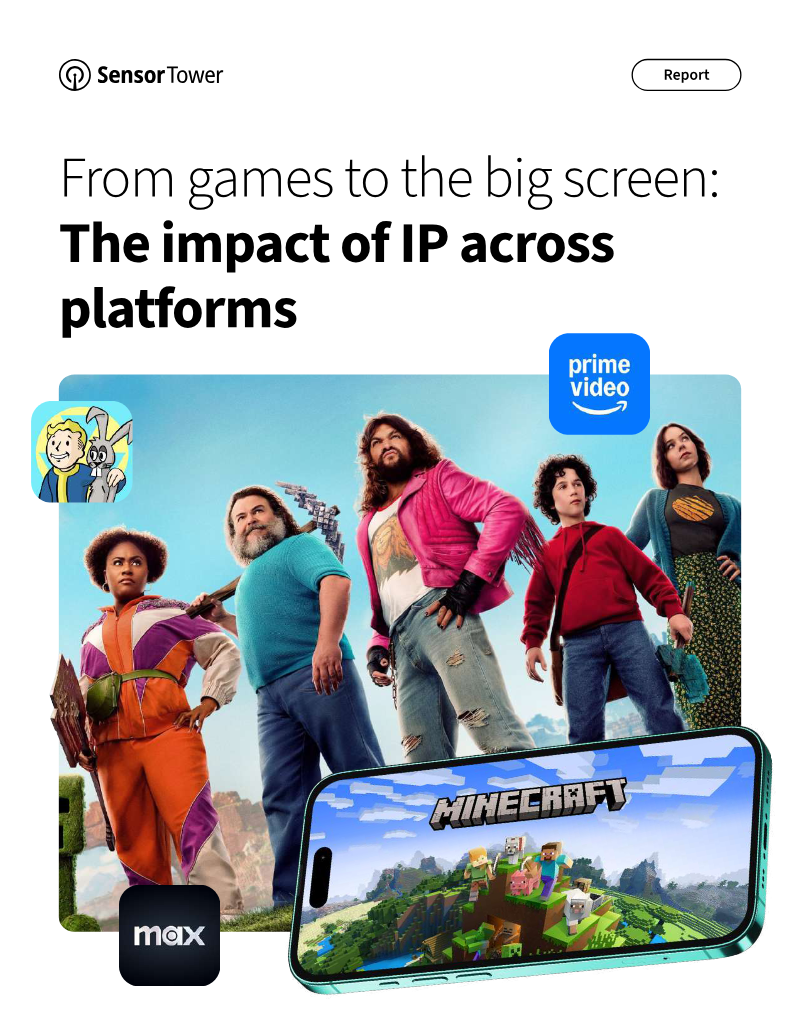
From Games to the Big Screen: The Impact of IP Across Platforms
The entertainment industry is increasingly leveraging a transmedia strategy where video game intellectual property serves as the foundation for high-budget scripted content. This approach creates a symbiotic relationship between platforms, where the release of films and television series triggers a boomerang effect that revitalizes interest in the original games. Data indicates that these adaptations drive significant growth across multiple metrics, including active users, digital downloads, and in-app purchases, while simultaneously boosting the performance of the streaming services hosting the content.
The scope of this analysis covers major cross-platform releases between 2024 and 2025, focusing on global mobile, PC, and console gaming segments alongside digital advertising and streaming app performance. Key findings highlight the success of the Minecraft movie, which grossed over $900 million and led to a 44% spike in mobile in-app revenue and a 36% increase in console sales. Similarly, the Fallout television series drove a 23% increase in Amazon Prime Video downloads and a massive 410% surge in daily sales for Fallout 4 on PC. The longevity of this impact is notable, with daily active users for legacy Fallout titles remaining 225% higher for up to 20 weeks following the show's premiere.
Methodology relies on proprietary data from Sensor Tower, tracking digital market insights, app usage, and advertising spend. The data reveals that strategic marketing is essential to this success; for instance, Amazon increased its desktop video ad spend twentyfold to promote Fallout, specifically targeting gaming-focused platforms like Twitch and IGN. While results vary based on the faithfulness of the adaptation and the monetization model of the game, the overarching trend suggests that transmedia releases are a powerful tool for re-engaging historical players and attracting new audiences to established gaming franchises.
- The Fallout television series triggered a 410% surge in daily PC sales for Fallout 4 and sustained a 225% increase in daily active users for legacy titles for up to 20 weeks post-premiere.
- The Minecraft film grossed over $900 million while driving a 44% spike in mobile in-app revenue and a 36% increase in console sales.
- Transmedia adaptations create a symbiotic growth loop that simultaneously boosts gaming metrics and streaming platform performance, such as the 23% increase in Amazon Prime Video downloads following the Fallout series launch.
- Strategic marketing is a critical success factor, evidenced by Amazon increasing its desktop video ad spend twentyfold on gaming-centric platforms like Twitch and IGN to support the Fallout release.
- Video game IP is increasingly serving as a foundation for high-budget scripted content to re-engage historical players and attract new audiences across mobile, PC, and console segments.
+2
Sensor TowerJan 2025
Report22 pages
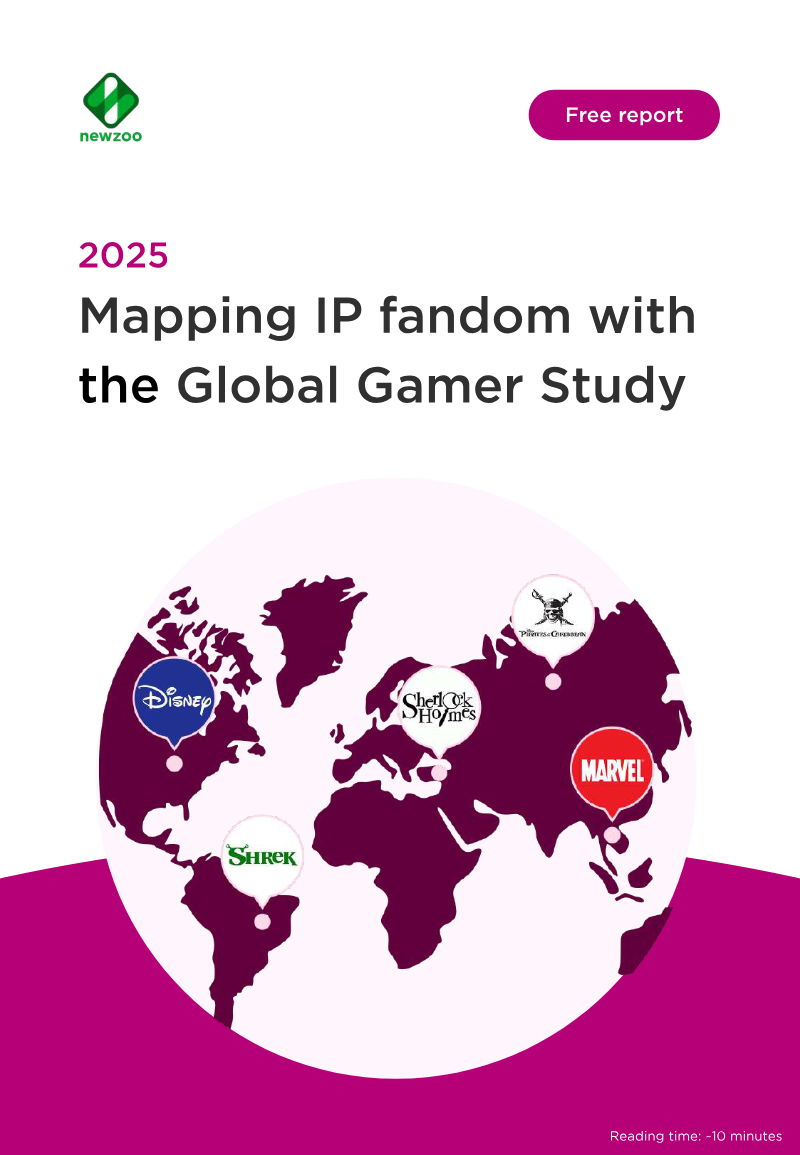
Mapping IP fandom with the Global Gamer Study
This analysis explores the intersection of intellectual property (IP) fandom and player engagement within the global gaming industry. The primary thesis is that while transmedia collaborations are essential for driving player acquisition and retention in a live-service landscape, the effectiveness of an IP is heavily dictated by regional awareness and cultural sentiment. Success in global gaming requires a move away from one-size-fits-all licensing toward market-specific strategies that align with local fanbases.
The findings are based on the 2025 Global Gamer Study, which surveyed over 73,000 consumers across 36 markets, tracking awareness and attitudes toward 42 popular entertainment IPs. Data indicates that a majority of gamers in 24 of the 36 countries are more likely to play a game featuring their favorite IP. This influence is strongest in South Asia (74%) and Latin America (64%), while Western Europe and Oceania show more reserved engagement levels (45%).
The research categorizes IPs into four quadrants based on the relationship between awareness and favorability. Global Favorites, such as Harry Potter and Disney, maintain near-universal recognition (90%) and high sentiment. Familiar Faces like Star Wars and Barbie possess high awareness but suffer from polarizing or lower favorability in specific regions. Hidden Gems, including Studio Ghibli and various anime titles, maintain niche global awareness but command intense loyalty in specific markets like Japan or Vietnam. Finally, IPs with Limited Appeal, such as Doctor Who or Percy Jackson, struggle with both low recognition and lukewarm sentiment outside their core territories.
Geographic variations are stark; for instance, anime franchises like Dragon Ball achieve 85–90% awareness in Latin America and Southeast Asia, nearly double their recognition in the West. Conversely, Western staples like DC Comics see high awareness in the U.S. (70%) but significantly lower traction in Japan (21%). The study concludes that cultural resonance, linguistic accessibility, and historical distribution patterns are the primary drivers of IP success in the gaming sector.
- In 24 of 36 surveyed markets, gamers are more likely to play a title featuring an IP they favor, confirming that transmedia collaborations are a primary driver for acquisition and retention.
- IP influence on player engagement varies significantly by region, peaking in South Asia (74%) and Latin America (64%) compared to more reserved engagement in Western Europe and Oceania (45%).
- Global Favorites like Harry Potter and Disney maintain 90% recognition with high sentiment, whereas IPs like DC Comics show extreme regional variance, with 70% awareness in the U.S. versus only 21% in Japan.
- Anime franchises like Dragon Ball demonstrate the importance of market-specific strategies, achieving 85–90% awareness in Latin America and Southeast Asia—nearly double their recognition in Western markets.
- The 2025 Global Gamer Study, which tracked 42 entertainment IPs across 73,000 consumers, identifies cultural resonance, linguistic accessibility, and historical distribution as the primary determinants of IP success.
+1
NewzooJan 2025
Report56 pages
Gaming: Your Marketing Cheatcode
Gaming has evolved into a horizontal cultural layer encompassing 3.4 billion global players who utilize interactive platforms to build identity and community. Despite this massive reach, the sector currently receives less than 5% of global media investment, representing a significant disconnect between consumer attention and advertising spend. The industry is increasingly defined by transmedia expansion and social connectivity, particularly among Gen Z audiences who prioritize platforms like Roblox and Discord for brand discovery and social interaction. Success in this landscape requires a strategic shift from isolated sponsorships toward full-funnel integrations that align with specific player motivations, including relaxation, achievement, and immersion.
The shift toward non-intrusive brand integration utilizes high-impact formats such as rewarded video and custom in-game partnerships to secure superior video completion rates and brand recall. Immersive strategies drive substantial consumer consideration, with 55% of players expressing interest in branded virtual items. Furthermore, custom experiences within gaming environments can yield up to 100x higher attention levels than traditional social media. Case studies involving major titles like Genshin Impact demonstrate that blending digital fandom with real-world value can result in triple-digit sales growth and heightened community engagement.
As a full-funnel engine, gaming integrations now produce measurable lifts in awareness and consideration through interactive campaigns. Data indicates that gamified loyalty programs can increase purchase rates by 12% and guest spend by 64%, while in-game commerce on platforms like Roblox generates significant revenue for developers. Looking ahead, the industry trajectory is shaped by the expansion of cloud gaming and highly anticipated hardware and software launches, such as the Nintendo Switch 2 and Grand Theft Auto VI. These developments reinforce gaming's role as a primary driver of modern media consumption and commercial conversion.
- Gaming commands 3.4 billion players globally, yet receives less than 5% of total media investment, indicating a significant misalignment between consumer attention and advertising spend.
- Custom in-game experiences can generate up to 100x higher attention levels compared to traditional social media platforms.
- Immersive brand strategies are highly effective, with 55% of players expressing interest in acquiring branded virtual items.
- Gamified loyalty programs are proven to drive commercial performance, increasing purchase rates by 12% and guest spend by 64%.
- Strategic integration in titles like Genshin Impact demonstrates that blending digital fandom with real-world value can trigger triple-digit sales growth.
+1
dentsu gamingJan 2025
Report112 pages
Championing the 25 Retailers and Digital Services Who Connect Music, Video and Games Creators with UK Fans Yearbook
The United Kingdom’s entertainment market reached a historic milestone in 2024, achieving a record valuation of £12.0 billion. This performance marks twelve consecutive years of growth and a 50% increase in market value since 2019. The industry has undergone a near-total digital transformation, with streaming and digital services now accounting for 93% of total revenues. Subscription-based models have become the primary engine of this economy, representing over three-quarters of total consumer spend across the music, video, and gaming sectors.
Video remains the largest individual segment, valued at £5.0 billion. This growth is fueled almost exclusively by Subscription Video on Demand (SVoD), which rose 8.3% to reach £4.46 billion, offsetting a sixteen-year decline in physical media. Conversely, the gaming sector experienced a 4.4% contraction to £4.61 billion. This decline was driven by a sharp 34.5% collapse in physical software sales and a cyclical downturn in hardware as major consoles reach maturity. Despite this, gaming remains overwhelmingly digital, with 98.6% of consumer spend occurring through online channels, particularly via mobile gaming and digital subscriptions.
Music emerged as the fastest-growing sector, reaching a record £2.4 billion. While digital streaming accounts for 85% of this value, the music industry is unique for its resilient physical market. Vinyl LPs saw their 17th consecutive year of growth, with unit sales rising to 7.1 million. This resurgence has revitalized the high street; independent music shops now account for 24% of total outlets, up from just 2% in 2015. While supermarkets and traditional retailers are exiting the physical games and video space, specialist and independent retailers are capturing a five-year high in physical market share, supported by major promotional events and a consumer shift toward high-definition and collectible formats.
- The UK entertainment market reached a record £12.0 billion valuation in 2024, marking twelve consecutive years of growth and a 50% increase since 2019.
- Digital services and streaming now dominate the industry, accounting for 93% of total revenue, with subscription models driving over 75% of consumer spending.
- Video is the largest sector at £5.0 billion, fueled by an 8.3% rise in Subscription Video on Demand (SVoD) to £4.46 billion, which successfully offset the decline in physical media.
- The gaming sector contracted 4.4% to £4.61 billion, impacted by a 34.5% collapse in physical software sales and a cyclical downturn in console hardware.
- Music is the fastest-growing sector at £2.4 billion, supported by a resilient physical market where vinyl LP sales grew for the 17th consecutive year to 7.1 million units.
ERAJan 2025

Report23 pages
U.S. Gamer Segmentation 2024 Edition
This analysis of the 2024 U.S. video gaming market identifies a resilient landscape where 71% of the population, or approximately 236.4 million people, engage with games. While this reflects a slight decline from the 74% peak seen in 2020, it remains significantly higher than the 67% recorded in 2018. The study utilizes a survey of 5,100 active gamers aged two and older, conducted between May and June 2024, to categorize the audience into six distinct behavioral segments: Super Gamers, Console Warriors, Transitionals, Easy Accessors, Daily Dabblers, and Incidental Players.
A primary finding is that while the total player count has dipped slightly, engagement and monetization are increasing. Gamers now spend an average of 14.5 hours per week playing, an increase of 1.8 hours since 2022. Spending has also risen to an average of $56.20 over a six-month period. Mobile remains the most pervasive platform, used by 65% of the total population, while console gaming has seen the most significant growth in weekly time investment. Conversely, PC gaming saw a 4% decline in reach since 2022.
The market is shifting toward more dedicated segments. There has been a notable decrease in casual "Incidental Players" and "Daily Dabblers," with a corresponding migration toward "Super Gamers" and "Transitionals." Super Gamers represent the most valuable demographic, typically consisting of males aged 18 to 34 who play across multiple platforms and engage deeply with gaming culture, including streaming and esports. Although teens and young adults remain the most valuable segments in terms of time and spend, the report notes that player investment is rising across nearly all age groups despite the overall contraction in the total number of gamers.
- The U.S. gaming population stands at 236.4 million people, representing 71% of the population, which is a slight decline from the 2020 peak of 74% but remains above 2018 levels.
- Average weekly engagement has increased to 14.5 hours, up 1.8 hours since 2022, while average spending over a six-month period has risen to $56.20.
- The market is shifting toward more dedicated segments, with a migration away from casual 'Incidental Players' and 'Daily Dabblers' toward 'Super Gamers' and 'Transitionals'.
- Mobile remains the dominant platform with 65% reach, while console gaming has experienced the most significant growth in weekly time investment.
- PC gaming reach has declined by 4% since 2022.
+1
CircanaAug 2024
Report30 pages
Global Gamer Study 2024: How Consumers Engage with Games Today
This analysis examines global consumer engagement with video games, drawing on data from over 73,000 surveyed individuals across 36 markets. The findings reveal that gaming has become a dominant pillar of modern entertainment, with 80% of the total online population playing games and 85% engaging with the medium through playing, viewing content, or participating in social communities. Engagement is highest among younger demographics; over 90% of Gen Alpha and Gen Z consumers are game enthusiasts, with Gen Alpha notably spending more time on gaming (5.2 hours per week) than on social media.
The data highlights a significant shift in how different generations and genders interact with the medium. While Adventure is the top genre for Gen Alpha, Gen Z, and Millennials, younger female players are increasingly likely to invest in pay-to-play titles, challenging traditional industry stereotypes. On PC and console platforms, players are motivated primarily by vast open worlds and deep storytelling. These platforms also attract higher-spending audiences compared to mobile; 22% of console players spend more than $25 per month, and over half are classified as medium-to-high spenders.
Despite a market where a small number of established franchises capture the majority of playtime, a vital segment of "new game seekers" remains. Approximately 31% of PC and console players actively hunt for trending titles. This cohort is highly valuable, as 80% of them spend money on games monthly and they are 50% more engaged than the average player. Geographically, this appetite for new experiences is strongest in emerging markets like China, India, and Saudi Arabia, while more mature markets like Japan and Western Europe show more conservative play patterns. The findings suggest that success in a competitive landscape requires moving beyond playable experiences to engage consumers across multiple dimensions, including social media, creator content, and transmedia brands.
- Gaming is a primary entertainment pillar, with 80% of the global online population playing games and 85% engaging through play, viewing, or social communities.
- Gen Alpha and Gen Z are the most active demographics, with over 90% engagement and Gen Alpha spending 5.2 hours per week on gaming, surpassing their time spent on social media.
- A high-value segment of 'new game seekers' makes up 31% of PC and console players; these users are 50% more engaged than average players and 80% of them spend money on games monthly.
- PC and console platforms command higher spending than mobile, with 22% of console players spending over $25 per month and more than half classified as medium-to-high spenders.
- Emerging markets including China, India, and Saudi Arabia show the strongest appetite for new titles, contrasting with more conservative play patterns in Japan and Western Europe.
+1
NewzooJul 2024

Report20 pages
Stream Hatchet Q2 2024 Report
Live streaming viewership reached 8.5 billion hours watched in the second quarter of 2024, marking a 10% year-over-year increase and a significant resurgence following a post-pandemic decline. While Twitch remains the market leader, its dominance is waning; its market share of hours watched fell from 70% in Q2 2023 to 60% in Q2 2024. This shift is driven by the growth of YouTube Gaming, which rose to a 23% share, and the emergence of alternative platforms like Kick, which now holds 5.5% of the market. Regional and niche platforms such as the South Korean Chzzk and the politically-oriented Rumble also gained traction, with the latter seeing a viewership spike during U.S. presidential debates.
The industry is also witnessing a democratization of viewership. The market share held by the top 5% of creators dropped from 98% in 2019 to 86% in 2024, suggesting a more diverse ecosystem for smaller streamers. In terms of content, Grand Theft Auto V and League of Legends remain the most-watched titles, though the Action genre saw a 30% surge driven by the Elden Ring DLC. Esports viewership remained stable at 654 million hours, with the League of Legends Mid-Season Invitational serving as the quarter's premier event.
This analysis covers global live-streaming trends across major platforms including Twitch, YouTube, Kick, and several emerging services. Data is derived from Stream Hatchet’s business intelligence platform, which aggregates granular viewership metrics such as hours watched and peak concurrent viewers. The findings highlight a transition from traditional FPS and MOBA dominance toward more dynamic RPG and Action titles, alongside a shifting platform landscape where new competitors are successfully challenging established leaders.
- Live streaming viewership reached 8.5 billion hours in Q2 2024, representing a 10% year-over-year increase.
- Twitch's market share of hours watched declined from 70% in Q2 2023 to 60% in Q2 2024.
- YouTube Gaming grew to a 23% market share, while the platform Kick captured 5.5% of the total viewership.
- The top 5% of creators now account for 86% of total viewership, down from 98% in 2019, indicating a more democratized creator ecosystem.
- The Action genre experienced a 30% surge in viewership, largely driven by the release of the Elden Ring DLC.
+1
Stream HatchetJun 2024
Report14 pages
Children’s In-Game Spending 2024
Ipsos’ fifth edition of the In‑Game Spending by Children and Parent Supervision study tracks how European families manage micro‑transactions in video games, focusing on trends from 2018 through 2024. The research aims to gauge the prevalence of child‑initiated spending, the amount of money involved, and the supervisory mechanisms parents employ. The 2024 survey covered the United Kingdom, France, Germany, Spain and Italy, sampling 2,772 adults with children who play games and 10,998 gamers aged 11‑64, using quota‑based online panels weighted to national populations.
Three‑quarters of parents report that their children do not purchase in‑game extras, a proportion that has remained stable since 2020. Among the 26 % who do spend, average monthly outlays fell to €31, down €8 from the previous year, with 73 % of spenders allocating €1‑20 per month. Gameplay‑impacting items such as new weapons or powers attract the most expenditure (38 %), while decorative cosmetics account for 30 % and loot‑box‑type rewards remain the least popular at 21 %. Parental oversight is high: 95 % of spending households have an agreement with their child, and 63 % maintain explicit rules, either requiring permission (49 %) or setting limits (27 %). Permission‑based agreements and two‑factor authentication have risen year‑on‑year, while a minority (5 %) admit to monitoring nothing.
Among all gamers surveyed, only 11 % have ever bought real‑money in‑game currency and 4 % have purchased loot boxes, figures that have shown little change over
- The majority of children (74%) do not make in-game purchases, a stability trend maintained since 2020.
- Among the 26% of children who do spend money in-game, the average monthly expenditure dropped to €31, with 73% of these spenders limiting their costs to €20 or less per month.
- Gameplay-impacting items like weapons or powers are the primary drivers of spending (38%), followed by decorative cosmetics (30%) and loot-box rewards (21%).
- Parental oversight is robust, with 95% of spending households having established agreements and 63% enforcing explicit rules such as mandatory permission (49%) or spending caps (27%).
- Only 11% of all surveyed gamers have purchased real-money in-game currency, and only 4% have purchased loot boxes, with both figures remaining largely stagnant.
+1
Video Games EuropeJun 2024
Report14 pages
Children’s In-Game Spending: Europe
This research analyzes trends in children’s in-game spending and parental oversight across major European markets, including Great Britain, France, Germany, Spain, and Italy. Based on an Ipsos survey conducted between February and April 2024, the study draws on responses from 2,772 parents of children who play video games, as well as a broader sample of nearly 11,000 players aged 11 to 64. The primary thesis is that while in-game monetization is a known element of modern gaming, the vast majority of children do not spend money on extras, and those who do are subject to high levels of parental monitoring and declining average expenditure.
Findings indicate that 76% of parents claim their children do not spend money on in-game extras, a figure that has remained stable since 2020. Among the minority who do spend, the average monthly expenditure dropped significantly from €39 in 2023 to €31 in 2024. The most common purchases are items that impact gameplay, such as new weapons or powers (38%), followed by cosmetic items (30%). Conversely, unknown rewards like loot boxes are the least popular category, with only 21% of spending children engaging with them. Among the general player population aged 11 to 64, only 11% have spent real money on in-game currency and only 4% on loot boxes.
Parental supervision remains a dominant factor in managing these transactions. Approximately 95% of parents whose children spend money in-game have an established agreement regarding expenditure. These agreements are often explicit, with 49% of children required to ask for permission and 27% operating under strict spending limits. The use of technical controls, such as two-factor authentication and spending caps, has seen a year-on-year increase, suggesting that parents are becoming more proactive in utilizing platform tools to regulate digital consumption.
- 76% of children do not spend money on in-game extras, a figure that has remained stable since 2020.
- Average monthly in-game spending among children who do make purchases dropped from €39 in 2023 to €31 in 2024.
- 95% of parents whose children spend money in-game have established formal agreements, with 49% requiring children to ask for permission and 27% enforcing strict spending limits.
- Gameplay-impacting items like weapons or powers are the most common purchases (38%), while loot boxes are the least popular, utilized by only 21% of spending children.
- Parental use of technical controls, such as two-factor authentication and spending caps, has increased year-on-year as a method for regulating digital consumption.
+1
IpsosJun 2024

Report9 pages
How Gamers Discover What to Play
Video game marketing remains a vital component of the industry, though consumer preferences have shifted toward authentic, multi-channel discovery rather than traditional overt sales tactics. Research conducted in May 2024 among 1,009 PC and console gamers in the United States reveals that the average player utilizes four to five different information sources before committing to a new title. This behavior underscores a move away from single-channel reliance toward a diverse marketing mix where authenticity and peer-led insights are prioritized over corporate messaging.
YouTube stands as the dominant platform for game discovery, used by 52% of respondents and cited as the most trusted source of information. However, discovery habits vary significantly by demographic. Younger gamers aged 18–24 are twice as likely to use TikTok and Instagram for news compared to those aged 34–44. Gender also influences platform choice, with men favoring YouTube and Twitch, while women are 13% more likely than men to utilize TikTok for discovery. Despite the prevalence of these platforms, trust remains fragmented; while YouTube is the most trusted, social media platforms like TikTok and X are frequently viewed with skepticism, suggesting that trust resides more in specific creators than the platforms themselves.
Purchasing decisions are primarily driven by familiarity and risk mitigation. Forty percent of gamers prioritize established franchises they already enjoy, and 25% favor games from respected developers. While reviews and influencer endorsements remain influential, cost-related factors such as subscription services and price promotions also play a significant role in the decision-making process. Ultimately, the data suggests that successful game discovery relies on building a presence across multiple social and video platforms while leveraging established brand equity and influencer relationships to overcome consumer distrust.
- Gamers utilize an average of four to five distinct information sources before purchasing a new title, reflecting a shift away from single-channel marketing reliance.
- YouTube is the primary discovery platform for 52% of gamers and is ranked as the most trusted source of information.
- Purchasing decisions are driven by risk mitigation, with 40% of players prioritizing established franchises and 25% favoring games from respected developers.
- Demographic discovery habits vary significantly, as gamers aged 18–24 are twice as likely to use TikTok and Instagram for news compared to those aged 34–44.
- Gender influences platform preference, with women being 13% more likely than men to use TikTok for game discovery.
+1
Big Games MachineMay 2024
Report33 pages
Mistplay Mobile Gaming Spender Report 2024: Decoding Mobile IAP Spenders
The mobile gaming landscape in 2024 is defined by a shift toward a more discerning consumer base, as economic headwinds prompt 32% of all spenders and 41% of high-value spenders to plan for reduced in-game expenditures. While gameplay progression and relaxation remain the primary motivators for engagement, publishers face increasing pressure to justify costs. Retention and monetization now depend heavily on the first month of play, during which 79% of spenders make their initial purchase. However, player churn is rising due to perceived imbalances in game mechanics, lack of progression value, and aggressive pricing structures that alienate low-to-mid-value segments.
To combat these challenges, the industry is pivoting toward value-driven incentives and personalized engagement strategies. Loyalty programs have emerged as a critical tool for sustainability, with 79% of spenders actively engaging with rewards and 60% of high-value players indicating a higher likelihood of spending when redeemable rewards are offered. While social recommendations and paid advertisements remain the primary drivers for game discovery and initial installs, they rarely influence long-term spending. Instead, financial commitment is triggered by tailored in-app deals and limited-time promotions that align with specific gameplay milestones.
Strategic growth in the current market requires a move toward diversified revenue streams and direct-to-consumer models. Implementing web shops can increase revenue by up to 25% by bypassing traditional app store fees and offering more flexible pricing. Although RPG and Strategy genres continue to dominate high-value spending through deep progression systems, success across all segments now requires a focus on lifetime value through frequent, lower-cost purchase options and transparent, fair-play mechanics. By prioritizing loyalty-driven in-app purchase strategies, publishers can maintain stability despite a more cautious spending environment.
- Economic pressure is causing 32% of all spenders and 41% of high-value spenders to plan for reduced in-game expenditures in 2024.
- The first month of play is critical for monetization, as 79% of spenders make their initial purchase during this period.
- Loyalty programs are essential for retention, with 79% of spenders engaging with rewards and 60% of high-value players reporting increased spending likelihood when redeemable rewards are offered.
- Implementing web shops can boost revenue by up to 25% by bypassing app store fees and enabling more flexible pricing structures.
- Player churn is rising due to aggressive pricing, perceived mechanical imbalances, and a lack of progression value, particularly among low-to-mid-value segments.
+1
MistplayMar 2024

Report53 pages
Mobile App Trends 2024: Japan Edition
The Japanese mobile app market maintains its status as a global powerhouse, generating $17.9 billion in consumer spending and 2.5 billion downloads in 2023. Despite a marginal decline in annual installs, the market demonstrated a strong recovery in the first quarter of 2024, characterized by a 3.5% rise in spending and a 3% increase in downloads. This growth is underpinned by high user engagement and a notable 30% ATT opt-in rate within the gaming sector, signaling a resilient ecosystem for data-driven marketing and monetization.
Mobile gaming remains the primary revenue driver, with RPGs accounting for nearly half of all consumer spend and achieving a high average revenue per monthly active user of $5.09. However, the landscape is evolving toward deeper immersion, as evidenced by simulation games reaching average session lengths of over 40 minutes. Simultaneously, the finance and e-commerce sectors are experiencing rapid expansion. Finance apps saw a 53.5% spending surge in early 2024, while e-commerce lifetime value in Japan reached $9.67 by the end of the first month, nearly doubling global medians.
Strategic shifts in user acquisition are evident across all segments, with a marked transition toward paid channels. The paid-to-organic install ratio for gaming reached 2.31 in early 2024, while finance and e-commerce also saw significant increases in paid acquisition efforts. This trend is complemented by the emergence of Connected TV as a critical performance channel. With ad spend projected to reach 170 billion yen by 2025, advertisers are increasingly reallocating budgets from social media to CTV to leverage its high viewership and its proven ability to assist in driving mobile app installs through sophisticated measurement and AI-driven creative optimization.
- The Japanese mobile market generated $17.9 billion in consumer spending in 2023, with Q1 2024 showing a 3.5% increase in spending and a 3% rise in downloads.
- Mobile gaming remains the primary revenue driver, with RPGs capturing nearly 50% of consumer spend and simulation games achieving session lengths exceeding 40 minutes.
- Finance apps experienced a 53.5% surge in spending in early 2024, while e-commerce apps reached a first-month lifetime value of $9.67, nearly double the global median.
- Connected TV is emerging as a critical performance channel, with ad spend projected to reach 170 billion yen by 2025 as advertisers shift budgets away from social media.
- User acquisition strategies have shifted heavily toward paid channels, evidenced by a 2.31 paid-to-organic install ratio in the gaming sector during early 2024.
+1
Sensor TowerMar 2024

Report21 pages
2023 Roblox Report: Behind the Data
The 2023 Roblox Report, produced by GameAnalytics, provides a comprehensive analysis of player behavior and performance benchmarks across the Roblox platform. The study is based on 2023 data from thousands of games that utilize the GameAnalytics SDK, representing over 50% of total player engagement on the platform. The dataset includes a significant sample of high-performing titles, featuring 300 games with over one million monthly active users and 60 titles exceeding ten million monthly sessions.
The findings reveal a highly fluid player base, with 47% of users accessing the platform via both mobile and desktop devices. Engagement is characterized by high frequency rather than single long sessions; over 50% of players engage at least twice daily, and the top 5% of games successfully bring players back more than 3.5 times per day. While the average session length for half of the tracked games is under six minutes, elite titles in the 95th percentile sustain engagement for nearly 30 minutes per session.
Monetization remains a significant challenge on the platform. Only 4.2% of players spend Robux within games, and more than half of those spenders contribute less than $1 annually. However, a small segment of high-value "power spenders" drives the majority of revenue, with the top 5% of games earning approximately $77 per playing player annually. Retention is identified as a universal struggle across the platform regardless of game quality; Day 1 retention typically ranges between 12% and 15%, dropping to near 1% by Day 90. The report concludes that success on Roblox requires optimizing for cross-platform play, implementing aggressive LiveOps to counter natural retention decay, and focusing on session frequency to drive monetization.
- Retention is a universal challenge on Roblox, with Day 1 retention averaging 12% to 15% and falling to approximately 1% by Day 90.
- Monetization is highly concentrated, as only 4.2% of players spend Robux, with over half of those spenders contributing less than $1 annually.
- Top-tier games in the 95th percentile generate approximately $77 per playing player annually, significantly outperforming the broader platform average.
- Player engagement is driven by frequency rather than session length, with over 50% of users playing at least twice daily and top games achieving over 3.5 sessions per day.
- While the median session length for half of tracked games is under six minutes, elite titles in the 95th percentile sustain sessions of nearly 30 minutes.
+1
GameAnalyticsMar 2024

Report32 pages
Gaming Report 2024: Meet the Moment
The global video game market, valued at $196 billion in 2023, is entering a period of sustained expansion with a projected annual growth rate of 6% through 2028. This upward trajectory is primarily fueled by younger demographics who increasingly utilize gaming environments as essential hubs for social interaction, creative expression, and commerce. To capitalize on this shift, industry leaders must pivot away from traditional, siloed development toward immersive, cross-platform ecosystems that prioritize interoperability and the integration of user-generated content. Expanding intellectual property across diverse media formats is now a critical requirement for maintaining relevance and maximizing consumer engagement.
The industry is simultaneously undergoing a structural transition toward a hardware-agnostic model, necessitated by the rise of cloud-based distribution and the demand for seamless, multi-channel experiences. As market saturation intensifies, the high failure rates observed in mobile gaming underscore the need for more rigorous operational discipline. Companies are increasingly required to align product development, finance, and marketing functions through data-driven strategies. By leveraging artificial intelligence to optimize user acquisition and retention, organizations can better navigate the volatility of the current landscape and address the growing disparity between headcount expansion and actual revenue growth.
To secure long-term viability, gaming organizations are modernizing their internal structures by standardizing development tools and fostering entrepreneurial autonomy. This evolution includes a holistic integration of generative AI into core workflows to improve operational efficiency and scale production capabilities. Furthermore, as competition for specialized talent intensifies, firms are refining their compensation and support models to align with broader technology industry standards. These combined technological and organizational shifts are essential for navigating current market turbulence and ensuring that gaming entities remain competitive in an increasingly complex and interconnected digital economy.
- The global video game market reached a $196 billion valuation in 2023 and is projected to grow at an annual rate of 6% through 2028.
- Industry growth is driven by younger demographics treating gaming environments as primary hubs for social interaction, commerce, and creative expression.
- Market leaders must transition from siloed development to immersive, cross-platform ecosystems that prioritize interoperability and user-generated content.
- The industry is shifting toward a hardware-agnostic model, requiring companies to adopt cloud-based distribution and seamless multi-channel experiences.
- Organizations must integrate generative AI into core workflows to improve operational efficiency, scale production, and address the disconnect between headcount growth and revenue.
+2
Bain & CompanyJan 2024

Report53 pages
The Xsolla Report: State of Play – Summer Edition 2024
The Summer Edition of the Xsolla Report demonstrates that indie game development has entered a phase of rapid democratization and commercial viability. Accessible engines such as Unity, Unreal, and the fast‑growing Godot now dominate production pipelines, enabling more than 8 000 titles to launch in 2023. Coupled with free or low‑cost asset stores and cloud backend services, indie studios can cut development time and costs dramatically, accelerating time‑to‑market and allowing them to compete with larger studios.
Sales data confirm the shift: indie titles generated over $15 million in lifetime revenue on Steam alone, and now account for 31 % of total Steam earnings. Action, adventure, and RPG genres remain the most lucrative, while indie games enjoy higher average Steam ratings (≈72 %) than AAA titles. The market share of indie games on PC and console platforms rose from 13 % in 2021 to 18 % in the United States, underscoring a growing consumer appetite for independent titles.
Influencer marketing has become the primary driver of discovery and purchase decisions, with YouTube still commanding the highest impact but TikTok and Instagram offering more cost‑effective alternatives. The sector’s marketing spend is projected to triple, reaching $24 billion by 2024. Meanwhile, the convergence of education and gaming—through MOOCs, online academies, and immersive technologies—has expanded the talent pipeline, raising average developer salaries from $60 k in 2010 to $95 k in 2024.
Geographically, the report focuses on North America and Europe, with a particular emphasis on U.S. market dynamics, while the time frame spans 2021–2024. The findings highlight that strategic adaptability, influencer partnerships, and cloud‑based commerce tools are essential for publishers, developers, and investors to capture the expanding indie market.
- Indie games now account for 31% of total Steam earnings, with their U.S. market share on PC and console platforms rising from 13% in 2021 to 18% in 2024.
- Marketing spend for the indie sector is projected to triple to $24 billion by 2024, with influencer partnerships on YouTube, TikTok, and Instagram serving as the primary drivers of discovery.
- Indie titles are outperforming AAA games in quality perception, maintaining an average Steam rating of approximately 72%.
- The democratization of development via engines like Unity, Unreal, and Godot, alongside cloud backend services, enabled the launch of over 8,000 indie titles in 2023.
- The talent pipeline has expanded through educational convergence, contributing to a rise in average developer salaries from $60,000 in 2010 to $95,000 in 2024.
+1
XsollaJan 2024

Report32 pages
Gaming Report 2024: Meet the Moment – How Gamers Are Changing the Game
The report demonstrates that the global video‑game market reached $196 billion in 2023 and is expected to grow at roughly 6 % per year through 2028. Growth is driven by a youthful demographic—80 % of players aged 2‑18—who devote nearly one third of their entertainment time to gaming. These gamers increasingly engage in immersive, cross‑platform ecosystems that combine social interaction, co‑creation and real‑world extensions of game IP. Their spending per hour can be up to five times higher when they participate in multiple activities, underscoring the commercial value of integrated experiences.
Key findings reveal that 70 % of players use multiple devices and 90 % desire a single consolidated marketplace, with half willing to pay for it. Publishers are therefore urged to develop device‑agnostic platforms, strengthen direct relationships with players and employ data‑driven marketing. In the mobile sector, an 80 % failure rate after three years contrasts sharply with a 10–25 % failure rate in software and retail, highlighting the need for highly targeted paid performance marketing, rigorous A/B testing and tight alignment across development, finance and marketing teams. Long‑term acquisition and retention strategies, coupled with generative AI for ad creation and optimization, are identified as critical success factors.
Operating models at leading studios are shifting toward standardised core tools, autonomous entrepreneurial teams with clear milestones and strategic embedding of generative AI. Talent attraction now demands a comprehensive package that includes purpose, competitive pay, work‑life balance, learning paths and ESG commitments to remain competitive with the broader tech industry. The report’s thesis is that understanding diverse gamer segments, delivering interoperable cross‑platform experiences and investing in data‑driven, AI‑enhanced operations are essential for capturing the rapidly expanding, monetarily active gaming audience.
- The global video game market reached $196 billion in 2023 and is projected to grow at an annual rate of approximately 6% through 2028.
- Engagement in immersive, cross-platform ecosystems is highly lucrative, as players spend up to five times more per hour when participating in multiple activities rather than gaming alone.
- Mobile game titles face an 80% failure rate after three years, necessitating rigorous A/B testing, targeted performance marketing, and tight alignment between development and finance teams.
- Consumer demand for platform interoperability is high, with 90% of players desiring a single consolidated marketplace and 50% willing to pay for such a service.
- Youth aged 2–18 represent 80% of the player base and dedicate nearly one-third of their total entertainment time to gaming.
+1
Bain & CompanyJan 2024
Report35 pages
How Consumers Engage with Games Today: Newzoo’s Global Gamer Study 2024
Gaming dominates contemporary culture, with eight in ten global consumers actively playing or engaging in related activities. The study identifies a highly engaged, high‑spending cohort—particularly Gen Alpha and Gen Z players—who devote an average of 5.2 hours per week to gaming, outpacing social media use. These younger generations also participate in content viewing and community interaction, favoring adventure‑type titles that deliver trend‑driven experiences.
Gen Z’s motivations center on expansive open worlds (66–73%) and deep storytelling (65–68%), with optional tasks, high‑speed action, competitive duels (71%) and cooperative goals (68%) also prominent. Their average daily playtime on PC/console is 2.1 hours, and 22 % spend $25 or more monthly, demonstrating a willingness to pay upfront. In contrast, mobile players prefer free‑to‑play models and lower spend levels.
A significant segment of PC/console gamers—about one third—are “new game seekers.” They spend 7–8 hours weekly, often across two or three platforms, and are predominantly Gen Z (42%) and Baby Boomers. These players allocate over $25 monthly on average, favor adventure, fighting, shooter, racing and battle‑royale titles with high graphics fidelity and survival themes. They consume gaming media at a rate exceeding 90 % and show strong loyalty to franchise titles such as Call of Duty, FIFA, and Roblox.
The findings underscore that Gen Alpha and Gen Z represent a sizable, spend‑capable audience for expansive, socially driven experiences. Simultaneously, the new‑game‑seeker cohort highlights opportunities for high‑quality, cross‑genre titles that appeal to both younger and older demographics across PC, console, and mobile platforms.
- Gen Z and Gen Alpha players spend an average of 5.2 hours per week gaming, surpassing their time spent on social media.
- Approximately 22% of Gen Z players spend $25 or more monthly on games, showing a strong preference for upfront payments compared to the free-to-play model favored by mobile gamers.
- One-third of PC/console gamers are 'new game seekers' who spend 7–8 hours weekly across multiple platforms and consistently invest over $25 monthly.
- Gen Z motivations are driven by open-world environments (66–73%), deep storytelling (65–68%), competitive duels (71%), and cooperative goals (68%).
- New game seekers are predominantly Gen Z (42%) and Baby Boomers who show high loyalty to major franchises like Call of Duty, FIFA, and Roblox.
+1
NewzooJan 2024