Report21 pages
Tools & Services Survey: November 2024
This analysis examines the evolving landscape of game development tools and services amidst a period of significant market volatility. Based on a November 2024 survey of the Game Developer Collective, the findings track shifts in engine preference, cloud infrastructure, and overall industry sentiment. The survey includes a global sample of developers, with 48% based in North America and 39% in Europe, primarily representing roles in programming, management, and game design.
A primary focus is the game engine market, which continues to react to Unity’s 2023 "runtime fee" controversy. Despite Unity eventually scrapping the fee, the company has steadily lost market share to Unreal Engine. While the percentage of Unity users planning to switch engines dropped from a peak of 70% in late 2023 to 36% in late 2024, this remains significantly higher than the 14% switch rate seen among users of competing engines. Sentiment toward Unity has moderated, but only 30% of developers report being happy with the company, suggesting a lasting impact on brand trust.
The broader industry environment is characterized by increasing financial pressure and underperformance. Approximately 55% of developers now describe market conditions as "bad," a notable increase from 47% six months prior. Business performance has also declined, with 41% of studios reporting they are underperforming against expectations. Consequently, while investment in tools remains steady for most, there is a growing emphasis on productivity and efficiency as the primary drivers for new purchases. AI-powered tools are a rare area of growth, with studios more likely to increase spending in this category compared to traditional services.
In specialized segments, Blender has emerged as the leading 3D modeling tool, used by 50% of studios. Cloud platform usage is at an all-time high, led by AWS and non-hyperscaler options, though these services remain highly "sticky" with low intent to switch providers. Conversely, specialist backend platforms struggle with low penetration, as only 38% of studios currently utilize these centralized solutions. Overall, the findings depict a cautious industry prioritizing efficiency and stability while navigating a difficult commercial climate.
- Market sentiment is increasingly negative, with 55% of developers describing current conditions as 'bad' and 41% of studios reporting underperformance against expectations.
- Unity continues to lose market share following its 2023 runtime fee controversy, with 36% of its users still planning to switch engines compared to only 14% for competitors.
- Brand trust in Unity remains damaged, as only 30% of developers report being happy with the company despite the reversal of its controversial fee policy.
- Studios are prioritizing efficiency and productivity in their purchasing decisions, with AI-powered tools being the only category seeing increased spending compared to traditional services.
- Blender has become the dominant 3D modeling tool, currently utilized by 50% of surveyed studios.
+1
Game Developer CollectiveNov 2024
Report36 pages
Gaming Industry Report: Q3 2024
• 2024 market size: $188bn (+2.1% YoY) Total gamers in 2024 by region (millions): • Public markets: leading public gaming ETFs up 22- • 36% YTD (vs S&P 500 = 21%) Middle East & Africa Venture funding in Q3‘ 24: $517m across 92 deals 559 (funding +1% QoQ, number of deals -14% QoQ) (16%) • Epic sidesteps Apple in the EU, sues Google Europe (454 3,422m • Discord launches Activities ...
- The gaming market size in 2024 is $188 billion, showing a 2.1% year-over-year growth. Asia-Pacific accounts for the largest share of gamers with 1,809 million (53%), followed by Europe with 454 million (13%).
- Venture funding in Q3 2024 reached $517 million across 92 deals, marking a 1% increase in funding quarter-over-quarter but a 14% decrease in the number of deals. Total private market funding for 2024 is $3,739 million, with a 15% QoQ increase in Q3.
- Public market gaming ETFs are significantly outperforming the S&P 500, with leading ETFs up 22-36% year-to-date compared to the S&P 500's 21%.
- Unity has fully removed its Runtime Fee, reverting to a seat-based subscription model with increased revenue and funding ceilings for Unity Personal (up to $200k) and price increases for Unity Pro (+8%) and Unity Enterprise (+25%).
- Epic Games is actively challenging platform policies, launching its own iOS app store in the EU with a maximum 12% commission and suing Google and Samsung over anti-competitive practices related to app distribution on Android.
+5
KonvoyOct 2024
Report20 pages
Live Streaming Trend Report: Q3 2024
The analysis of live‑streaming activity in the third quarter of 2024 demonstrates a robust rebound in overall viewership, with total hours watched rising 12 percent year‑over‑year to reach 8.5 billion. Growth is concentrated on emerging services, most notably Kick, which expanded its audience by 103 percent, delivering 534 million hours of content and securing a 6.3 percent share of the market. Its peak week recorded 45 million hours watched, positioning Kick as the third‑largest platform despite Twitch’s modest 4 percent decline in the same period. The surge extends to Spanish‑language streams on Kick, where viewership accelerated sharply, underscoring the platform’s expanding appeal in non‑English markets.
Subscriber dynamics also reached new heights. VTuber ironmouse achieved an all‑time high of roughly 320 thousand followers on Twitch during the “SUBtember” marathon, while FaZe Clan’s 30‑day joint subathon generated 99.5 thousand and 73.7 thousand new subscribers for members jasontheween and plaqueboymax respectively. These figures illustrate a growing willingness among audiences to convert viewership into direct financial support for creators.
Esports viewership contributed a historic peak, with the LCK Grand Final between T1 and GEN drawing an estimated two million concurrent viewers, reinforcing the continued draw of high‑stakes competitive events. Collectively, the data reveal a diversifying ecosystem in which emerging platforms and regional language streams are reshaping audience distribution, while monetization through subscriptions and esports remains a powerful driver of engagement across the global live‑streaming landscape.
- Total live-streaming viewership reached 8.5 billion hours in Q3 2024, marking a 12 percent year-over-year increase.
- Kick emerged as the third-largest streaming platform with 534 million hours watched, representing a 103 percent growth rate and a 6.3 percent market share.
- Twitch experienced a 4 percent decline in viewership during Q3 2024, even as it hosted record-breaking subscriber events like ironmouse’s 320,000-follower marathon.
- Esports remains a primary engagement driver, evidenced by the LCK Grand Final between T1 and GEN drawing a peak of two million concurrent viewers.
- The live-streaming ecosystem is diversifying through the rapid expansion of non-English markets, particularly Spanish-language streams on the Kick platform.
+1
Stream HatchetSept 2024
Report17 pages
Console/PC Games Investment Report September 2024
The analysis presents a comprehensive review of investment and merger‑and‑acquisition activity within the console and PC video‑game sector for the 2023 fiscal year, positioning 2023 as an outlier driven primarily by Microsoft’s $68.7 billion acquisition of Activision Blizzard. Total deal value reached $69.5 billion across 200 transactions, a 612 % increase in value yet a 25 % decline in transaction count compared with 2022, and twice the combined value of the preceding five‑year period (2018‑2022). Investment volume fell to $627.8 million across 161 deals, while M&A volume surged to $68.8 billion in 39 deals, accounting for more than 99 % of North American M&A value. IPO activity contracted sharply, with six offerings generating $46 million in market capitalisation, down 85 % from the prior year.
Geographically, North America and Europe dominated private investment, contributing $184.7 million (29 % of volume) and $358.8 million (57 % of volume) respectively, while Australia and New Zealand saw limited activity aside from a government grant program. Investors favored micro‑studios (median six employees), whereas acquirers targeted slightly larger teams (median 39 employees). Blockchain‑related deals comprised 15 % of investment value but only 13 % of transaction count, highlighted by Mythic Protocol’s $6.5 million seed round.
Methodologically, the review counts only closed transactions, excluding announced deals, and treats SPAC proceeds as the investment amount rather than post‑transaction valuation. Data are drawn from a proprietary, sixteen‑year‑old database that tracks Western‑focused game‑industry deals across development, publishing, and technology, ensuring consistency and comparability across quarters. The findings underscore a market concentrated around a few mega‑deals, with modest activity elsewhere and a clear shift toward larger, strategic acquisitions.
- The 2023 fiscal year saw total deal value reach $69.5 billion, a 612% increase driven almost entirely by Microsoft’s $68.7 billion acquisition of Activision Blizzard.
- While total deal value surged, the actual number of transactions fell by 25% compared to 2022, and investment volume dropped to $627.8 million across 161 deals.
- M&A activity dominated the market with $68.8 billion across 39 deals, accounting for more than 99% of North American M&A value.
- IPO activity contracted significantly in 2023, with only six offerings generating $46 million in market capitalization, an 85% decline from the previous year.
- Private investment was concentrated in Europe and North America, which contributed 57% ($358.8 million) and 29% ($184.7 million) of investment volume, respectively.
+2
DDMSept 2024
Report20 pages
Live Streaming Trends Report: Q2 2024
The global live streaming industry experienced a significant resurgence in the second quarter of 2024, with total viewership reaching 8.5 billion hours. This 10% year-over-year increase represents the first substantial growth period since the pandemic-era peak. While Twitch maintains its position as the primary market leader, its dominance has softened from 70% to 60% of total hours watched. This shift reflects a diversifying landscape where YouTube Gaming and Kick have captured 23.4% and 5.5% of the market, respectively, and Rumble has established itself as a top-ten platform by leveraging political content and debate-related viewership.
Content trends during this period were heavily influenced by major software releases and political events. The launch of downloadable content for Elden Ring triggered a 331% surge in viewership for the title, driving a 30% increase in the broader Action genre. Conversely, traditional pillars such as First-Person Shooters and MOBAs saw slight declines in market share. The VTuber segment remains a high-growth area, particularly within the Grand Theft Auto V category, where individual creators saw viewership spikes exceeding 300%. Esports also reached new heights, evidenced by the LCK Grand Final achieving a record 2.7 million concurrent viewers.
A critical structural shift is occurring in creator demographics, characterized by the decentralization of viewership. The market share held by the top 5% of streamers fell to 86% from a 2019 high of 98%, while the share held by the top 0.01% of channels dropped from 45% to 33%. This trend suggests a maturing ecosystem where visibility is increasingly distributed among a broader range of mid-tier creators rather than being concentrated exclusively at the top. These findings indicate a healthy, diversifying industry that is successfully transitioning from pandemic-driven volatility to sustainable, multi-platform growth.
- The live streaming industry saw a 10% year-over-year growth in Q2 2024, reaching 8.5 billion total hours watched.
- Twitch's market share dropped from 70% to 60%, while YouTube Gaming and Kick captured 23.4% and 5.5% of the market, respectively.
- Viewership is decentralizing, with the top 5% of streamers now holding 86% of the market share, down from 98% in 2019.
- The top 0.01% of channels saw their market share decline from 45% to 33%, indicating a shift toward mid-tier creator visibility.
- Major software releases significantly impact genre performance, evidenced by Elden Ring's DLC launch driving a 331% surge in its viewership and a 30% increase in the broader Action genre.
+1
Stream HatchetJul 2024
Report1 pages
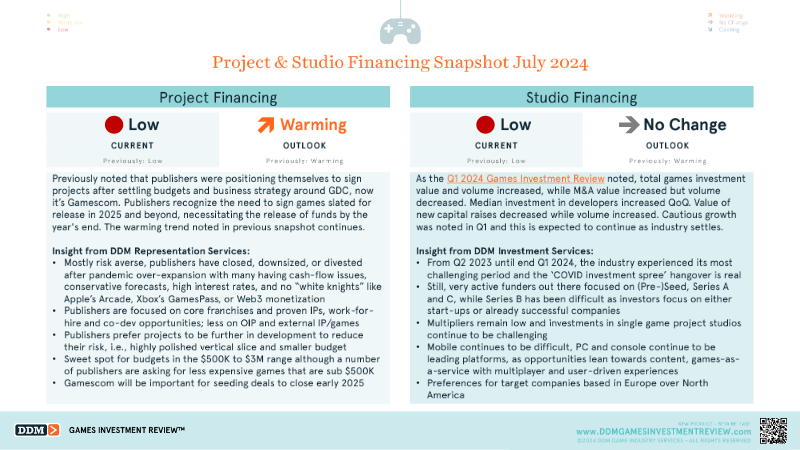
Project & Studio Financing Snapshot July 2024
The snapshot evaluates financing conditions for game projects and development studios as of mid‑2024, highlighting a persistently constrained capital environment while noting modest signs of warming in project funding. Publishers remain risk‑averse after pandemic‑driven over‑expansion, with many having reduced staff, divested assets, and facing cash‑flow pressures compounded by high interest rates and the absence of large platform backers. Consequently, they prioritize core franchises, proven IP and work‑for‑hire arrangements, demanding projects that are further along in development, feature polished vertical slices, and fall within a budget sweet spot of roughly $500 k to $3 million, though an emerging demand for sub‑$500 k titles is evident. The upcoming Gamescom event is expected to catalyze deal flow for releases slated for 2025 and beyond.
Studio financing remains low with no change in outlook, reflecting cautious growth after a volatile Q1 2024 period in which total investment value and volume rose, M&A value increased while deal count fell, and median developer investment grew quarter‑over‑quarter. New capital raises saw a decline in total value but an increase in deal count, underscoring a shift toward smaller, more frequent funding rounds. Investors continue to focus on early‑stage (pre‑seed, Series A) and later‑stage (Series C) opportunities, while Series B financing proves scarce as capital gravitates toward either nascent start‑ups or already successful entities.
Geographically, funders exhibit a preference for European‑based studios over North American counterparts, and platform trends show mobile projects facing heightened difficulty, whereas PC and console titles dominate, especially those built around games‑as‑a‑service, multiplayer, and user‑generated content models. Overall, the financing landscape is characterized by conservative publisher behavior, modest but steady studio investment, and a strategic emphasis on later‑stage, lower‑risk projects as the industry settles post‑pandemic.
- Publishers are prioritizing low-risk projects with budgets between $500k and $3 million, though there is an emerging demand for titles under $500k.
- Investment is heavily skewed toward early-stage (pre-seed/Series A) and late-stage (Series C) rounds, leaving Series B financing scarce.
- Funding trends show a shift toward smaller, more frequent capital raises, evidenced by a decline in total new capital value despite an increase in deal count.
- PC and console titles—specifically those featuring games-as-a-service, multiplayer, or user-generated content—are currently prioritized over mobile projects.
- Investors are showing a geographic preference for European-based studios over North American counterparts.
+1
DDMJul 2024
Report30 pages
Global Gamer Study 2024: How Consumers Engage with Games Today
This analysis examines global consumer engagement with video games, drawing on data from over 73,000 surveyed individuals across 36 markets. The findings reveal that gaming has become a dominant pillar of modern entertainment, with 80% of the total online population playing games and 85% engaging with the medium through playing, viewing content, or participating in social communities. Engagement is highest among younger demographics; over 90% of Gen Alpha and Gen Z consumers are game enthusiasts, with Gen Alpha notably spending more time on gaming (5.2 hours per week) than on social media.
The data highlights a significant shift in how different generations and genders interact with the medium. While Adventure is the top genre for Gen Alpha, Gen Z, and Millennials, younger female players are increasingly likely to invest in pay-to-play titles, challenging traditional industry stereotypes. On PC and console platforms, players are motivated primarily by vast open worlds and deep storytelling. These platforms also attract higher-spending audiences compared to mobile; 22% of console players spend more than $25 per month, and over half are classified as medium-to-high spenders.
Despite a market where a small number of established franchises capture the majority of playtime, a vital segment of "new game seekers" remains. Approximately 31% of PC and console players actively hunt for trending titles. This cohort is highly valuable, as 80% of them spend money on games monthly and they are 50% more engaged than the average player. Geographically, this appetite for new experiences is strongest in emerging markets like China, India, and Saudi Arabia, while more mature markets like Japan and Western Europe show more conservative play patterns. The findings suggest that success in a competitive landscape requires moving beyond playable experiences to engage consumers across multiple dimensions, including social media, creator content, and transmedia brands.
- Gaming is a primary entertainment pillar, with 80% of the global online population playing games and 85% engaging through play, viewing, or social communities.
- Gen Alpha and Gen Z are the most active demographics, with over 90% engagement and Gen Alpha spending 5.2 hours per week on gaming, surpassing their time spent on social media.
- A high-value segment of 'new game seekers' makes up 31% of PC and console players; these users are 50% more engaged than average players and 80% of them spend money on games monthly.
- PC and console platforms command higher spending than mobile, with 22% of console players spending over $25 per month and more than half classified as medium-to-high spenders.
- Emerging markets including China, India, and Saudi Arabia show the strongest appetite for new titles, contrasting with more conservative play patterns in Japan and Western Europe.
+1
NewzooJul 2024
Report15 pages
Mobile Games Annual Investment Report
The mobile gaming investment landscape in 2023 was characterized by a strong concentration of capital within early-stage ventures, with a significant emphasis on blockchain integration and infrastructure. Venture capital activity was led by prominent firms such as Andreessen Horowitz, which deployed 63 million dollars across eight investments, including a notable 33 million dollar seed round for Proof of Play. This trend highlights a strategic pivot toward developers who combine traditional mobile gameplay with decentralized technologies and infrastructure solutions.
Investment patterns reveal a diverse range of sub-sectors receiving capital, including social gaming, AI-driven development, and fantasy sports. For instance, Lumikai focused heavily on the Indian market and social platforms, leading a 22 million dollar round for Eloelo. Meanwhile, firms like BITKRAFT Ventures and Animoca Brands continued to bridge the gap between mobile and web3, funding projects like Redemption Games and Upland. While early-stage seed and Series A rounds dominated the volume of transactions, late-stage funding remained selective, as evidenced by Animoca Brands’ 11.9 million dollar raise.
Geographically and operationally, the sector shows a global distribution of capital, targeting both established publishers and niche studios. Total round values for top investors ranged from approximately 15 million to over 60 million dollars, signaling a cautious but steady flow of capital into the mobile ecosystem. The data suggests that while the broader gaming market faced economic headwinds, investors remained committed to high-growth areas such as blockchain-enabled rewards platforms, mid-core mobile development, and innovative monetization models through digital ownership.
- Venture capital in 2023 prioritized early-stage mobile gaming ventures, specifically those integrating blockchain technology and decentralized infrastructure.
- Andreessen Horowitz led investment activity by deploying 63 million dollars across eight deals, including a 33 million dollar seed round for Proof of Play.
- Investment focus remained diverse, spanning social gaming, AI-driven development, and fantasy sports, exemplified by Lumikai’s 22 million dollar investment in Eloelo.
- Firms such as BITKRAFT Ventures and Animoca Brands actively funded projects like Redemption Games and Upland to bridge the gap between traditional mobile gaming and Web3.
- While early-stage seed and Series A rounds dominated transaction volume, late-stage funding remained highly selective, highlighted by Animoca Brands’ 11.9 million dollar raise.
+1
DDMJun 2024
Report20 pages
Stream Hatchet Q2 2024 Report
Live streaming viewership reached 8.5 billion hours watched in the second quarter of 2024, marking a 10% year-over-year increase and a significant resurgence following a post-pandemic decline. While Twitch remains the market leader, its dominance is waning; its market share of hours watched fell from 70% in Q2 2023 to 60% in Q2 2024. This shift is driven by the growth of YouTube Gaming, which rose to a 23% share, and the emergence of alternative platforms like Kick, which now holds 5.5% of the market. Regional and niche platforms such as the South Korean Chzzk and the politically-oriented Rumble also gained traction, with the latter seeing a viewership spike during U.S. presidential debates.
The industry is also witnessing a democratization of viewership. The market share held by the top 5% of creators dropped from 98% in 2019 to 86% in 2024, suggesting a more diverse ecosystem for smaller streamers. In terms of content, Grand Theft Auto V and League of Legends remain the most-watched titles, though the Action genre saw a 30% surge driven by the Elden Ring DLC. Esports viewership remained stable at 654 million hours, with the League of Legends Mid-Season Invitational serving as the quarter's premier event.
This analysis covers global live-streaming trends across major platforms including Twitch, YouTube, Kick, and several emerging services. Data is derived from Stream Hatchet’s business intelligence platform, which aggregates granular viewership metrics such as hours watched and peak concurrent viewers. The findings highlight a transition from traditional FPS and MOBA dominance toward more dynamic RPG and Action titles, alongside a shifting platform landscape where new competitors are successfully challenging established leaders.
- Live streaming viewership reached 8.5 billion hours in Q2 2024, representing a 10% year-over-year increase.
- Twitch's market share of hours watched declined from 70% in Q2 2023 to 60% in Q2 2024.
- YouTube Gaming grew to a 23% market share, while the platform Kick captured 5.5% of the total viewership.
- The top 5% of creators now account for 86% of total viewership, down from 98% in 2019, indicating a more democratized creator ecosystem.
- The Action genre experienced a 30% surge in viewership, largely driven by the release of the Elden Ring DLC.
+1
Stream HatchetJun 2024
Report19 pages
Q2’24 Gaming Deals Report
The second quarter of 2024 marks a period of stabilization for the global gaming industry, signaling an end to the post-pandemic "hangover" phase. Private investments established a new quarterly benchmark of $1 billion across 116 rounds, driven by a steady volume of early-stage venture capital. While late-stage deal-making remains sluggish due to ongoing market headwinds, early-stage activity has normalized around stable Seed rounds and more volatile Series A funding. Corporate venture capital has also shifted toward increased co-investment alongside traditional venture firms.
The mergers and acquisitions segment shows a gradual recovery in deal volume, though the total value of closed transactions remains lower than historical peaks due to a lack of large-scale announcements. Public offerings continue to be the most muted segment, with listing activity remaining low amid macroeconomic instability and turbulence in gaming stocks. Geographically, Asia remains the primary driver for mobile gaming hits, with titles like Dungeon & Fighter: Origin generating significant in-app purchase revenue. On PC and console platforms, Steam full-game sales grew 27% year-over-year, largely supported by a robust catalog of indie and AA titles.
The analysis covers global transactions involving video game publishers, developers, and platform technology providers, excluding pure gambling and non-gaming blockchain entities. Data is sourced from public media, business partners, and market insights, focusing on closed transactions rather than announced deals. The methodology utilizes a weighted average ranking system for venture funds based on both total deal participation and lead investor roles. Overall, the findings suggest the industry is entering a more predictable growth phase characterized by cautious but consistent investment and a diversifying PC/console market.
- Private investment in the gaming industry reached a new quarterly benchmark of $1 billion across 116 rounds in Q2 2024, signaling a stabilization of the market.
- Steam full-game sales grew by 27% year-over-year, driven primarily by a strong performance from indie and AA titles.
- Early-stage venture capital is fueling current market activity, while late-stage deal-making remains sluggish due to persistent economic headwinds.
- Mergers and acquisitions are seeing a gradual recovery in volume, though total transaction values remain below historical peaks due to a lack of large-scale deals.
- Asia continues to lead the mobile gaming sector, with titles such as Dungeon & Fighter: Origin driving significant in-app purchase revenue.
+1
InvestGameJun 2024
Report35 pages
Gaming Spotlight H1 2024
Mobile gaming solidifies its position as the leading segment of the global video‑game market, with revenue projected to reach $83 billion in 2024, reflecting a 6 percent year‑over‑year increase. In contrast, home‑console spending is expected to decline by 1 percent to $42 billion, while handheld revenues are slated to fall 2 percent to just under $2.5 billion. The upward trajectory of mobile is driven primarily by rapid expansion in emerging regions such as India and Indonesia, where user acquisition and spending are accelerating faster than in mature markets. Within mobile, fast‑growing sub‑genres—particularly simulators and multiplayer online battle arenas—accounted for $2.34 billion, representing 5.8 percent of total mobile revenue, and achieved a modest 0.4‑point rise in download share during the latest reporting period.
In the United States, monetisation patterns among mobile players continue to favour rewarded‑video advertisements. These ads recorded the highest net‑sentiment score of +20 points and were the most frequently encountered format in the third quarter of 2023. Other ad formats, including playable, native, banner/display, and standard video, lagged behind both in visibility and user sentiment, indicating a clear preference hierarchy that shapes publisher revenue strategies.
Overall, the data underscore a market increasingly centred on mobile platforms, propelled by growth in developing economies and reinforced by user‑friendly ad experiences. Console and handheld segments face modest contractions, suggesting that future investment and innovation will likely concentrate on mobile‑first titles, emerging‑region outreach, and optimisation of rewarded‑video ad ecosystems to sustain growth.
- Mobile gaming remains the dominant market segment with projected 2024 revenues of $83 billion, representing a 6 percent year-over-year increase.
- Home-console and handheld gaming segments are experiencing a decline, with projected revenues of $42 billion (down 1 percent) and $2.5 billion (down 2 percent) respectively.
- Growth in the mobile sector is primarily driven by rapid user acquisition and spending expansion in emerging markets, specifically India and Indonesia.
- Mobile simulators and multiplayer online battle arenas generated $2.34 billion in revenue, accounting for 5.8 percent of total mobile earnings and a 0.4-point increase in download share.
- Rewarded-video advertisements are the most effective monetization format in the U.S. market, achieving the highest net-sentiment score of +20 points during Q3 2023.
+2
Sensor TowerJun 2024
Report19 pages
Q2'24 Gaming Deals Report: Gradual Recovery
The second quarter of 2024 gaming industry analysis highlights a period of sustained activity in early-stage venture capital and a growing market for independent and mid-sized titles. The findings track global investment trends, mergers and acquisitions, and platform-specific performance across North America, Western Europe, Asia, and emerging markets. Data is compiled from public media, business partners, and market insights, focusing specifically on video game publishers and developers while excluding gambling and non-gaming blockchain entities.
Investment activity in Q2 2024 was characterized by a robust early-stage venture capital environment. BITKRAFT emerged as the most active fund by deal count, participating in 18 rounds, while a16z Games led in total deal value, participating in transactions worth $124 million. Geographically, Asia led in early-stage investment volume with $320 million across 28 deals, followed by North America with $162 million. Late-stage venture capital remained more concentrated, with North America securing $239 million across seven deals.
Market performance data indicates a healthy period for software sales. Steam full-game sales grew 27% year-over-year, a trend largely attributed to a strong catalog of AA and indie titles. In the mobile sector, Asia remains the primary driver of high-revenue releases; Dungeon & Fighter: Origin significantly outperformed other new titles, generating $227 million in net revenue from 5.4 million installs. Other notable mobile successes included Wuthering Waves and Gakuen Idolmaster, reflecting the continued dominance of Action RPGs and simulation genres in the region.
The analysis concludes that while the industry continues to navigate shifting capital flows, the appetite for early-stage innovation remains high. Strategic shifts are also evident in the publishing sector, noted by the launch of new labels like Knights Peak, which focus on co-publishing premium PC and console titles for global audiences.
- Steam full-game sales grew 27% year-over-year in Q2 2024, driven primarily by strong performance from independent and mid-sized titles.
- Asia led global early-stage investment with $320 million across 28 deals, while North America dominated late-stage venture capital with $239 million across seven deals.
- BITKRAFT was the most active early-stage investor by volume with 18 rounds, while a16z Games led in total deal value with $124 million invested.
- The mobile game 'Dungeon & Fighter: Origin' significantly outperformed competitors in Asia, generating $227 million in net revenue from 5.4 million installs.
- The publishing sector is seeing strategic shifts toward co-publishing models for premium PC and console titles, exemplified by the launch of new labels like Knights Peak.
+1
InvestGameJun 2024

Report71 pages
Insights into Global Mobile Game Marketing & Ad Spend Trends for H1 2024
The global mobile gaming landscape in the first half of 2024 is defined by a strategic pivot toward hybrid-casual and subscription-based models as developers seek stable revenue and higher user lifetime value. This transition is supported by the rapid expansion of mini-games on super-apps, currently engaging approximately 650 million players, and the integration of 5G and AI-driven personalization. Marketing success now hinges on the synergy between App Store Optimization and paid search, alongside the use of predictive modeling to mitigate rising acquisition costs. Rewarded playtime has emerged as a critical monetization tool, yielding eCPMs 2.7 times higher than standard formats.
Market activity surged during this period, with monthly active advertisers increasing 33.7% year-over-year to exceed 55,000. Despite this influx, the intensity of individual campaigns moderated, with the average monthly creatives per advertiser falling to 105. Video remains the primary medium, accounting for 77% of ad formats, though AI-generated imagery is gaining significant traction. While Western Europe maintains the highest advertiser density, the Hong Kong, Macau, and Taiwan regions represent the most competitive environments. Genre-wise, casual and puzzle games dominate advertiser participation on Android, but RPGs have surpassed strategy titles in total creative volume through the aggressive use of AI-generated content.
Regional performance highlights distinct growth corridors, such as Brazil’s emergence as a hub for casino games and the Middle East’s demand for localized simulation and strategy titles. Successful campaigns frequently utilize "mini-game" video ads and deliberate-failure narratives to drive conversions. High-performing titles like Legend of Mushroom and Solo Leveling: Arise demonstrate the efficacy of high-volume creative output and IP-driven TikTok marketing. Ultimately, the industry is moving toward a bifurcated strategy where Asia-Pacific markets focus on intensive pre-registration windows while Western markets prioritize long-term promotional stability.
- Monthly active advertisers in mobile gaming grew 33.7% year-over-year in H1 2024, surpassing 55,000 total advertisers.
- Rewarded playtime has become a primary monetization driver, generating eCPMs 2.7 times higher than standard ad formats.
- Video remains the dominant ad medium at 77% of total formats, though average monthly creatives per advertiser dropped to 105 as AI-generated imagery gains traction.
- Mini-games on super-apps have reached 650 million players, serving as a core component of the industry's shift toward hybrid-casual and subscription-based models.
- RPG titles have overtaken strategy games in total creative volume, largely driven by the aggressive integration of AI-generated content.
+2
SocialPetaJun 2024

Report45 pages
Digital Market Index: Q2 2024
Global consumer spending reached a record $36.2 billion in the second quarter of 2024, representing an 11.7% year-over-year increase. This growth was primarily propelled by non-gaming applications, which now constitute 46% of total market expenditure. While iOS strengthened its revenue leadership with 13% growth, global download trends remained bifurcated; mature markets like the United States and India experienced stabilization or decline, whereas emerging regions such as Indonesia and Nigeria demonstrated significant expansion. Within the mobile gaming sector, the Strategy genre underwent a major shift, surpassing RPGs as the top-grossing category for the first time since 2017, largely due to the performance of titles like Last War and the successful launch of Squad Busters.
The digital advertising landscape saw United States expenditure exceed $27 billion, with social media channels capturing 76% of that total. TikTok maintained its market dominance, breaking records with over $1.3 billion in quarterly consumer spend while reclaiming the top position for global downloads. Advertising strategies became increasingly aggressive, as evidenced by Tencent’s massive YouTube-centric campaign for Squad Busters. In the retail media space, Walmart maintained a commanding lead with 11.7 billion impressions, though specialized retailers like Best Buy dominated specific niches, such as consumer electronics.
Strategic diversification and co-branded partnerships defined the retail media environment during this period. While Walmart and Target maintained broad influence, brands like L'Oreal successfully scaled advertising efforts across multiple major retailers simultaneously. High-performing collaborations, such as those between Chewy and Purina or Walmart’s partnerships with Kraft Heinz and PepsiCo, underscore a shift toward integrated, multi-platform marketing strategies. These trends indicate a maturing digital economy where non-gaming utility and sophisticated retail media placements are becoming the primary engines of financial growth.
- Global consumer spending reached $36.2 billion in Q2 2024, an 11.7% year-over-year increase driven largely by non-gaming applications, which now account for 46% of total expenditure.
- Strategy games surpassed RPGs as the top-grossing mobile gaming genre for the first time since 2017, bolstered by the performance of titles like Last War and Squad Busters.
- U.S. digital advertising expenditure exceeded $27 billion in Q2 2024, with social media platforms capturing 76% of that total spend.
- TikTok reclaimed the top position for global downloads and set a record with over $1.3 billion in quarterly consumer spending.
- Global download trends are bifurcated, with mature markets like the U.S. and India seeing stabilization or decline, while emerging regions like Indonesia and Nigeria show significant expansion.
Sensor TowerJun 2024
Report20 pages
Live Streaming Trends Reports (Q2'24)
Live streaming viewership reached 8.5 billion hours in the second quarter of 2024, marking a 10% year-over-year increase and the industry's first significant growth surge since the post-pandemic decline. This resurgence is characterized by a diversifying platform landscape and a shift in creator influence. While Twitch remains the market leader, its share of hours watched dropped from 70% in Q2 2023 to 60% in Q2 2024. YouTube Gaming capitalized on this shift, growing its share to 23.4%, while newer competitors like Kick and the South Korean platform Chzzk secured spots in the top five.
The competitive landscape for creators is also evolving toward a more decentralized model. The market share held by the top 5% of streamers fell from 98% in 2019 to 86% in 2024, suggesting increased visibility for smaller broadcasters. Content trends highlight the massive impact of major updates and DLCs; for example, Elden Ring saw a 331% viewership surge following its expansion release. While Grand Theft Auto V and League of Legends maintain their positions as the most-watched titles, traditional esports genres like First-Person Shooters and MOBAs have seen their total viewership share decline in favor of Action and RPG categories.
Geographic and niche platform trends show Rumble emerging as a significant player for political content, particularly in North America, where debate-related streams accounted for nearly a third of its weekly viewership. In the creator space, KaiCenat claimed the top overall spot, while Mira led the female creator rankings. The report, produced by Stream Hatchet using data from major global streaming platforms, indicates that the industry is moving away from a "winner-take-all" dynamic toward a more fragmented and diverse ecosystem of platforms, genres, and creators.
- Live streaming viewership reached 8.5 billion hours in Q2 2024, representing a 10% year-over-year increase and the first significant growth surge since the post-pandemic decline.
- Twitch’s market share of hours watched dropped from 70% in Q2 2023 to 60% in Q2 2024, while YouTube Gaming grew its share to 23.4%.
- The streaming ecosystem is becoming less centralized, with the top 5% of streamers now holding 86% of the market share, down from 98% in 2019.
- Viewer interest is shifting away from traditional FPS and MOBA esports toward Action and RPG categories, with major game updates like the Elden Ring expansion driving viewership spikes of up to 331%.
- Newer platforms are gaining traction, with Kick and South Korea's Chzzk entering the top five, and Rumble establishing a significant niche in North American political content.
Stream HatchetJun 2024

Report39 pages
State of the Game Industry 2025
The global game industry entered 2025 defined by a paradox of technological advancement and profound structural instability. While PC remains the dominant platform for 80% of projects, the workforce faces significant volatility, with 41% of developers impacted by layoffs or studio closures over the past year. This instability has triggered a shift in studio composition, marked by a decline in AAA representation to 15% and a corresponding rise in solo developers, who now constitute 21% of the workforce. Despite these pressures, the industry continues to diversify, with women and non-binary individuals making up 32% of the workforce and LGBTQ+ representation reaching 25%.
Operational trends indicate a cooling of the initial fervor surrounding generative AI. Although 52% of developers utilize the technology, 51% express deep ethical concerns regarding intellectual property theft and job displacement, leading 27% of companies to abandon interest in the tools entirely. Simultaneously, the market is pivoting away from the live-service model due to saturation and burnout, with 42% of developers expressing no interest in the format. This strategic shift coincides with a tightening of the financial landscape; 56% of all developers and 82% of independent creators now rely on self-funding as traditional venture capital and publishing deals become increasingly scarce.
Labor conditions have tightened for the first time in several years, with the average workweek lengthening and the percentage of developers working 40 hours or less dropping to 57%. While 58% of the workforce supports unionization as a remedy for crunch and job insecurity, active organizing remains limited to 22% of respondents. Furthermore, external environmental factors are becoming a tangible operational risk, as 16% of developers report that natural disasters such as wildfires and floods have directly impacted their productivity. These combined factors suggest an industry in a state of cautious restructuring, balancing ethical and financial hurdles against a diversifying talent pool.
- The industry is experiencing significant instability, with 41% of developers affected by layoffs or studio closures and a shift toward smaller teams, as AAA representation drops to 15% while solo developers rise to 21%.
- Financial access is tightening, forcing 56% of all developers and 82% of independent creators to rely on self-funding due to a scarcity of venture capital and publishing deals.
- Generative AI adoption is cooling; while 52% of developers use the technology, 51% cite ethical concerns regarding IP theft and job displacement, leading 27% of companies to abandon the tools.
- Market sentiment is shifting away from live-service models due to saturation and burnout, with 42% of developers expressing no interest in pursuing the format.
- Labor conditions are deteriorating, as the percentage of developers working 40 hours or less has dropped to 57%, prompting 58% of the workforce to support unionization.
+2
InformaMay 2024
Report52 pages
Global Games Market Report 2023
The analysis projects that worldwide consumer spending on video games will reach $183.9 billion in 2023, serving more than 3.3 billion players. Revenue is now detailed by downloadable content, micro‑transactions and in‑game subscriptions across PC and console platforms, reflecting a more granular view of monetisation. Estimates are derived from a top‑down model that integrates macro‑economic and census data with primary research from over 74,000 respondents in 36 key markets, supplemented by partner‑provided transaction figures and updated each quarter.
Geographically, the Asia‑Pacific region remains the dominant market, accounting for 46 % of global gaming revenues, yet its growth turned negative at ‑0.2 % year‑over‑year, driven by declines in China, Japan and South Korea. The region’s publisher landscape is led by Tencent, which tops the list of publicly‑traded companies by revenue. The study covers 35 countries that together represent more than 90 % of worldwide game income, encompassing PC, console and mobile segments.
Genre performance highlights shooters as the leading PC category, generating $5.5 billion—14.1 % of PC revenue—and expanding 4.9 % YoY, buoyed by titles such as Valorant, Counter‑Strike, Payday 3 and S.T.A.L.K.E.R. 2. On mobile, role‑playing games hold the largest share at 23.1 % of mobile revenue, but they are experiencing a year‑on‑year decline as Apple and Google privacy reforms have raised user‑acquisition costs.
Overall, the market retains its massive scale but shows signs of slowing growth, particularly in its largest region, while shifts in privacy policy are reshaping mobile economics and shooter titles continue to drive PC revenue growth.
- The global video game market is projected to reach $183.9 billion in consumer spending across 3.3 billion players in 2023.
- The Asia-Pacific region accounts for 46% of global gaming revenue, though it experienced a 0.2% year-over-year decline due to downturns in China, Japan, and South Korea.
- Shooter games are the leading PC category, generating $5.5 billion in revenue and achieving 4.9% year-over-year growth.
- Mobile role-playing games, which hold the largest share of mobile revenue at 23.1%, are currently in decline due to increased user-acquisition costs stemming from Apple and Google privacy reforms.
- Tencent remains the leader among publicly traded gaming companies by revenue.
NewzooMay 2024
Report40 pages
2024 Casual Gaming Apps Report
The global casual gaming market entered a period of recovery between April 2023 and April 2024, characterized by rebounding consumer spend despite a slowdown in total downloads. This shift is defined by a strategic migration from hyper-casual titles toward more complex hybrid-casual and 3D match models. User acquisition remains highly bifurcated by platform; iOS costs average $4.83 per install compared to just $0.65 on Android, though iOS continues to deliver a superior Day 7 return on ad spend. North America remains the most expensive and lucrative geographic region, while simulation games have emerged as the most cost-effective genre for acquisition.
Casual games function as a critical ecosystem driver, generating 91% of their own installs and significantly influencing mid-core titles. Puzzle subgenres, particularly Match3 and Mahjong Solitaire, now command 37% of casual installs, while the 3D Match category has seen explosive growth, increasing its US iOS market share fivefold in a single year. To sustain this growth, market leaders are increasingly relying on sophisticated LiveOps and social mechanics. Successful strategies include collaborative partner events, social win streaks, and "digging" minigames, all of which leverage group competition to drive engagement and baseline revenue.
Monetization strategies have evolved toward player choice and direct-to-consumer models. Progressive offers and "pick-one" bundles are now standard in 70% of top-performing US casual games, providing structured value through tiered rewards. Furthermore, developers are aggressively adopting engagement-linked offers and external web stores. By linking premium rewards to gameplay tasks and moving transactions to proprietary web platforms, developers are successfully bypassing traditional app store fees while fostering long-term player loyalty through exclusive digital storefronts and daily login incentives.
- The casual gaming market is shifting from hyper-casual titles toward hybrid-casual and 3D match models, with 3D Match category market share on US iOS increasing fivefold between April 2023 and April 2024.
- Developers are increasingly bypassing app store fees by adopting proprietary web stores and engagement-linked offers, a strategy now utilized by 70% of top-performing US casual games.
- User acquisition costs are highly bifurcated, with iOS installs averaging $4.83 compared to $0.65 on Android, though iOS maintains a superior Day 7 return on ad spend.
- Puzzle subgenres, specifically Match3 and Mahjong Solitaire, currently dominate the market by commanding 37% of all casual gaming installs.
- Simulation games have emerged as the most cost-effective genre for user acquisition, while casual games overall generate 91% of their own installs.
+3
LiftoffApr 2024
Report52 pages
Developer Satisfaction Survey 2023 - Summary Report
The 2023 global game development landscape is defined by a period of intense economic contraction and employment volatility, marked by the highest rates of layoffs and terminations recorded since 2014. While the workforce remains predominantly composed of highly educated men in their thirties, there is significant representation from neurodivergent and LGBTQ+ communities. Despite a broad consensus on the importance of workplace diversity, a profound disconnect exists between corporate policy and reality. Two-thirds of developers report that equal opportunity does not exist within the industry, and fewer than half believe that existing equity policies are adequately enforced.
Labor conditions remain a primary concern as "crunch" culture persists, with nearly one-third of developers working over 60 hours per week during peak production cycles. This instability has fueled a growing interest in unionization, particularly through national sectoral unions, as workers seek to address a lack of transparency in crediting and disciplinary procedures. Financial disparities are also widening between full-time employees and precarious workers. While a majority of full-time staff earn over $50,000 annually with access to healthcare and retirement benefits, 66% of freelancers earn below that threshold and lack basic protections such as paid sick leave or vacation time.
The industry’s overall benefit structure is in decline, with health coverage gaps more than doubling over the past year. Self-employed developers and small studio owners face particularly acute financial instability; many frequently forgo their own salaries to cover business overhead, and nearly one-third earn less than $15,000 USD annually. Ultimately, the sector is characterized by a tension between high levels of creative autonomy and a precarious economic environment where frequent layoffs, inadequate enforcement of equity initiatives, and a lack of protections for non-traditional workers undermine long-term sustainability.
- The 2023 game industry experienced its highest rates of layoffs and terminations since 2014, reflecting a period of intense economic contraction and employment volatility.
- Labor conditions remain poor, with nearly one-third of developers working over 60 hours per week during peak production cycles, fueling increased interest in unionization.
- A significant disconnect exists regarding workplace equity, as two-thirds of developers report that equal opportunity is absent and fewer than half believe existing policies are adequately enforced.
- Financial disparities are widening, as 66% of freelancers earn less than $50,000 annually and lack basic protections like paid sick leave, compared to the majority of full-time staff.
- Industry benefit structures are declining, with health coverage gaps for developers more than doubling over the past year.
+1
International Game Developers' AssociationMar 2024
Report28 pages
2023 Yearly Live Streaming Trends Report
The global live streaming market entered a period of stabilization in 2023, reaching 38.3 billion hours watched with the lowest volatility recorded since 2020. While the industry leader, Twitch, experienced a 4.9% decline in total hours watched, the broader landscape remained dynamic due to the 11% growth of YouTube Gaming and the rapid ascent of Kick. Within its first year, Kick secured the position of the third-largest Western streaming platform, displacing Facebook and hosting nearly one million unique channels. This shift reflects a diversifying market where platform loyalty is increasingly challenged by new entrants and multi-platform simulcasting, the latter of which has been shown to increase creator audiences by an average of 100%.
Esports remains a primary engine for engagement, with viewership rising 9% year-over-year to 2.5 billion hours. This growth is heavily supported by the rise of co-streaming, which now accounts for nearly 30% of total esports consumption. While First-Person Shooters remain the dominant gaming genre at 4.7 billion hours, non-gaming categories such as "Just Chatting" and "Sports" are expanding their market share. Notable content trends include the continued rise of VTubers on YouTube and significant regional growth in Japan, where Twitch viewership increased by 283 million hours.
Demographic and geographic shifts further define the current landscape. Kick has established a predominantly English-speaking base and shows a slightly higher representation of top female creators compared to its competitors. Meanwhile, Europe saw a massive 400% surge in Battle Royale esports viewership driven by major international championships. As the industry matures, the integration of sophisticated analytics and marketing ecosystems allows stakeholders to navigate a complex environment where traditional gaming content, creator-led events, and diverse language markets intersect to maintain high levels of global engagement.
- The global live streaming market stabilized at 38.3 billion hours watched in 2023, characterized by Twitch's 4.9% decline and YouTube Gaming's 11% growth.
- Kick emerged as the third-largest Western streaming platform within its first year, hosting nearly one million unique channels and displacing Facebook.
- Esports viewership grew 9% year-over-year to 2.5 billion hours, with co-streaming now driving nearly 30% of total esports consumption.
- Multi-platform simulcasting has become a critical growth strategy, increasing creator audiences by an average of 100%.
- First-Person Shooters remain the dominant gaming genre with 4.7 billion hours watched, though non-gaming categories like 'Just Chatting' are gaining market share.
Stream HatchetMar 2024