Updated Mar 23, 2026 by International Game Developers’ Association
Legal · December 21, 2023
Published by International Game Developers’ Association
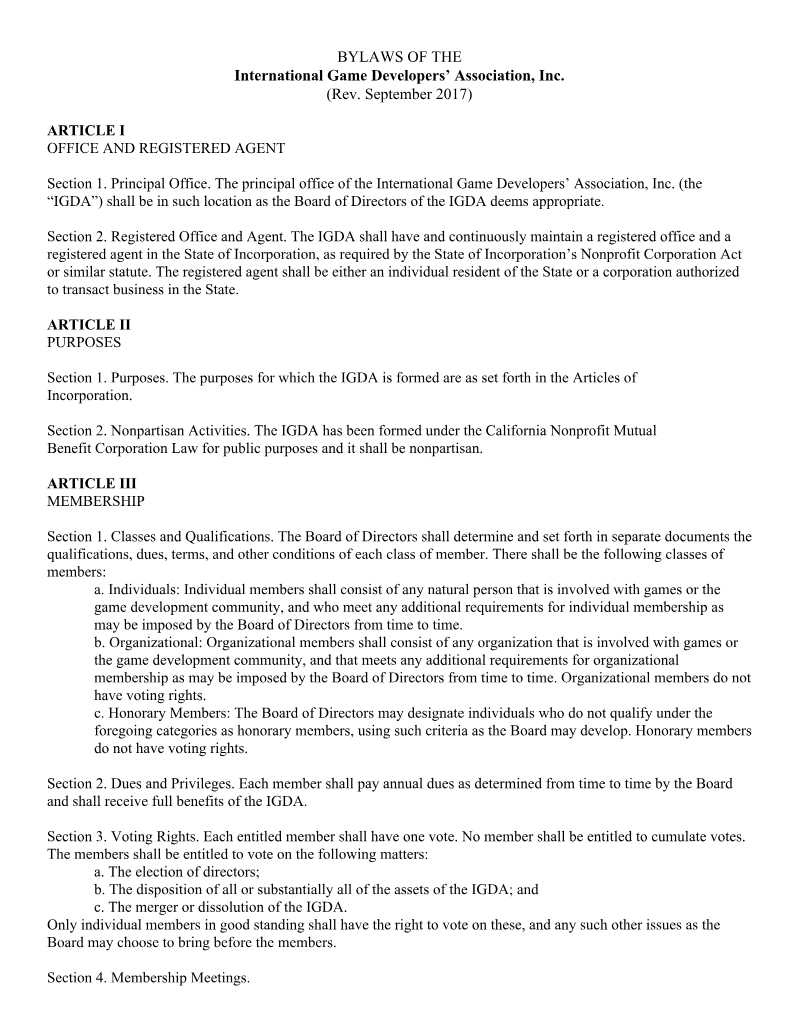
The bylaws establish the governance framework for the International Game Developers’ Association, Inc., a California‑based nonprofit dedicated to supporting professionals in the game development industry. The organization’s purpose is defined by its Articles of Incorporation, emphasizing nonpartisanship and public benefit. Membership is categorized into individuals, organizations, and honorary members, with voting rights reserved for individual members in good standing. Annual dues are set by the Board, and membership meetings—annual and special—are governed by detailed notice, quorum, and voting procedures that prioritize electronic participation. The Board of Directors, composed of up to six appointed directors, at least three elected directors, and an optional ex‑officio director, holds ultimate authority over business affairs. Directors serve three‑year terms and must maintain good standing; removal requires a majority vote of members or the Board. Officers—Chair, Vice‑Chair, Secretary, Treasurer—are appointed by the Board and serve one‑year terms, with specific duties outlined for each role. Committees, including an Executive Committee and various task forces, are empowered to advise the Board but cannot amend bylaws or dissolve the organization. An Executive Director serves as chief executive, accountable to the Board and subject to its terms of engagement. Fiscal year aligns with the calendar year, and indemnification provisions protect directors, officers, and employees from liability incurred in good faith. Amendments to the bylaws may be made by a majority vote of members or the Board, ensuring flexibility for evolving governance needs.
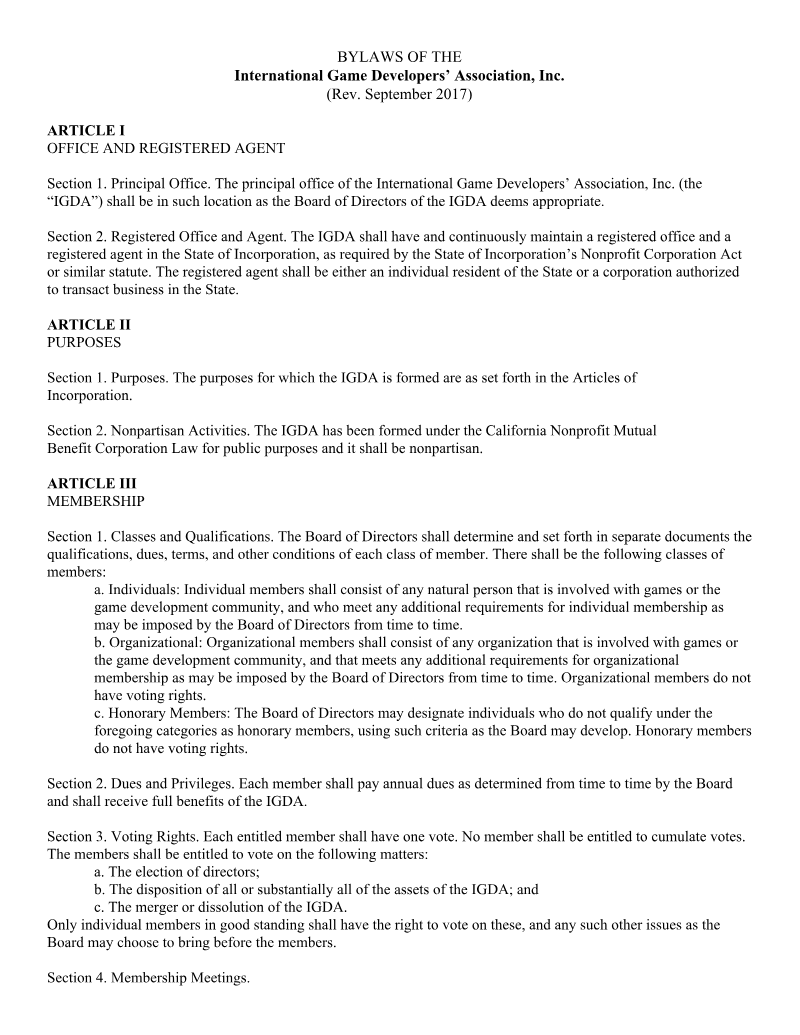
BYLAWS OF THE International Game Developers’ Association, Inc. (Rev. September 2017) ARTICLE I OFFICE AND REGISTERED AGENT Section 1. Principal Office. The principal office of the International Game Developers’ Association, Inc. (the “IGDA”) shall be in such location as the Board of Directors of the IGDA deems appropriate. Section 2. Registered Office and Agent. The IGDA shall have and continuously maintain a registered office and a registered agent in the State of Incorporation, as required by the State of Incorporation’s Nonprofit Corporation Act or similar statute. The registered agent shall be either an individual resident of the State or a corporation authorized to transact business in the State. ARTICLE II PURPOSES Section 1. Purposes. The purposes for which the IGDA is formed are as set forth in the Articles of Incorporation. Section 2. Nonpartisan Activities. The IGDA has been formed under the California Nonprofit Mutual Benefit Corporation Law for public purposes and it shall be nonpartisan. ARTICLE III MEMBERSHIP Section 1. Classes and Qualifications. The Board of Directors shall determine and set forth in separate documents the qualifications, dues, terms, and other conditions of each class of member. There shall be the following classes of members: a. Individuals: Individual members shall consist of any natural person that is involved with games or the game development community, and who meet any additional requirements for individual membership as may be imposed by the Board of Directors from time to time. b.
he following classes of members: a. Individuals: Individual members shall consist of any natural person that is involved with games or the game development community, and who meet any additional requirements for individual membership as may be imposed by the Board of Directors from time to time. b. Organizational: Organizational members shall consist of any organization that is involved with games or the game development community, and that meets any additional requirements for organizational membership as may be imposed by the Board of Directors from time to time. Organizational members do not have voting rights. c. Honorary Members: The Board of Directors may designate individuals who do not qualify under the foregoing categories as honorary members, using such criteria as the Board may develop. Honorary members do not have voting rights. Section 2. Dues and Privileges. Each member shall pay annual dues as determined from time to time by the Board and shall receive full benefits of the IGDA. Section 3. Voting Rights. Each entitled member shall have one vote. No member shall be entitled to cumulate votes. The members shall be entitled to vote on the following matters: a. The election of directors; b. The disposition of all or substantially all of the assets of the IGDA; and c. The merger or dissolution of the IGDA. Only individual members in good standing shall have the right to vote on these, and any such other issues as the Board may choose to bring before the members.
ction of directors; b. The disposition of all or substantially all of the assets of the IGDA; and c. The merger or dissolution of the IGDA. Only individual members in good standing shall have the right to vote on these, and any such other issues as the Board may choose to bring before the members. Section 4. Membership Meetings.
a. There shall be an annual meeting of the members upon such date, time and place, as the Board shall determine. During the annual meeting, voting members shall have the right to vote on matters that the Board may choose to bring before the members. Voting on all other matters is expressly reserved for the Board of Directors. b. Special meetings of the members may be called by the Chair of the Board or upon the request of five percent (5%) of the voting members. The issues addressed and voted on at any Special Meeting will be limited to the issue presented in the request or as set by the Chair in calling the meeting. The Special Meeting will be comprised of four parts: 1. Notice: Members shall receive not less than 35 days prior notice of commencement of voting period stating the purpose of the special meeting. 2. Discussion: During that 35 day run up to the voting period positions of the interested parties and other discussions regarding the subject of the meeting will be facilitated by the Executive Director. Such discussion shall commence no less than 21 days prior to commencement of the vote. 3. Meeting: In the discretion of the Board of Directors, any special membership meeting shall be held at a designated place or in whole or in part by means of electronic transmission. 4. Vote: The Executive Director will determine the methodology and procedure to vote on the issue. Such procedure shall be by electronic means for a period of not less than 14 days and reasonably accessible to all eligible IGDA members. 5. Only members eligible to vote on the date notice is given for the meeting shall be allowed to vote at a special meeting.
and procedure to vote on the issue. Such procedure shall be by electronic means for a period of not less than 14 days and reasonably accessible to all eligible IGDA members. 5. Only members eligible to vote on the date notice is given for the meeting shall be allowed to vote at a special meeting. Section 5. Quorum. For the purposes of removal of a member of the Board of Directors a quorum shall consist of twenty percent (20%) of the total members eligible to vote on the date notice is given for the meeting. For all other membership actions a quorum shall consist of the members present during a meeting of the members provided proper notice for the meeting is given. A majority of the votes cast at a meeting at which a quorum is achieved shall constitute the action of the members. Section 6. Removal. Any member may be removed from membership and, for purposes of these bylaws, is not in “good standing” if the member (a) has failed to pay its annual dues for thirty days after such dues have become due; (b) the Member has demonstrated a lack of integrity or unethical behavior, as determined by the Board of Directors (e.g., violating the IGDA’s Code of Ethics), or (c) upon the affirmative vote of at least seventy-five percent (75%) of the members. ARTICLE IV BOARD OF DIRECTORS Section 1. Powers. There shall be a Board of Directors of the IGDA, which shall supervise and control the business, property, and affairs of the IGDA, except as otherwise expressly provided by law, the Articles of Incorporation of the IGDA, or these Bylaws.
members. ARTICLE IV BOARD OF DIRECTORS Section 1. Powers. There shall be a Board of Directors of the IGDA, which shall supervise and control the business, property, and affairs of the IGDA, except as otherwise expressly provided by law, the Articles of Incorporation of the IGDA, or these Bylaws. Section 2. Number and Qualifications. The Board of Directors of the IGDA shall be composed of up to six (6) Special Appointed Directors, at least three (3) Elected Directors (Article IV, Section 3 below), and if appropriate, one (1) Ex-Officio Director (Article IV, Section 6 below). The total number of Directors may be increased or decreased by affirmative vote the Board of Directors. All Directors are required to be members of the IGDA as of the time of their election or appointment, and to have been a member for at least the two (2) consecutive years prior to taking office. All Directors must remain as members in good standing of the IGDA for the duration of their term and adhere to the Board of Directors Code of Ethics. Section 3. Elected Directors. Elections of Elected Directors shall be conducted in accordance with the Election Procedures Policy adopted by the Board of Directors. The total number of members casting votes in the election of Directors shall constitute a quorum for such election.
The global game development landscape in 2022 reflects a period of significant structural and cultural transition. PC remains the primary development platform, while the PlayStation 5 maintains its position as the leading console choice. Conversely, mobile development has experienced a decade-long decline in developer interest. Emerging hardware like the Steam Deck and PlayStation VR2 continues to capture attention, yet the industry remains deeply skeptical of speculative technologies such as the metaverse, cryptocurrency, and NFTs. These concerns are rooted in anxieties regarding environmental sustainability, ethical business practices, and the long-term viability of blockchain-based models. Workplace culture and labor dynamics have emerged as central themes, marked by a measurable improvement in work-life balance as 60 percent of developers now maintain a 40-hour work week or less. Despite this progress, the industry struggles with systemic issues, as a majority of studios have failed to adequately address internal reports of misconduct and toxicity. This environment has fueled a growing movement toward collective bargaining, with 55 percent of developers supporting unionization and nearly one-quarter of workplaces engaging in active discussions regarding labor organization. The industry continues to prioritize accessibility, with a record 39 percent of developers integrating inclusive design features into their projects. However, broader efforts toward diversity and social activism remain inconsistent across various studios. Furthermore, the workforce remains predominantly male and early-career, highlighting a demographic imbalance that persists alongside ongoing tensions between developers and major platform holders. As evidenced by the 34 percent of developers who support Epic Games in its legal conflict with Apple, there is a clear desire for greater autonomy and a shift in the power dynamics that currently govern the digital distribution ecosystem.
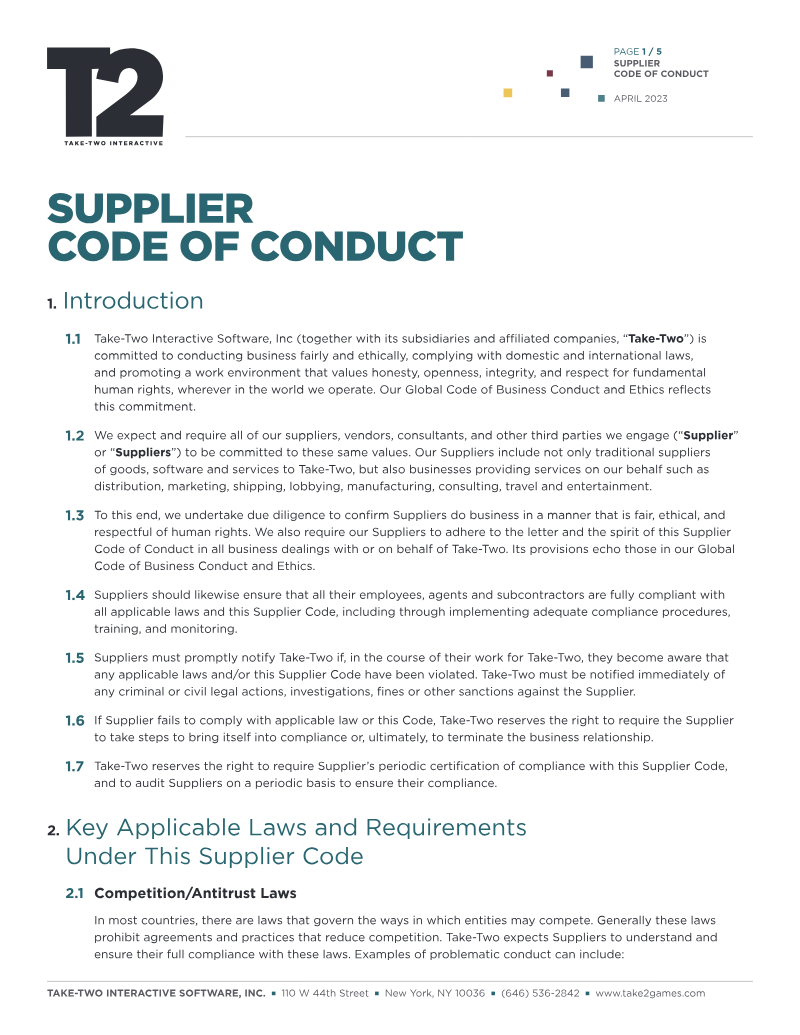
The Supplier Code of Conduct for Take-Two Interactive Software, Inc., updated in April 2023, establishes the ethical, legal, and professional standards required of all third-party partners. The primary thesis is that all suppliers, consultants, and vendors must mirror the company’s internal commitment to honesty, integrity, and human rights. This mandate extends globally to any entity providing goods or services, including distribution, marketing, and manufacturing, and requires these partners to ensure compliance among their own subcontractors and employees. The document outlines specific legal requirements across several critical domains. Suppliers must strictly adhere to competition and antitrust laws, anti-bribery and corruption statutes such as the US Foreign Corrupt Practices Act and the UK Bribery Act, and anti-money laundering regulations. Furthermore, the scope includes strict compliance with trade sanctions and export controls, specifically highlighting high-risk regions such as Iran, Cuba, Syria, North Korea, and certain areas of Ukraine. Partners are also prohibited from engaging in insider trading based on non-public information gained through their relationship with the company. Beyond legal compliance, the standards emphasize social responsibility and operational integrity. Key provisions include the prohibition of child or prison labor, the protection of fundamental human rights, and the maintenance of a work environment free from discrimination and harassment. Suppliers are required to maintain accurate financial records, protect intellectual property, and avoid conflicts of interest. To ensure adherence, the company reserves the right to conduct periodic audits and requires immediate notification of any legal investigations or violations. A global reporting infrastructure is provided, featuring a 24-hour ethics hotline available across more than twenty countries, supported by a non-retaliation policy for those reporting grievances in good faith.
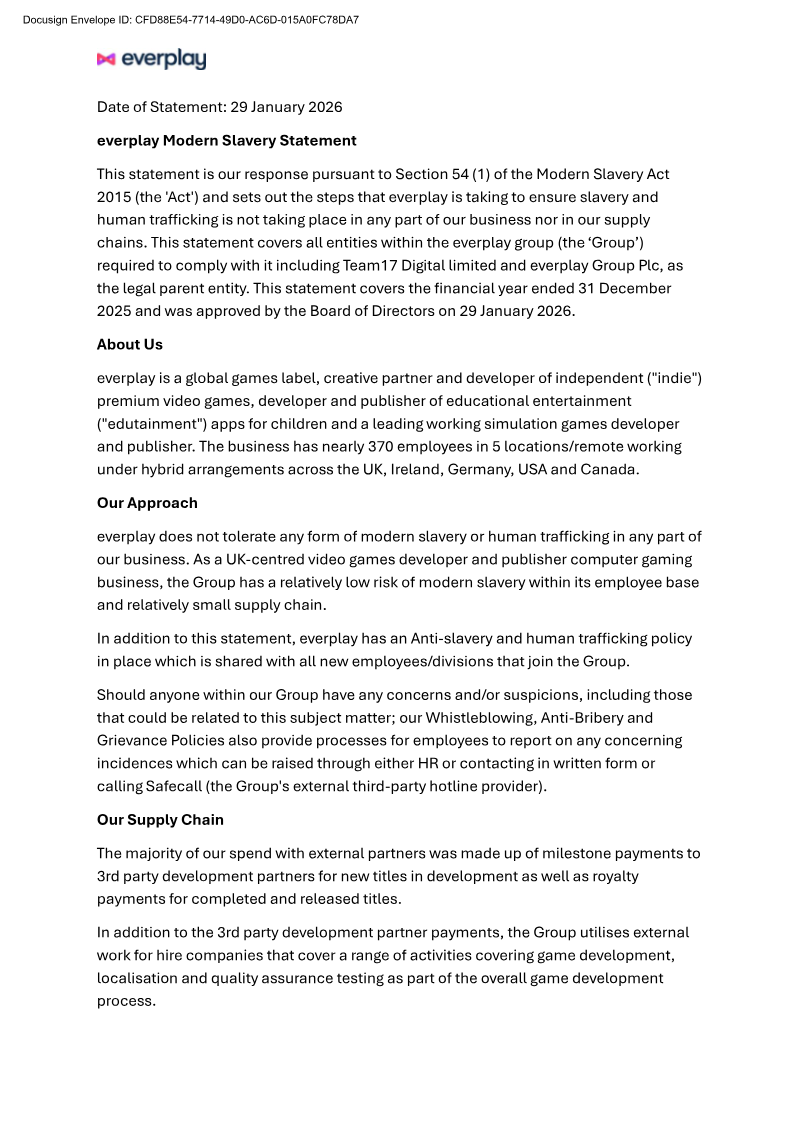
Everplay maintains a zero-tolerance stance toward modern slavery and human trafficking across its global operations and supply chains. As a UK-centered video games developer and publisher, the organization identifies as having a relatively low inherent risk due to the nature of the digital entertainment industry. The operational scope covers the financial year ending December 31, 2025, and encompasses approximately 370 employees working across the United Kingdom, Ireland, Germany, the United States, and Canada. The primary supply chain expenditures involve milestone and royalty payments to third-party development partners, alongside work-for-hire contracts for game development, localization, and quality assurance testing. While the overall risk profile remains low, the organization identifies localization and quality assurance as areas carrying a slightly higher risk. To mitigate these concerns, all new and renewing contracts include mandatory compliance clauses regarding the Modern Slavery Act 2015, granting the company the right to terminate agreements in the event of a breach. Governance is managed through the Audit Committee, which reports to the Board of Directors at least twice annually. Due diligence efforts include a risk-based approach to supplier assessment and the implementation of internal policies such as whistleblowing, anti-bribery, and grievance procedures. Employees and third parties are provided with confidential reporting channels, including an external hotline. The effectiveness of these measures is tracked through an annual risk register assessment, which currently reports zero incidents of modern slavery. Training and awareness initiatives are provided to ensure that employees and stakeholders can identify and report potential risks effectively.
Take-Two Interactive Software establishes a comprehensive framework for maintaining ethical business practices and safeguarding human rights across its global operations as of October 2025. The primary objective is to eliminate modern slavery, forced labor, and human trafficking within the organization and its extensive supply chains. This commitment extends across all major publishing labels, including Rockstar Games, 2K, Private Division, and Zynga, covering the development and distribution of interactive entertainment for console, PC, and mobile platforms. The policy outlines rigorous hiring and employment standards, mandating that all employees be at least 16 years of age and that employment is strictly voluntary. Compensation and benefits are reviewed annually to ensure they meet or exceed legal minimums and market standards. Furthermore, the company enforces a strict non-discrimination policy, ensuring that recruitment and career advancement are based solely on ability and merit rather than protected characteristics. These internal standards are reinforced by a Global Code of Business Conduct and Ethics that applies to all directors, officers, employees, and contractors. To ensure compliance throughout the supply chain, which includes disc replicators, printers, and logistics providers in regions such as North America, Europe, and Japan, the company utilizes a dedicated Supplier Code. This requires third-party partners to represent that they do not utilize child, prison, or slave labor. Oversight is maintained through biennial training for employees and targeted training for consultants. Additionally, the company provides a confidential reporting hotline managed by an independent third party, protecting whistleblowers from retaliation. Key suppliers are also expected to conduct periodic internal or independent audits to verify adherence to labor, health, and safety standards.