VR



Whitepaper
Social Virtual Reality Best Practices 2018
The 2018 landscape of social virtual reality emphasizes the critical role of user safety, identity, and intuitive interaction in fostering sustainable digital communities. As immersive environments transition from solitary experiences to shared social spaces, developers must prioritize tools that mitigate harassment and empower users to manage their personal boundaries. Effective moderation strategies include the implementation of personal space bubbles, which prevent unwanted physical proximity, and robust reporting mechanisms that allow for immediate intervention. These features are essential for maintaining a welcoming atmosphere, particularly as the demographic reach of virtual platforms expands across global markets. Identity and self-expression serve as the primary drivers of engagement within these ecosystems. High-fidelity avatar customization and expressive non-verbal communication, such as hand gestures and spatial audio, significantly enhance the sense of presence and social connection. Data suggests that users are more likely to return to platforms that offer a high degree of agency over their digital representation. Furthermore, the integration of shared activities—ranging from casual gaming to collaborative media consumption—acts as a catalyst for organic social interaction, moving beyond simple voice chat to create meaningful, activity-based bonds between participants. Technical performance remains a foundational requirement for social cohesion, as latency and poor synchronization can break immersion and lead to physical discomfort. Ensuring consistent frame rates and low-latency audio is vital for facilitating natural conversation flow. From a strategic perspective, the industry is moving toward cross-platform compatibility to prevent community fragmentation, allowing users on different hardware tiers to interact seamlessly. By focusing on inclusive design and proactive community management, developers can build resilient social architectures that support the long-term growth of the virtual, augmented, and mixed reality sectors.
International Game Developers’ AssociationJan 2018

Report
State of the Game Industry 2017
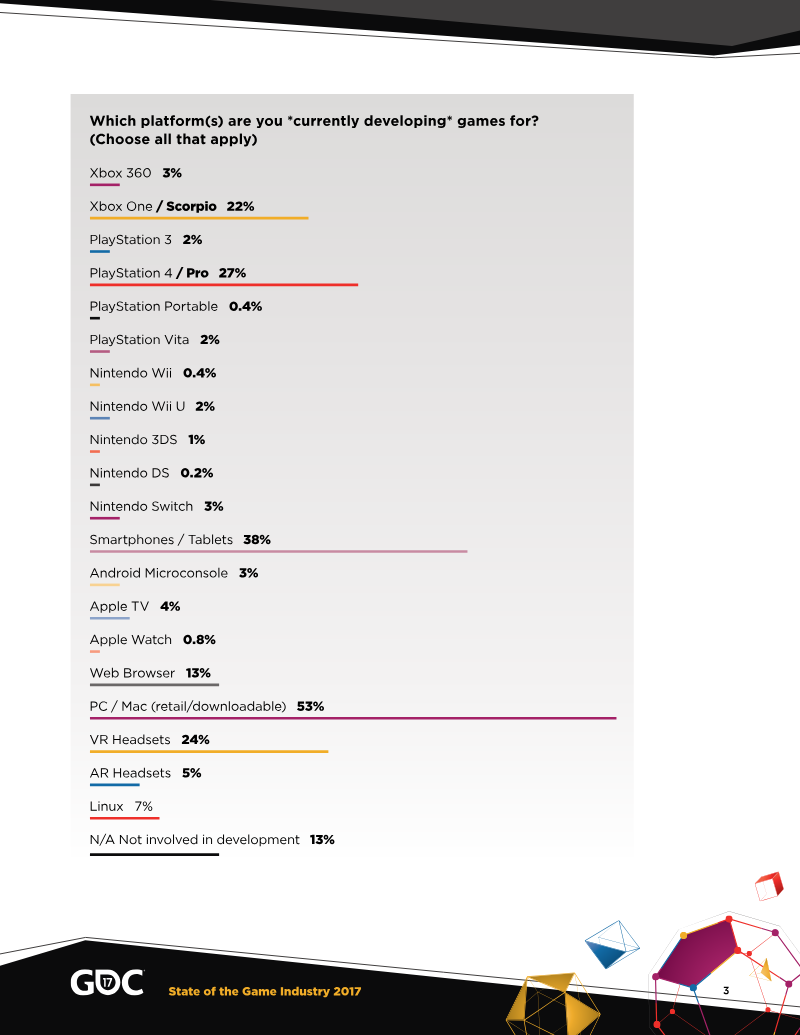
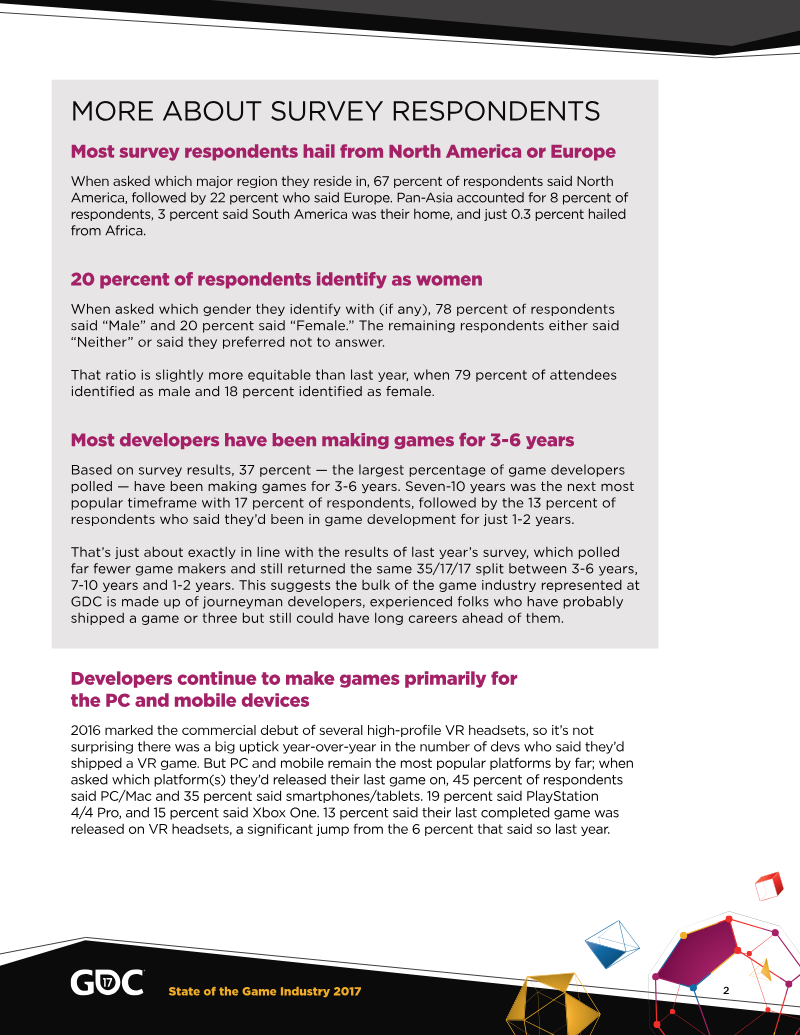
The 2017 State of the Game Industry report provides a comprehensive snapshot of the global development landscape leading into the 31st Game Developers Conference. Based on a survey of over 4,500 professional game developers, the data primarily reflects the perspectives of "journeyman" creators in North America (67%) and Europe (22%), with the largest segment of respondents (37%) possessing three to six years of industry experience. The findings highlight a significant shift in the immersive technology sector, where the HTC Vive emerged as the leading platform for VR/AR development, surpassing the Oculus Rift in both current usage and future interest. While 61% of developers are not yet involved in VR, those who are have increasingly moved toward the Vive, which 40% of respondents expect to support for their next projects. Despite concerns regarding hardware costs and motion sickness—which affects 83% of developers to some degree—75% of the industry views VR and AR as a sustainable long-term business, with a plurality predicting that augmented reality will be the dominant immersive tech within twenty years. In the broader platform market, PC (53%) and mobile (38%) remain the primary targets for development. Notably, Android (54%) surpassed iOS (51%) in developer interest for the first time in the survey's history. Regarding consoles, developers expressed cautious optimism for the Nintendo Switch, with 50% predicting it will outsell the Wii U. However, the industry remains divided on mid-cycle hardware refreshes like the PS4 Pro and Project Scorpio; while only 5% view them negatively, 41% remain undecided about their impact on the traditional "fixed-spec" benefits of console development. Financially, the industry continues to lean toward independence, with 55% of projects funded by internal company resources and 54% of developers operating without a traditional publisher. Confidence in crowdfunding saw a slight decline, with 46% of respondents expressing no interest in the model. Conversely, confidence in eSports reached an all-time high, with 90% of developers affirming its long-term sustainability as it moves toward mainstream social acceptance.
Game Developers ConferenceJan 2017