FinancialGREE
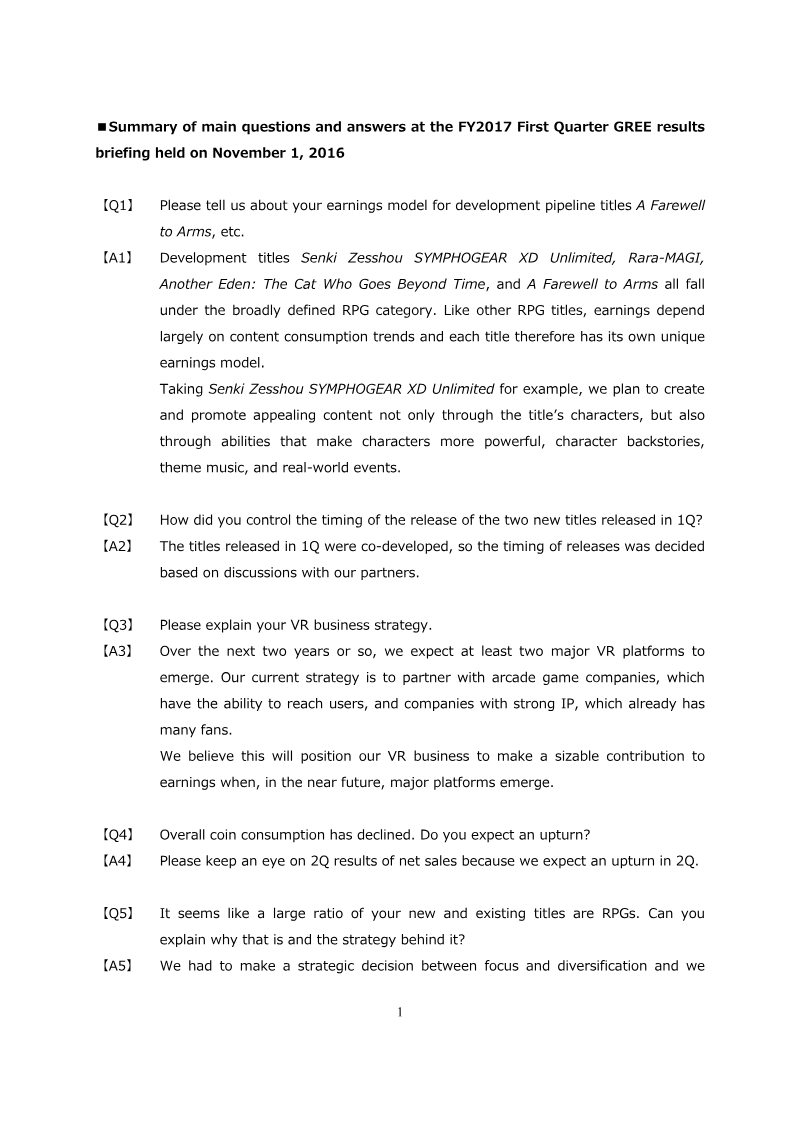
Summary of Main Questions and Answers at the FY2017 First Quarter GREE Results Briefing
1 Nov 20162 pages~3 min full read
The financial performance and strategic direction for the first quarter of fiscal year 2017 center on a transition toward high-growth segments within the Japanese mobile gaming market. A primary focus is the consolidation of development efforts into the broadly defined RPG category, which is identified as the largest and most resilient market segment in Japan. This strategic concentration is intended to leverage internal development expertise, streamline game operations, and facilitate more effective collaborations with intellectual property partners. Key upcoming titles such as Another Eden and Senki Zesshou SYMPHOGEAR XD Unlimited are expected to drive revenue through diverse monetization models involving character progression, music, and live events.
While overall coin consumption experienced a decline during the first quarter, projections indicate a recovery in net sales starting in the second quarter. This anticipated upturn is supported by a successful turnaround in the domestic native games business. However, operating income is forecasted to decrease by approximately 1.0 billion yen in the second quarter due to planned strategic investments. these expenditures include increased advertising costs, rental expenses, and goodwill amortization, all aimed at securing long-term growth.
The long-term growth strategy also incorporates a significant expansion into the virtual reality sector. The current approach involves partnering with arcade game companies and established IP holders to build a user base ahead of the emergence of major VR platforms. While these initiatives are critical for future positioning, they are not expected to contribute significantly to earnings until after the conclusion of fiscal year 2017. Consequently, the immediate financial recovery remains dependent on the performance of the core mobile gaming portfolio and the successful launch of the current development pipeline.
GREE · 2026
GREE · 2026
GREE · 2026
GREE · 2025
GREE · 2025
GREE · 2025
GREE · 2025
GREE · 2025
GREE · 2025
GREE · 2025
GREE · 2025
GREE · 2025
CyberAgent · 2025
GREE · 2025
CyberAgent · 2024
GREE · 2024
GREE · 2023
GREE · 2023
GREE · 2023
GREE · 2022
GREE · 2022
CyberAgent · 2021
GREE · 2021
GREE · 2020