Paperboy
Game
3 documents in the library are about Paperboy, from writers such as Game Developers Conference, Games Industry Africa and G|A|M|E – The Italian Journal of Game Studies. Each has a summary and key insights with the page they come from.
Connections
Each row is a game or company named alongside Paperboy, each column a document, oldest first. A mark means that document names it. Select a row to see those documents.
Documents about Paperboy

Shroom and Gloom Sets September 10 Early Access Launch Date
Johannesburg-based studio Team Lazerbeam has announced that its fungal roguelike deckbuilder Shroom and Gloom will enter Early Access on Steam on September 10, 2026.
- South African studio Team Lazerbeam will launch its fungal roguelike deckbuilder, Shroom and Gloom, into Early Access on September 10, 2026.
- The game has achieved significant pre-launch traction on Steam, reaching 206,233 wishlists as of June 2026.
- Team Lazerbeam has set a new post-announcement goal of reaching 250,000 Steam wishlists by the Early Access launch date.
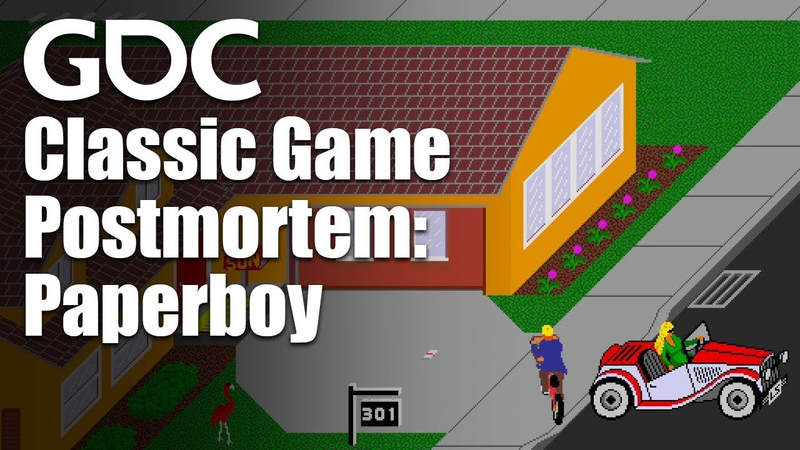
Classic Game Postmortem: Paperboy
The development of the 1985 arcade title Paperboy represents a pivotal shift in Atari’s design philosophy, moving away from traditional vector-based graphics toward a sophisticated, isometric raster-based experience.
- The NES home console port of Paperboy achieved significant commercial success with 2 million copies sold, far outpacing the 3,500 units sold for the original 1985 arcade version.
- Development of the arcade title utilized Atari’s System 2 hardware, featuring a 16-bit processor programmed in BLISS and a custom medium-resolution monitor to surpass the fidelity of 8-bit competitors.
- Gameplay was engineered around tight 30-to-90-second loops to maximize arcade player turnover, a strategy refined after initial focus group failures led to a shift toward a parallel horizontal layout.
A New Angle on Parallel Languages: The Contribution of Visual Arts to a Vocabulary of Graphical Projection in Video Games
Graphical projection has been underused and loosely described in game studies, where press and players rely on catch-all labels such as "top-down" and "isometric."
- The paper argues that game studies relies on loose labels such as "top-down view" and "isometric graphics" and proposes art-historical terminology, classified by underlying projection principles rather than by technology, as a sturdier analytical framework.
- Perspective (rooted in Alberti's treatise) simulates human vision through foreshortening, whereas parallel projection preserves relationships between axes; pictorial projection splits into oblique forms (cavalier, cabinet) and axonometric forms (isometric, dimetric, trimetric).
- Dimetric rendering with its 2:1 pixel ratio is far more common in practice than true isometric projection, a point the author uses to show that the popular label often misdescribes what games actually display.
Companies behind it

As the documents state it.