Jetpack Joyride
Game
Documents about Jetpack Joyride
Google cuts store fees and welcomes back Fortnite plus Hay Day Match, Halfbrick, Antihero and more
The mobile games industry is undergoing a significant shift in platform economics following a legal settlement between Google and Epic Games.
- Google is uncoupling its billing services from the Play Store, allowing developers to use third-party providers for a flat 5% service fee, down from the previous 30% rate.
- The new Google Play billing structure will be implemented in the EU, UK, and US by June 2024, Australia by September, and globally by September 2027.
- Antihero Studios, founded by Supercell and King alumni, raised $4.5 million in seed funding to develop 'Misfits,' an extraction shooter that has already been tested by 70,000 players.
Iterating Design and Fighting Fires: Updating Fruit Ninja and Jetpack Joyride
The mobile gaming landscape demands a delicate balance between rapid iteration and the preservation of a title’s core identity.
- Maintain a design-first philosophy to filter community feedback, ensuring that new features do not compromise the integrity of the core gameplay loop.
- Implement a 'chaser update' model that pairs major content drops with rapid, community-focused patches to stabilize player retention and improve store ratings.
- Transition from simple currency-based shops to achievement-based progression systems to increase long-term player engagement and sense of accomplishment.
The Jetpack Joyride Postmortem
Jetpack Joyride represents a strategic masterclass in mobile game design, originating from a focused four-week development cycle by a three-person team at Halfbrick Studios.
- Halfbrick Studios developed Jetpack Joyride in a four-week cycle with a three-person team, proving that focused development can produce highly successful mobile titles.
- The game’s core retention strategy relied on a layered mission system that replaced static goals with progressive challenges to foster long-term player engagement.
- By intentionally incorporating randomized, occasionally unfair obstacles, the design mitigated player frustration and encouraged immediate re-engagement with the core gameplay loop.

FTUE: Apple TV
The Apple TV serves as a dedicated hardware platform for streaming media and gaming, positioning itself as a unified ecosystem that mirrors the existing iOS App Store experience.
- Apple TV gaming relies heavily on Apple-led curation for discoverability, as the platform lacks a robust search function and Siri’s voice search capabilities remain limited for games.
- The absence of an advertising ecosystem on Apple TV forces developers away from ad-supported free-to-play models, favoring a premium, paid-app pricing structure that is higher than mobile equivalents.
- While the device includes a compact remote with a trackpad, the platform supports third-party MFi-enabled controllers to accommodate complex gaming experiences and bridge the gap for demanding players.
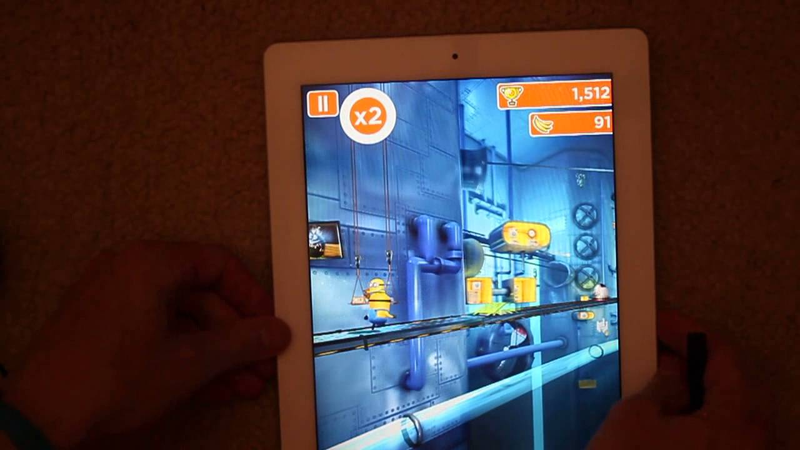
Monetizer: Gameloft's Despicable Me: Minions Rush
Despicable Me: Minion Rush, a free-to-play 3D endless runner developed by Gameloft for the iPad, utilizes a standard monetization framework common to the genre.
- Gameloft’s Despicable Me: Minion Rush utilizes a dual-currency economy of bananas and gold tokens, with purchase bundles ranging from $2 to $50.
- The game drives monetization through a multiplier-based progression system and by offering paid revives and mission-skipping mechanics.
- Onboarding is hindered by a lengthy initial download and an immediate, intrusive push notification prompt that risks early player churn.