Double Dragon
Game
3 documents in the library are about Double Dragon, from writers such as DiGRA. Each has a summary and key insights with the page they come from.
Connections
Each row is a game or company named alongside Double Dragon, each column a document, oldest first. A mark means that document names it. Select a row to see those documents.
Documents about Double Dragon
Between Punches and Flying Attacks: Ludonarrative Imaginaries in 1980s Beat 'em Up Games
This paper examines how 1980s beat 'em up video games drew on the social and cultural imaginaries of their era, particularly anxieties about urban violence in major American cities, and how intermedial ties to Hollywood cinema shaped their themes and design.
- The paper argues that 1980s beat 'em up games such as Renegade, Double Dragon, Final Fight, and Streets of Rage emerged from a feedback loop between lived social conditions and mediated representations, not as accidental products of a popular genre.
- The genre's origin is traced to Renegade (1986), which launched a series that grew to more than fifty releases across platforms.
- New York City recorded its highest number of criminal incidents in 1980, with a homicide rate roughly three times that of 2020, and these figures did not begin declining until the early 1990s.
Counterfeit Circuits: Decolonial Practices and the Rise of Video Games in Brazil
This paper examines how cloning and piracy practices shaped the emergence of Brazil's video game culture during the 1980s, focusing on the period of the Brazilian Market Reserve policy (1984–1992).
- The paper's central thesis is that Brazilian cloning and piracy of video games in the 1980s were decolonial interventions in global technology circuits, not merely economic responses to scarcity, drawing on Walter Mignolo's 'epistemic disobedience' and Jacques Rancière's 'distribution of the sensible'.
- Brazilian local firms produced functional clones of the Atari 2600, NES, Apple II, ZX Spectrum, and MSX computers, and these clones were adaptive rather than derivative, often incorporating technical modifications suited to local power standards and component availability.
- The Brazilian Market Reserve policy (1984–1992), designed to protect domestic industry, paradoxically restricted access to foreign hardware and software, which encouraged reverse engineering, reproduction, and rapid diffusion of consoles and computers across the country.
From Euclidean Space to Albertian Gaze: Traditions of Visual Representation in Games Beyond the Surface
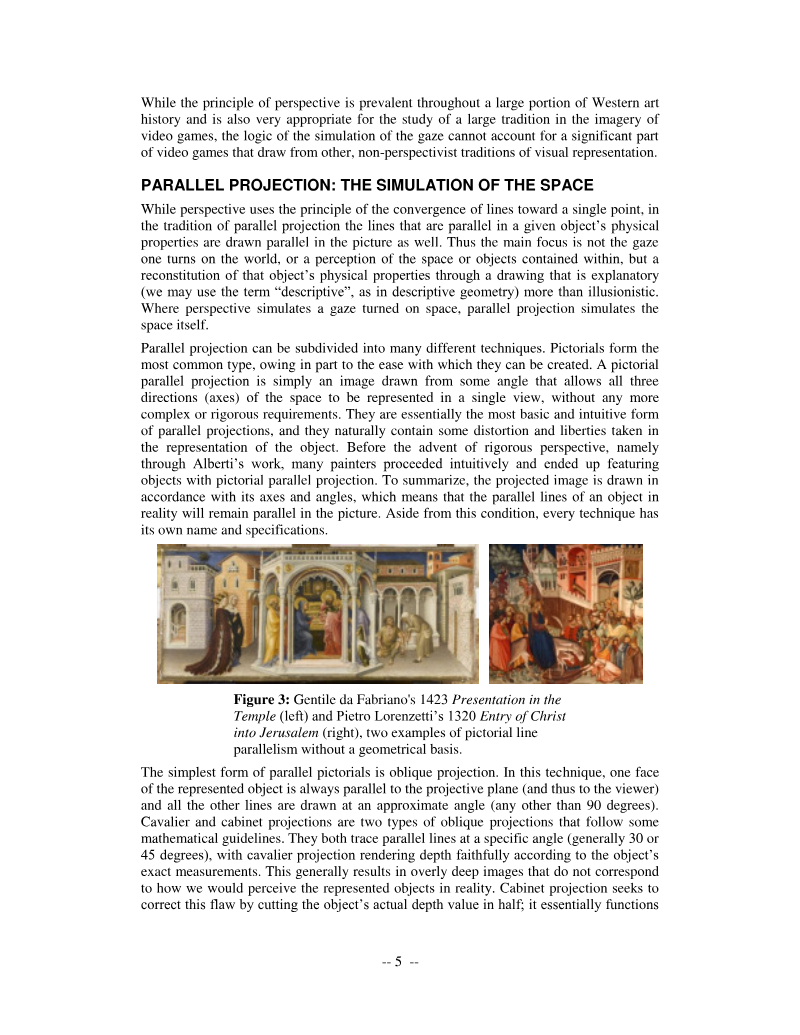
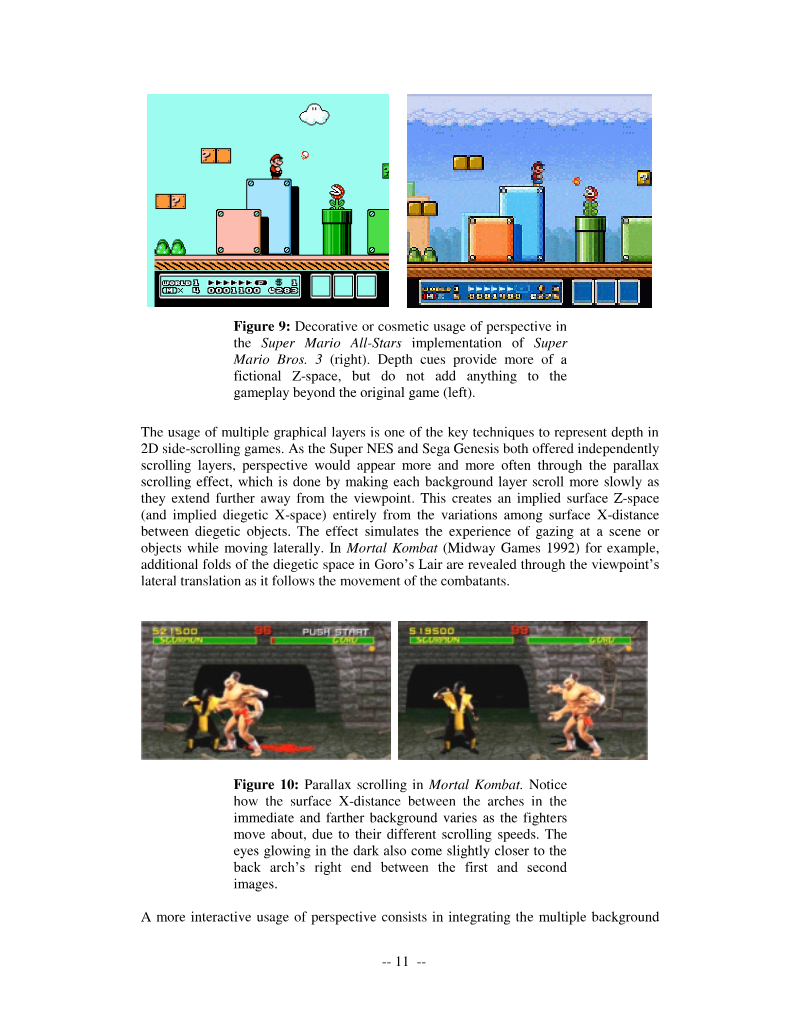
This paper argues that the visual analysis of video games has been dominated by perspective, the mathematical "simulation of the gaze" descended from Alberti, and that this emphasis obscures the wider repertoire of representational traditions games actually draw on.
- The visual analysis of games has been dominated by Albertian perspective, which obscures the wider repertoire of representational systems games actually use, including oblique, axonometric, and parallel projections.
- The paper argues that the choice among projection systems is governed by functional and gameplay demands rather than artistic lineage, illustrated by SimCity 4 (parallel projection) versus Red Dead Redemption (perspective) as genre-driven decisions.
- The 26.6-degree dimetric angle yields a clean 1:2 pixel ratio, which explains why isometric and dimetric projections persisted in pixel-art games.