Double Dragon
Game
Documents about Double Dragon
Whitepaper4 pages
Counterfeit Circuits: Decolonial Practices and the Rise of Video Games in Brazil
This paper examines how cloning and piracy practices shaped the emergence of Brazil's video game culture during the 1980s, focusing on the period of the Brazilian Market Reserve policy (1984–1992).
- The paper's central thesis is that Brazilian cloning and piracy of video games in the 1980s were decolonial interventions in global technology circuits, not merely economic responses to scarcity, drawing on Walter Mignolo's 'epistemic disobedience' and Jacques Rancière's 'distribution of the sensible'.
- Brazilian local firms produced functional clones of the Atari 2600, NES, Apple II, ZX Spectrum, and MSX computers, and these clones were adaptive rather than derivative, often incorporating technical modifications suited to local power standards and component availability.
- The Brazilian Market Reserve policy (1984–1992), designed to protect domestic industry, paradoxically restricted access to foreign hardware and software, which encouraged reverse engineering, reproduction, and rapid diffusion of consoles and computers across the country.
DiGRAJun 2026
Whitepaper18 pages
From Euclidean Space to Albertian Gaze: Traditions of Visual Representation in Games Beyond the Surface
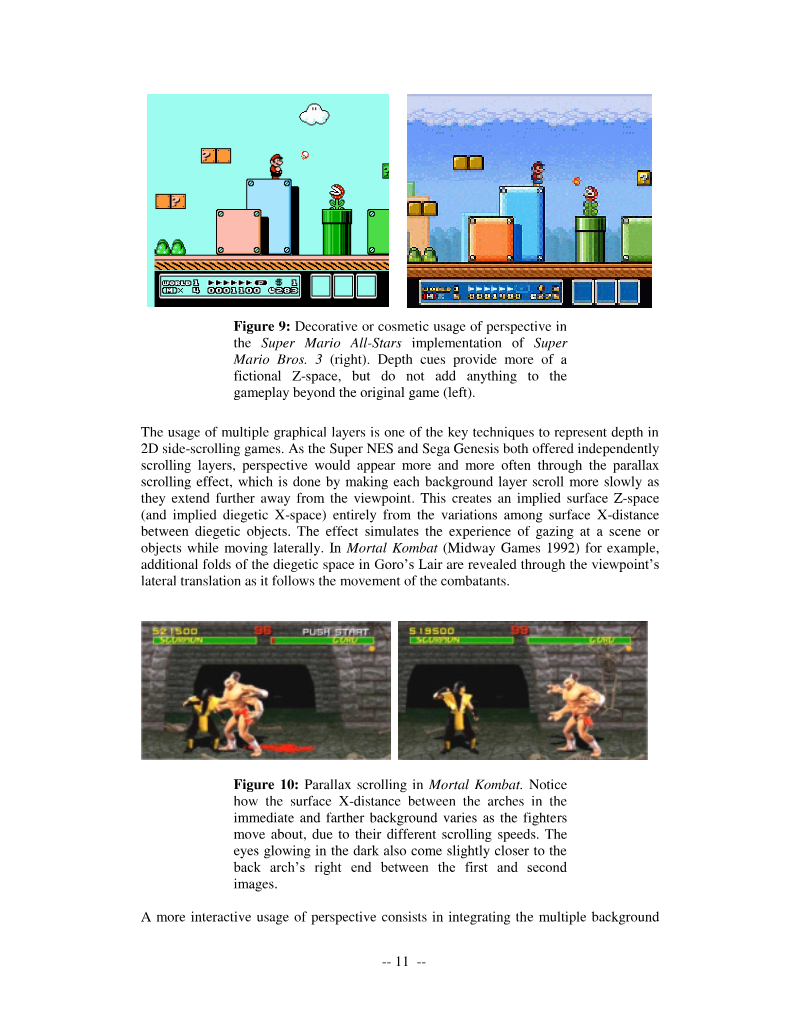
This paper argues that the visual analysis of video games has been dominated by perspective, the mathematical "simulation of the gaze" descended from Alberti, and that this emphasis obscures the wider repertoire of representational traditions games actually draw on.
- The visual analysis of games has been dominated by Albertian perspective, which obscures the wider repertoire of representational systems games actually use, including oblique, axonometric, and parallel projections.
- The paper argues that the choice among projection systems is governed by functional and gameplay demands rather than artistic lineage, illustrated by SimCity 4 (parallel projection) versus Red Dead Redemption (perspective) as genre-driven decisions.
- The 26.6-degree dimetric angle yields a clean 1:2 pixel ratio, which explains why isometric and dimetric projections persisted in pixel-art games.
DiGRAJan 2014