Canabalt
Game
Documents about Canabalt

Press Play to Start: The Challenges of Exhibiting Video Games at the Museum
Museums are increasingly grappling with how to exhibit video games as art, a shift that has accelerated since MoMA's 2012 acquisition of fourteen games for its Architecture and Design collection and the Smithsonian's The Art of Video Games that same year.
- Games resist conventional art presentation because their interactivity, dependence on evolving technology, and commercial origins do not fit the neutral 'white cube' gallery model, a tension framed through theorists Brian O'Doherty and Lev Manovich.
- Institutional recognition of games as art accelerated with MoMA's 2012 acquisition of fourteen games for its Architecture and Design collection and the Smithsonian's 2012 exhibition The Art of Video Games.
- Curators must 'translate' games' digital culture, community-based contexts, and interactive logic for diverse audiences, a framework associated with Domenico Quaranta, while funding pressures and audience appeal shape which titles are selected.
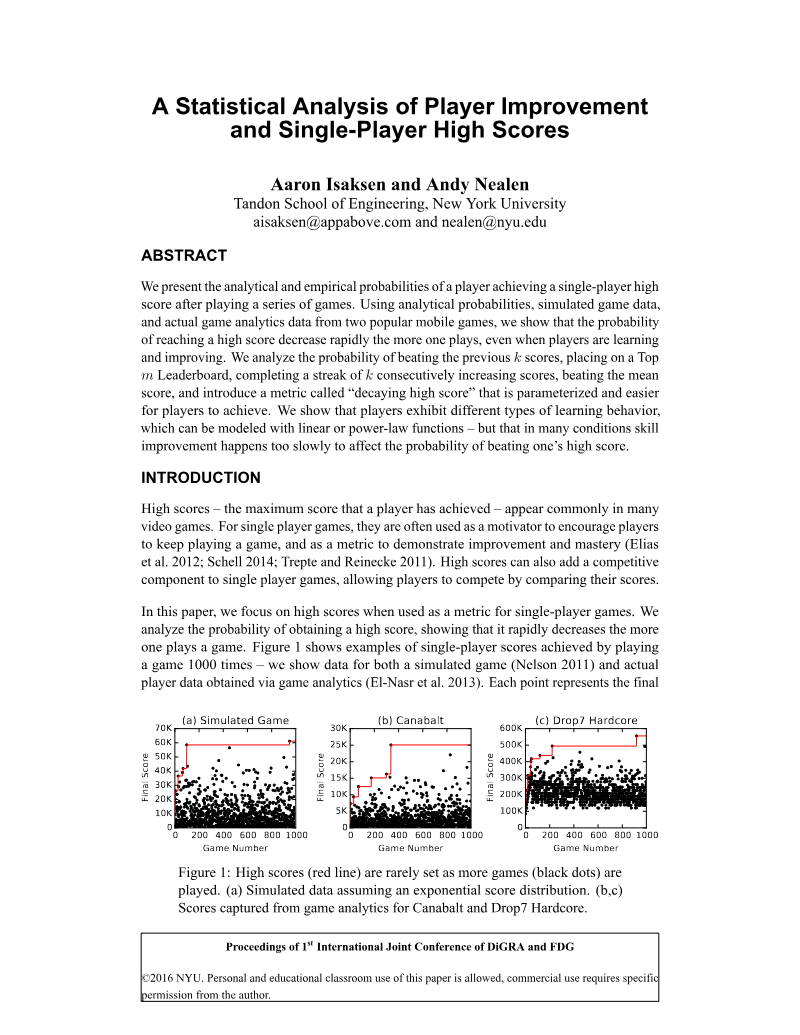
A Statistical Analysis of Player Improvement and Single-Player High Scores
The analysis investigates the statistical likelihood of players achieving high scores and streaks in single-player games, positing that the probability of setting new high scores rapidly diminishes over time, even with player skill improvement.
- Improvement in player skill is often too slow to offset the declining odds of beating past scores, so high-score rewards become progressively harder to earn as play continues.
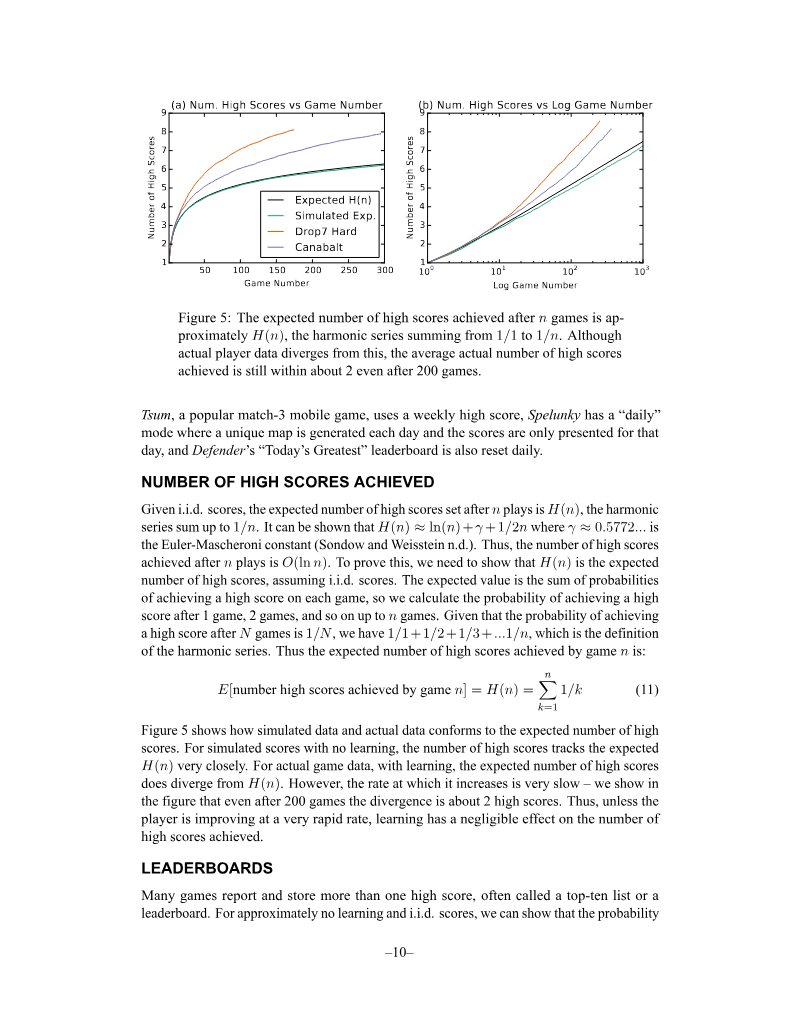
- Under an i.i.d. baseline with no learning, the chance of beating the previous score is 1/2 and the chance of a new all-time high on game n is 1/n, so expected high scores follow the harmonic series (approximately ln(n) plus the Euler-Mascheroni constant).
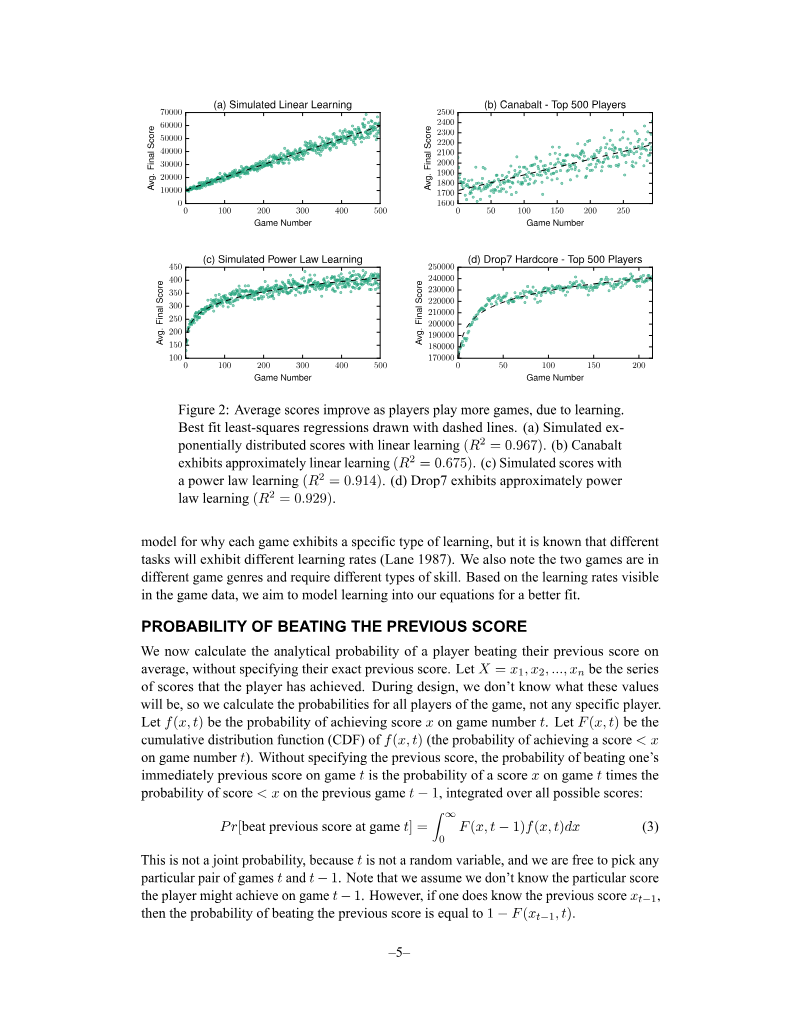
- Real data from Canabalt (roughly linear skill improvement) and Drop7 Hardcore (power-law learning curve) closely track these no-learning predictions, with fitted correction factors of only about 1.01 to 1.11 attributable to learning, whose influence diminishes as games accumulate.
One Simulated Hand, Two Real Hands: Antisimulation and Phenomenological Correspondence in Videogame Control Schemes
This analysis establishes a framework for evaluating videogame control schemes through the lens of phenomenological correspondence, which measures the relationship between the complexity of a simulated action and the physical input required by the player.
- Control schemes can be categorized into three models based on phenomenological correspondence: reductionist, completionist, and antisimulation.
- Antisimulation games like QWOP, Surgeon Simulator 2013, and Octodad: Dadliest Catch intentionally design controls to be more complex than the simulated task to disrupt player agency.
- Reductionist correspondence, seen in titles like Call of Duty 4 and Canabalt, simplifies complex real-world actions into intuitive, singular inputs to prioritize player empowerment.

Retro Evolved: Level Design Practice Exemplified by the Contemporary Retro Game
"Retro Evolved: Level Design Practice Exemplified by the Contemporary Retro Game" examines the level design methodologies prevalent in independent "contemporary retro games," which blend nostalgic aesthetics with modern, focused gameplay.
- The paper argues that contemporary retro games treat level design as a deliberate craft, building play experiences on established core mechanics rather than treating levels as incidental content.
- The authors propose qualities of good level design: a balance of difficulty and flow, tension between freedom and constraint, risk and reward, alignment with narrative, and effective player guidance.
- The authors argue these five practices overlap rather than compete, and identify balancing repetition with variation as the key to sustaining player flow.