
Brothers: A Tale of Two Sons
GameBy Starbreeze Studios · Released Aug 7, 2013
Documents about Brothers: A Tale of Two Sons
Whitepaper12 pages
Exploring How Changes in Game Systems Generate Meaning
This paper examines how changes in game mechanics, rather than representational elements such as cutscenes or dialogue, can generate meaning and deliver plot points in ways unique to the medium.
- The paper argues that changes in game mechanics, rather than representational elements like cutscenes or dialogue, can generate meaning and deliver plot points in ways unique to the medium, and that play is essential to interpreting those changes.
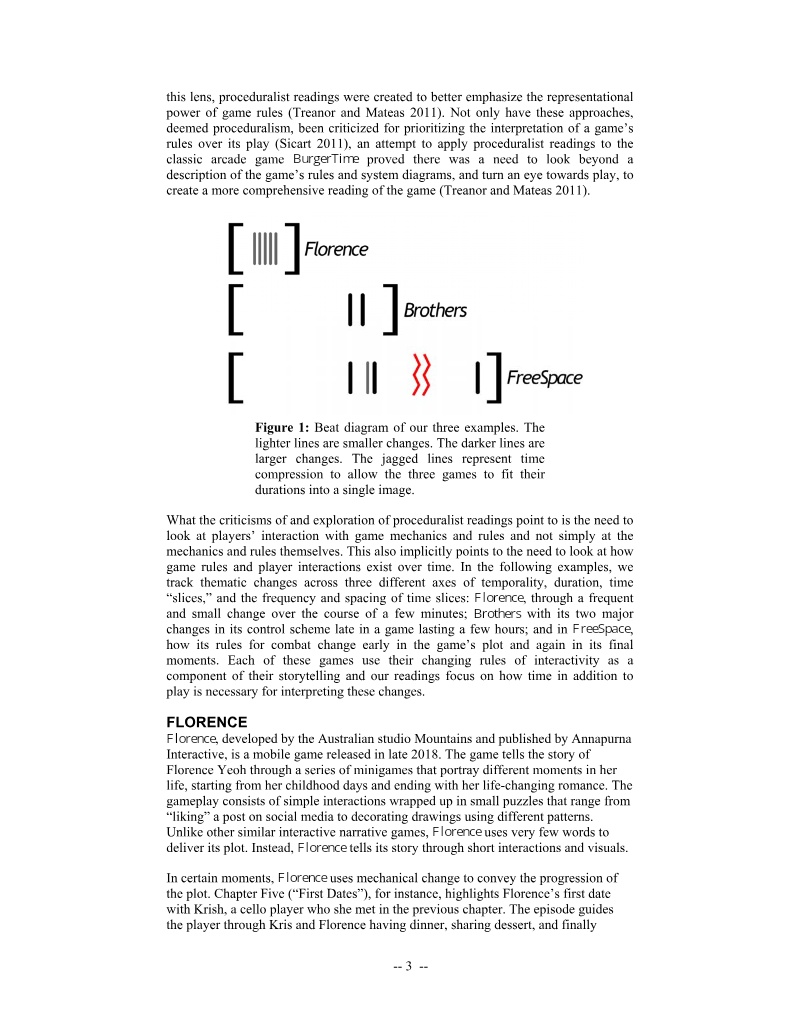
- A game's temporal structure, including the timing, frequency, and duration of mechanical shifts, shapes how players understand those changes.
- Close readings of Florence (altering a drag-and-drop puzzle mechanic across a short chapter), Brothers: A Tale of Two Sons (removing half the player's controls late in the game to mirror a sibling's death), and Descent: FreeSpace - The Great War (introducing and withdrawing targeting and shield rules across a long campaign) illustrate these ideas.
DiGRAJan 2019
Whitepaper21 pages
Quilting the Meaning: Gameplay as Catalyst of Signification and Why to Co-op in Game Studies
"Quilting the Meaning" argues that meaning in digital games arises chiefly through the cognitive and interpretive work of gameplay, which functions as a hub connecting semantics, narrative, aesthetics, interaction, and mechanics.
- The paper argues that meaning in digital games arises chiefly through the interpretive work of gameplay, which acts as a hub linking semantics, narrative, aesthetics, interaction, and mechanics.
- Its central thesis is that a gameplay-centered perspective can help consolidate a fragmented game studies field in which many partial and sometimes conflicting theories struggle to engage one another.
- A thought experiment built on Street Fighter II illustrates that changing how players act can alter a game's meaning even when its visuals and rules stay identical.
DiGRAJan 2018
Companies behind it

As the documents state it.