AdVenture Capitalist
Game
5 documents in the library are about AdVenture Capitalist, from writers such as DiGRA, PocketGamer.biz and Quantic Foundry. Each has a summary and key insights with the page they come from.
Connections
Each row is a game or company named alongside AdVenture Capitalist, each column a document, oldest first. A mark means that document names it. Select a row to see those documents.
Documents about AdVenture Capitalist
Unplayable Encounters with the Anthropocene: Rethinking Scale and Agency in Game Studies
Paolo Ruffino's paper critically examines the dominant approaches to studying videogames in relation to the Anthropocene and proposes an alternative framework centred on non-scalability.
- Ruffino argues that the dominant approaches to games and the Anthropocene, the instrumental (games as tools for pro-environmental behaviour) and the representational (games depicting nature), share an unexamined assumption that ecological messages scale up through repeated exposure to shift player behaviour at population level.
- The paper contends this scalability paradigm offers false reassurance that the climate crisis is being addressed through games, when it may not be.
- Drawing on Anna Tsing's non-scalability and friction, Timothy Morton's hyperobjects and subscendence, and Joanna Zylinska's minimal ethics of the Anthropocene, the author proposes studying meaningful game engagement as situated, contradictory encounters that resist aggregation into unified political messages.
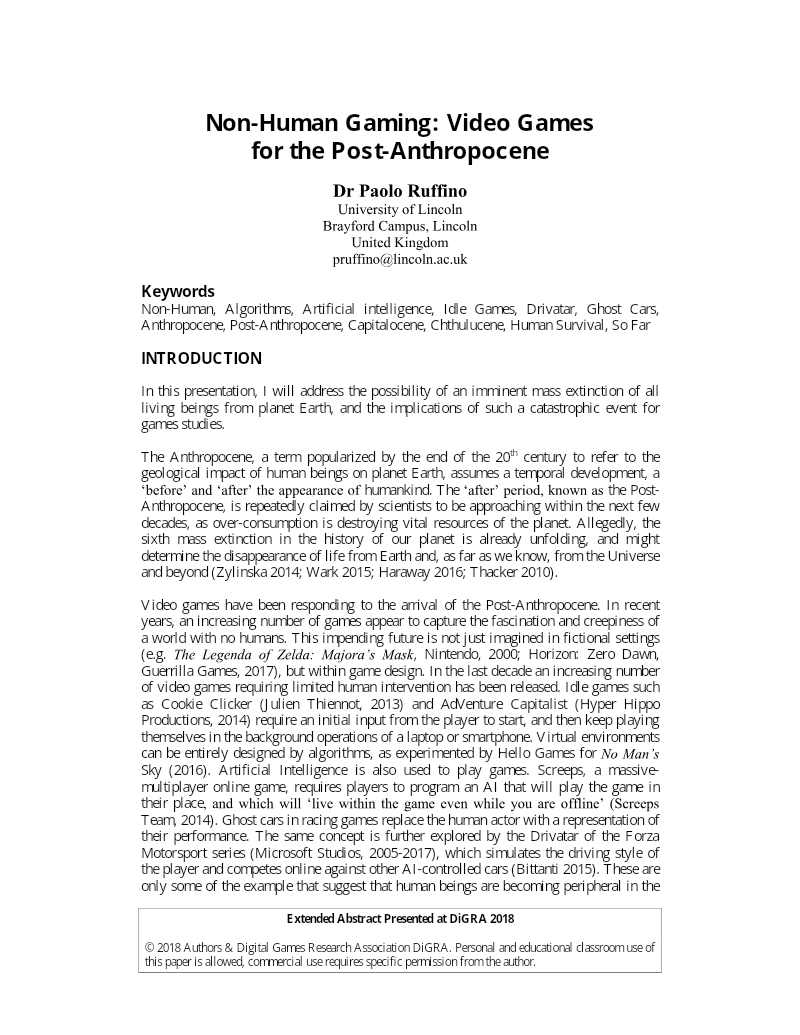
Non-Human Gaming: Video Games for the Post-Anthropocene
The document explores the concept of "Non-Human Gaming" as a response to the impending Post-Anthropocene era, characterized by the potential mass extinction of human life due to environmental degradation.
- Dr Paolo Ruffino's DiGRA 2018 extended abstract argues that games designed to play themselves or run with minimal human involvement form a long-standing presence in the medium, which he terms Non-Human Gaming rather than an anomaly or passing fashion.
- The paper frames Non-Human Gaming as a response to anxieties about a possible mass extinction and a coming Post-Anthropocene, and claims existing game studies frameworks built around human agency, interactivity, and skill have largely failed to address it.
- Examples cited include idle games such as Cookie Clicker and AdVenture Capitalist that progress after minimal input, No Man's Sky's algorithmically generated environments, and Screeps, where players program AI agents that act for them while offline.

How Hyper Hippo built hit game AdVenture Capitalist
Hyper Hippo Games, led by CEO Lance Priebe and CFO Sam Fisher, emphasizes a culture of rapid iteration, data-driven validation, and player-centric design as the primary drivers of success in the modern mobile gaming industry.
- Hyper Hippo transitioned from high-budget, multi-year projects to a lean development model after a major failure, prioritizing rapid experimentation over safe, derivative titles.
- The studio utilizes the UDA Loop (Observe, Orient, Decide, Act) framework to accelerate decision-making and empower small teams to validate concepts with audience feedback before committing significant budgets.
- AdVenture Capitalist achieved market success by focusing on long-term player retention and engagement rather than traditional, aggressive monetization tactics.
The Surprising Profile of Idle Clicker Gamers
Idle Clicker games, a minimalist genre that combines active clicking with automated, offline progression, are widely assumed to appeal to casual players.
- Idle clicker games attract a core gamer audience, with titles like Clicker Heroes ranking in the top 2% of most-played games on Steam, often outperforming major titles like Counter-Strike.
- The primary psychological drivers for idle clicker players are Completion and Power, while they score lowest on motivations related to Excitement and Fantasy.
- Idle clickers succeed by isolating and distilling the core progression and accumulation mechanics found in AAA RPGs and MMOs, stripping away secondary elements like narrative and complex combat.
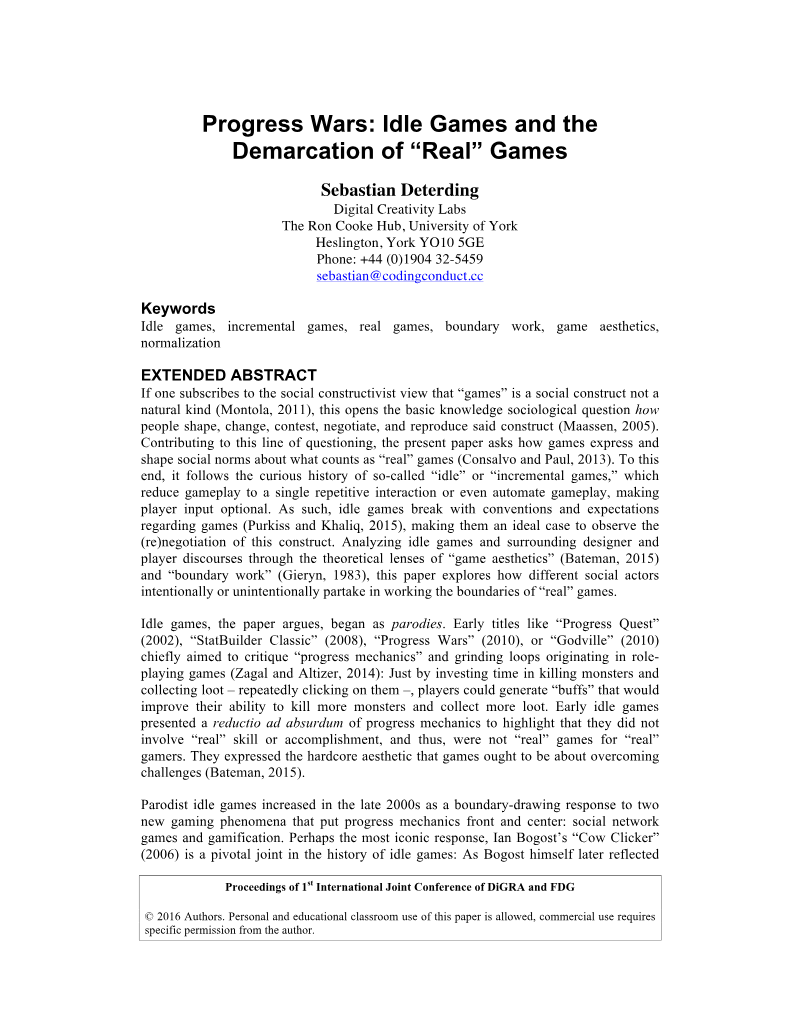
Progress Wars: Idle Games and the Demarcation of "Real" Games
This paper examines how idle games have influenced and redefined the social construct of what constitutes a "real" game.
- The paper argues that the category of "real" games is not a natural given but is actively produced through contested practices of designers, players, and critics, drawing on social constructivist views of games.
- Idle games began as parody: titles like Progress Quest (2002), StatBuilder Classic (2008), Progress Wars (2010), and Godville (2010) used reductio ad absurdum on RPG grinding mechanics to argue such progress involved no real skill.
- Ian Bogost's satirical Cow Clicker (2006) unexpectedly became hugely popular, revealing an absorptive "being in the zone" appeal that its critical intent had not anticipated.
Companies behind it
As the documents state it.