Key insights
6 slides
New Reality
Gaming is now a mainstream entertainment platform.
The term 'gamer' is increasingly synonymous with the broader consumer category.
Beyond Playing
Most gamers engage with the medium beyond just playing.
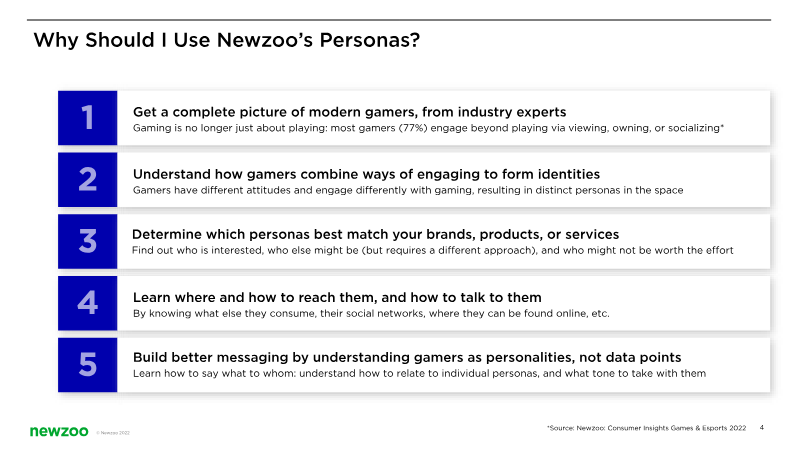
77% of gamers engage with the medium beyond just playing. This emphasizes the critical role of viewing and social interaction in modern gaming identity.
New Framework
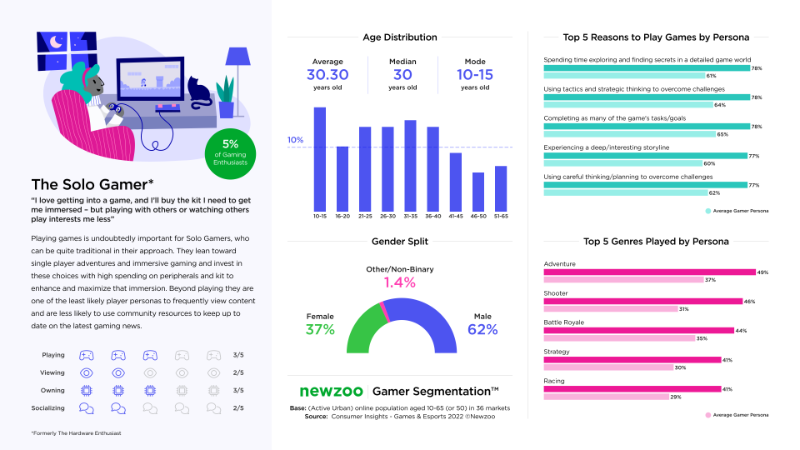
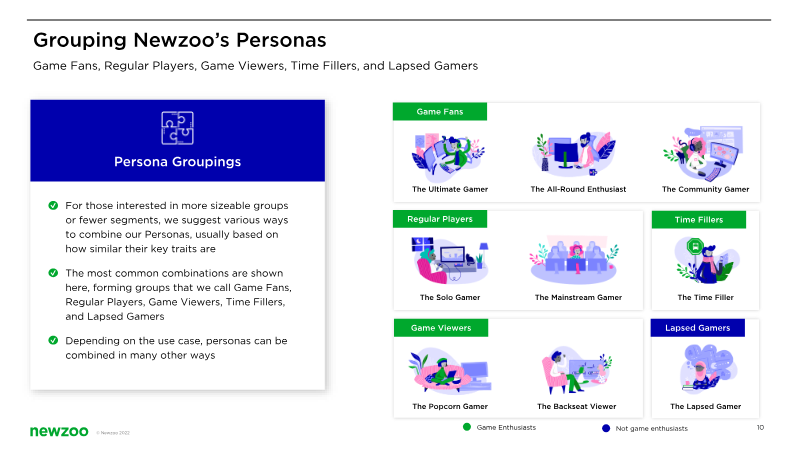
The gaming audience is defined by nine distinct personas.
These personas are based on motivations and behaviors, moving beyond traditional 'casual' or 'core' labels.
Strategic Analysis
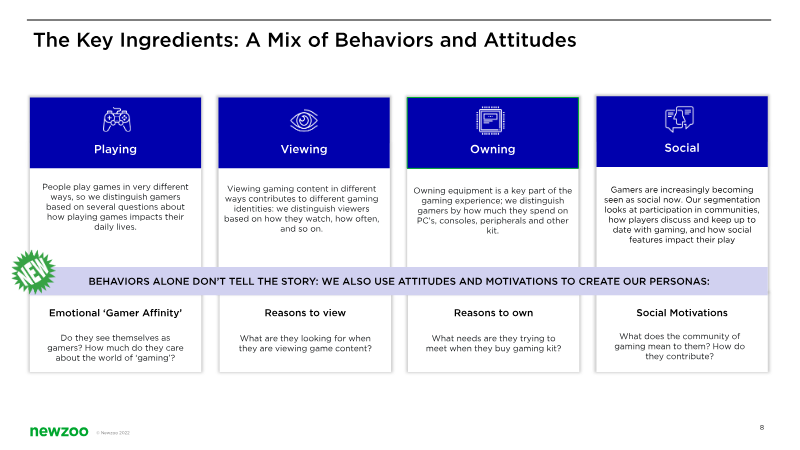
Effective market strategy requires analyzing individual participation in the ecosystem.
This includes hardware ownership, viewing habits, and community engagement.
Holistic View. Effective market strategy requires analyzing individuals through their specific participation in the ecosystem.
Targeted Approach
Moving to a personality-based framework allows for more precise product development.
It moves away from viewing gamers as simple data points.
Research Foundation
The segmentation analysis is based on a robust dataset.
Data was collected between February and April 2022.
Solid Data. The 2022 segmentation analysis is derived from a dataset of 75,930 respondents across 36 global markets.
Page 9 of the report75,930
Respondents in the dataset.
- Global markets
- 36
1 / 6
Ask AI about this report