VideoTwo & a Half Gamers
🧠 What You Send Is What You Get: Signal Engineering and the Future of Attribution with Core Plan
17 Jun 202625 min video
You can do all kinds of these signal engineering tactics here and there, but I just only see very simple as like examples and no implementation from the founders. So, we want to actually, you know, remove this friction.
How? How?
I I mean you already have the SDK in place. So, once you actually set up the events, we just try to, you know, guide you to track certain events that are necessary for doing the signal engineering and on the back end, we just control everything.
[music] [music] [music] [music] [music]
[music] [music]
Hello everybody. It is two and a half gamers from MAU day two, again surviving, but we have a special guest with Roy from Airbridge and my name is Misha.
Till I launch this I'm I'm your host. So, Roy, can you introduce yourself and your company? I mean, you've been on the podcast before, but
Yeah, just No, I'm first time.
Yeah, yeah, yeah.
Yeah, so hi everyone. Nice to meet you all. I'm Roy. I'm CEO and a founder of Airbridge. So, Airbridge is a is a MMP, mobile measurement partner, you know who we are. So, we've been trusted by more than like thousands apps in the world and we've been doing this for the last 10 years and happy to be here.
Nice. Welcome, welcome. And today we're going to talk about Core Plan.
Yeah.
Let's start with unpacking what actually is.
Mhm. Mhm. Absolutely. So, you know, like you've been using MMP for many, many years. And you
All of them.
All of them. Hopefully all of them. And many of them are just committing themselves to the 1-year, 2-year, 3-year, multi-year plan. And it's not easy for, you know, early-stage like F founders to commit themselves to the few thousand bucks a year or even 10 10K a year kind of a 1-year plan or 2-year plan is not easy. So, I actually talked with a lot of F founders. And especially in the AI-native world, you know, like fast time to value is the essence. So, when you actually use like image generation tools like how many minutes do you expect for you to get one image? 2 minutes or 3 or 3 minutes, right?
Yeah, even less.
You just need it, you know, right now, right here. So, AI-native tools out there very fast to deliver the value, but MMPs have been different. You have to talk with the sales people. You have to, you know, listen to their demo. You have to, you know, sign up. And then you need to wait for, you know, them to send you the DocuSign. You sign it. And then you wait
for until you the CSM will board you. You need to read the documentation and so the SDK. Get everything up and running. It takes like few weeks to even like 2 months. So, we thought this is not a right thing to do for this early-stage F founders who are super fast, you know, super smart
Yeah.
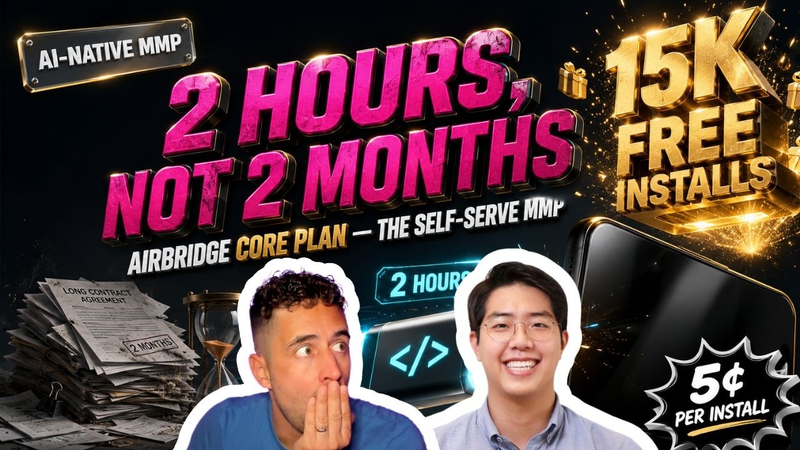
who wants to grow their app fast. So, we built the Core Plan. So, Core Plan is a self-serve, you know, plan, pay-to-go service that comes with the 15K attributed installs for free for 1 year.
Okay.
It's a it's a huge amount that any founders can easily sign up on our dashboard right now and use our MCP and our guided, you know, AI pilot system to easily install the SDK within just few hours of time. Get everything up and running in just 2 to 3 hours. Bam. That's it.
Nice. Okay. Why now? Why coming up with the Core Plan now then?
Well, we've been doing this business for 10 years and something happened last year. We all know about that, AI. So now everyone's just like rolling out the apps so quickly. In the past, it was
like the waterfall approach. You think about the market, do the keyword research, you find out which keywords to target, you think about all these benchmarking and compare analysis. Not saying that these don't exist now, but these things happen so fast nowadays that people just research with the, you know, AI tools. They ask a bunch of questions to the AI, let them summarize the information, pick the segment that they want to battle, and really build their app fast in just a few days. So you see that like, you know, some according to A16Z, like the annual like YOY, the number of the apps being released on the market like grew at least by 60%.
insane.
Yeah, it's insane. So and we see them that they're they're actually from all kinds of these verticals like healthcare, education, social, like dating and whatnot. And and as you mentioned, the irony here is that they need to do the advertising. Cuz nowadays distribution is a moat. You need to distribute your app fast. We can't grow organically because the competition is too severe. But in order for them to advertise, they need to
measure. And the measurement should be there, but that shipment of the measurement is so slow that we really decided that now is the best time that we really just kick in and really serve these founders right in a right way.
Yeah. So who's the target audience pretty much? Like founders with AI apps, small teams, or of any any geo that you prefer?
Yeah, pretty much. Actually like 50 50 more than 50% of our existing core plan users are coming from the US or English-speaking countries and Europe as well. So it's it's kind of like well-balanced and spread out across the globe. And we typically want to, you know, work with those founders who are having less than 10 million in ARR.
Okay.
So those who we believe to be small to medium-sized founders could be one time
ARR is not small.
It's not small, but I would just call them a mid-market.
Okay. Yeah, okay, okay.
It's a mid-market. So, small to mid-market of founders less than 10, you know, million in ARR who have a team size of, you know, just one person to up
to like 20 people who wants to do a lot of UA, grow by UA, you know, running all kinds of creatives here and there would be the best target.
Okay. And like what's the difference between the core plan and the the rest of the plans that you have?
Well, what happened is core plan is a pay-you-go service. So, we actually provide you with 15K attributed installs for free. But, after that point, you actually pay 5 cents per one attributed installs. Not conversions, but installs.
Okay. Yeah, yeah, yeah.
Sometimes you you don't have to you sometimes you confuse the conversions and installs, but it's just totally different two things. So, 15K installs for free and so, we actually had to like kind of, you know, only leave the core functions. That's the reason why we call it a core plan. Yeah. So, in a high-level overview, I would say we actually left like 65% of what we have in the enterprise plan. But, we actually took out some of the unnecessary like advanced reporting like multi-touch attribution, a little bit of incrementality. And actually, we kind of limited the number of integrations that
you can activate up to two. And also, we kind of like, you know, just pulled out some of the other like advanced like management services like, you know, security, little bit of security, not all, little bit of security, and agency management functions, and all of these auxiliary functions that you need to, you know, keep in order to for you to run the big team with a lot of partners. So, we kind of left everything core and essential to your growth. We have the cohort analysis. We have the, you know, raw data export.
Yep.
You get up to two integrations. You can integrate with RevenueCat, Adaptly. You can integrate with Google AdMob. You can integrate with, you know, Amplitude, Mixpanel, and even Braze. So, these third-party integrations are all in place. And better thing, like you have the deep linking with you. So, these core functions all remain inside this package so that you can grow without thinking too much on the, you know, extra cost.
So, yeah. Okay, deep linking and the sinking the the apps in this case are really the core kind of target because
then you can do web to app campaigns as well. Okay. Okay. And how about AI agents and like what are you using? Is it also within like the core plan or is it like an upgrade already?
It's part of the core plan. So, we have the MCP, we have the pilot, which is our AI assistant tool embedded into the dashboard. So, MCP is as as you can imagine, when you install the MCP in your, you know, code apps or cloud code, you can just ask them anything. So, they'll create reports for you, they'll answer the questions. And not only that, when you install the, you know, SDK, some of these like things like setting up the taxonomy and really just placing the codes into the right places, they're very difficult. So, typically, you would just read the documents from the beginning to the end, which is going to take you another like few hours to study them. So, MCP is there for you so that you can just, you know, not only just like, you know, ask those questions about the analysis and the performance of your apps, but you
can easily just install the SDK with them. Yeah.
Okay. Why 50,000 installs? Not more or less. And why did you strip different features and then just created a core plan? Like how did you Like what was the thought process?
Well, may maybe I would ask you. Do you think 15K attributed installs would be sufficient now for these early stage apps? Yeah.
For the early startups, maybe. But then if you you said mid-market, like that that's a small amount of installs.
Exactly. So, 15K, we kind of designed in a way, you You for any kind of early stage apps to reach around like 3 to 5,000 USD in MRR enough for them to prove the you know, product market fit.
Okay.
But once you actually go past the stage, of course, like you need to just uh you know, do the pay-as-you-go or maybe even consider upgrading because when you upgrade, the benefit of it is the unit price goes down. But the important thing here is that
many of these you know, PLG products of the you know, originally SLG companies are designed in a way to do the lead gen. They're not something that is built for sustainability. But for us, we try to build it in a way that you just stay here forever. We're okay with that and you're okay with that.
Yeah, but you will then have limited features and functions.
Exactly. So, once they reach around like 5 to 10 million in ARR, I think they can upgrade. And it's actually even better for them.
should.
Yeah, they should to work with you know, a lot of the other platforms for sure. Yeah. Mhm.
Yeah, so like is this is pretty much like foot in the door for you, right?
I would say yeah, it's you know, first time in our company history you know, trying this PLG motion. But I was pretty you know, I was worried when I was launching the plan.
Why?
Cuz I've never done it before. I've been doing sales all time and you know, meeting with people. That was natural to me like meeting with people, persuading them in these you know, pitches and con
calls. But what turns out is magical like we already have like you know, more than 1,000 sign-ups, few hundred orders who are using it already.
Okay.
And we're seeing some early positive signals that this could be you know, something worthwhile for the founders to check out. And maybe that's the reason why I'm I'm here is just like try to really share this news with you.
Of course. I mean, look like I I use Core Plan with my my apps as well and I I love the fact that I don't really need to care about the Facebook SDK and what SDK and whatnot and I'm just using one and then [clears throat] like I can and grow because I have like my apps are not really anywhere near million 10 million
[laughter]
nowhere near nowhere near but potentially they can grow but yes I don't want to sign up for 12 months and pay 10k. I want to try and see if yeah if it works.
Well, I I never know but yeah yeah I mean do you do you also have your own consumer apps?
Yeah, I do.
Okay. What do you mean? You know you have been using Corilla for Come on. No, I mean I I wanted to be you know
wanted to be showing my big joy that you are using. Of course I know but how do you feel so far?
Well, it's again like it's opened also doors for me because I tried different things and experiment and this allows me to experiment on different channels as well. And also have like cross and cohort analysis which I don't have on Facebook so it works.
Oh yeah.
But again I'm not nowhere near 10 million ARR so I will be in this core plan for a while for a while for sure.
Well, I hope not. I mean I mean of course I hope not as well but you never know.
Okay, so to where where do you go from from here with the with the core plan like what's what's next? I mean
Well, I think right now we're seeing you know founders who are like tech savvy or for product savvy marketing savvy you know these founders installing the SDK in two to three hours of time. Which is amazing cuz I typically when we on boarding enterprises we actually set a timeline to be two months conservatively. So helping them installing the SDK within
two hours of time that's great but when you think of the other AI native services out there like image generation, music generation tools you just get the first result in a few minutes. So we want to make the same so even without installing the SDK what can we do to help these founders is what we're thinking. So maybe what we're actually trying to deliver is you know just like just by signing into the you know Facebook, Google or TikTok or Apple Ads account we actually give you the initial analysis or, you know, recommendations. And just pulling out all these data from all these platforms, consolidating consolidating them in one place even before they install the SDK, that would be one of the things that we're dreaming of, which we're building at this moment. But maybe in the one month or two, you'll see that it come out. And second is, you know, I I know you're pretty bullish on web-to-app nowadays. And I want to talk about it. And, you know, setting up web-to-app, when you know it, it's easy.
Even if you know it, it's a nightmare. Come on.
Oh, right. It's hard, yeah.
It's complicated kind of, but still you need to have a
Facebook pixel and ID. You need to then try track it like the the the users in the MMP as well. So, not everybody gets that. So.
I know. So, I I I think it's a nightmare for the first-time triers, but like someone like you, Netea, who's the expert in doing that, it it is a is a piece of cake, but it's really hard for any normal people to reach that, you know, level of expertise. And I I just wanted to make web-to-app so much easier for everybody. Uh, just like maybe the AI, you know, pilot will guide you step-by-step, like do this and that and that. Voilà. So, I just wanted to do that. And it's actually already part of our product, but I want to even further streamline it. And lastly, I want to talk about like signal engineering. Signal engineering, funny thing about that
Tell me Tell me more.
Yeah, I mean, signal engineering is such a hot topic like everywhere. I've been hearing about signal engineering for the last like 2 years. Yeah. So, people, you know, when I first heard about it from Marcus, you know, 3 years ago, he actually talked about this concept
qualified free trials. I was like, what is it? And then, oh, like, you know, 20% of the people impossibly purchase the subscription plans, they cancel within like 20-30 minutes. If you send the signal to the meta and Google, they may misunderstand who your real audience is. And the the the machine learning algorithm might be hurt. I was dazzled. Oh my god, this is a new kind of, you know, era of sending the right data to the platforms. And ever since that I've been hearing a lot about, you know, this from the gurus of the market. But the real problem is everyone talks about it, but if I ask them, "Founders, have you implemented it?" Nobody. Or just one or two. So, and and even if they implement it, there's like several types of signal engineering, you know, things that you could do. So, like waiting for 2 hours to send a signal to Meta after the cancellation is just one thing.
Yep.
You can do all kinds of these signal engineering tactics here and there. But I just only see very simple as like examples and no implementation from the
founders. So, we want to actually, you know, remove this friction.
How?
How?
I mean, you already have the SDK in place. So, once you actually set up the events, we just try to, you know, guide you to track certain events that are necessary for doing the signal engineering on the back end. We just control everything. So, just by toggling on or just by adding some events on the dashboard, click, click, then you will have it. It's what we want to build build and this signal engineering thing, I I actually believe that with the event of CAPI, Conversions API, I think it's going to be so much bigger. And I was surprised when, you know, Meta actually put additional parameters to the CAPI, which is PLTV. I'm not sure how things going to turn out in the future, but what I see in the market is that many platforms out there, they want to fill in the gap. The signal gap between these services and themselves. And the more data that you send, the richer data that you send,
and more purified that they are, you get better results, is what I think.
I I was talking about this and and said, "What what you send is what you get, pretty much."
Uh yeah, you put it so right. Yeah. Yeah.
That's that's it. But then, okay, so but then this feels like Corplan is going to be like a core plan plus or like how do you want to
Then then kind of differentiate because it's like already so much more.
I know. I know. So, I mean fact we're also You're right. I mean nothing like stays like, you know, forever or perpetually as they are. So, we're just figuring out what would be ideal for the app founders, what would be ideal for us. So, in fact like 15K attributed install for us is the experiment as well.
Okay.
So, if you join now, you get 15K, but if you join later, things get changed.
Yeah.
So, as we actually add more of these, you know, AI power features as well as the augmentation layer like signal engineering, easier web to app and all that. Maybe our plans change, but I think for now all we want to do is just like, you
know, really on board more of these customers, listen to their feedback, try to adapt to the new, you know, learnings that we get. Yeah.
What was the What was the timeline for like all of these new new upgrades for core plan?
Few months of upcoming few months.
Soon.
Six months or six months.
You know, every CEO tells like people that it's coming in few months and it's true.
It's true. Okay.
So, I I don't want to over promise, but like signal engineering is something that we already have in our back end.
Nice.
That we already tested with a few subscription apps. Things went well. Like one example is there's a sleep tracking app who's actually, you know, pretty doing well in Japan. They actually hit the number one like in a category. And actually they kind of saved like 27% just by applying this like simplest tactic of removing those, you know, impulsive cancellations.
Yeah.
Seven 27% uh cut in CPA. And we also are working with few other like subscription apps. So, we already have this feature in place.
Yeah.
But the shipping is a different thing.
So, that's the reason I think in upcoming months you'll see that. Yeah.
Okay. And is it going to be in core plan and then in the like the other plans afterwards?
Okay.
Okay. Obvious. Yeah, obviously. Yeah, it's a subset of the growth plan. So.
Yeah. Yeah.
So, you mentioned you have 1,000 sign-ups and some demos. Like, what's the success like what what success means for you in terms of these numbers? Like
Well, it means that there's certainly a market demand.
Yeah.
And there is something that we can contribute. That's what that's clearly the message that I got from this, you know, observation. But most importantly, funny thing is I now realize that there's a myriad of apps out there.
Ah.
I actually Yeah, I mean, you you know there's all kinds of like great apps, weird apps, and then strange apps.
Strange, yes.
Yeah, funny apps, and I My hobby is to really go through the list of all the new app registrations, go into each one of them. And I'm surprised and my imagination is
always like getting expanded because there's always a one app that really just beats my, you know, expectation. Why does app really exist or this app exists?
Like either way.
[laughter]
I'm very confident that the long tail market is actually thick tail market. And you'll see more of these coming in a market because AI is just unlocks your imagination. It just turns everything into realities.
Yep.
New types of games, new types of apps. Those are things that are poured into this market. I just want to meet with them and helping them, you know, easily distribute their apps by measuring things is what we can help them better at. Yeah, yeah.
So, what would be the success then?
Success? Yeah.
These No, what would be the success? So, you want to meet all of these founders and then just help them distribute the apps.
Yeah, and and get the fair value exchange. We have to earn money as well.
I mean Of course.
Yeah, yeah, of course. So, pay our bills, help them pay their bills in a mutual way, uh of course.
And actually, I'm not joking because when I talk with these founders, they don't care what MMP is in
Of course.
They don't care what MMP is. They don't know what the other services exist in the world. What they know about is, "Oh, I'm running like Google, Meta, TikTok.
Yep.
I want to measure things correctly. I want to set up my own unique economics so that I can turn this aspect into revenue, plus, you know, save the cost."
Yep.
That's all they want. And I don't want to even boast that I'm MMP doing this for 10 years. Of course, it's important, the credibility, but all I want is just to, you know, just make it simple. Very simple and very fast.
That's what I think about.
Yeah. Yeah. So, where where do people sign up?
Oh, like literally 50% coming from, you know, US, UK, the classic, you know, like app founders coming from the US, UK, and elsewhere. Literally everywhere. We we see people signing up from South Africa, North Africa, Latin America, APAC. So, I I know that we haven't we
have been focusing on, you know, certain verticals like, you know, we initially thought of subscription apps, but now we're seeing all kinds of, you know, games or even but subscription app is like 60% still. But all kinds of other verticals like gaming, or those like uncategorized apps are just coming
being more skewed towards apps rather than games?
Yeah, right now apps are dominant, like 85%.
And is it going to be a focus for future as well?
Yeah. Yeah. So, we don't necessarily, you know, stop games from using us.
Of course.
Yeah, we don't necessarily stop them. But this tool is certainly designed to better support the consumer apps and subscription apps. Like when you think of Singular Engineering, maybe games don't need it, but maybe they need they need it generally. But technically, they may need it later or when they successfully get the IP in place. So, I I I that right now we want to
really focus and double down on consumer apps and help these kinds be successful in the market.
Yeah. Yeah. So, where do people go when they want to sign up for the core plan?
airbridge.io
Very simple. Okay.
Yeah.
Okay.
Yeah.
Anything else you want to you want to share with the audience and the guys that is important?
Well, I mean what what I can tell is I think what founders need and what all these marketers need is is actually best practices. So, I I would certainly recommend you watching your channel plus all the other, you know, follow all these other experts on LinkedIn so you can read about all these stuff like web to app
Yeah.
or signal engineering and all that. And what I can also tell to the people is you know, MCP is great and MCP helps you streamline a lot of things, but if you go further than that, REST API still work as well cuz like MCP is just a wrap
Yeah.
of the REST APIs. So, it is important to really pick those vendors or the services who are well, you know, you know, equipped it with the MCP or the best-in-class REST APIs in order for you to automate things, streamline things faster. So, I think we're pretty good at that. So, that you always have to consider now especially since you're using cloud code and code X and everything. Yeah.
Of course.
Yeah.
Yeah. Of course. So, guys, airbridge.io sign up for core plan and thanks for coming and also thanks for thank you for coming. Amazing. See you later. Bye-bye.
Auto-generated captions from YouTube — names and numbers may be misheard.
Airbridge has introduced Core Plan, a self-serve, pay-as-you-go mobile measurement partner (MMP) solution designed to address the needs of early-stage app founders. The primary thesis is that as AI tools accelerate the app development lifecycle—with app releases increasing by approximately 60% year-over-year—measurement infrastructure must evolve from a weeks-long enterprise sales process to a rapid, product-led-growth model. The plan provides 15,000 attributed installs free for the first year, after which users pay 5 cents per attributed install, aiming to help startups reach $3,000–$5,000 in monthly recurring revenue and prove product-market fit.
The service targets small-to-mid-market founders with under $10 million in annual recurring revenue and teams of 1–20 people. Currently, the user base is composed of approximately 85% consumer and subscription apps, with a global distribution led by the U.S., U.K., and Europe. Core Plan retains roughly 65% of the enterprise feature set, including cohort analysis, raw data export, deep linking, and support for two third-party integrations, while omitting advanced reporting, multi-touch attribution, and complex agency management tools.
A key differentiator is the AI-native onboarding process, which utilizes an embedded AI pilot and MCP integration to assist founders with SDK installation, taxonomy setup, and report generation, reducing the typical two-month onboarding timeline to just two or three hours. Future roadmap priorities include pre-SDK ad account analysis, streamlined web-to-app setup, and automated signal engineering. The latter is highlighted as a critical growth tactic; by delaying cancellation signals to platforms like Meta, one sleep-tracking app successfully reduced its cost per acquisition (CPA) by 27%. By automating these technical optimizations, the platform aims to bridge the gap between complex data engineering and the needs of fast-moving, non-technical founders.

Two & a Half Gamers · 2026

Two & a Half Gamers · 2026

Two & a Half Gamers · 2026

Two & a Half Gamers · 2026

Two & a Half Gamers · 2026

Two & a Half Gamers · 2026

Two & a Half Gamers · 2026

Two & a Half Gamers · 2026

Two & a Half Gamers · 2026

Two & a Half Gamers · 2026

Two & a Half Gamers · 2026

Two & a Half Gamers · 2026

Naavik · 2026
Two & a Half Gamers · 2026
Two & a Half Gamers · 2026
Two & a Half Gamers · 2026
Two & a Half Gamers · 2025
Two & a Half Gamers · 2025

Deconstructor of Fun · 2025
Two & a Half Gamers · 2025
Deconstructor of Fun · 2024

Two & a Half Gamers · 2026

Deconstructor of Fun · 2026

Two & a Half Gamers · 2026
Comments