1 free read left. Create a free account for unlimited reading + AI research.
Create free accountArticle American Journal of Play
1 free read left. Create a free account for unlimited reading + AI research.
Create free accountArticleAmerican Journal of Play
The roundtable revisits Pervasive Games: Theory and Design, published in 2009, ten years later. The authors judge several of its claims optimistic or inaccurate in hindsight.
The roundtable revisits Pervasive Games: Theory and Design (2009), the first book-length treatment of pervasive games, which grew out of the EU-funded Integrated Project on Pervasive Games (IPerG) from 2005 to 2008. Held in 2019 at the Urban Play Spring Seminar in Tampere, Finland, the discussion brings together the book's authors, Markus Montola, Jaakko Stenros, and Annika Waern, with moderator Dale Leorke and audience members. The authors judge several of the book's claims optimistic or inaccurate in hindsight, particularly the prediction that commercially viable pervasive games would compete with pastimes rather than other games, while many of its analytical contributions on the design space have endured.
The participants agree that the term "pervasive games" has lost ground in academic usage since around 2010, yet they still find it useful as a technology-agnostic analytical concept, even though none of the authors now uses it for their own research. The discussion identifies the rise of smartphones and the free-to-play mobile business model as the central changes of the decade. Montola argues that temporal expansion of play through timers, energy mechanics, and push notifications has become the most commercially significant dimension of pervasiveness, and that this shift drew investment away from location-based games until Pokémon GO emerged as a rare exception, with over a billion downloads.
The authors also reassess the ethics chapter, acknowledging gaps around privilege and a Western, middle-class orientation, while noting its principles still inform human-computer interaction research on public space. Audience discussion addresses wearables, the movement from pervasive games toward self-organized pervasive play, and whether constant smartphone use reflects playfulness or merely social media engagement. The panelists' recent favorite examples lean toward pervasive LARPs, art-world experiments, and municipal and museum play design.
Each row is a game or company this document names, each column a document, oldest first. A mark means that document names it. Select a row to see those documents.
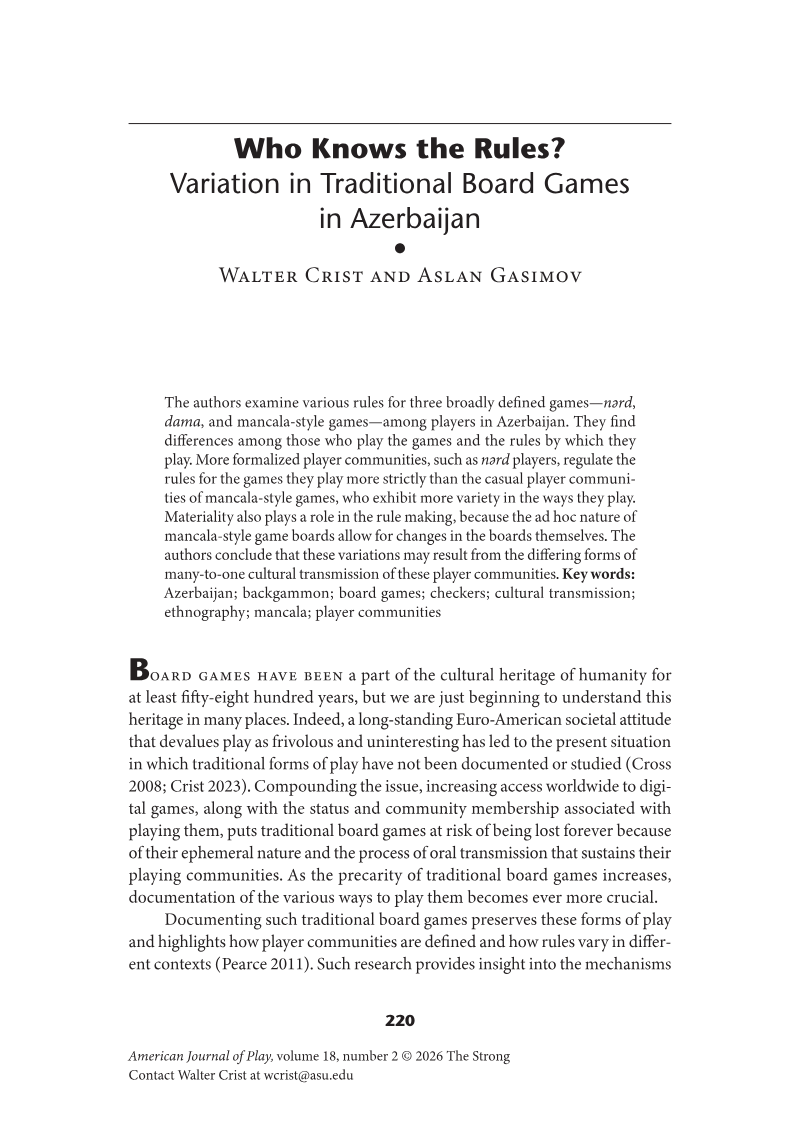
American Journal of Play · 2025
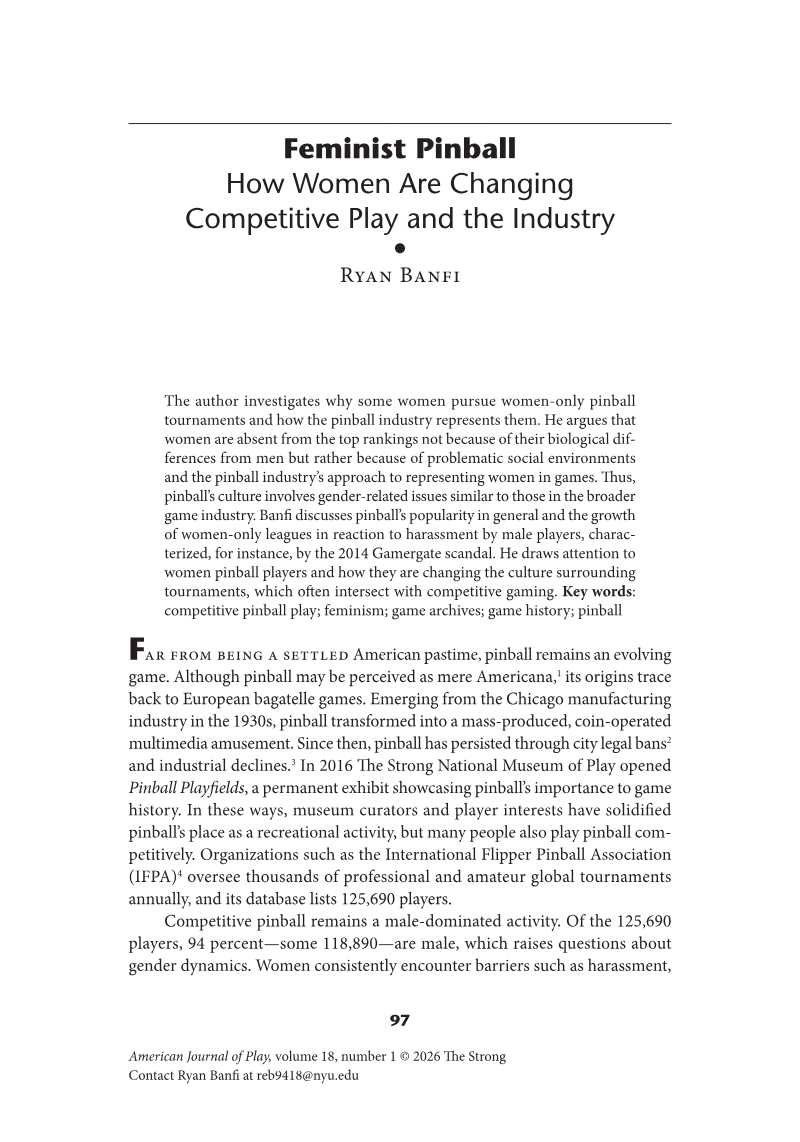
American Journal of Play · 2025

American Journal of Play · 2024
American Journal of Play · 2024
American Journal of Play · 2024
American Journal of Play · 2023
American Journal of Play · 2022
American Journal of Play · 2022
American Journal of Play · 2021
American Journal of Play · 2020
American Journal of Play · 2020
American Journal of Play · 2019