1 free read left. Create a free account for unlimited reading + AI research.
Create free account
The staggering rise of mobile app gaming – 2018 insights
Key insights
6 takeaways- 01Mobile platforms now hold the majority share of the $137 billion global gaming market, driven by the widespread availability of high-performance mobile hardware.
- 02The mobile gaming sector continues to lead other mobile verticals in average revenue per user (ARPU) growth while maintaining proactive efforts to mitigate mobile ad fraud.
- 03Mid-core and strategy titles dominate the market, accounting for 52% of all non-organic installs, while hyper-casual games experienced a 300% growth surge in a single quarter.
- 04Western developers are increasingly targeting Eastern markets like China, where simpler, casual gaming experiences are easier to localize than complex titles.
- 05Organic growth multipliers have diminished, forcing developers to rely on paid acquisition strategies despite rising costs-per-install (CPI), which remain consistently higher on iOS than on Android.
- 06To address low in-app purchase conversion rates, many casual game developers are shifting their revenue strategy toward in-app advertising models.
Ask AI about this video
Transcript
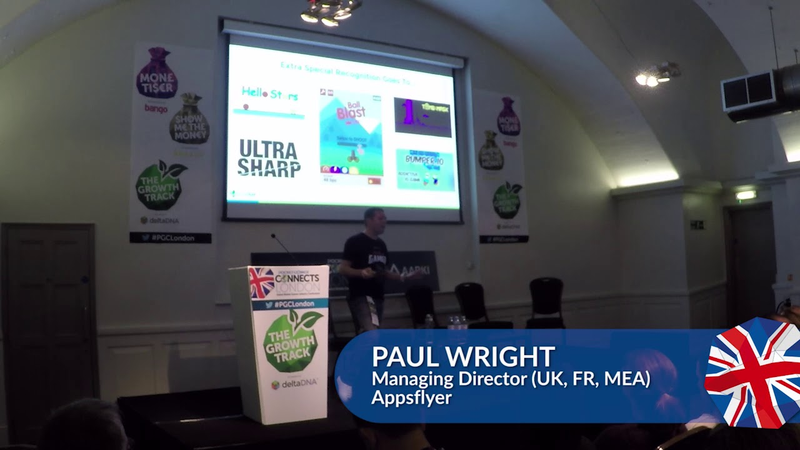
[Music] morning everybody thank you for the introduction thank you for the welcome for those who don't know me my name is Paul Wright managing director of Apps flyer and for those that don't know Apps we're quite simply we're the leaders in mobile attribution and marketing analytics enough of a sales pitch I wanted to talk to you today about staggering rise of gaming app marketing and I was thinking about this what's putting together the presentation I thought to myself January really is like my favorite time of the year it's the year where you can look forward to all those exciting things to come but more importantly a time to to look back right look back at what's what's happened what insights we can tease out and how that can shape our
strategy going forward I think it's an obvious thing to say in a room for the gamers but we are living in this age of gaming but but sometimes I feel we need to understand perspective if mobile is on the rise right now then the gaming is is absolutely booming place in terms of the number of the number of installs the dominance in the charts the number of people say in this room every kind of metric kind of points in the right direction this fantastic study by News ooh really for me put things into perspective you know look at the look at the number right in the middle right the bull's eye that's that's kind of what we're saying here right we're saying the gaming industry as a whole 137 billion and you know we can see how that that breaks down into a PC desktop tablet etc but on the far right it's this which is really interesting to me right 70 billion from mobile all right so for the first time we're seeing
mobile app being the majority stakeholder in this industry right and I think we need to understand why that is so let's start let's dig into some of the data let's see what we uncovered and hopefully I can share and you can take this away and improve performance in order to do so we put together perhaps one of our biggest data studies to date we had to tease out on billion paid installs this was across two and a half thousand apps that were measuring app install purchases of Piper casuals all the buzz so we also had to tease out all of those apps in this case 1100 of them that were generating revenue from in-app ads and in terms of the acquisition cost we needed to understand and and again retrieved a decent amount thirty million in ad spend across 1200 apps so pretty robust the biggest data study that we've put together as certainly in gaming what
is it that's moving the needle and sort of underpinning all of this right as a gamer I'm I'm more on this side you know that's probably an age thing as well as a fat finger and sort of slow reaction kind of thing but I think it's fair to say that the emergence of these cheap devices and all sort of CPU and powerful graphics engines and things like this you know they're more immersive environments and more sort of strategic kind of gameplay that we can now put in place you know this is what's exciting and it's amazing to see that that sort of transition but it's also placed what I feel is more of a demand on the model and also in order to scale there's increasing complexities I think you know we've all perhaps heard about this multiplier of a paid in store can generate you know maybe 22.5 organic installs right and we used to use this as a mechanism to drive and build our
audience that's gone that's gone right anyone who's getting that kind of multiplier right now is either very smart or very lucky but in reality what we're having to do now is dig deep to build our audience spend to acquire and it's it's a pay to play game and in doing so I think in order to still maintain and hit our ROI and LTV goals we're seeing this sort of seemingly opposite directions occur right on the Left we have the sort of the hyper casual gaming space which for me is quite interesting simply because I guess it's it's still one that is isn't fully defined as such I mean we can talk about basic gameplay we can talk about percentage of revenue generated from in-app ads these kind of things but I think we can all see it as a more sort of simpler experience versus the raw advanced strategic in depth of mersive environment that we also have come to love and no digging a little bit deeper
than into the data into the rise of hyper casual looking back at the growth for q2 q3 last year you can see very very clearly right this is surging right now you know we're seeing around about 300 percent growth in in just that one quarter alone right it's it's dwarfing the growth of any category all right so we can understand why there's so much hype and buzz about this if it's not clear already you know a few examples hello stars ball blast bumper dot IO you know these all for us I think you know we can sort of congratulate as having a great successful 2018 of course I don't mean to leave anybody out there there are many many others in this category but I think it's also worth again looking back at this perspective right it's it's big on growth but what is the sort of the market share look like and not just here locally here in the UK or in a Europe but but globally right when we start to look at and feed in China from data from
China from India from Latin we actually see in our data set it only accounts for about 6% it's actually the mid core and strategy if you can see here at 52% which is the sort of the largest and more dominating category here in terms of non organic paid installs right not only that but it's a growing category as well and it's it's growing inexpensive the sort of the casual amount of space food for thought so what else did we uncover in the data well a very interesting trend I mean again it could it could be an obvious one at high level but what we're seeing is more and more Western companies going east of course places like China are very attractive huge markets but they're not without their complexities there's a massive hurdle when it comes to localization it's a somewhat confusing landscape for a lot of people to get involved in you know there's there's a numerous app stores that you
may not have come across local media players you know the challenges and the barrier to entries can can be high so let's dig down a little bit further again so we took all of the Western apps or to put it another way we excluded apps with a HQ in in East break so we're we're totally ring-fencing now those sort of western apps and looking at their traffic in the eastern markets and we saw that 36 percent launched their first tied to all their first campaign and started running activity in these markets another 31 percent who are already up and running increased their traffic so overwhelming you know more than two-thirds here are increasing their activity and region and I guess those 33 percent are those that are feeling the the pain and the difficulties that I explained previously looking again a little bit further and starting to understand the non-organic
so the paid installs in that market we saw an eighty percent growth but where is that growth you know what's underpinning that growth and it's clear that the data speaks to the casual gaming and you know when we speak to our customers and say why is this why is it the casual succeed mutter in the market and again it comes down to that ease of localization you know it doesn't take a genius to realize if you have an incredibly complex game lots of I not talking about language obviously but the the experience itself the nuances that come with localization it can be a challenge so a simple game easy to take to another market sadly in amongst all of this data that we were uncovering we also in covered some bad news right it's getting super expensive out there there's a low percentage of users to actually go on to make in-app purchases and the retention rates are a pain point right and then they can be quite poor so let's jump
into some of these the cost per install I've tried to break it down by category casino mid cool casual hyper and then by country right I don't think there's any surprises when we dug up the fact that casino is more expensive $2 55 cents on the other end of the scale for for hyper casual and I've heard just today actually through a number of conversations in a common strategy around launching in emerging markets so you'll see the likes of Brazil Indonesia with lots of low CPI costs right for a lot of people and also an Android wear cost per installs are often much lower and we see this price difference with with iOS right it was $2.00 for can see no and now we're at $4 59 right so you see the media uplift you know that's a significant price hike and 55 cents on on hyper going up to a dollar five again you know you see these emerging markets I think the way I would
take this data and try and interpret it is where the gaps between iOS and Android in the same market aren't as steep there's an opportunity there you know it's not double your money now this is actually not as not a dissimilar cost in some markets for some people just finding revenue generating users alone remains elusive and just to be clear what we're looking at here right so I'm going to break it down again by mid core hyper and a few other categories what we're seeing is what is the percentage of people that go on to convert in that first 90 day period right so you've paid to acquire them do they go on to make an in-app purchase and you'll see the average rate conversion rate here for Japan Australia and the UK all right you know we're sort of 3.5% is an average okay what's also super interesting to me is is this blue sort of data right so we took the tongue top 10% those country leaders and
category leaders and looked at their conversion rate right so if I'm in Japan and I'm seeing that my conversion rate should be around 3.5 actually I know what's obtainable right I know that I can get somewhere near 10 percent if I'm like a leader and what staggering is the Delta in markets like China right where the average the average conversion rate is you know right about sort of 2 or 3 percent but actually I can get almost near 15 percent and if I can compete with the top guys similar sort of thing with casual the top three don't change too much right we've got Australia in there again we've got Japan in there this time Germany's jumped in the position of you cave I remember clearly and and again you know you can see these sort of big big gaps in competition you know China again you know you've got a you've got to be really winning to get that conversion rate up high and this is casual and then casino I guess this also kind of suggests that everyone in Australia UK and Japan likes to gamble maybe that's true but but also
at the lower end right you know I mentioned some of these emerging markets like Indo and Brazil actually you know if you're looking to test and launch you may not see the results that you want in this kind of vertical because these people are less inclined to be spending and converting into in-app purchases so it may not extrapolate the way you'd hope it would another solution to try and generate more money if you're struggling to convert these people in into in-app purchases is to change your your revenue stream entirely and as drastic as that sound the data again kind of teased out some examples of this if we look at casual and we looked at the monetization strategies across the year it's very clear that in June you know we saw sort of 30% of people monetizing by in-app ads that the vast majority are running with in-app purchases yet six months later it's almost flipped on its head right the majority of people now in casual are
monetizing through in-app ads for mid core and strategy I mean that looks pretty rock-solid right nice and consistent I you may interpret this as a slight trend going on but in compare very stable and clearly and overwhelmingly its in-app purchases and and again perhaps we can take from this that the environment the the the the gameplay itself lends itself to a certain type of monetization retention super tricky we know it's a pain for a lot of people okay when I see charts like this it scares the life out of me too to be in a situation where you know after one day you've got twenty percent of yours sorry twenty seven percent of your users left and then thirty days only four point six yeah that's that's pretty alarming but I will take some positives from this data right because what I see is marketers doing a fantastic job at
optimization here right I see a thirty day four point six and then as the years go by creeping up to five point five and again if we look at day seven or day one right across the years you see those those positive shifts occurring so though it's a challenge I want to flip it on its head a little bit and speak more positively and say we're getting better and there is more good news I truly believe that gaming at marketers you know a setting setting the standards really and roane when we look at another KPI average revenue per user it's almost exclusively gaming right social casino casual games mid core strategy year-on-year are increasing the amount of revenue that you can generate from your users at the bottom of the class you know we have food and drink shopping social these guys are literally going backwards they're making less money year on year from the existing user base and when it comes to fraud gamings at the
bottom okay I'm not saying it's not an issue what I'm saying is out of that all the verticals gamers are quite literally killing fraud right you guys are doing an awesome job at not only identifying it addressing it using the right tools to block it prevent it and weed out all these statistical anomalies and you can see how certainly you know in that sort of July period when there was a huge surge in blots and spoofing activity and things like this again the the the spike left for gaming wasn't it wasn't as prominent as all these other verticals so continue to do the great work is is kind of the message here that waiver of some of the stats that we pulled out obviously you know go and download it it's free there's a lot more that you can digest and take back to the business the question I have is are you really riddle to ready to level up in the mobile age of gaming and one other thing that I kind of wanted to leave you
with and we put this together partly for Pocket Gamer but also as part of our educational series there's been a lot of talk today and yesterday around you know the difficulties in challenging around soft launching and we've got a great sort of whiteboard here sharing knowledge giving back to the community and hopefully that'll help as well let's do it thank you very much [Applause] [Music]
Summary
The mobile gaming industry has reached a pivotal milestone, with mobile platforms now commanding the majority share of the global $137 billion gaming market. This shift is driven by the proliferation of affordable, high-performance mobile devices that support increasingly immersive and complex gameplay. As the industry matures, the landscape has become a highly competitive, pay-to-play environment where traditional organic growth multipliers have largely diminished, forcing developers to rely heavily on paid acquisition strategies to scale their audiences.
Data analysis of over one billion paid installs across thousands of applications reveals a clear bifurcation in market trends. While hyper-casual games have experienced explosive growth—surging 300% in a single quarter—mid-core and strategy titles remain the dominant segment, accounting for 52% of non-organic installs. Furthermore, Western developers are increasingly expanding into Eastern markets, particularly China, where success is often tied to the relative ease of localizing simpler, casual gaming experiences compared to more complex titles.
Despite this growth, developers face significant challenges regarding rising acquisition costs, low in-app purchase conversion rates, and poor long-term retention. Cost-per-install (CPI) metrics vary significantly by region and platform, with iOS consistently commanding higher prices than Android. To combat monetization hurdles, many casual game developers are pivoting from traditional in-app purchases toward in-app advertising models. Nevertheless, the gaming sector continues to outperform other mobile verticals in average revenue per user (ARPU) growth and remains a leader in proactively identifying and mitigating mobile ad fraud. Ultimately, success in this competitive climate requires rigorous data-driven optimization, strategic localization, and a nuanced understanding of regional market dynamics to improve conversion and retention.






















Comments